Medical Error by Richard L. Mabry, MD

It is time for a FIRST Wild Card Tour book review! If you wish to join the FIRST blog alliance, just click the button. We are a group of reviewers who tour Christian books. A Wild Card post includes a brief bio of the author and a full chapter from each book toured. The reason it is called a FIRST Wild Card Tour is that you never know if the book will be fiction, non~fiction, for young, or for old…or for somewhere in between! Enjoy your free peek into the book!

You never know when I might play a wild card on you!


Today’s Wild Card author is:


and the book:


Medical Error (Prescription for Trouble Series)

Abingdon Press (July 12, 2010)

***Special thanks to Maegan Roper, Marketing/PR Manager, Christian Fiction, Abingdon Press for sending me a review copy.***

ABOUT THE AUTHOR:

Dr. Richard Mabry built a worldwide reputation as a clinician, researcher, author, and teacher before retiring from medicine. He entered the field of non-medical writing after the death of his first wife, with the publication of his book, The Tender Scar: Life After The Death Of A Spouse.

Richard describes his work as “medical suspense with heart.” Medical Error is his second novel. His first novel, Code Blue, was published by Abingdon Press in April of 2010, and will be followed next spring by the third book in the Prescription For Trouble series, Diagnosis Death.

He and his wife, Kay, live in North Texas.

Visit the author’s website.
Visit the author’s blog.

Product Details:

List Price: $13.99
Paperback: 288 pages
Publisher: Abingdon Press (July 12, 2010)
Language: English
ISBN-10: 1426710003
ISBN-13: 978-1426710001

AND NOW…THE FIRST CHAPTER:

Eric Hatley’s last day alive began routinely enough.


He paused beside his brown delivery truck, shifted the bulky package, and turned in a tight circle to search for the right apartment.

Shouts filled the air. Firecrackers exploded all around him. A dozen red-hot pokers bored holes through his gut.

The package flew from his arms. He crumpled into a privet hedge at the edge of the sidewalk, clutching his midsection and recoiling when his fingers encountered something wet and slimy.

A wave of nausea swept over him. Cold sweat engulfed him.

Eric managed one strangled cry before everything faded to black.

* * *

Dr. Anna McIntyre bumped the swinging door with her hip and backed into Parkland Hospital’s Operating Room Six, her dripping hands held in front of her, palms inward. “Luc, tell me what you’ve got.”

Chief surgical resident, Dr. Luc Nguyn, didn’t look up from the rectangle of abdomen outlined by green draping sheets and illuminated by strong surgical lights. “UPS driver, making a delivery in the Projects. Got caught in the crossfire of a gang rumble. Took four bullets in the belly. Pretty shocky by the time he got here.”

“Find the bleeding source?”

“Most of it was from the gastric artery. Just finished tying it off.”

Anna took a sterile towel from the scrub nurse and began the ritual of gowning and gloving made automatic by countless repetitions. “How about fluids and blood replacement?”

Luc held out his hand, and the nurse slapped a clamp into it. “Lactated Ringer’s, of course—still running wide open. We’ve already pushed one unit of unmatched O negative. He’s finishing his first unit of cross-matched blood. We’ve got another one ready and four more holding in the blood bank.”

“How’s he responding?”

“BP is still low but stable, pulse is slower. I think we’re catching up with the blood loss.”

Anna plunged her hands into thin surgical gloves. “Lab work?”

“Hematocrit was a little over ten on admission, but I don’t think he’d had time to fully hemodilute. My guess is he was nine or less.”

Anna turned slightly to allow the circulating nurse to tie her surgical gown. “Bowel perforations?”

“So far I see four holes in the small intestine, two in the colon.”

“Okay, he’ll need antibiotic coverage. Got that started?”

Luc shrugged. “Not yet. We don’t know about drug allergies. His wallet had ID, but we’re still working on contacting next of kin. Meanwhile, I have Medical Records checking his name in the hospital computer for previous visits.”

“And if he’s allergic—“

The nursing supervisor pushed through the swinging doors, already reading from the slip of paper in her hand. “They found one prior visit for an Eric Hatley, same address and date of birth as on this man’s driver’s license. Seen in the ER two weeks ago for a venereal disease. No history of drug allergy. They gave him IM Omnilex. No problems.”

The medical student who’d been assisting moved two steps to his left. Anna took his place across the operating table from Luc.

Luc glanced toward the anesthesiologist. “Two grams of Omnilex IV please.”

Anna followed Luc’s gaze to the head of the operating table. “I don’t believe I know you. I’m Dr. McIntyre.”

The doctor kept his eyes on the syringe he was filling. “Yes, ma’am. I’m Jeff Murray, first year anesthesia resident.”

A first year resident on his own? Where was the staff man? “Keep a close eye on the blood and fluids. Let us know if there’s a problem.” Anna picked up a surgical sponge and blotted a bit of blood from the edge of the operative area. “Okay, Luc. Let’s see what you’ve got.”

In the operating room, Anna was in her element. The green tile walls, the bright lights, the soft beep of the monitors and whoosh of the respirator, the squeak of rubber soles as the circulating nurse moved about the room—all these were as natural to her as water to a fish or air to a bird. Under Anna’s direction, the team worked smoothly together. Conversation was at a minimum, something she appreciated. Do the job in the OR, talk in the surgeons’ lounge.

“I think that’s got it,” Luc said.

“Let’s check.” Anna’s fingertips explored the depths of the patient’s belly with the delicate touch of a concert violinist. Her eyes roamed the operative field, missing nothing. Luc had done an excellent job. He’d do well in practice when he finished his training in three months.

Anna stepped away from the table. “I think you’re through. Routine closure, leave a couple of drains in. Keep him on antibiotic coverage for the next few days.”

Luc didn’t need to hear that, but she figured the medical student did. She might as well earn her Assistant Professor’s salary with a little low-key teaching.

She stripped off her gloves and tossed them in the waste bucket at the end of the operating table. “If you need me—“

“Luc, we’ve got a problem. Blood pressure’s dropping, pulse is rapid.” A hint of panic rose in the anesthesiologist’s voice.

The scrub nurse held out fresh gloves, and Anna plunged her hands into them. “He must be bleeding again. Maybe one of the ligatures slipped off.”

“No way,” Luc said. “Everything was double-tied, with a stick-tie on the major vessels. You saw yourself, the wound was dry when we finished.”

“Well, we’ve got to go back in and look.” Anna turned to the anesthesiologist. “Run the IV wide open. Hang another unit of blood and send for at least two more. Keep him oxygenated. And get your staff man in here. Now!”

He snapped out a couple of requests to the circulating nurse before turning back to Anna. “He’s getting hard to ventilate. Do you think we might have overloaded him with fluid and blood? Could he be in pulmonary edema?”

“I want your staff doctor in here now! Let him evaluate all that. We’ve got our hands full.” Anna snatched a scalpel from the instrument tray and sliced through the half-dozen sutures Luc had just placed. “Deavor retractor.” She shoved the curved arm of the instrument into the edge of the open wound and tapped the medical student’s hand. “Hold this.”

Anna grabbed a handful of gauze sponges, expecting a gusher of blood from the abdomen. There was none. No bleeding at all within the wound. So why was the blood pressure dropping?

“Pressure’s down to almost nothing.” The anesthesia resident’s voice was strained. “And I’m really having trouble ventilating him.”

Dr. Buddy Jenkins, one of the senior anesthesiologists, pushed through the swinging doors. “What’s going on?”

Anna gave him the short version. “Blood pressure’s dropping, pulse is climbing. We’ve gone back into the belly, but there’s no bleeding. And there’s a problem ventilating him.”

Jenkins moved his resident aside, then slipped a stethoscope under the drapes and listened for a moment. “Wheezes. And no wonder. Look at his face.”

Anna peeked over the screen that separated the patient’s head and upper body from the operative field. Her heart seemed to skip a beat when she saw the swelling of the lips and the red blotches on the man’s face.

“It’s not blood loss,” Jenkins said. “He’s having an anaphylactic reaction. Most likely the blood. Did you give him an antibiotic? Any other meds?”

Anna’s mind was already churning, flipping through mental index cards. Anaphylaxis—a massive allergic reaction, when airways closed off and the heart struggled to pump blood. Death could come quickly. Treatment had to be immediate and aggressive.

“He had two grams of Omnilex,” Luc said. “But his old chart showed—“

Jenkins was in action before Luc stopped speaking. “I’ll give him a cc. of diluted epinephrine by IV push now, then more in a drip.” He turned to the anesthesia resident. “Get that ready— one milligram of epinephrine in a hundred milliliters of saline.”

“Luc, you two close the abdominal wound,” Anna said. “I’m going to break scrub and help Dr. Jenkins.”

Jenkins handed her a syringe. “Give him this Decadron, IV push. I need to adjust the ventilator.”

Anna injected the contents into the patient’s intravenous line. She said a quick prayer that the epinephrine and steroid would turn the tide, that they hadn’t been too late in starting treatment.

The team battled for almost half an hour, at first gaining ground, then losing it steadily. Finally, Jenkins caught Anna’s eye. They exchanged glances. There was no need for words.

She sighed and stepped away from the table. “I’m calling it.” Her voice cracked. “Time of death is eleven oh seven.”

Luc let the instrument he’d been holding drop back onto the tray. Jenkins picked up the anesthesia record and began to scribble. Murray, the anesthesia resident, turned back to his supply table and started straightening the mess. The medical student looked at Anna. She nodded toward the door, and he slipped out of the room. She didn’t blame him. This was probably the first patient he’d seen die.

Anna tossed her gloves and mask into the waste container. She shrugged, but the tension in her shoulders didn’t go away. “Any idea why this happened? The blood was supposed to be compatible. He’d tolerated Omnilex before. What else could have caused it?”

No one offered an answer. And she certainly had none. But she intended to find out.

The OR charge nurse directed Anna to the family room, where she found Hatley’s mother huddled in a corner, twisting a handkerchief and occasionally dabbing at her eyes. The room was small and quiet, the lighting was soft, the chairs as comfortable as possible. A box of tissues sat on the table, along with a Bible and several inspirational magazines. Soft music playing in the background almost covered the hospital sounds drifting in from the nearby surgical suite.

Anna whispered a silent prayer. She’d done this dozens of times, but it never got any easier. She knelt in front of the woman. “Mrs. Hatley, I have bad news for you.”

Anna stumbled through the next several minutes, trying to explain, doing her best to make sense of a situation that she herself couldn’t fully understand. When it came to the matter of permission for an autopsy, Anna wasn’t sure of the medico-legal situation here. Hatley had died after being shot, but his injuries weren’t the cause of death. Would she have to call the County Medical Examiner and get him to order one? The weeping mother solved the problem by agreeing to allow a post-mortem exam.

There was a light tap at the door, and the chaplain slipped into the room. “I’m sorry. I was delayed.” He took the chair next to Mrs. Hatley and began speaking to her in a low voice.

Anna was happy to slip out of the room with a last “I’m so sorry.” Outside, she paused and took several deep breaths.

It took another half-hour for Anna to write a chart note, dictate an operative report and final case summary, and change into clean scrubs. She was leaving the dressing room when her pager sounded. The display showed her office number followed by the suffix “911.” A “stat” page—respond immediately.

As she punched in the number, Anna wondered what else could possibly go wrong today. “Lisa, what’s up?”

“Dr. McIntyre, there are two policemen here. They want to talk with you. And they say it’s urgent.”

* * *

Nick Valentine looked up from the computer and grimaced when he heard the morgue attendant’s rubber clogs clomping down the hall. The summons he knew was coming wasn’t totally unexpected. After all, he was the pathologist on autopsy call this week, which was why he was sitting in this room adjacent to the morgue of Parkland Hospital instead of in his academic office at the medical school. But he’d hoped for some undisturbed time to get this project done.

The attendant stuck his head through the open door. “Dr. Valentine, you’ve got an autopsy coming up. Unexpected death in the OR. Dr. McIntyre’s case. She asked if you could do it as soon as possible. And please page her before you start. She’d like to come down for the post.” The man’s head disappeared like that of a frightened turtle. More clomps down the hall signaled his departure.

There was nothing new about an attending wanting a post-mortem done ASAP. You’d think they’d realize there was no hurry any more, but that didn’t seem to stop them from asking. At least she was willing to come down and watch instead of just reading his report. Nick turned to the shelf behind his desk and pulled out a dog-eared list headed “Frequently Needed Pager Numbers.” He ran his finger down the page. Here it was: Department of General Surgery. Anna E. McIntyre, Assistant Professor. He picked up the phone and punched in her number. After he heard the answering beeps, he entered his extension and hung up.

While he waited, Nick looked first at the pile of papers that covered half his desk, then at the words on his computer screen. He’d put this off far too long. Now he had to get it done. To his way of thinking, putting together this CV, the curriculum vitae that was so important in academics, was wasted effort. Nick had no interest in a promotion, didn’t think he’d get one even if his chairman requested it from the dean. But his chairman wanted the CV. And what the chairman wanted, the chairman got.

The phone rang. Probably Dr. McIntyre calling back.

“Dr. Valentine.”

“Nick, this is Dr. Wetherington. Do you have that CV finished yet?”

“I’m working on it.”

“Well, I need it soon. I want you to get that promotion to Associate Professor, and I have to be able to show the committee why I’ve nominated you. Don’t let me down.”

Nick hung up and riffled through the pile on his desk. Reprints of papers published, programs showing lectures delivered at medical meetings, textbooks with chapters he’d written, certificates from awards received. His professional résumé was pitifully small, but to Nick it represented the least important part of his job. What mattered most to him was what he was about to do: try to find out why the best efforts of a top-notch medical staff failed to save the life of some poor soul. If he did his job well, then maybe those doctors would be able to snatch some other patient from the jaws of the grim reaper.

His phone rang. “Dr. Valentine, are you about ready?” the morgue attendant said.

Nick looked at his watch. Almost half an hour, and Dr. McIntyre hadn’t responded to the page. He hated to start without her, but he might have to. “Give me another ten minutes.”

While he waited, Nick figured he might as well try to make Dr. Wetherington happy. Now when did he deliver that paper before the American Society of Clinical Pathology? And who cared, anyway?

* * *

Her administrative assistant met Anna at the doorway to the outer office. “Dr. McIntyre, I didn’t know what to do.”

“That’s all right, Lisa. I’ll talk with them.” Anna straightened her white coat and walked into her private office, where two people stood conversing in low tones. Lisa had said, “Two policemen,” but Anna was surprised to see that one of them was a woman.

The man stepped forward to meet Anna. “Doctor McIntyre?”

Anna nodded.

He pulled a leather folder from his pocket and held it open for her inspection. Anna could see the gold and blue badge pinned to the lower part of the wallet, but couldn’t read the words on it. The card in the top portion told her, though. It carried a picture beside the words, US Drug Enforcement Administration.

Lisa had been wrong. These people were from the DEA, not the police. Still, an unannounced visit from that agency made most doctors sweat. You never knew when some innocent slip might get you into trouble.

The man flipped the credential wallet closed. “This won’t take long.”

“Good. I’ve just finished an emergency case, and I still have a lot to do.” Anna moved behind her desk and sat.

“Your chairman said you’d give us as much time as we need.”

Anna glanced pointedly at her watch. “Well, have a seat and let’s get to it. What do you need from me?”

The man lowered himself into the chair, his expression slightly disapproving. His partner followed suit. “We have some things we need for you to clear up.”

“Could I see those credentials again?” Anna said. “Both of you.”

They obliged, laying the open wallets on the desk. Anna pulled a slip of notepaper toward her and began copying the information, occasionally glancing up from her writing to match the names and faces on the ID’s with the people sitting across from her. The spokesman was Special Agent John Hale, a chunky, middle-aged man wearing an off-the rack suit that did nothing to disguise his ample middle. Anna thought he looked more like a seedy private eye than an officer of the law.

The woman, the silent half of the pair so far, was Special Agent Carolyn Kramer, a woman who reminded Anna of a California surfer bunny, complete with perfect tan and faultlessly styled short blonde hair. The resemblance stopped there, though. Kramer’s eyes gleamed with a combination of intelligence and determination that told Anna she’d better not underestimate the woman. Kramer wore a stylish pants suit that had probably cost more than Anna made in a week, How could a DEA agent have money for an outfit like that?

Anna handed the badge wallets back to Hale and Kramer. “All right, how can I help you?”

Hale pulled a small notebook from his inside coat pocket and flipped through the pages. “Doctor, recently you’ve been writing a large number of Vicodin prescriptions, all of them for an excessive amount of the drug. Can you explain that?”

“I don’t know what you mean,” Anna said. “I’m pretty sure I haven’t written any more Vicodin ‘scripts than usual, and I certainly haven’t changed my prescribing practices.”

Hale nodded, stone-faced. “What are those practices?”

“I prescribe Vicodin for post-operative pain in many of my patients, but always in carefully controlled amounts, usually thirty pills at a time. By the time they’ve exhausted that first prescription I can generally put them on a non-narcotic pain reliever. It’s rare that I refill a Vicodin ‘script.”

Apparently it was Kramer’s turn in the tag-team match. She picked up a thick leather folder from the floor beside her chair, unzipped it, and extracted a sheaf of papers held together by a wide rubber band. “Would you care to comment on these?” Her soft alto was a marked contrast to Hale’s gruff baritone,

Anna’s eyes went to the clock on her desk. “Will this take much longer? I really have things I need to do.”

Kramer seemed not to hear. She held out the bundle of papers.

“Okay, let me have a look.” Anna recognized the top one in the stack as a prescription written on a form from the faculty clinic. She pulled it free and studied it. The patient’s name didn’t stir any memory, but that wasn’t unusual. She might see twenty or thirty people in a day. The prescription read:

VICODIN TABS

Disp. [#100]

Sig: 1 tab q 4 h PRN pain

At the bottom of the page, three refills were authorized. The DEA number had been written into the appropriate blank on the lower right-hand corner.

Anna squinted, closed her eyes, then looked again. There was no doubt about it. The DEA number was hers. And the name scrawled across the bottom read: Anna McIntyre, MD.

“Can you explain this?” Kramer asked.

A familiar vibration against her hip stopped Anna before she could reply. She pulled her pager free and looked at the display. The call was from the medical center, but she didn’t recognize the number. Not the operating room. Not the clinic. She relaxed a bit when she saw there was no “911” entry after the number. If this was about the autopsy, she’d have to miss it.

Hale picked up the questioning as though there had been no interruption. “What can you tell us about all these prescriptions for Vicodin?”

“I suppose the most important thing I can tell you is that I didn’t write them.” She riffled through the stack, paying attention only to the signature at the bottom of each sheet. “None of these are mine.”

“That’s your number and name. Right?” Kramer said.

“Right. But that’s not my signature. It’s not even close.”

“Can you explain how someone else could be writing prescriptions on your pads using your DEA number?” Hale asked.

“I have no idea.” Anna made no attempt to keep the bitterness out of her words. “Sorry, I’ve just lost a patient, and I’m not in the best of moods. Can’t we wind this up? I didn’t write those ‘scripts, and I don’t know who did.”

Obviously, Hale didn’t want to let the matter go. “You’re sure there’s nothing you want to tell us?”

“What would I have to tell you? I said I don’t know anything about this.”

Kramer spoke, apparently filling the role of good cop. “Take a guess. Help us out here.”

Anna felt her jaw muscles clench. These people were relentless. She had to give them something, or this would never end. “I really don’t know. I mean, we’ve got an established routine, and all the doctors here are pretty careful.”

Kramer pulled a silver ballpoint from the leather folder and began twirling it between her fingers. “Why don’t you walk us through that routine?”

Anna wanted to follow up on Hatley’s autopsy, talk with her department chair about today’s events, eventually sit down and try to relax. She was drained. The agents, on the other hand, seemed to have unlimited time and energy.

“Doctor?” Kramer’s voice held no hint of irritation. Patient, understanding, all the time in the world. Just two women chatting.

“Sorry.” Anna tried to organize her thoughts. “The prescription pads in the faculty clinic are kept in a drawer in each treatment room. That way they’re out of sight, although I guess if someone knew where they were he could latch onto one when no one was in the room.” She looked at the agents. Kramer simply nodded. Hale scowled. “Hey, we know it’s not perfect, but that’s the way we have to do it. Otherwise, we’d waste all our time hunting for a pad.”

“And do you ever forget and leave the pads sitting out when you’ve finished writing a prescription?” Kramer asked.

“Sure. Especially when we’re in a hurry.” Anna’s cheeks burned.

Hale turned a page in his notebook and frowned. “How about your DEA number?”

“You’ll notice those aren’t printed on the forms. Each of us has to fill in our number.”

“Maybe someone else had access to your number. Do nurses ever write the prescriptions for you?” This came from Kramer. Anna felt as though she was watching a tennis match, going back and forth between the two agents.

“When we have a nurse in the room with us, yes, she’ll write the prescription. I don’t know what the other doctors do, but I sign the prescriptions after she writes them. And I add the DEA number to the narcotic ‘scripts myself.”

The questioning went on for another half hour. Anna’s throat was dry, her eyes burned, she felt rivulets of sweat coursing between her shoulder blades. Finally, she’d had enough. “Look, am I being charged with something? Because if I am, I’m not saying another word without a lawyer.”

Hale replaced his notebook in his pocket. Kramer picked up her folder and purse. They let the silence hang for a moment more before exchanging glances, then standing.

“Right now, we’re simply investigating, Doctor,” Hale said. “You may be hearing from the Texas Department of Public Safety and the Dallas Police as well. Also, since your DEA number and identity have been compromised, I’d advise you not to prescribe any controlled substances for now. You’ll receive formal notification in writing tomorrow about applying for a new permit.”

The agents walked out, leaving Anna with her hands pressed to her throbbing temples.

* * *

Nick stepped back from the autopsy table, pressed the pedal under his right foot, and spoke into the microphone hanging near his head. “No other abnormalities noted. The balance of findings will be dictated after review of the histopathology specimens and the results of the toxicology tests. Usual signature. Thanks.” He turned away from the body and gestured to the morgue assistant to close the incisions. “I’ll be in the office if you need me. Thanks for your help.”

Nick removed his goggles and stripped off his mask, gown, and gloves. He was standing at the sink outside the autopsy room, drying his hands, when he heard footsteps hurrying down the corridor toward him. He turned to see a woman approaching. The attractive redhead wore surgical scrubs, covered by a white coat. As she neared him, he could make out the embroidered name above the breast pocket: Anna McIntyre, MD. She stopped in front of him, and the set of her jaw and the flash of her green eyes told Nick she was in no mood for light banter.

“Dr. McIntyre?”

She nodded.

“Nick Valentine. I paged you, but when you didn’t answer I had to go ahead and get started. Sorry.”

She waved away his apology. “No, it’s my fault. I couldn’t break free to answer your page. What can you tell me?”

“Why don’t I buy you a cup of coffee and I’ll tell you what I’ve found so far? If we go to the food court, we can get away from the smell down here. I hardly notice it anymore, but I’ve learned that my visitors aren’t too fond of the odor of chemicals.”

She hesitated for a few seconds. “Okay. Lead the way.”

It seemed to Nick there was a Starbucks on every corner of every major city in the US. Most important to him, however, was the one here in the basement of the Clinical Sciences Building at Southwestern Medical Center. As he waited to order, he sniffed the rich aromas that filled the air. The smell of coffee never failed to lift his spirits. Maybe it would do the same for the woman who stood stoop-shouldered beside him. For most doctors, caffeine was the engine that helped propel them through long days and longer nights. Maybe all she needed was a booster shot.

When they were seated at a corner table with their venti lattes Nick filled her in on his findings at the autopsy he’d just completed. “That’s about it,” he concluded. “I’ll sign the death certificate with the preliminary cause of death as anaphylaxis due to an unknown cause.”

“But you won’t have a final diagnosis until—“

“Right. I’ll review the tissue samples and the results of the toxicology screen, but I doubt that we’ll find anything there. I’m going to have some tests run on the blood samples I took, and maybe that will help us. I’ll need to research whether there’s a good blood test for a drug reaction or latex allergy. The long and short of it is that we may never know the real reason he developed anaphylaxis and died.”

“I hadn’t even thought of latex allergy,” she said. “But that’s pretty rare, isn’t it?”

“Less than one percent of the population. Seen in people chronically exposed to latex: surgeons and nurses, industrial workers, patients with lifelong indwelling catheters.” He felt himself slipping into his lecture mode and made an effort to pull back. “I mean, we could talk about all these uncommon things, but I’ll bet you learned the same thing in medical school that I did. When you hear hoof beats—“

“Think horses, not zebras.” She managed a tiny smile. “Yes, I know. So we should concentrate on the blood or the antibiotic. If it was the blood, there’s a problem in the blood bank because he got one unit of unmatched O negative, which should have been okay, and one unit that was supposedly compatible by cross-match.”

“The residuals in both bags of blood are being re-typed and cross-matched against your patient’s blood as we speak. We’ll know the answer by the time we finish our coffee.” He drank deeply from his cup. “Don’t you think an antibiotic reaction is the most likely cause?”

She took a sip of coffee. “Probably, although I hope not. Choosing an antibiotic wasn’t a routine matter, because we didn’t know if Hatley had any drug allergies. The resident—one of our sharpest ones, by the way—thought he’d see if we could get the information another way. He had medical records check for a previous visit for the patient. They found a recent emergency room visit by the patient where he tolerated Omnilex. Since that antibiotic’s the best choice to cover spillage from a perforated bowel, I agreed with Luc when he ordered it.”

“But—“

“I know. If you give that drug to a patient who’s allergic to it or to penicillin, their reaction is likely to be severe—like this one. But I thought, since we had that history of tolerance, it was okay.” She blinked hard. “I should have known better. Should have made him use a different drug.”

Nick sensed he was treading on thin ice here. Maybe he should change the subject. Besides, he wanted to know more about this woman. “You know, I’ve seen you in the halls, but we’ve never actually met. Did you train here?”

She hesitated before reeling off what had apparently become a stock answer. “Raised in Oklahoma. Graduated from med school in North Carolina. Duke, actually. Lucky enough to get a surgery residency here at Parkland, and when I finished I was offered a faculty position in the Surgery Department. I’ve been here a little less than a year now.”

Nick held up a hand, palm out. “I know better. You don’t get a surgery residency here because you’re ‘lucky.’ You get one because you’re good. Let me guess. AOA at Duke?” If Anna was Alpha Omega Alpha, she must have been in the top ten percent of her class.

“Right. But I don’t guess it’s enough to be bright if you foul up and cost a patient his life.” She drank from her cup, and Nick noticed that she kept swallowing several more times after that.

Nick was barely aware of the activity around him, the ebb and flow of people, the sounds of pagers punctuating dozens of conversations. All he saw was Anna. She was one of the prettiest women he’d encountered in quite a while. But he was certain there was more to this trim, green-eyed redhead than striking good looks. Right now she was focused on medicine—it was obvious she cared a great deal about her patients, and this loss hit her hard—but Nick had a sense that in a different setting she’d be fun to know. And he intended to see if he couldn’t arrange that. Anna shifted in her chair. He couldn’t let her leave yet.

“Wait a minute,” he said. “Aren’t you curious about me at all? There may be a prize if you can answer all the questions later.”

Did he see the ghost of a grin? “Sure. Why not? What’s your story—the Reader’s Digest version?”

Nick moved his cup aside and leaned forward with his elbows on the table. He wasn’t sure how much longer he could draw out their time together, but he was determined to give it his best shot. “My roots are Italian. Named for my grandfather. He was Nicolo Valentino when he got off the boat, changed his name when he got his citizenship. I’m Nicolo the Third.” He ticked off the points on his fingers. “Worked my way through pre-med at Texas Tech. Got into the med school there by the skin of my teeth. Managed to get a residency in pathology here at Southwestern. When I finished, they had an opening in the department.” He held out his hand, palm up, fingers spread, thumb tucked under. “So here I am—four years in the department, still an Assistant Professor. Up for promotion now, and I suspect that if I don’t make it they’ll cut me like a dead branch from a tree.”

Nick’s last sentence rang a faint alarm bell in his head. He had to finish that project or the chairman would be royally ticked off, but it only took Nick a second to put that chore out of his mind. He was sitting with the most beautiful woman he’d ever met. He wanted to get to know her better, and he intended to keep her here as long as possible, even if it meant incurring Dr.. Wetherington’s wrath.

MY REVIEW:

Medical Error is the first book I’ve read by Dr. Mabry but I don’t intend for it to be my last. I plan to pick up a copy of Code Blue asap and look forward to reading Diagnosis Death upon its release. Hoping it will be on my ‘to review’ list also. Medical Error was one of those books I couldn’t put down – it kept me up way TOO late. Filled with compelling characters, medical drama, riveting suspense, a strong message of faith, plus a bit of a love triangle, the twists and turns of the plot kept me flipping  the pages.

After a patient dies on the operating table on her watch, Dr. Anna McIntyre soon finds that is the least of her troubles. She also learns that she is under investigation by both the FBI and the city police force, her identity has been stolen, and it is up to her to find some answers. As Anna works with Dr. Nick Valentine, a pathologist and her attorney Ross Donovan to solve the mystery, she finds herself drawn to both men.

Why has someone stolen Anna’s identity and how did they manage to do it? How is her stolen identity connected with mysterious deaths and forged prescriptions? Who could be setting her up? Will Anna choose Nick or Ross? You can find the answers to these and other questions if you pick up a copy of Medical Error for yourself. I highly recommend that you do so.

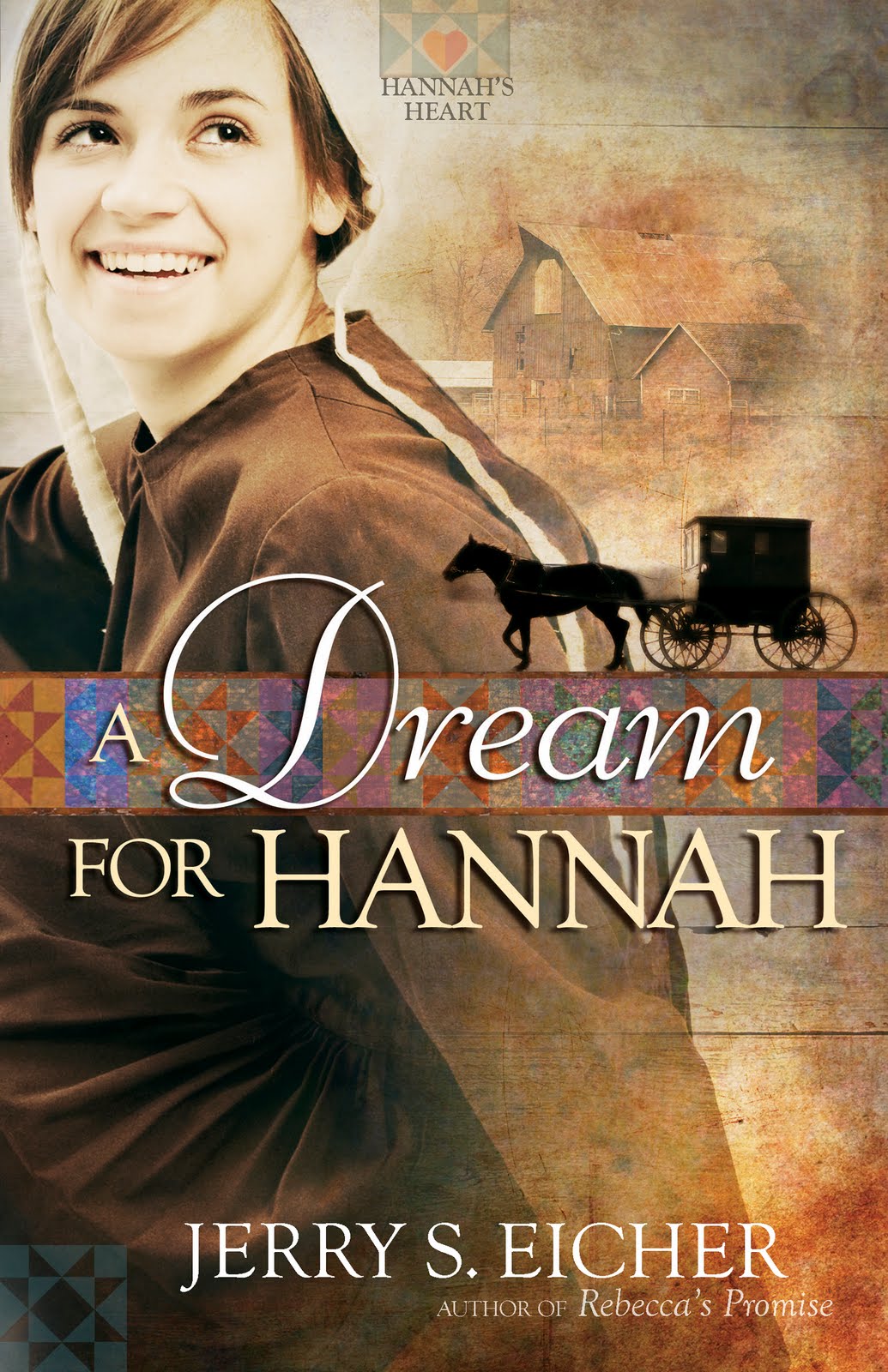
A Dream for Hannah by Jerry Eicher

It is time for a FIRST Wild Card Tour book review! If you wish to join the FIRST blog alliance, just click the button. We are a group of reviewers who tour Christian books. A Wild Card post includes a brief bio of the author and a full chapter from each book toured. The reason it is called a FIRST Wild Card Tour is that you never know if the book will be fiction, non~fiction, for young, or for old…or for somewhere in between! Enjoy your free peek into the book!

You never know when I might play a wild card on you!


Today’s Wild Card author is:


and the book:


A Dream for Hannah

Harvest House Publishers (June 1, 2010)

***Special thanks to Karri James of Harvest House Publishers for sending me a review copy.***

ABOUT THE AUTHOR:


As a boy, Jerry Eicher spent eight years in Honduras where his grandfather helped found an Amish community outreach. As an adult, Jerry taught for two terms in parochial Amish and Mennonite schools in Ohio and Illinois. He has been involved in church renewal for 14 years and has preached in churches and conducted weekend meetings of in-depth Bible teaching. Jerry lives with his wife, Tina, and their four children in Virginia.

Visit the author’s website.

Product Details:

List Price: $11.99
Paperback: 272 pages
Publisher: Harvest House Publishers (June 1, 2010)
Language: English
ISBN-10: 0736930450
ISBN-13: 978-0736930451

AND NOW…THE FIRST CHAPTER:

Outside Hannah Miller’s upstairs window, springtime had come. The earth was finally awakening from what had been a worse than normal northern Indiana winter.

Breakfast was finished, and her mother would soon call from downstairs for help. Her cousins were coming to visit this evening, and there was a lot of work to do.

As she secured her dark hair beneath the head covering she wore for work, Hannah glanced down at the paper on which she had scribbled the words of the poem. Surely she had time for another quick read, and that would have to do. Her almost seventeen-year-old hands trembled as she held the writing in front of her.

The words of the poem by E.S. White, written in 1908, gripped her again.

A Ballad of Spring

It’s Spring, my Love.

Bowed down with care,

Your branches are stripped and bare.

Old Winter’s past.

Its snow and cold

Have melted long and lost their hold.

The earth it waited

With bated breath for something more,

For life renewed called from its core.

It opens wide its arms.

For strength, for vigor, for its best,

It stirs its creatures to their nests.

All around it lies the warmth

Because the sun has drawn near,

Touching, caressing, there and here.

Arise, it calls.

The pomegranates bloom.

They yell that life has room.

Will you come, my Dear,

Hold my hand, touch what I bring?

Because, my Love, it’s Spring.

Hannah paused as thoughts raced through her head. Can this be true? Is there really such a feeling? Is this something I could really feel…this thing called love?

Then, from downstairs she heard the urgent sound of her mother’s voice, “Hannah, time to start the day.”

“Yes, I’m coming,” she called as she quickly placed the poem on the dresser, smoothed the last wrinkles out of the bed covers, and then rushed out of her room and down the stairs.

“The wash needs to be started right away,” her mom said as she busied herself with the dishes in the kitchen sink.

“Yes, right away,” Hannah said. After making one last check for dirty clothes in the bedrooms, she made her way down to the basement. The sparse room seemed dingy and damp, in stark contrast to the fresh spring day she had seen from her upstairs window. She’d much rather be outside, but the laundry must be done.

Hannah ran the water into the tub from the attached hose. When the water reached the fill line, she turned off the water and tossed in the first load of dirty clothes. With a jerk on the starter rope, the old tub started vibrating. The motor changed its speed and sound as the center tumbler turned, dragging the load of pants and shirts through the water.

As Hannah reached inside the washer to check the progress, the memory of the poem returned to her. Then she thought of James back in seventh grade. His grin had been lopsided but cute. He was a sweet boy—his eyes always lit up whenever Hannah looked at him. Was that the first stirrings of whatever this thing called “love” was?

Surely not. Such ideas! If someone could read my thoughts… “A dumm-kopf, that’s what they’d say,” she spoke aloud, smiling at her youthful memory.

Her hand dodged the tumbler’s wrath, but still the tumbler caught a piece of cloth and whipped water in her direction.

Then her memory moved up to eighth grade. Sam Knepp. A thirteen-year-old girl just had to have someone to like. The other girls would have thought her a true dummkopf if she had no one. And so she had picked Sam at random. What other choice had there been? Sam sat across the aisle from her. He was sort of cute. He had freckles, red hair, and a good smile. But there was that horrible habit he had of opening his mouth when he was puzzled or surprised.

When Hannah told the other girls she liked Sam, they reacted with admiration. So she had made the right choice. Maybe she was not a dummkopf. Her friend Mary stuck up for her choice. Mary was blonde and sweet on Laverne, who was truly a wonder in the world of Amish eighth graders. He was easily the best-looking boy in the district. In fact Hannah would have picked Laverne had he not already been taken by Mary. For some reason, it didn’t bother her that Annie, who was in the sixth grade, had her attention on Sam; blushing every time he walked by, but saying nothing.

No, Hannah decided, Sam didn’t fit for her. Not really. Maybe Laverne would have been a good choice, but not as long as he was Mary’s choice. Hannah supposed even now that Laverne and Mary would soon be dating.

“Hannah,” her mother called from upstairs, “are you done yet?”

“Coming,” Hannah called out. “This old washer is going as fast as it can.”

“Well, hurry up. The clothing needs to be on the line soon. The sun is already well up.”

“Yes,” Hannah called out again, “I’ll get it out as soon as I can.”

Minutes later the cycle was finished, and Hannah quickly loaded the basket with the heavy wet laundry and made her way up the steps and out to the clothesline.

Outside, the glorious spring day greeted her brightly. Hannah turned her face skyward and almost lost her grip on the basket as she soaked in the warm sunshine. What a glorious spring it was going to be! It felt so good to be young and alive.

Hannah began pinning the wet clothes onto the line till they stretched out, heavy in the still morning air. Later the breeze would pick up and dry the clothes as they flapped in the wind. It was a beautiful sight to behold. Hannah hoped the wind would stay gentle until the last piece was fully dry, but with spring days, one was never sure. The wind could have a mind of its own.

She stood back and watched with approval the first of the wash begin to move slightly in the breeze. Yes, this is going to be a wonderful spring, she decided as she picked up the basket and turned to go back inside.

The sun was still out when the first buggies arrived for the evening’s family gathering. Two buggies came in, one right after the other, and then two more arrived fifteen minutes later. Among the guests were Ben and Susan Yoder—Susan was Hannah’s mom’s cousin. Also in attendance were Leroy and John, brothers on her dad’s side, and Mose, Leroy’s brother-in-law. Other people who were in some way connected to the Millers had also been invited. Having a few outside guests allowed for some spontaneity while maintaining some of the structures formed by the natural family. Sam Knepp came that night because one of the cousins had taken the notion to invite him.

It amused Hannah to see Sam again, having just thought of him that morning. She noticed that he still had that habit of occasionally allowing his mouth to drop open almost randomly.

After a hearty supper, all the young people went outside to play. Since so many younger children were involved, they had to choose a simple game. The game they chose was Wolf, which caused Hannah to consider whether or not she might be too old to join in. The game involved races run at full speed in the darkness. When all of the cousins and Sam announced they would play, Hannah decided to join in. After all, Sam and she were the same age. If he could play, so could she.

With that decided, the game was called to order, and the first “wolf”—her cousin Micah—was chosen. He picked the big tree beside the house for his home base, hollered loudly that the game had begun, and began to count. The children scattered to find hiding places before he counted to one hundred. Hannah decided to try to bluff the wolf by hiding just around the corner of the house.

At the count of a hundred, the wolf silently moved to the edge of the house, stuck his head around the corner, spotted Hannah, and howled with glee. He easily beat her back to the tree trunk.

“That was stupid of me,” Hannah muttered as she joined Micah at the tree.

“They try that on me all the time,” the wolf crowed in triumph. “Now let’s get the rest of them. You go around the house that way, and I’ll take the side you hid on.”

Hannah imitated the wolf’s trick, now that she was one herself, but the corner of the house produced no hidden sheep. The moon had already set by now, and the only light came from the stars. This corner of the house was particularly dark, absent of any light beams from the gas lanterns in the living room and kitchen.

Hannah felt her way along the house and, hearing a noise, she turned toward the front porch where she flushed someone out of the bush and found herself in a race back to the tree trunk. Hannah wasn’t sure who she was chasing, but that didn’t matter. The only thing that mattered was who got to the tree first.

Just as she passed the corner of the house, Hannah’s world exploded into a deeper darkness than the evening around her. Sam, the one she had flushed from the bush, somehow collided with Hannah. He flew backward, and Hannah flew off into complete darkness in the other direction. Two other racers just missed her fallen body and dodged Sam who had now crawled slowly to a sitting position.

Young cousin Jonas, one of the children who had to jump to avoid Hannah’s body, immediately ran to the kitchen door, stuck his head in, and yelled in his loudest little-boy voice, “Someone bring a light! There’s been a hurt!”

Roy Miller, Hannah’s father, reacted first. He grabbed the kitchen lantern from its hook and ran outside.

“What’s going on?” he called from the porch, holding his lantern aloft, the light reaching out in a great circle.

“She’s hurt! Over here!” Sam called. He now rested on his left elbow and pointed toward Hannah’s still body.

As Roy approached, Sam slowly huddled closer to Hannah, both hands wrapped around his head. “Hannah,” he whispered, “are you hurt?”

By the light of Roy’s approaching lantern, Sam saw that Hannah was not moving. He took his hands off his head and gently pushed her arm but got no response. “You okay?” he asked again, tilting his head sideways to look down at her.

“Oh no, I hurt her!” Sam yelled as he jumped to his feet. He then stood speechless, his mouth wide open.

With the lantern in hand, Roy was now standing over the two young people. Glancing briefly at Sam, Roy reached for Hannah’s hand and then focused his attention on Hannah’s head, which had obviously taken the brunt of the hit as evidenced by a deep gash and wound to her left eye. Roy gently gathered Hannah in his arms and spoke to his brother, Leroy, standing beside him.

“Better take a look at Sam,” Roy said with a motion of his head toward the boy, and then he headed to the kitchen with Hannah.

Hannah’s mom met them at the door. “How bad is she hurt?” she asked, holding the kitchen door open.

“I don’t know,” Roy told her. “Let’s get her to the couch.”

Roy placed Hannah down gently and then stepped aside as Kathy got her first good look at Hannah’s head.

“We have to take her to the doctor—now,” Kathy said. “This looks serious.”

“Are you sure?” Roy said. “Is it that bad?”

“Roy, just look at her eye and that cut on her head!”

Roy, for the first time, carefully studied his daughter’s injury and then nodded. “Can someone run down to Mr. Bowen’s place and call for a driver?” he asked.

“I’ll go,” Ben said as he headed for the door.

Hannah had become alert enough to barely moan but nothing more.

Ben returned minutes later, a little breathless but with news. “Mr. Bowen said it wasn’t necessary to call for a ride. He’ll take her himself.”

“Da Hah be praised,” Roy said, worried about his daughter.

Old Mr. Bowen drove his car up to the front porch. Roy helped the groggy Hannah into the backseat.

“Why don’t you ride in the back with her?” Roy suggested to Kathy.

Kathy nodded, slid in next to Hannah, and held her upright against her own shoulder. With Roy in the front seat, Mr. Bowen pulled out of the driveway.

“Is she hurt badly?” Mr. Bowen asked.

“I can’t tell,” Roy said. “Her head seems to have…quite a gash in it. And her left eye doesn’t look normal.”

“I’ll get you there as fast as I can.” Mr. Bowen accelerated slowly on the gravel road and hung tightly onto the steering wheel. Once they reached the blacktop, he sped up considerably.

They reached Elkhart without incident, and Mr. Bowen pulled into the hospital parking lot. Roy quickly got out, opened the back door, and helped Hannah out of the car. He and Kathy took Hannah’s arms and made their way into the emergency room reception area.

The attending nurse took one look at Hannah, brought a wheelchair for her, and then took her to an examining room to wait for the doctor.

An hour later Roy and Kathy were seated in the waiting room.

“Did they say how bad she is?” Roy asked again.

“The nurse said she’ll be fine. That’s all she said,” Kathy repeated.

“Will she lose the eye?”

“No, surely not,” Kathy said, though with some uncertainty.

“We’ll just have to trust,” he said, attempting a smile and squeezing her hand.

“I’ll wait for you folks. Whatever time this takes,” Mr. Bowen assured them.

“That awful nice of you,” Kathy said. “We can call when we’re done. This could take much of the night.”

“The Mrs. understands,” Mr. Bowen said. “I don’t need much sleep myself anyway.”

“It’s still nice of you,” Kathy said with a smile as she took a seat beside Roy.

A few minutes later, the attending doctor walked into the waiting room and motioned for Hannah’s parents to follow him.

“I’m Dr. Benson,” he announced to the couple as they walked down the hall. “Your daughter is resting now. There isn’t much more we can do other than keep her under observation. We can’t let her sleep for a while, of course.”

“What happened?” Kathy asked.

“A bad concussion, that’s all, from what I can tell. The bone structure of her skull has actually been damaged where the impact occurred. That’s also what caused her left eye to protrude. We patched her up as best we could. Now nature will have to take its course. The eye, I believe, will return to normal now that we have taken the worst of the pressure off. We’d like to keep her here under observation for a day or two just to be sure.”

“Yes, of course,” Roy said. “I appreciate the prompt attention. She had us really worried. Will we be able to see her now?”

“Yes, the nurse will take you back. Do you have any questions?”

Roy and Kathy looked at each other, and Kathy said, “No, doctor, I don’t think so. Thank you for all you’ve done.”

The couple then followed the nurse into the elevator and two floors up.

Hannah lay in the bed, covered with white sheets and kept awake by a watchful nurse. The bed beside Hannah was occupied by another girl whose face was turned away from them. She moved slightly when they walked in but didn’t turn in their direction.

“You’re in good hands,” Kathy whispered and squeezed Hannah’s hand.

Hannah blinked slowly but made no other response.

“A little groggy,” the nurse said and smiled. “We gave her something for the pain.”

“We’d better leave, then, I suppose,” Kathy whispered. “They’ll take good care of you, Hannah. I’ll come back tomorrow first thing.”

Hannah nodded, and Kathy brushed her hand across her cheek.

At the doorway, Kathy glanced back quickly before she followed Roy out.

“She looked okay,” Roy assured her.

“But here—all night by herself.”

“They’ll watch her. You can come back in the morning. Half the night’s gone already the way it is.”

“I suppose so,” Kathy agreed.

Roy pushed the elevator button. They stepped inside when the doors opened and arrived at the waiting room to find Mr. Bowen had nodded off, his chin on his chest.

“We’re back,” Roy whispered into his ear.

He awoke with a start, grinned, and promptly bounced to his feet.

“How is she?” he asked as they walked outside.

“She’ll be okay,” Roy said, “but she’s staying for a day or two.”

“Sounds good for how she looked,” Mr. Bowen commented. “So let me get you folks home. I suppose you’re ready?”

“That we are,” Roy agreed.

Mr. Bowen drove slowly on the way home, taking his time around the curves. When he pulled into the Miller’s graveled driveway, he turned to Kathy in the backseat. “What’s your driver situation for tomorrow?”

“I have no one,” Kathy said, “and I have to go first thing in the morning, but I’ll call around from the pay phone.”

“No, just count on me as your driver until this is over,” Mr. Bowen said.

“That’s awfully nice of you,” Kathy said, “but we don’t to want to take advantage.”

“Think nothing of it,” Mr. Bowen assured her. “I’m more than glad to help out.”

MY REVIEW:

A Dream for Hannah is the story of a young Amish girl and her idealistic dream of love based upon a poem. When Hannah’s fantasies come face to face with reality and tragedy is the result, she sinks into depression and vows never to dream again. Out of desperation her parents send her to visit her aunt in Montana for the summer where Hannah meets Jake, a young man also running from shattered dreams. Unfortunately Hannah’s unresolved guilty conscience and some misunderstandings work together to prevent Hannah and Jake’s relationship from developing.

A Dream for Hannah is a sweet and simple romance that is written as if intended for young teens. With its key theme of how one small decision can affect a life and the lives of others should give young people something to think about. Character development could have been better but should not detract from enjoyment by the target audience.

Tender Vow by Sharlene MacLaren

It is time for a FIRST Wild Card Tour book review! If you wish to join the FIRST blog alliance, just click the button. We are a group of reviewers who tour Christian books. A Wild Card post includes a brief bio of the author and a full chapter from each book toured. The reason it is called a FIRST Wild Card Tour is that you never know if the book will be fiction, non~fiction, for young, or for old…or for somewhere in between! Enjoy your free peek into the book!

You never know when I might play a wild card on you!


Today’s Wild Card author is:


and the book:


Tender Vow

Whitaker House (September 1, 2010)

***Special thanks to Cathy Hickling of Whitaker House for sending me a review copy.***

ABOUT THE AUTHOR:


After over thirty years of teaching, with her children grown, “Shar” prayed for direction, asking God for a new mission that would fill her heart with the same kind of passion she’d felt teaching and raising children. She began to write fiction – stories filled with fallen heroes and redeemed villains, daring women and starry-eyed children – plotlines that ultimately brought her characters face to face with God’s grace and restorative power. That choice has proven to be an excellent career move as the prolific author is releasing her 9th novel in September 2010. Sharlene grew up in western Michigan and graduated from Spring Arbor University with a degree in education. She traveled the world with a musical group before returning home to marry Cecil MacLaren, whom she’d known since boyhood. The couple lives in western Michigan.

Visit the author’s website.

Product Details:

List Price: $9.99
Paperback: 432 pages
Publisher: Whitaker House (September 1, 2010)
Language: English
ISBN-10: 1603740988
ISBN-13: 978-1603740982

AND NOW…THE FIRST CHAPTER:

PROLOGUE

Icy breezes whistled through the trees in Fairmount Cemetery, prompting the faithfuls gathered there to pull their collars tighter and button their coat fronts higher, as the tent that had been set up for the occasion did little to protect them from the elements. Just two days ago, northern Michigan had experienced a warm front, unusual for late November, but today’s temperatures made a mockery of it. Twenty-nine-year-old Jason Evans shivered, no longer feeling his fingers or toes, and wondered if the numbness came from the dreadful cold or from his deliberate displacement of emotion. He still couldn’t believe it—it was just two days after Thanksgiving, and his brother, John, two years older than he, was gone. Gone.

As Pastor Eddie Turnwall from Harvest Community Church pronounced the final words of interment, sobs and whimpers welled up from the mourners. His mom’s guttural cry among them gouged him straight to the core. Jason’s dad pulled his wife closer while Jason placed a steadying hand on her shoulder. His girlfriend, Candace Peterson, stuck close by, her hand looped through his other arm. His sister-in-law—John’s widow, Rachel—stood about six feet away, clinging tightly to her father and borrowing his strength as tears froze on her cheeks. Her coat bulged because of her pregnancy of eight months, and Jason worried that the added stress of her grief might send her into early labor. Meagan, John and Rachel’s three-year-old daughter, was the only one oblivious to the goings-on; she twirled like a ballerina until Rachel’s fifteen-year-old sister, Tanna, bent down to pick her up. If she knew the significance of this day, Jason thought, she’d be standing as still as a statue. What a blessing God kept her shielded—at least, for the time being.

“And now, dear Father, we commit John Thomas Evans into your hands,” Pastor Turnwall declared. “We know—”

“No!” Rachel’s pitiful wail brought the reverend to a temporary halt. In the worst way, Jason wanted to go to her, but he had his mom to think about. Mitch Roberts supported his daughter, whispered something in her ear, and nodded for the reverend to continue. Pastor Turnwall hastened to a finish, but the last of his words faded in the howling winds.

At the close of the brief ceremony, many of the mourners stepped forward to give the family some final encouragement. Jason went through the motions, nodding and uttering words of thanks. While he longed to linger at the bronze casket, the weather made it impossible, so, as the last of the small crowd left the tent, he followed, Candace’s quiet sniveling somehow disarming him. He didn’t have the strength to comfort her, especially since she’d barely known his brother; she barely knew his family, for that matter.

“Are you all right?” Candace asked in a quavery voice.

“I’m doing okay,” he muttered, his gaze pointed downward as they walked along the frozen path. How did one explain how he really felt on a day like this?

In front of them, mourners scattered in various directions, heading for cars covered in a thin layer of freshly fallen snow. Despite the cold, Rachel walked with slow, faltering steps, sagging against her father. Even from ten or so feet back, Jason could hear her sobbing moans. The sound made his chest contract.

Without forethought, he left Candace to her own defenses and raced ahead to catch up with them.

“Rachel.” Breathless, he reached her side. “I’m so sorry.”

“Jay.” She turned from her father’s supportive grip and fell into Jason’s arms, her sobs competing with the sighing winds.

They stopped in the path, and he held her sob-racked body, feeling his eyes well up with tears. Through his blurred vision, he noted both families halting their steps to look on. One of Rachel’s girlfriends took Meagan from Tanna and headed toward one of the cars. “Shh. You can do this, Rachel,” he whispered. “Think of Meagan—and your baby.”

“I—I c-can’t,” she stammered, her voice barely resembling that of the Rachel he’d known since high school, when he and John would argue over who was going to win her in the end. Of course, it’d been John, and rightfully so. And not for a second had Jason ever begrudged him. They fit like a glove, Rachel and John.

“Sure, you can,” he murmured in her ear. “You are Rachel Evans, strong, courageous, capable—and carrying my brother’s son, don’t forget.” He set her back from him and studied her perfect, oval face, framed by wisps of blond hair falling out from beneath her brown, velvet, Chicago cuff hat. Her blue eyes, red around the edges, peered up at him from puffy eyelids without really seeing. Chills skipped up his spine, and he didn’t think they came from the air’s cold bite. “Come on, let’s get you to the car,” he urged her, thankful when Candace stepped forward to take Rachel’s other arm, and they set off together. Rachel barely acknowledged Candace, and he wondered if she even remembered her, so few were the times he had brought her home.

“I can’t believe it, Jason, I just—I can’t believe it,” Rachel kept murmuring. “Just last week, we were making plans for our future, talking about John Jr. coming into the world, wondering how Meagan would feel about having a baby brother….”

“I know.”

“He just finished painting the nursery, you know.”

“I’m glad.”

She frowned. “Tell me again what happened.”

His throat knotted. “What? No, Rach, not here.”

She slowed her steps to snag him by the coat sleeve. “I need to hear it again,” she said, punctuating each word with determination.

“We’ll talk later, but first, we need to get you out of the cold.”

“Jason’s right, honey,” Mitch said, coming up behind them. “Let’s go back to the house.”

“But I don’t understand how it happened. I need to understand.”

“We’ve been over it,” Donna Roberts said as she joined them. Tanna came up beside her mother and held her hand as they walked. Like everyone else’s, Arlene Roberts’s face bore evidence of having shed a river of tears.

“I don’t care!” Rachel’s voice conveyed traces of hysteria. She stopped in her tracks, forcing everyone else to do the same. “John was a good skier,” she said. “He knew the slopes on Sanders Peak like the back of his hand. You said yourself you guys used to ski out there every spring.” Her seascape-colored eyes shot holes of anguish straight through Jason—critical, faultfinding eyes.

A rancid taste collected at the back of his throat. “We did, Rach, and he was the best of the best, but it takes a champion skier to navigate Devil’s Run. Come on, your car’s just ahead.”

Her feet remained anchored to the frozen ground. “Did you force him, Jason?”

“What?” The single word hissed through his teeth. “How could you even suggest such a thing?”

“Rachel, now is not the time for such….”

But Rachel covered her dad’s words with her own. “Did you provoke him into taking Devil’s Run? Witnesses heard you two arguing, Jay. Why would you be fighting on top of a mountain?”

“We weren’t fight—”

“You’ve always been the risk taker, the gutsy, smug one, ever looking for a challenge. You pushed him to do it, didn’t you?”

“What? No! What are you saying, Rachel? It was a stupid accident, that’s all.”

She stood her ground, her eyes wild now. “John isn’t like you, Jay, never was. Why drag him to the top of Devil’s Run if only a ‘champion skier’ can handle it? You of all people knew his capabilities—and his limitations.”

Jason wanted to shake her but refrained, merely giving her a pointed stare instead. “I did not drag him anywhere, Rachel, and we’ve both navigated Devil’s Run before. It’s just…the conditions were extra bad that day. I told him not to try it. You have to believe me.”

“Then why, Jason? Just tell me why he’d take the chance! Why?” she wailed, thumping him hard in the chest. Shock pulsed through his veins as he grabbed her fist in midair to prevent another assault. Everyone gasped, and Candace took a full step back, looking bewildered. Blast if he wasn’t dumbfounded himself. Where did she get off blaming him for the accident? Didn’t she realize his heart ached as much as hers over John’s death?

Mitch stepped forward and put his arm around his daughter. “Witnesses say John went down of his own accord, honey, and the police ruled his death accidental. No one forced him down that slope.”

Now she threw her father an accusatory glare. “How do you know that, Dad? Were you there?”

Mitch frowned. “Well—of course not.”

As if that should have settled it, Rachel pulled away and marched up the snowy walkway, albeit with stumbling steps. In robotic fashion, everyone else followed, shaking their heads in dismay. Taken aback by her insinuations, Jason fell in at the tail of the procession. “She blames me,” he muttered.

“She’s completely rude,” Candace said, taking his gloved hand in hers with a gentle squeeze.

“No, she’s just not thinking straight.”

“I don’t see how you can defend her. She just hauled off and hit you square in the chest.”

He cared very much for Candace, but she sometimes annoyed him with her snap assessments. “She just lost her husband, Candace.”

Mitch reached the car ahead of Rachel and opened the front door for her. “Where’s Meaggie?” she suddenly asked, almost as an afterthought, turning full around to scan the cemetery.

“Aunt Emily took her back to the house,” her mother said, climbing into the back with Tanna.

“Oh.”

Before climbing into the car, she glanced about, focusing on Jason. “He was a good skier, Jason.”

Jason nodded his head in agreement. “Yes, he was, Rachel. No question about that.”

“As good as you?” she questioned with a cynical hint.

“Yes. As good as me,” he lied.

Seeming pacified, she bent her awkward, pregnant body and eased into the seat. Mitch closed the door behind her and went around to his own side, nodding at Jason’s parents, Tom and Donna Evans, and the rest of his family before climbing into the driver’s side and starting the engine.

When the car disappeared from view, Jason murmured again, “She blames me.”

“It will pass,” said Tom, removing his keys from his coat pocket. “Give her time.”

As they approached his dad’s late-model Chevrolet, Jason asked, “What about you, Dad? Do you think I’m to blame?”

“Son, please, let’s not talk about this anymore.”

“Well, do you?”

“Get in the car,” his dad ordered in a tone Jason hadn’t heard since his youth. Even though he was a grown man, he felt compelled to obey. Candace climbed in ahead of him, and they all rode back to the house in icy silence.

CHAPTER ONE

Ten months later

“Mommy, will you play with me?” Meagan asked for at least the dozenth time.

Rachel scanned the kitchen, overwhelmed by the sight of empty juice bottles, a spilled box of baby cereal, a pan of lukewarm potato soup, and a pile of several weeks’ worth of mail. A quick glance at the clock on the wall told her it was already 8:05 p.m. Her pounding head and jangling nerves were additional reminders of her upside-down life, and Rachel shot Meagan a weary look. “Mommy can’t play just now, honey. It’s already past your bedtime, and I still have to get you and your brother in the bathtub.” She wiped her damp brow with the back of her hand. It had been an unusually warm day for September, and the heat and humidity still lingered in the house, despite the open windows. In fact, the entire summer had been the hottest and driest Rachel could remember.

“I don’t want a bath.”

“I know, but you played hard today. A bath will feel good.”

“Uh-uh. Baths stink,” Meagan whined.

Rachel had a good comeback on the tip of her tongue, but she kept it to herself.

“Can you read me a book?”

“Not this minute, no.” Suddenly, it occurred to her that things were too quiet in the living room, where she’d left John Jr. Setting down her dishcloth, she headed toward the other room and found an assortment of magazines scattered about, their pages ripped out and thrown helter-skelter. Johnny looked up and grinned, his mouth jammed full with something. She ran across the room, knelt down beside him, and pried open his jaws, using her index finger to fish out a glob of wet paper. “Oh, Johnny-Boy, you little stinker, you’d better not have swallowed any of this.”

“If he did, it’ll come out in his diaper,” Meagan stated.

In spite of herself, Rachel laughed, something she’d rarely done since becoming a single parent. In fact, more often than not, she laid her exhausted self in bed each night and cried into her pillow, counting all the ways she’d failed at her mothering job that day, wishing John were there to ease the load.

She whisked Johnny up and headed for the stairs, deciding to leave the kitchen mess alone for now. “Come on, Meaggie. It’s bath time.” She lifted the latch on the gate and allowed Meagan to pass ahead of her, patting her on the back to urge her up the stairs.

“Noooooo,” came another expected whine.

Mustering up a bright voice, she said, “Remember, Grandma and Grandpa Evans are picking you up in the morning to take you to the circus! You’ll see elephants, tigers, horses…and I bet you’ll even see some clowns. Won’t that be fun?”

“Is Johnny goin’, too?”

“Nope. Tomorrow is strictly a Meagan day.”

“Yay!” she squealed, her mood instantly improved.

Later, with the children tucked in bed, the kitchen cleaned, and the house put back into a semi-ordered fashion, Rachel collapsed into her overstuffed sofa and heaved a mountainous sigh. Her chest felt heavy, a sensation she’d come to expect these days.

Be still, and know that I am God.

“I know, Lord,” she whispered, breathing deeply. “But it’s hard. Sometimes, I don’t feel Your presence. I will never understand why You took John.”

Be still….

She leaned down and pulled John’s Bible from a stack of books beneath the coffee table, guiltily wiping off a fine layer of dust. “Lord, I’ve been so busy, I haven’t even opened Your Word for weeks. What kind of a Christian am I, anyway? Shoot, what kind of a parent am I? I can’t even find time in a day to read Meagan a book.”

Be still….

“I’m trying.”

She opened the leather book, noting many highlighted verses interspersed throughout the slightly worn pages. John had been an avid reader, putting her to shame. She knew God more with her head than her heart, but John had known Him with both. She missed his wisdom, his courage, and his strength. Most days, it felt like she was floundering without her other half. If only she’d had the chance to say good-bye—then, maybe, she’d have fewer gnawing regrets. She gave her head a couple of fast shakes to blot out the memory.

I will never leave you nor forsake you, came the inner voice. It sounded good, but could she truly believe it?

***

Saturday morning dawned bright and full on the horizon, the skies a brilliant blue. The heady scent of roses wafted through her bedroom window. If John were still alive, he’d have headed out at daybreak and picked her a bouquet for the breakfast table. She smiled at the thought. Gentle, cool breezes played with the cotton curtains, causing shadows to dance jubilantly across the ceiling. She hauled her downy comforter up to her chin and turned her head to glance at the vacant pillow on the other side of the king-sized bed. His side always remained unruffled, no matter how much she tossed and turned in the night.

Two doors down, Johnny stirred, his yelps for attention growing by decibels. On cue, her breasts sent out an urgent message that it was feeding time. “I’m coming, Johnny Cakes,” she called out, then sighed as she tossed back the blankets, donned her robe, and stepped into her slippers. She padded across the room, stopping briefly to touch the framed photo of her and John on their wedding day before continuing to the nursery, where her towheaded, nine-month-old baby was waiting in his Winnie-the-Pooh pajamas. Oh, how she thanked the Lord she still had her beloved children. Yes, they wore her to a frazzle, but they also kept her grounded.

When the doorbell rang at nine o’clock on the dot, Meagan sailed through the house in her pink, polka-dotted shorts and matching shirt, her blond hair flying, and made a running leap into her grandpa’s waiting arms, wrapping her legs around his middle. Tom Evans laughed heartily and planted a kiss on her cheek, and Donna smiled, tousling the child’s head.

“Grandpa Evans!” Meagan squealed, reaching up to cup his cheeks with her hands. “You and Grandma are taking me to the circus!”

“No! Are you sure?” He feigned surprise. “I thought we were just going for a walk in the park.”

“Uh-uh. Mommy says we’re goin’ to the circus. What’s a circus, anyway?”

Tom laughed and began explaining what she should expect at the circus, while Donna took Johnny from Rachel’s arms and moved to the bay window for a look at the gleaming sunshine.

While her father-in-law talked to Meagan, Rachel looked on, getting glimpses of John in his every gesture. Tom Evans’ manner of speech, his pleasant face, his lean, medium build, the way he angled his head as he spoke, and even his rather bookish, industrious nature put her in mind of John.

She then thought of Jason, sort of the black sheep of the family, only in the sense that he was just the opposite with his tall, strongly built frame, cocoa-brown hair and eyes, and reckless, devil-may-care personality. And he was terribly likable to everyone—except Rachel, even though she, John, and Jason had been almost inseparable during their high school and college years. They had stuck together despite Jason’s penchant for weekend parties and John’s utter dislike of them; Jason had spent so much time socializing, it was a wonder he’d even graduated. But she and Jason had grown apart, especially after the accident, and she hadn’t seen him since last Christmas—her own choice, of course.

Tom stepped forward to plant a light kiss on Rachel’s cheek. “How are you doing these days, Rachel?”

“I’m all right,” she said with a mechanical shrug and a wistful smile. She never felt like discussing her innermost feelings.

Tom narrowed his gaze as he set Meagan down. The child scooted over to her grandma, who smiled down at her, then looked up at Rachel and said, “Say, why don’t you stop by the house tomorrow afternoon? You haven’t been over for such a long time.”

Visiting her in-laws’ home was like walking into yesterday, and Rachel didn’t know if she was ready to pass over the threshold again. The last few times had been too painful; she’d found herself glancing around the house and expecting John to come barreling out of one of the rooms. Silence followed as she bit down hard on her lip.

“Jason is coming home,” Donna went on, bouncing Johnny as she moved away from the window. “He called yesterday, and I convinced him to come for dinner. He hasn’t been home for a couple of months. I know he’d love to meet little Johnny. He asks about him every time he calls, and you know how much he loves and misses Meagan.”

Just hearing Jason’s name incited painful memories packed with guilt. For a time, Rachel had hated Jason, even blamed him for John’s death. Now, she just resented him for reasons she couldn’t define. In high school, the phrase “Three’s a crowd” had never applied to them. Instead, “All for one, and one for all” had been their motto—until she and John had become a couple, that is. After that, the chemistry among the three of them had changed. Oh, she’d had warm feelings for both brothers, and she’d even dated Jason off and on, but John ultimately had won her heart in his final two years of college with his utter devotedness to her, his promise of a bright future, and his maturity and passionate faith.

“What do you say, Rachel?” Donna asked, turning her head to keep Johnny from pulling on one of her dangling, gold earrings.

“Yes, you should come,” echoed Tom.

“I—I’m not sure. I think my parents are stopping over.”

“Oh, no; they’re coming straight from church to our place for lunch. They didn’t mention that?” Donna asked, bobbing Johnny in her arms. The two families had always been close, having lived in neighboring towns and attended the same church for years. Then, when Rachel and John had gotten married, the bond had grown tighter still.

“Um, I guess they did, but I…I forgot.” Panic raced through Rachel from head to toe. She didn’t want to see Jason, couldn’t picture him in a room without John there, too.

“Rachel.” Donna touched Rachel’s arm, her eyes moist. “We miss John more than you can imagine, but—we still have Jay. His birthday is Tuesday, remember? Won’t you come and help us celebrate it like old times?”

Jason’s birthday. She’d forgotten all about it. Yes, she did recall celebrating it as a family, just as they’d celebrated hers, John’s, and every other family member’s.

“I’m sorry; I just don’t feel like celebrating anything or anyone.”

“But he’s your brother-in-law, sweetheart. Don’t you want to see him? Remember how the three of you used to be so inseparable?”

“Mom, please,” Rachel warned her. “It’s all different now.”

“Of course, I know that. But—”

“Leave it be, Donna,” Tom said sternly. Meagan, growing as restless as a filly, tugged at her grandfather’s pant leg. “I can understand why Rachel wouldn’t want to see Jason. Too many memories, right, Rachel?” He reached up and touched her shoulder. “It’s probably for the best—you two keeping your distance, at least for now.”

She swallowed a tight knot and released a heavy breath. “Thanks.”

Donna blinked. “Well, if that’s how you feel…. But, at some point, I hope you’ll reconsider.” She shifted her fidgety body and frowned at her husband, then smiled down at Meagan and tweaked her nose. “Well, we should be getting to that circus, don’t you think, pumpkin?”

“Yes!” Meagan jumped with unadulterated glee. Oh, to be that innocent, Rachel thought.

“We’ll try not to be too late getting her home. How ’bout trying to get some rest when you put Johnny down?” Tom asked as Donna handed Johnny off to Rachel. “You look plain tuckered out.”

It sounded wonderful, but also completely unrealistic, considering the overflowing baskets of dirty clothes in the laundry room, the teetering pile of dishes in the kitchen sink, and the brimming wastebasket in every bathroom. Whoever said “A woman’s work is never done” must have been a single mom, Rachel thought. Then, nodding with a forced smile, she saw the circus-goers to the door.


MY REVIEW:

Tender Vow is the highly emotional story of recently widowed Rachel Peterson and her brother-in-law Jason. Although both brothers and Rachel had been close friends throughout school, John’s death created a tension filled distance between the two survivors. Jason’s early attempts to help Rachel and her children were rebuffed, primarily because of guilt and doubt. As the book progresses, it illustrates the ups and downs of their relationship as well as their faith in God.

Tender Vow was well written with fully developed and realistic characters.  I did find the pace a bit tedious at times, but then I can be pretty impatient. I tend to want the characters to just get on with life so I am probably not the best judge of a book that deals with psychological issues like grief recovery. Hopefully I have more patience with the people around me. If you enjoy books of that type, Tender Vow would probably be a good choice.

Love Me Tender by Janice Hanna

This week, the
Christian Fiction Blog Alliance
is introducing
Love Me Tender
Summerside Press
(September 1, 2010)
by

Janice Hanna


ABOUT THE AUTHOR:

Award-winning author Janice Thompson also writes under the pseudonym Janice Hanna, She got her start in the industry writing screenplays and musical comedies for the stage. Janice has published over fifty books for the Christian market, crossing genre lines to write cozy mysteries, historicals, romances, nonfiction books, devotionals, children’s books and more. In addition, she enjoys editing, ghost-writing, public speaking, and mentoring young writers. Janice currently serves as Vice-President of CAN (Christian Authors Network) and was named the 2008 Mentor of the year for ACFW (American Christian Fiction Writers).

She was thrilled to be named the 2010 Barbour/Heartsong Author of the Year with three books on the top ten list for that house. Janice is active in her local writing group, where she regularly teaches on the craft of writing. Her online course, “Becoming a Successful Freelance Writer” has been helpful to many who want to earn a living with their writing. Janice is passionate about her faith and does all she can to share the joy of the Lord with others, which is why she particularly enjoys writing. She lives in Spring, Texas, where she leads a rich life with her family, a host of writing friends and two mischievous dachshunds. She does her best to keep the Lord at the center of it all.

ABOUT THE BOOK:

As “Love Me Tender” plays in the background, Debbie Carmichael determines to salvage her family’s restaurant, Sweet Sal’s Soda Shoppe, when her father’s health fails. Teen heartthrob Bobby Conrad agrees to perform at a fundraiser concert. But just two weeks before the highly publicized event, Bobby backs out of the benefit. Enter Johnny Hartman, a young, unknown singer to take Conrad’s place. Debbie soon realizes the twists and turns leading up to the concert are divinely orchestrated. And it isn’t dreamy Bobby Conrad who has stolen her heart – but the tender love of Johnny Hartman.

If you would like to read the first chapter of Love Me Tender, go HERE.

Learn more about Janice and her books on her Website.


MY REVIEW:

For a trip down memory lane to the early days of rock and roll, poodle skirts, and drive-ins, Love Me Tender is just the ticket. A sweet and tender love story set primarily in a popular diner near the beach in sunny California, this novel features a young woman dedicated to making life easier for her ailing father. As she plans a benefit concert hoping to meet the hot new singer/actor Bobby Conrad, she  meet Johnny Hartman, a newcomer to LA who just wants a chance to share his music.

As in her other books, Janice Hanna (Thompson) has managed to present the reader with likable and interesting characters while keeping it real. Both Bobby and Johnny were portrayed as young men whose strong faith kept them on track in a day when rebels like Marlon Brando and James Dean were the norm. Excerpts from the Hollywood Heartthrob magazine at the beginning of each chapter added an extra layer or interest to the story. While not as humorous as some of Hanna’s other novels, Love Me Tender still had its moments, especially in scenes featuring Jim’s son Toby.

If you love TV shows and movies such as “Happy Days” and “Grease”, Love Me Tender should be a must have addition to your reading list. The cover alone will grab your attention.

Pearl In The Sand by Tessa Afshar

This week, the
Christian Fiction Blog Alliance
is introducing

Pearl In The Sand
Moody Publishers (September 1, 2010)
by

Tessa Afshar


ABOUT THE AUTHOR:

Tessa Afshar was born in a nominally Muslim family in Iran and lived there for the first fourteen years of her life. She survived English boarding school for girls before moving to the United States permanently. Her conversion to Christianity in her mid-twenties changed the course of her life forever. Tessa holds an MDIV from Yale University where she served as co-Chair of the Evangelical Fellowship at the Divinity School. She has spent the last twelve years in full and part-time Christian work and currently serves as the leader of Women’s and Prayer ministries at a church in Connecticut.

ABOUT THE BOOK:

Can a Canaanite harlot who has made her livelihood by looking desirable to men make a fitting wife for one of the leaders of Israel? Shockingly, the Bible’s answer is yes. At the age of fifteen Rahab is forced into prostitution by her beloved father. In her years as a courtesan, she learns to mistrust men and hate herself. Into the emotional turmoil of her world walks Salmone, a respected leader of Judah. Through the tribulations of a stormy relationship, Rahab and Salmone learn the true source of one another’s worth in God and find healing from fear and rejection.

If you would like to read the first chapter of Pearl In The Sand, go HERE

Watch the book video:

MY REVIEW:

I have not been much of a fan of biblical fiction simply because much of what I have read in the past was pretty dry. So you can imagine just how thrilled I was to find that Pearl In The Sand was of that genre. But because I am dedicated to helping promote Christian fiction and the book was on my list of blog tours, I decided to at least give it a try. I am glad I did.

Pearl In The Sand is the story of Rahab the harlot, partially taken directly from scripture and partially from what might have been. This author made Rahab come alive and the story was so realistic that I left it hoping that was the way it really happened. Rahab’s story was handled with sensitivity and  her life as a harlot was portrayed discreetly. I wish I had taken notes because this book is jam packed with a wealth of quotes that offer wonderful spiritual insight that blended into the story very naturally.

I commend Ms. Afshar on a job well done and hope to see more of her work in the future.

McKenzie by Penny Zeller

It is time for a FIRST Wild Card Tour book review! If you wish to join the FIRST blog alliance, just click the button. We are a group of reviewers who tour Christian books. A Wild Card post includes a brief bio of the author and a full chapter from each book toured. The reason it is called a FIRST Wild Card Tour is that you never know if the book will be fiction, non~fiction, for young, or for old…or for somewhere in between! Enjoy your free peek into the book!

You never know when I might play a wild card on you!


Today’s Wild Card author is:


and the book:


McKenzie (Montana Skies series #1)

Whitaker House (September 1, 2010)

***Special thanks to Cathy Hickling of Whitaker House for sending me a review copy.***

ABOUT THE AUTHOR:


Penny Zeller is the author of four books and numerous magazine articles in national and regional publications. She is an active volunteer in her community, serving as a women’s Bible study small-group leader and co-organizing a woman’s prayer group. Her passion is to use the gift of the written word that God has given her to glorify Him and to benefit His kingdom. When she’s not writing, Penny enjoys spending time with her family and camping, hiking, canoeing, and volleyball. She and her husband Lon reside in Wyoming with their two children.

Visit the author’s website.

Product Details:

List Price: $6.99
Paperback: 320 pages
Publisher: Whitaker House (September 1, 2010)
Language: English
ISBN-10: 1603742166
ISBN-13: 978-1603742160

AND NOW…THE FIRST CHAPTER:

September 18, 1881


Boston, Massachusetts

Clutching the envelope that had just been delivered to her home, McKenzie Worthington walked into the parlor and closed the doors behind her. Sitting down, she ran her finger over the familiar, hasty penmanship on the outside of the envelope. There was no return address, but McKenzie already knew who had sent the letter. Bracing herself for the words on the pages within, she carefully opened the seal and unfolded the tattered, soiled piece of stationery.

My dearest sister McKenzie,

I write this letter with a heavy heart and a fearful spirit. I am convinced that Darius is not the man I thought him to be when I married him. He drinks almost continually, and when there is no more money to purchase his whiskey, he places the blame on me. He used all the money in my trousseau long ago, and we are constantly on the run to avoid the law. His threats are many if I dare turn him in to the local sheriff.

We are without food much of the time, but Darius always finds funds for his alcohol. All the money sent to me in the past, he has found a way to spend. I wish more than anything that I could find a way to leave this place and return home. However, Darius has threatened my life if I leave and has arranged for several of his friends at the saloon to keep an eye on me. One of his friends, Bulldog, lives nearby and watches my every move. He scares me to death, McKenzie.

Please, help me get away from Darius. He is such a mean man with a horrid temper. I fear for my life, at times. If Darius knew I was writing to you, I know he would kill me. I ask again that you please not tell Mother and Father the seriousness of my situation, since they will surely say that I deserve it for running away with Darius. But please come, and come quickly.

With much love,

Kaydie

When she had finished reading the letter, McKenzie clutched it to her chest. She could feel a tear threatening to fall, and she diverted her attention to the mantel above the fireplace. A large, three-foot-square oil painting hung proudly in the same place it had for the past ten years. McKenzie stared at the three people in the portrait and suddenly yearned for things to be as they had been then. Time had passed so quickly; the years of her childhood seemed barely a whisper in the conversation of life.

On the left-hand side of the painting, McKenzie’s younger sister, Kaydie, posed in her pink satin gown. Her long, blonde hair flowed over her shoulders, and her brown eyes seemed to hold a sparkle that McKenzie knew was long gone due to Kaydie’s present circumstances.

Sitting on a higher stool in the middle, McKenzie’s older sister, Peyton, emphasized her role as the eldest and most favored Worthington daughter. Beneath her dark, rolling locks, her large, green eyes held the look of arrogance and superiority that she continually flaunted over her less-preferred sisters.

On the right-hand side, her head tilted toward Kaydie’s, sat McKenzie, then fourteen years old. Her long, strawberry blonde hair was pinned up at the sides, and she wore her favorite turquoise gown. The smirk on McKenzie’s face had caused her mother great disturbance. “Proper ladies never smile in a portrait. Your father will be so disappointed,” her mother had scolded her. “We shall have to insist the painting be redone.”

The artist had been paid a reduced fee for failing to change McKenzie’s smile to a look of solemnity and had never been asked to paint any further portraits for the Worthington family. So, the portrait of Arthur and Florence Worthington’s daughters had never been repainted.

Once the servants had hung it above the mantel, there it had remained, serving as a memory in different ways to the different members of the Worthington household. To Peyton, it was a reminder that she was the eldest and the most obedient. To McKenzie and Kaydie, it was a reminder of enjoyable days past, when they would secretly embark on adventures that were considered unbecoming for young women from families of prestige and wealth. To McKenzie’s mother, the portrait was a disgrace because of McKenzie’s smirk, and to her father, it was the observance of a costly tradition that had been carried on from generation to generation.

McKenzie scanned the portrait again, her focus stopping on Kaydie’s face. Hang on, my dear Kaydie. I promise I will figure out a way to save you from Darius. Please don’t give up hope, she silently begged her sister. I don’t know how I will do it or when, only that I will. This much I promise you.

McKenzie sat for a moment longer in the quietness of the parlor. She recalled her parents’ disturbance when their youngest daughter had eloped with Darius Kraemer and moved West with him.

McKenzie’s mother had covered her mouth with her left hand and fanned herself with her right, clearly indicating her dismay at the situation. “I am so distraught by Kaydie’s marriage that I can barely manage day-to-day living,” she’d lamented.

“She never should have married a man so far beneath her. Now we’ll likely never hear from her again,” Peyton had said, sipping her tea. “Of course, Kaydie was always the one who thought she could do whatever she pleased and face the consequences later.” Peyton’s voice had done little to hide her smugness. “I would never do such a thing. Not only was it an unwise decision to marry someone without a pedigree and move far from civilization, but it has brought nothing but shame to the Worthington family. I can’t begin to count the number of times I’ve had to make up stories to explain her absence in order to preserve our family’s impeccable reputation.”

McKenzie had glared at her older sister. “Now, Peyton, not everyone can marry such a fine gentleman as Maxwell Adams,” she’d said with more than a hint of sarcasm, thinking of how grateful she was that she herself hadn’t married Maxwell, or anyone like him. While he was polite and treated Peyton well, he was also stuffy and prudish, and he seemed incapable of doing anything for himself. It had been Peyton who had secured his position at their father’s law office. Maxwell hadn’t even been able to apply for the job himself. In McKenzie’s opinion, Maxwell was a helpless, spineless, sorry excuse for a man.

“At least I am married,” Peyton had said, glaring at her sister, “unlike some people I know.” Peyton never missed an opportunity to rub in the fact that McKenzie, as an unmarried woman, was an oddity in a society that held marriage as the highest priority for women—marriage to a man from a wealthy family and with a thriving career, of course. The fact that Peyton had been successful on both accounts gave her an edge over a sister who in most other respects won the competition war.

“Now, girls, please. This bickering between the two of you must stop,” their mother had said, wringing her hands.

“You’re right, Mother. It is a shame that McKenzie doesn’t conduct herself in a manner more in line with our upbringing,” Peyton had said, smiling smugly at her mother.

McKenzie shook her head now and pictured her mother. With the exception of her long, gray-blonde hair and the age difference, she and Peyton could be twins. Her mother’s large, emerald eyes made her look as though she were in a constant state of surprise. Her pert, upturned nose further conveyed the air about her that she knew she was from one of the wealthier families in the Boston area, both by birth and by marriage.

“Marry a man of wealth, have children, attend social gatherings, and busy yourself with acceptable volunteer work” were the maxims McKenzie’s mother sought to instill in her daughters. Kaydie had managed to fulfill one of those wishes—she’d married. Yet, it had been in defiance of her parents’ desire, for Darius was hardly wealthy. Yes, they had met while doing volunteer work, but, based on what McKenzie knew now, it had probably been a ruse.

The chiming of the tall, mahogany clock in the corner brought McKenzie back to the present, and she again focused her attention on Kaydie’s predicament. She knew that mailing money to Kaydie to secure her fare to Boston would be impossible, as she had no access to any funds; the money in her dowry would be passed to her husband alone.

Poor Kaydie had thought her normally calm and complacent life would be so full of adventure when she’d agreed to marry the wayward Darius. He’d captured her heart and taken her from security and wealth to the dangerous, uncivilized Wild West. Granted, he was an attractive man with allure brimming in his erratic personality. He’d even said all the things Kaydie had longed to hear, making the men of Boston pale in comparison. Only after it was too late had Kaydie discovered that Darius made his living by swindling and robbing. When things didn’t go according to plan, he took out his fury, both verbal and physical, on Kaydie, essentially holding her hostage in her own marriage.

Now, Kaydie was suffering because she’d fallen in love with what had turned out to be a mere façade. Her dowry, which Darius had been after from the beginning, had been spent while Kaydie had been blinded by the love she’d thought she had found.

McKenzie had always been closest to Kaydie and knew that there must be a way to help her. Besides, she knew Kaydie would do the same if the situation were reversed. She reached up to twirl one of her tendrils between her finger and her thumb, as she habitually did when she was in deep thought. Not one to allow discouragement to defeat her, McKenzie knew she had to be the one to concoct a plan to rescue her sister. Kaydie’s life depended on it. No one else knew of the four letters Kaydie had mailed intermittently to McKenzie. McKenzie had been sworn to secrecy regarding Kaydie’s predicament, and, besides, her parents would no doubt have no shortage of words regarding their judgment of their youngest daughter’s poor choice. No one else knew the way her life had taken a turn for the worse. No one else knew of Kaydie’s desperation. McKenzie was the only one who knew and the only one who could help. But how would she afford the trip west? And, once she got there, where would she stay? Who would protect her while she searched potentially dangerous towns for her sister?

Just then, it came to her—an idea so crazy, she thought that it just might work.

MY REVIEW:

McKenzie is another mail order bride story but with a twist. In this version, McKenzie Worthington is a pampered Boston society daughter who decides that agreeing to a mail order marriage is the only way to get to Montana to rescue her sister from desperate circumstances. So without giving much thought to the man she is to marry, she sets off cross country with her own agenda.

McKenzie is an entertaining, easily read tale that moves along well without getting bogged down. The characters are realistic and easy to identify with. I did not particularly like McKenzie at first but enjoyed reading about changes in her life as she moved from just knowing about God to having a relationship with Him. Zach was a true hero who was likable from the very beginning. The romance element of the story was enjoyable and historical details were informative.

I would recommend McKenzie for anyone who enjoys a historic western romance.