A Necessary Deception by Laurie Alice Eakes


MY REVIEW:

I was a little skeptical about this book when I realized it was a Regency romance, however I didn’t have to read very far before I learned that “A Necessary Deception” would far exceed my usual expectations for this category. Although the author included some necessary descriptions of clothing, homes, society events, etc. to define her setting, far more valuable space was used to communicate the actual plot.

Lady Lydia Gale is an independent widow who has sworn off men after her experiences with an overbearing father and husband who discouraged her love of painting. Her self-reliance has also distanced her from God who she also suspects wants to control her. When she is blackmailed and tries to protect her family, she soon finds everything spinning out of her control and has no idea who she can trust. Even her new friend and self-appointed protector Christien de Meuse is suspect. Can Lydia trust her own heart that wants to love Christien and can she finally learn to turn her problems over to the Lord?

“A Necessary Deception”was filled with suspense almost from beginning to end. There was so much going on that I was just as puzzled as Lydia and Christien as to who might be behind the sinister plot. It was only as I neared the end of the book that I suddenly had an idea of who had to be the mastermind of everything that had happened. Plenty of action, romance, and interesting characters made the story a delight to read.  I look forward to the next installment of this series.

“A Necessary Deception” is a must read for those who love Regency romance but I also recommend it to those who love a good historical mystery.

This book was provided for review by
Revell, a division of Baker Publishing Group.

Available October 2011 at your favorite bookseller from Revell, a division of Baker Publishing Group.


ABOUT THE BOOK:

Who Can a Lady Really Trust?

A young widow, a mysterious Frenchman, and the threat of blackmail keep readers guessing in this Regency romance

Laurie Alice Eakes captures the hearts of her readers once again by weaving intrigue, suspense, and romance together in her new novel, A Necessary Deception, set during the Regency time period.

When young widow Lady Lydia Gale helps a French prisoner obtain parole, she never expected doing so would put her family in jeopardy. But that’s just what happens when a shadowy figure corners her during an evening stroll and blackmails her with the threat of treason.

She returns to her family just as the London Season is getting underway, and is shocked when the French prisoner appears in her parlor calling himself by a new name, Christien de Meuse, and carrying a letter from the shadowy man.

While she should be helping her younger sisters, bookish Cassandra, who’s about to get married, and headstrong Honore, who’s about to enter into London society, Lydia can’t help being preoccupied with the mysterious Frenchman. Nor can she deny her attraction to him. Is he a spy or a suitor? Can he be trusted? Is she putting her family in danger or sparing them from harm?

With an eye for detail and in-depth knowledge of the period, Laurie Alice Eakes brings alive the drawing rooms of London’s elite .

(ISBN: 978-0-8007-3466-4, $14.99, October, 352 pages)

ABOUT THE AUTHOR:

Laurie Alice Eakes is also the author of Lady in the Mist and several other novels. She won a National Readers Choice Award for Best Regency in 2007 for Family Guardian. Laurie Alice writes full-time from her home in Texas, where she lives with her husband and sundry dogs and cats.

The Girl in the Gatehouse by Julie Klassen

This week, the

Christian Fiction Blog Alliance is introducing

The Girl in the Gatehouse
Bethany House (January 1, 2011)

by

Julie Klassen

ABOUT THE AUTHOR:

Julie says: My background is in advertising and marketing, but I am blessed with a dream job—working as an editor of Christian fiction. I have been writing since childhood, but Lady of Milkweed Manor was my first novel. It was a finalist for a Christy Award and won second place in the Inspirational Reader’s Choice Awards. My second novel, The Apothecary’s Daughter, was a finalist in the ACFW Book of the Year awards. I am currently writing one novel a year.

I graduated from the University of Illinois and enjoy travel, research, BBC period dramas, long hikes, short naps, and coffee with friends.

My husband and I have two sons and live near St. Paul, Minnesota.


ABOUT THE BOOK:

Miss Mariah Aubrey, banished after a scandal, hides herself away in a long-abandoned gatehouse on the far edge of a distant relative’s estate. There, she supports herself and her loyal servant the only way she knows how–by writing novels in secret.

Captain Matthew Bryant, returning to England successful and wealthy after the Napoleonic wars, leases an impressive estate from a cash-poor nobleman, determined to show the society beauty who once rejected him what a colossal mistake she made.

When he discovers an old gatehouse on the property, he is immediately intrigued by its striking young inhabitant and sets out to uncover her identity, and her past. But the more he learns about her, the more he realizes he must distance himself. Falling in love with an outcast would ruin his well-laid plans. The old gatehouse holds secrets of its own. Can Mariah and Captain Bryant uncover them before the cunning heir to the estate buries them forever?

If you would like to read the first chapter of The Girl in the Gatehouse, go HERE.

Learn more about Julie and her books on her Website.

MY REVIEW:

Although I had a difficult time getting started with The Girl in the Gatehouse, once I was able to sit and read for awhile, I thoroughly enjoyed it. The way the author slowly introduced bits and pieces about the reasons behind Mariah’s banishment kept my interest building. Was her novel writing the scandal or was it something else?

Besides Mariah and Matthew, The Girl in the Gatehouse is filled with several interesting characters that add to the enjoyment. A couple of other romantic sub-plots make this book one for romance lovers. Although a bit slow paced at times with some predictable scenes, several unexpected twists and the delightful characters make The Girl in the Gatehouse well worth the read.

The Preacher’s Bride by Jody Hedlund

This week, the

Christian Fiction Blog Alliance

is introducing

The Preacher’s Bride

Bethany House; Original edition (October 1, 2010)

by

Jody Hedlund

ABOUT THE AUTHOR:

Jody has written novels for the last 16 years (with a hiatus when her children were young. In May of 2009 she double-finaled in the Genesis contest, a national fiction-writing contest for unpublished writers, sponsored by American Christian Fiction Writers (ACFW.Shortly after the final, Jody acquired an agent, Rachelle Gardner of Word Serve Literary. Her agent spent the summer of 2009 working on selling her books. In September of that year, Jody signed a three-book deal with Bethany House Publishers. Jody’s debut novel, The Preacher’s Bride, releases in Oct. 2010. Her next book will release in 2011 and a third in 2012.


ABOUT THE BOOK:

In 1650s England, a young Puritan maiden is on a mission to save the baby of her newly widowed preacher–whether her assistance is wanted or not. Always ready to help those in need, Elizabeth ignores John’s protests of her aid. She’s even willing to risk her lone marriage prospect to help the little family. Yet Elizabeth’s new role as nanny takes a dangerous turn when John’s boldness from the pulpit makes him a target of political and religious leaders. As the preacher’s enemies become desperate to silence him, they draw Elizabeth into a deadly web of deception. Finding herself in more danger than she ever bargained for, she’s more determined than ever to save the child–and man–she’s come to love.

If you would like to read the first chapter of The Preacher’s Bride, go HERE.


MY REVIEW:

The Preacher’s Bride is an interesting historical fiction novel about English Puritans during the mid 1600’s. Based loosely on the life of John Bunyan, the story graphically illustrates the persecution of the Puritans by the Royalists during the time period near the end of John Cromwell’s rule. Related primarily from Elizabeth’s point of view, The Preacher’s Bride tells her story with all the emotions she experienced including compassion, fear, pain, love and joy. The Preacher’s Bride is a well-written and powerful tale that provides the reader with a first-hand look at the social issues that led to the Puritan immigration to America. It is a promising first novel from a talented author.

With Hearts and Hymns and Voices by Pam Rhodes

It is time for a FIRST Wild Card Tour book review! If you wish to join the FIRST blog alliance, just click the button. We are a group of reviewers who tour Christian books. A Wild Card post includes a brief bio of the author and a full chapter from each book toured. The reason it is called a FIRST Wild Card Tour is that you never know if the book will be fiction, non~fiction, for young, or for old…or for somewhere in between! Enjoy your free peek into the book!

You never know when I might play a wild card on you!


Today’s Wild Card author is:


and the book:


With Hearts and Hymns and Voices

Monarch Books (May 24, 2010)

***Special thanks to Cat Hoort, Trade Marketing Manager for Kregel Publications, for sending me a review copy.***

ABOUT THE AUTHOR:


Pam Rhodes has presented Songs of Praise—one of the world’s leading religious television programs—since 1987. Prior to that she had been a journalist and TV news reporter.

Visit the author’s website.

Product Details:

List Price: $14.99
Paperback: 352 pages
Publisher: Monarch Books (May 24, 2010)
Language: English
ISBN-10: 1854249754
ISBN-13: 978-1854249753

AND NOW…THE FIRST CHAPTER:

When the phone rang, she almost missed it. She was down in the cellar, digging out crepe paper supplies for the Sunday School youngsters, and although she heard it ring, Helen ignored it. Clive was in—let him get it.


By the time she realized he was ignoring it too, and she’d climbed over the cat basket and a line of wellington boots to clamber up the stairs, Helen was breathless as she grabbed the phone.

‘Hello, St. Michael’s Vicarage, I’m sorry!’

‘I’m not,’ said a woman’s voice, with a slightly musical lilt to it. Was it Scottish? ‘St. Michael’s Vicarage is what I’m after. Is the vicar there?’

‘Well, he should be,’ said Helen, craning her neck to peer into Clive’s study, ‘but apparently not. What time is it? He’s got a funeral at ten-thirty this morning—he’s probably gone over to the church. Can I help? I’m his wife.’

‘I’m sure you can. I’d like to fix a time to come and chat with him. I’m going to be down your way on Wednesday afternoon—I just wondered if he’s got any time free then?’

Definitely Scottish, Helen thought.

‘Well, I don’t know of anything booked for that afternoon, but that doesn’t mean a thing. I’ll get him to ring you back, if you like. Can I tell him who called?’

Helen tucked the receiver under her chin as she reached for the pen, attached with tape and string to the phone, and searched for a corner of paper that wasn’t already written on.

‘My name is Jan Harding. I’m the Producer of the BBC. I want to look into the possibility of doing a Songs of Praise from Sandford.’

Helen’s pen came to a halt in mid-air.

‘Can I leave my number, and perhaps your husband—it’s the Reverand Clive Linton, isn’t it?’

‘That’s right.’

‘Do you think he could ring me later today? I’d like to get things moving.’

Helen seized the pen again, and scribbled down the number. ‘I’ll pass the message on. He’ll probably get back to you in an hour or so. Bye.’

Helen replaced the receiver, and stared at the phone. What an extraordinary call! Songs of Praise, here? Sleepy little Sandford. Population eight hundred, and shrinking? Sandford, on a road that probably went somewhere once, but no one could quite remember why. This was a backwater, a place seldom found except by accident—and for most of the locals, except perhaps the ones who wouldn’t mind a bit more B & B business, that was just fine.

Helen chuckled. Wait till Bunty heard! Think how she’d set up four committees just to organize the summer fete! Something like this would keep her happily harassed and indispensable for weeks!

That reminded her—the Parish Magazine. Bunty had already rung twice, first to remind, and then to demand, that Clive get his intro over to her by yesterday at the latest. This morning, he’d promised he would closet himself in the study first thing, and get it done.

What was the time? Helen glanced at her watch. Five to ten. Wherever was he?

Dear Clive—so well-meaning, so willing to offer, so often to disappoint. For a man whose life was structured by services and meetings, time seemed to have surprisingly little relevance. He just forgot. As his thoughts took him on to heady spiritual heights, the worldly business of getting on with the day simply faded from his mind. He never meant to let anyone down, or cause confusion. He hadn’t a hurtful bone in his body. He simply forgot. And what he forgot, Helen—good old reliable Helen—always remembered, and organized around him.

Helen reached for her coat, and glanced at her reflection in the hallstand mirror. Her cheeks were flushed. Simmering frustration always left her that way, and nowadays, it seemed to hear that frustration was all she ever felt where Clive was concerned. What an old grouch she was becoming! She gave herself a stern look in the mirror, grabbed the funeral service sheets Clive had probably meant to take with him, and dropped the key, as usual, into the black flowerpot before pulling the front door shut.

Had he been forgetful when she’d first met him, she wondered, as she walked toward the church? He probably was, but it hadn’t mattered then. At twenty-four, in his last year of a theology degree, Clive’s search for truth, and his certainty of answers in the Christian faith, made him a compelling, mesmerizing companion. She admired his clarity of thought, his passion, his vision. She found herself watching him, asking about him, wishing she knew him better. And even before he ever really noticed her among the gaggle of students who often hung around together, she was probably already a little in love with him.

It had been the Christian Fellowship that finally brought them together. He suggested they invite along a well-known evangelical minister to one of their meetings. She volunteered to write the letter, and do the publicity. He had chaired that meeting, and introduced the speaker. She had arranged the tickets, the chairs, and given the vote of thanks for the floor. A week later, he received a card thanking him for organizing such a stimulating and thoroughly enjoyable evening. She was rewarded by the warm glow of friendship in Clive’s eyes, a warmth that over the months, steadily grew into love.

‘Oh, Mrs. Linton!’

Helen’s thoughts were jolted back, as she saw the comfortable, coated frame of Mrs. Hadlow waiting at the church door.

‘Oh, Mrs. Linton. I am glad to see you, dear. I didn’t bring my key, you see, because the vicar said he’d be here. Just thought I ought to spruce things up a bit, well, for poor John, of course. So sad. Never really knew him well, but he seemed nice. Lonely, I think, all by himself, since Maisie died. His heart must have been broken. I told George, I thought it must have been broken, he missed her so much. Poor John. It’s a real shock. We’ll miss him.’

Helen smiled to herself, as she turned the key in the lock. ‘It’s kind of you to both, Mrs. Hadlow. I’ll just come and switch the lights on, and light that fire in the vestry. I’m sure Clive will be over in a while.’

‘I’ve brought my own tin of polish with me,’ said Mrs. Hadlow as she eased herself through the door. ‘I never really think you get a proper shine from a spray. It’d doesn’t smell right. I popped up to take a look in John’s garden this morning, to see if his daffs were out. His always seemed to be the first, and I thought he might like his own flowers in church this morning. Too early, though—but he did love his garden! What ever’s going to happen to that garden now? Did he and Maisie have any family, do you know? My Rosemary, she did breakfast at The Bull this morning—well, it’s Thursday, so she always does—she said there’s a couple staying there, come for the funeral today. Do you think they’re relatives? Poor man, kept himself to himself. I never really knew him well.’

Helen headed back towards the door.

‘Oh, leave the door on the jar, would you, dear? Mrs. Murray said she’d pop over. Did you hear her leg’s bad again? Those pills really aren’t working. I keep telling her she ought to go back and ask, but you know how she hates making a fuss. Anyway, she’ll want to come and pay her respects. We all do, poor man.’ And as Mrs. Hadlow began a cheerful, tuneless hum, Helen slipped away.

So, Clive wasn’t at the church. She headed for the next most logical place…


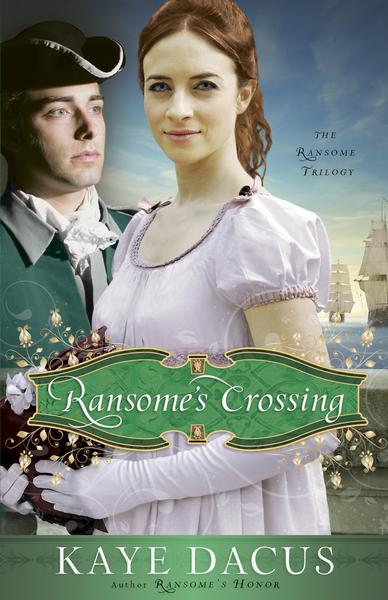
Ransome’s Crossing by Kaye Dacus

It is time for a FIRST Wild Card Tour book review! If you wish to join the FIRST blog alliance, just click the button. We are a group of reviewers who tour Christian books. A Wild Card post includes a brief bio of the author and a full chapter from each book toured. The reason it is called a FIRST Wild Card Tour is that you never know if the book will be fiction, non~fiction, for young, or for old…or for somewhere in between! Enjoy your free peek into the book!

You never know when I might play a wild card on you!


Today’s Wild Card author is:


and the book:


Ransome’s Crossing (The Ransome Trilogy)

Harvest House Publishers (June 1, 2010)

***Special thanks to Karri James of Harvest House Publishers for sending me a review copy.***

ABOUT THE AUTHOR:


Kaye Dacus, author of Ransome’s Honor has a Bachelor of Arts in English, with a minor in history, and a Master of Arts in Writing Popular Fiction. Her love of the Regency era started with Jane Austen. Her passion for literature and for history come together to shape her creative, well-researched, and engaging writing.

Visit the author’s website.

Product Details:

List Price: $13.99
Paperback: 336 pages
Publisher: Harvest House Publishers (June 1, 2010)
Language: English
ISBN-10: 0736927549
ISBN-13: 978-0736927543

AND NOW…THE FIRST CHAPTER:

Portsmouth, England
August 17, 1814


Ned Cochrane, first lieutenant, HMS Alexandra, stepped out of the jolly boat onto the stone dock and glanced around at the early morning bustle of the dockyard crew. Only nine days remained to fill the crew roster and fit out the ship with the supplies needed for the first leg of a transatlantic voyage. With yesterday lost in celebrating Captain—no, Commodore Ransome’s wedding—and since the commodore’s attention would be necessarily split between distractions on land and his duties to his ship, Ned would shoulder the burden of preparing the ship and crew.

“Sir, look out! Lieutenant Cochrane!”

Ned spun—and fell back just in time to save himself from being swept off the quay by a net full of barrels swinging at the end of a crane. His hat wasn’t so fortunate.

The cargo swayed menacingly overhead. Ned scrambled backward, out of harm’s way. Once clear, he leapt to his feet. “You, there! Watch what you’re about. Secure that crane,” he yelled at the negligent dock crew.

“Are you all right, sir?”

The voice—an odd timbre in the chorus of tenor, baritone, and bass tones usually heard in the dockyard—matched the one which had called the warning. He turned.

A young man, not really more than a boy in a worn, ill-fitting midshipman’s uniform, stood holding Ned’s dripping hat. Sure enough, the lad’s right sleeve was wet to the shoulder.

“Nothing injured but my pride.” Ned took his hat and studied the midshipman. The boy’s tall, round hat concealed most of his dark hair, but…Ned squinted against the bright glare of the sun off the water and surrounding gray stone. “Do I know you, lad?”

The boy touched the brim of the shabby hat. “Charles Lott, sir. We spoke last week. You said there might be a place for me aboard your ship.”

“Ah, yes.” Ned now recalled meeting the midshipman, who’d answered Ned’s questions when the boy had first approached him about a position aboard Alexandra last week, even the question Ned had missed the first time he’d stood for his lieutenancy examination. “I’m sorry, but we have filled the positions on Alexandra.”

Shocked disappointment filled the boy’s elfin face.

“However, I have recommended you to the captain of Audacious.” Ned struggled to keep the smile from his face.

“Audacious? Captain Yates, then?”

Ned sighed. He liked Commodore Ransome’s friend extraordinarily and had looked forward to the fun to be had on Jamaica station with two such commanders. “Alas, I am afraid to say Captain Yates has resigned his commission. Captain Parker is taking command of Audacious.” Ned glanced around the quay. “There is his first officer. Come, I shall introduce you.”

“Thank you, sir.” Midshipman Lott straightened the white collar and cuffs of his too-large coat.

Ned caught his counterpart’s attention and met him near the steps to the upper rampart. He made the introduction and stood back as the first lieutenant of Audacious, Montgomery Howe, put a series of questions to the lad. Lott answered each quickly and with near textbook precision.

“Well done, Mr. Lott. You are ordered to present yourself day after tomorrow to begin your official duties.”

The boy’s face paled. “Sir, may I have until next Thursday?”

“The day before we sail?” Howe crossed his arms and glared at Ned and then at Lott.

Ned ground his teeth at the boy’s impertinence, which was casting him—Ned—in a bad light. He’d recommended the lad, after all.

“Yes, sir. I am aware it is an inconvenience, but my mother is a widow, and I must see that she is settled—that our business affairs are settled—before I could leave on such a long journey.”

“And it will take a sennight?” Ned asked.

“We live in the north part of the country, sir. ’Tis a three days’ journey by post, sir.” Lott spoke to the cobblestones below his feet.

Aye, well should he be ashamed to make such a request…though many years ago, a newly made captain had let a newly made lieutenant have four days to see to his own widowed mother and sister.

Apparently, from the expression that flickered across Howe’s face, he had also received a similar mercy some time earlier in his career. “Very well, then. You are to present yourself to me on deck of Audacious no later than seven bells in the morning watch Thursday next. If you are late, your spot will be given to someone else. Understand?”

“Aye, sir!” Lott touched the brim of his hat again. “Thank you, sir.”

“Dismissed—oh, and Mr. Lott?”

The boy, a few paces away already, halted and turned, at attention again. “Aye, sir?”

“Make yourself more presentable by next week if you can. You can find plenty of secondhand uniforms available in the shops in much better condition than yours. And get a haircut. I do not allow midshipmen to tuck their hair under their collars.”

Lott’s hand flew to the back of his neck, eyes wide. “Aye, aye, sir.”

“Dismissed.”

Ned moved to stand beside Howe as the boy ran down the quay. “Sorry for the inconvenience, Monty, but I have a feeling that boy will do well by you.”

“I’ve never heard a lad recite the answers so perfectly. He’s slight. Says he’s fifteen? Can’t be more than thirteen or fourteen.”

“Some boys don’t mature as quickly as others. You should remember that quite well.” Ned bumped his shoulder against his former berth mate’s.

Howe shoved him back. “Just because you gained height and a deeper voice before I did doesn’t mean you matured faster, Ned. In fact, you could probably learn manners in decorum and respect from little Charlie Lott.”

Ned guffawed and bade his friend farewell. He wasn’t certain if he could learn anything from the young midshipman, but he would certainly look out for him and do whatever he could to promote the boy’s interest. He had the feeling Charles Lott would make a good officer some day.

Charlotte Ransome dived behind a large shrub and held her breath. Footsteps crunched on the gravel garden path, coming toward her closer and closer.

Had he seen her?

Keep walking. Please, Lord, let him keep walking.

When he reached her shrub, Charlotte squeezed her eyes shut, fearful of blinking. If the gardener had seen and recognized her, he would report her to the Yateses, who would in turn report her to her mother and brother—and all would be lost.

A gust of wind rustled the verdure around her. Her heart thundered against her ribs, and she feared she might be sick.

But the gardener did not stop. Long after his footsteps faded, Charlotte kept to her hiding place. Quiet descended until only the noise of the streets and alleys beyond the garden walls filtered in around the enclosure behind the enormous townhouse.

Peeking around the shrub, she found the path clear once again.

Sneaking into the garden through the servants’ entrance in the rear had proven risky but successful. She hadn’t been sure she’d avoid being spotted by any of the servants, busy with their early morning duties, but Providence appeared to be with her.

She cautiously made her way across the garden to the back of the house. She peeked through the window of Collin Yates’s study and, finding it empty, slipped inside, relieved no one had discovered that she’d left it unlocked when she sneaked out of the house near dawn. She stuck her head out into the hallway, and, hearing no movement, made her way upstairs as quietly as she could. She paused on the landing and looked around the corner, down the hallway on which all of the bedrooms opened. No stirrings, no sounds. Heart pounding wildly and trying to keep her feet from touching the floor, she made her way along the thick carpet to the bedroom at the end of the hall and slipped inside, pushing the door closed with a soft click.

Movement across the room caught her eye. Turning to face the intruder, she found herself looking at a bedraggled boy in an oversized coat and britches, a tall, round hat jammed on his head almost down to his eyes.

She laughed, and the bedraggled midshipman in the mirror did likewise. Yes, her disguise was convincing enough to startle even herself. With a sigh she unbuttoned the coat and pulled it off, dropping it to the floor. When Lieutenant Cochrane had looked at her with recognition in his gray eyes, she was certain her entire plan would crash like a ship against a rocky shore. She sent up a quick prayer of thanks that he hadn’t connected her appearance as Charles Lott with her true identity.

Sinking into the chair at the dressing table, she yanked off the hat and pulled her long thick hair out from under the high collar of the uniform coat. She’d tried pinning it flat to her head, but the cumbersome length of it—past her waist when unbound—created too much bulk for even the oversized hat to conceal.

The small porcelain clock on the mantel chimed once. Half-past eight. Panic once again rising, Charlotte peeled out of the uniform—picked up for mere pennies the first time she’d been able to sneak away from her mother’s and Mrs. Yates’s chaperonage a few days ago—stuffed it in the bottom of her trunk, threw her sleeping gown over her head, and jumped into the bed, still trying to find the sleeves with her hands as the bedroom door swung quietly open.

At the thump of the water pitcher on the commode, Charlotte sat up as if awakened by the sound.

Her maid curtsied. “Good morning, miss. I brought you fresh water for washing.”

“Thank you.” Charlotte grabbed her dressing gown from the end of the bed and shrugged into it, and then she stepped behind the screen in the corner. The scent of lilacs drifted up from the warm water as she poured it into the porcelain basin in the top of the exquisite dark-wood cabinet.

After running most of the way back from the dockyard, the wet cloth felt good against her skin, especially on her neck and back where her thick braid had been pressed against her by her uniform coat.

With the maid’s assistance, she soon stood before the mirror where Midshipman Charles Lott had been reflected less than an hour ago, now looking upon a fashionable young lady. Fear that she wouldn’t be able to pull off her plan swirled in her stomach, but she pushed it aside.

“The irons are ready, miss.”

Charlotte sat at the dressing table, sipped the coffee which had been delivered while she dressed, and reviewed her plans for the next eight days as the maid twisted and twirled and pinned her hair.

Anticipation, anxiety, and excitement danced within her veins. In just over a week, she would leave Portsmouth on a grand adventure. A grand adventure that would culminate in arriving in Jamaica, being reunited with Henry Winchester, and marrying him.

“Your new rank suits you, Commodore Ransome.”

William met Julia’s green eyes in the mirror’s reflection. Sitting in the middle of the bed in her white sleeping gown, her coppery hair cascading in riotous curls around her shoulders and back, she looked as young as when he’d made the gut-wrenching decision to walk away from her twelve years ago.

Now she was his wife. His knees quaked at the thought.

He returned to the examination of his new uniform coat, delivered from the tailor just this morning. “I am indebted to your father for arranging the promotion. There are many officers more deserving. All will say I received special favor because I am now his son-in-law.”

“As you should know by now,” Julia said, climbing off the bed and crossing to her dressing table, “my father does nothing unless he thinks it best for the Royal Navy.” Drawing her hairbrush through her fountain of hair, she ambled across the colorful carpet toward him. “He secured your promotion before he knew of our engagement, so that did not have any bearing on his decision.” She pulled the mass of her hair over her left shoulder and continued pulling the soft bristles of the brush through it. “And when have you ever worried about rumors going around about your being favored by my father?” A mischievous grin quirked the corners of her full lips. “Isn’t worrying about rumors and gossip what got us here in the first place?”

The fact she’d forgiven him, that she could now joke about the past, both thrilled and humbled him. He did not deserve her.

She set the brush down and came to stand behind him, looking around him at the reflection. She ran her hand along his sleeve to the braid-laden cuff. His arm tingled in reaction. He did not want to respond to her like this—every time she spoke, moved, breathed, he lost track of everything but her. He had to conquer it; otherwise, her presence aboard ship would be detrimental to his command.

A knock on the door roused both of them. The maid Lady Dalrymple had assigned to Julia entered on Julia’s entreaty.

“I will leave you.” William inclined his head and made for the door, and then he stopped as soon as he reached it. He turned and smiled at her. “Do not be long.”

“I will join you for breakfast shortly.”

He stood in the hallway a few moments after the door closed, separating him from Julia for the first time since their wedding yesterday morning. Pleasure and regret battled within him. Marrying Julia Witherington had, in less than twenty-four hours, brought him more joy than he could ever have dreamed or deserved. Yet when he thought of his duty, of his commitment to the Royal Navy, to king and country, he couldn’t help but fear he’d made his life more difficult by marrying at such a time.

The east wing of the manor house at Brampton Park, home to Lady Dalrymple, rang with emptiness. While William appreciated the privacy afforded them by the dowager viscountess’s invitation to stay in the unused section for their wedding night—with hints she would like them to stay even longer—the grandeur of it made his skin crawl, and he could not wait until he could deposit Julia at her father’s house and return to his ship.

After two wrong turns, he managed to find the small breakfast room, unused for nearly a century according to Lady Dalrymple, since the new wing and the much larger dining room had been completed.

The small room, paneled with dark wood, set him somewhat more at ease. By ignoring the narrow, tall windows, he could almost imagine himself aboard a ship in this room.

He paced, waiting for Julia, pondering how he could recover his good sense around her. When she entered the room a little while later—queenly in a purple dress, her hair the only crown she would ever need—he realized the only way he would be able to regain control of his mind would be to limit his contact with her.

Trying not to watch her serve eggs, sausage, and toast onto her plate, nor admire the curve of her neck above the lace set into the neck of her gown, William piled food onto his own plate, held Julia’s chair for her, and then took his place at the head of the small table.

“I must return to my ship today.”

Julia stirred sugar into her coffee. “Of course. I knew you would need to spend your days preparing Alexandra for the voyage.”

He cleared his throat of the bite of egg that wished to lodge there. “What I mean is that I must return to reside aboard my ship.”

Julia’s spoon clanked against her cup. Her face paled, and the light which had danced in her eyes all morning vanished.

William’s innards clenched. Perhaps he should have eased into the idea instead of blurting it out. He blamed it on her. He could not think clearly in her presence.

“Have…have you received word from your crew that there is trouble?” Her voice quavered.

“No. It is nothing like that.” Unable to stop himself, he reached across the corner of the table and took her hand in his. “My duty is to my ship, to my crew. I am needed there. Here, my attentions and loyalty are divided.”

For a brief moment, Julia’s chin quivered. But she pressed her lips together and drew in a deep breath. “I understand. And I have no desire to draw you away from your duties. I have already created too much inconvenience and upheaval in your life. I do not wish to generate more. However, I have promised Lady Dalrymple we would join her tonight for her dinner and card party as her honored guests. If we were to abdicate from her hospitality today, how would that reflect on her?”

Though well masked, the pain in Julia’s expression made William want to retract his words, to promise her he would stay here with her the remainder of the time they had in England. Any other woman would have been offended by his blundering, unreasonable demand. Julia apologized for inconveniencing him.

He raised her hand and kissed the back of it. “Aye. We will stay one more night.” Then, giving in to impulse, he leaned over, cupped that quivering chin, and claimed her lips in a searing kiss. “And I will not have you thinking yourself an inconvenience to me.”

His action resulted in the desired effect—the spark rekindled in her green eyes. She ran her finger along his jaw. “You lie too well, Commodore Ransome.”

“You start off our marriage ill, Mrs. Ransome, if you believe I would ever lie to you.” He squeezed her hand and then tucked in to his breakfast.

“Conceal the hard truth, then,” she said, cocking her head and sending the spiral curls at her temples dancing, “for the last few days have not been a convenience to you.”

“An upheaval, certainly.” He feigned a close interest in the piece of sausage speared on his fork. “However, any inconvenience I have suffered has been more than adequately recompensed not just by gaining a wife, but by finally receiving the complete approbation of my admiral.”

Julia’s gasp preceded a gale of laughter.

A surge of contentment washed away the morning’s anxieties. Perhaps being married would not interfere with his duty to the navy as severely as he’d feared.


The Country House Courtship by Linore Rose Burkard – FIRST

It is time for a FIRST Wild Card Tour book review! If you wish to join the FIRST blog alliance, just click the button. We are a group of reviewers who tour Christian books. A Wild Card post includes a brief bio of the author and a full chapter from each book toured. The reason it is called a FIRST Wild Card Tour is that you never know if the book will be fiction, non~fiction, for young, or for old…or for somewhere in between! Enjoy your free peek into the book!

You never know when I might play a wild card on you!


Today’s Wild Card author is:


and the book:


The Country House Courtship

Harvest House Publishers (January 1, 2010)

***Special thanks to Linore Rose Burkard and Dave Bartlett (Harvest House Publishers) for sending me a review copy.***


ABOUT THE AUTHOR:

Linore Rose Burkard is the creator of “Inspirational Romance for the Jane Austen Soul.” Her characters take you back in time to experience life and love during the era of Regency England (circa 1811 – 1820). Fans of classic romances such as Pride & Prejudice, Emma, and Sense & Sensibility, will enjoy Linore’s feisty heroines, heart-throb heroes and happy endings.

Enjoy the free resources on Linore’s website: http://www.LinoreBurkard.com/resources.html

Visit the author’s website.

Product Details:

List Price: $13.99

Paperback: 300 pages

Publisher: Harvest House Publishers (January 1, 2010)

Language: English

ISBN-10: 0736927999

ISBN-13: 978-0736927994

AND NOW…THE FIRST CHAPTER:


London, England, 1818


Mr. Peter O’Brien felt surely he had a devil plaguing him, and the devil’s name was Mr. Phillip Mornay. The paper in his hand should have made him happy. Indeed, it ought to have elicited nothing but joy after two years of holding a curacy that didn’t pay enough to feed a church-mouse. Yet, instead he was staring ahead after reading a letter of recommendation for him as though he’d seen a ghost.

His previous naval commander, Colonel Sotheby, had recommended Mr. O’Brien to a wealthy landowner whose vicarage had gone vacant. It was the sort of letter that a poor Curate should rejoice over. The man who obtained the vicarage in the parish of Glendover, the Colonel said, in addition to having a decent curate’s salary, would have claim to a large glebe, a generous and well built house, and, in short, would see himself by way of having enough to begin a family. (If he found a wife to marry, first, of course. O’Brien could just hear the Colonel’s good-natured laugh ring out at that remark.)

But still his own mouth was set in an unpromising hard line: The landowner’s name was Mr. Phillip Mornay, none other than the Paragon, himself. And Mornay, Mr. O’Brien knew, would never grant him the living. To do so would go against everything he knew to be true of him. After all, no man who had once overstepped his bounds with Mr. Mornay’s betrothed, as Mr. O’Brien unfortunately had, would now be presented to the vicarage on the man’s lands. Of all the rotten, devilish luck! To have such a letter of commendation was like gold in the fiercely competitive world of the church, where there were more poor curates looking for a rise in their situations than there were church parishes who could supply them.

Therefore, instead of the boon from heaven this letter ought to have been, Mr. O’Brien was struck with a gloomy assurance that Mornay would sooner accept a popinjay in cleric’s clothing than himself. Even worse, his mother agreed with his appraisal.

He had taken the letter into the morning room of their house on Blandford Street, joining his mother while she sat at her breakfast.

“You do not wish to renew old grievances,” she said. “Mr. Mornay is not, to my knowledge, a forgiving man; shall you be put to the expense and trouble of travelling all the way to Middlesex, only to be turned down in the end? What can you possibly gain in it?”

Mr. O’Brien nodded; he saw her point. But he said, “I may have to do just that. The Colonel will never recommend me for another parish if he learns that I failed to apply myself to this opportunity.”

“Write to him,” replied his mama. “See if you can politely decline this honour, with the understanding that any other offer should be most welcome and appreciated!”

He doubted that any letter , no matter how ‘politely’ written, would be able to manage his desire to avoid this meeting with Mornay, as well as secure the hope of a future recommendation. But he thought about it, put quill to paper and sent the Colonel a reply. He asked (in the humblest terms he could manage) if the man might commend him for a living to be presented by some other landowner, indeed, any other landowner, any other gentleman in England than Phillip Mornay.

He could not explain the full extent of his past doings with Mr. Mornay without making himself sound like an utter fool; how he had hoped to marry the present Mrs. Mornay himself, some years ago. How presumptuous his hopes seemed to him now! Miss Ariana Forsythe was magnificent as the wife of the Paragon. He’d seen them in town after the marriage, but without ever presenting himself before her. It appalled even him that he had once thought himself worthy or equal to that beautiful lady.

When the Colonel’s reply came, there was little surprise in it. He assured Mr. O’Brien that his apprehensions were ill-placed; that Mr. Mornay’s past reputation of being a harsh, irascible man was no longer to the purpose. Colonel Sotheby himself held Mornay in the greatest respect, and insisted that the Paragon had as good a heart as any Christian. In short, (and he made this terribly clear) Mr. O’Brien had best get himself off to Middlesex or he would put the Colonel in a deuced uncomfortable spot. He had already written to Aspindon House, which meant that Mr. O’Brien was expected. If he failed to appear for an interview, he could not expect that another recommendation of such merit and generosity would ever come his way again.

Mr. O’Brien realized it was inevitable: he would have to go to Middlesex and present himself to Mornay. He knew it was a vain cause, that nothing but humiliation could come of it, but he bowed to what he must consider the will of God. He knelt in prayer, begging to be excused from this doomed interview, but his heart and conscience told him he must to it. If he was to face humiliation, had he not brought it upon himself? Had he not earned Mornay’s disregard, with his former obsession with Miss Forsythe, who was now Mrs. Mornay?

He no longer had feelings for the lady, but it was sure to be blesséd awkward to face her! No less so than her husband. Nevertheless, when he rose from his knees, Peter O’Brien felt equal to doing what both duty and honour required. He only hoped that Mr. Mornay had not already written his own letter of objections to the Colonel; telling him why he would never present the living to Peter O’Brien. The Colonel was his best hope for a way out of St. Pancras . It was a gritty, desperate parish with poverty, crime, and hopelessness aplenty—not the sort of place he hoped to spend his life in, for he wanted a family. A wife.

Prepared to face the interview come what may, Mr. O’Brien determined not to allow Mornay to make quick work of him. He was no longer the youthful swain, besotted over a Miss Forsythe. A stint in the Army, if nothing else, had hardened him, brought him face to face with deep issues of life, and left him, or so he thought, a better man.

******

Aspindon House, Glendover, Middlesex

Ariana Mornay looked for the hundredth time at her younger sister Beatrice, sitting across from her in the elegantly cozy morning room of her country estate, Aspindon. Here in the daylight, Beatrice’s transformation from child to warm and attractive young woman was fully evident . When Mrs. Forsythe and Beatrice had arrived the prior evening, Ariana had seen the change in her sister, of course, but the daylight revealed it in a clarity that neither last night’s flambeaux (lit in honour of their arrival) or the interior candlelight and fire of the drawing room had been able to offer.

Beatrice’s previously brown hair was now a lovely luminous russet. Ringlets peeked out from a morning cap with ruffled lace, hanging over her brow and hovering about the sides of her face. The reddish brown of her locks emphasized hazel-green eyes, smallish mischievous lips and a healthy glow in her cheeks. Beatrice noticed her elder sister was studying her, and smiled.

“You still look at me as if you know me not,” she said, not hiding how much it pleased her to find herself an object of admiration.

“I cannot comprehend how greatly you are altered, in just one year!”

“I regret that we did not come for so long,” put in Mrs. Forsythe, the girls’ mother. She was still feasting her eyes upon Ariana and the children (though the nurse, Mrs. Perler, had taken four year old Nigel, the Mornay’s firstborn, from the room, after he had spilled a glass of milk all over himself minutes ago). “We wished to come sooner, as you know, but Lucy took ill, and I dared not carry the sickness here to you with your new little baby.” At this, she stopped and cooed to the infant, who was upon her lap at the moment.”No, no, no,” she said, in the exaggerated tone that people use when addressing babies, “we can’t have little Miranda getting sick, now can we?”

Ariana smiled. “It matters not, mama. You are here, now. I only wish Papa and Lucy could have joined you.” Lucy, the youngest Forsythe sister, and Papa, had been obliged to stay home until the spring planting had been seen to. Mr. Forsythe did not wish to be wholly bereft of his family, so Lucy, who was a great comfort to him, had been enjoined to remain in Chesterton for his sake.

“I could not bear to wait upon your father a day longer,” she answered with a little smile. “They will come by post chaise after papa has done his service through Easter. And then we will all be together–except for the Norledges. Perhaps when Papa comes, he may bring your older sister and her husband?”

“I would want Aunt Pellham too, in that case,” murmured the blond-haired young woman.

“Oh, my! With your Aunt and Uncle Pellham, and the Norledges, even this large house would be filled with guests, I daresay!” said her mother.

Beatrice was still happily ingesting the thought that Ariana had evidently noticed her womanhood. At seventeen, hers was not a striking sort of beauty—one did not stop in instant admiration upon spying Beatrice in a room, for instance, as had often been the case for Ariana; but the younger girl had no lack of wits, a lively eye and countenance, and, not to be understated, an easy friendliness. Among a group of reserved and proper English young ladies, Beatrice would be the beacon of refuge for the timid; she was welcoming where others were aloof; inquisitive and protective where others looked away.

Nor was she the sort of young woman to glide across a floor, dignified and elegant. Instead, Beatrice was ever having to keep her energy in check; When rising from a chair (her mama had made her practice doing so countless times) she could appear as elegant as the next young woman. She ate nicely, even daintily. But left unchecked, her natural enthusiasm might propel her through a room with alarming speed. Her shawls were ever hanging from her arms, never staying in place over her shoulder; and her mother forbade her from wearing hair jewellery, as it tended to lose its place upon her head. Bandeaux were her lot; besides bonnets, of course.

“It is fortunate that I am only seventeen,” she had said to her mama only last week, while the woman was draping a wide bandeau artfully around Beatrice’s head. “Or I believe you would exile every manner of female head attire from this house, saving turbans! Although my hair holds a curl twice as long as Lucy’s!”

Mrs. Forsythe had paused from her ministrations and met her daughter’s eyes in the looking glass before them. “I daresay you are suited for turbans; perhaps we should shop for some. I believe they are very popular just now.” Since the last thing in the world Beatrice wished to wear upon her head was a turban—no matter how many ladies in the pages of La Belle Assemblée wore them—she simply gave voice to an exasperated huff, evoking a knowing smile upon her mama’s face.

“I should adore a full house of guests,” she said, now. “Please do invite the Norledges’ Ariana! Only think of the diversions we could have; play-acting with enough people to fill all the roles, for a change! Or charades; or even a dance!”

Ariana looked at her sister fondly. “Which dances do you like best?”

“The waltz!” she quickly responded, with a smile to show that she knew it was mischievous to prefer the waltz—the single dance which entailed more contact with the opposite sex than any other ballroom fare. Mrs. Forsythe clucked her tongue, but Beatrice blithely ignored this, taking a peek at her brother-in-law to gauge his reaction, instead. The host of the gathering was reading his morning paper, however, and not listening to the small talk between his wife and her relations.

And relations were virtually all around him. In addition to Beatrice and Mrs. Forsythe, there was his aunt, Mrs. Royleforst, staying with them at the present, and her companion, skinny, nervous Miss Bluford. These two ladies had not appeared yet for breakfast, which was probably on account of Mrs. Royleforst. She found mornings difficult and either slept in, or took a tray in her room.

“What do you think, sir?” asked Mrs. Forsythe, of her host. “Shall my daughter invite the Norledges to join Mr. Forsythe and Lucy when they set out for your house? Or is your home already filled enough for your liking?”

Mr. Mornay looked over his paper enough to acknowledge that he had heard her question. “As it is your and my wife’s family, I think the two of you must decide upon it. As long as there are bed-chambers enough,” he added, looking at Ariana, “you may fill them with guests as you please.”

“Thank you, darling,” she said, making Beatrice stifle a titter. Her sister and her husband were still inordinately romantic, to her mind. Good thing no one else was present save her mother! She would have been embarrassed for them in company.

“Shall I take the baby, mama?” said Ariana, for Miranda was beginning to fuss.

“I suppose she wants to be fed,” agreed her mother. Ariana nodded to a maid who was seated against the wall, who went and received the child from her grandmother and brought her gingerly to her mama. Ariana’s eyes sparkled with happiness as she took her little girl. She murmured to the baby, by turns picking her up and kissing her face, and then just holding her in her arms and gazing at her in loving adoration. “I shan’t feed her yet,” she said. “She isn’t insisting upon it.”

Beatrice’s thoughts were still upon the diversions that would be possible with a large group staying at the house. “If they all come, can you and Mr. Mornay hold a ball, Ariana? Or, will you take me to London this year for the Season? Then I may go to as many balls as I like, and you will not have the expense of holding them!”

“If she takes you to London for the Season,” put in her mama, “she will have a great deal more expense than just that of a ball! Besides which, you are too young for such.”

Beatrice looked at her mama, her enthusiasm temporarily dampened. “But my sister sees I am older, now,” she said, looking at Ariana with a silent plea in her gaze. “And I am not too young for a Season, according to the magazines. Many girls my age do have their coming out, mama!”

“Many gels,” she returned, instantly, “have little sense, and their parents, no better; your papa and I did not allow either of your sisters to go about in society at your age. You have been already too pampered, if you ask me. London society is out of the question!”

Beatrice was now thoroughly dampened in her spirits, but she looked about and settled her eyes upon her brother-in-law. “I daresay Mr. Mornay has seen many a girl of my age–and younger—make their debut during the Season. And to no ill effect! Why, I am sure some of them have made the most brilliant matches! Many a man of good standing prefers a younger lady for his wife. You had ought to let me go while I am young enough to enjoy this advantage.”

Mr. Mornay was frowning behind his newspaper. He knew that his young relation wanted his support in the matter, but Mr. Mornay was assuredly not in the habit of coming to the aid of young women, particularly regarding a London Season. So he said nothing, though an ensuing silence in the room told him the ladies waited for his opinion.

Ariana, who knew better, offered, “Let us discuss it another time. There are months, yet, before the Season. And with Miranda so young, I cannot decide at this point, in any case.”

Beatrice, who had no idea she was treading on dangerous ground, said, “Only let Mr. Mornay tell us his thoughts! I know my mother will listen if you tell her, sir,” she said, directly to him.

He put his paper down reluctantly, and then looked at Beatrice. “I think Ariana was young to face society at nineteen. At your age, you need to be sheltered, not put forth among the wolves.”

Her face fell so entirely, that he almost chuckled at it. “Why are you so eager for a Season?”

She smiled a little. This was better; he was inviting her to explain so that her mother could see the good advantage in it. “I have long lived with the memory of my sister’s tales of her experiences in London;” she said. “She met you there! Her coming out is what brought her to marriage, to Aspindon, to a better life! I have had my fill of Chesterton, I assure you! The prospects for marrying well in that region are as dismal as ever, if not worse;” she said. (Ariana closed her eyes at this; she could hardly bear to hear her sister telling all the reasons Phillip would most despise.) “Why does it seem that all the eligible young men in the county are either in a regiment somewhere, or at sea, or in need of a fortune? I must go to London or Bath, where there are more men one can meet!”

She paused, looking at him earnestly. “I have no fortune, sir, as you are well aware. And with your connexions, I am certain to make very advantageous acquaintances! What could be more certain? I shall end up, no doubt, just as my sister has, with a man like you, sir!” Beatrice evidently thought she was giving him a great compliment. She waited, expecting a gracious answer.

“Oh, Beatrice!” moaned Mrs. Forsythe. “You foolish gel!”

Mr. Mornay stood up, after folding his paper to a neat size. He said, “It takes more than wearing a corset to say a young lady is grown up, would you not agree?” He directed his remark to the whole room, and then settled his eyes upon Beatrice for one second too long, before giving a small bow to the women in general, and turning to leave the room. Beatrice considered his words for a moment. He had rested his eyes on her long enough so that she knew exactly what he meant.

Mr. Frederick met his master at the door, holding out a salver with a letter for Mr. Mornay, who took it but then looked curiously at the butler.

“It arrived in that condition, sir! I daresay it was lost in the mail or some such thing.”

“Hmm, very good, Freddie.” He held up a battered and ink-soiled missive for his wife to see, while eyeing it dubiously.

She looked amused. “Who is it from?”

He unfolded the paper, as the sealing wax was almost entirely worn off already, and scanned the signature at the bottom. “Colonel Sotheby. I’ll read it in my office.” She nodded, and Mr. Mornay left the room.

Beatrice was still smarting from his earlier remark, and said, as soon as he’d gone, “How ‘grown up’ can I be, when I am forced to exist in a small country village, with no prospects, and genteel company only upon a Sunday?”

“You overstate your case! That is not true,” answered her mama, disapprovingly.

“And as for wearing a corset,” Beatrice continued, after taking a sip of tea, “I do not pretend that wearing one is what makes me of age for a Season. I have formed my principles upon sound reason. I have sat beneath the tutelage of my father and of Mr. Timmons, and of his curate, and I should say my principles are well-founded.”

“We are glad to hear it,” Ariana said, with great forbearance, “but really, you should not be setting your mind upon seeking a man like my husband; you should be intent upon finding the man that God has chosen for you.”

“And so I am!” she protested, her eyes wide and laughing. “But look at the advantage He gives me in having you for my sister! Am I to ignore that? When it could be the very means of bringing me and my future husband together?”

Ariana played absently with little Miranda’s blanket, tucking it in about her chin more snugly. She met her sister’s eyes. “London is not the only place a young woman may meet a husband. And if you want my husband’s approval of your plan, the last thing in the world you should tell him is that you want to meet a man like him! Or that you wish to marry above you in any way!”

“But is it above me? To marry well? When my sister is Mrs. Mornay of Aspindon House?”

“It is above you,” said her mother, “because you are Miss Forsythe of Chesterton.”

“I am a gentleman’s daughter,” she replied.

“With no dowry to speak of,” said her mama.

Beatrice’s cheeks began to burn. “With a rich and famous brother-in-law!” she said, petulantly.

“That does not signify!” said her mother.

“It does, to me!”

“It should not!” Mrs. Forsythe was quickly growing ashamed of her daughter, and she was relieved that Mr. Mornay had left the room, and was not hearing Beatrice right now. Ariana’s eyebrows were raised and she was doing her best to act as though she had no part in the dialogue.

“But it does, mama!”

“Beatrice! You have already said far too much on this topic, which proves to me your great ignorance of the world.” She held up her hand for silence as Beatrice was about to protest; “Not another word! I shan’t have it, not another word.” Mrs. Forsythe turned her attention to her elder daughter.

“I think I will visit the Nursery to see how Nigel is faring. Do you mind?”

“Of course not! He will enjoy showing you his toys.” She smiled, while her mother rose to leave the room. “I’ll be up myself, shortly, to feed the baby.”

“Very good.” She nodded to her daughter, and then her eye fell upon Beatrice. “I think it would be wise if you said nothing more regarding a Season. In fact, I forbid you to mention it to Mr. Mornay again! Do you understand me?”

“I do, mama.” Beatrice was not happy but she recognized the tone of voice her mother was using. She considered, moreover, that it would be a simple matter to keep from mentioning her hopes to the man, for he evidently would not encourage her in them. But as for herself, she would continue to think of the Season in London. She would continue to hope; and some other day, when Ariana was in a good disposition, she would prevail upon her to sponsor her in London.

Beatrice did not want to seem disrespectful, but she knew that Mr. Mornay was quite in error regarding her. He did not know, for instance, that she was determined to make a good match, and recognized it as her lot in life. Every inch she saw of Aspindon just confirmed her sense that a rich life awaited her. She was born for it. And now all that was necessary was to meet her future husband—the man who could make it all happen. She had long prayed for just such a meeting, and knew that it was bound to occur. All she had to do was be properly outfitted, and in the proper company, for it to do so.

All she had to do was change her sister and brother-in-law’s mind on the matter. How difficult could that be?

MY REVIEW:

To read my thoughts about The Country House Courtship from my February 19 post, click here.