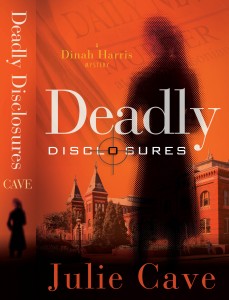
Deadly Disclosures by Julie Cave

It is time for a FIRST Wild Card Tour book review! If you wish to join the FIRST blog alliance, just click the button. We are a group of reviewers who tour Christian books. A Wild Card post includes a brief bio of the author and a full chapter from each book toured. The reason it is called a FIRST Wild Card Tour is that you never know if the book will be fiction, non~fiction, for young, or for old…or for somewhere in between! Enjoy your free peek into the book!

You never know when I might play a wild card on you!


Today’s Wild Card author is:


and the book:


Deadly Disclosures

New Leaf Publishing Group/Master Books (February 15, 2010)

***Special thanks to Stacey Drake of New Leaf Press for sending me a review copy.***

ABOUT THE AUTHOR:


Julie first heard a creation science speaker at her church when she was just 15, igniting her interest in creation science and sparking an enthusiasm for defending the Bible’s account of creation. She has obtained a degree in health science, and is currently completing a degree in law. Julie is married with one daughter and lives on the east coast of Australia.

Visit the author’s website.


Product Details:

List Price: $9.99
Paperback: 288 pages
Publisher: New Leaf Publishing Group/Master Books (February 15, 2010)
Language: English
ISBN-10: 0890515840
ISBN-13: 978-0890515846

AND NOW…THE FIRST CHAPTER:
Thomas Whitfield climbed out of the Lincoln Towncar and stood in the snappy, early morning fall air, breathing deeply. The temperature had fallen a few more degrees overnight, signaling that winter was truly on its way.


Thomas glanced up and down the wide street. There was nobody around at this early hour, and he took a moment to drink in the sights of his beloved city. The graceful willows, their branches arching over the street, were turning gold and red and, in the gentle yellow morning light, threw off highlights like burnished copper. This street was like many others in the center of DC — wide and tree-lined, with magnificent government buildings standing one after the other. That was another thing that Thomas found so delicious about this city — so much of it hinted at the enormous wealth and prosperity of the country, and yet only a few streets behind these world-famous landmarks, the seedier side of American poverty flourished. It was a city of contradictions, Thomas thought.

His gaze fell finally to the building right in front of him — the main complex of the Smithsonian Institution. Enormous stone pillars flanked the entryway into a marble lobby, and behind that were laid out the evidence of mankind’s brilliance. Everything about the institution was testament to the scientific and anthropological advances of man over the pages of history — the inventions, the discoveries, the deductions, the sheer radiance of a human being’s intelligence at its finest.

Thomas Whitfield had always been immensely proud of this place, and everything it showcased. He had boasted about it, defended it, nourished it, and protected it, the way a proud father would his prodigious child.

He was the secretary of the Smithsonian, after all, and he felt a strange kind of paternal relationship with the buildings and their contents.

He stood for a moment longer, a slender whippet of a man dressed immaculately, with highly polished shoes gleaming, thinning dark hair cut short, and a gray cashmere scarf to ward off the cold. Then he purposefully strode down the path and into the main building, scarf fluttering behind him.

To the malevolent eyes watching him through high-powered binoculars down the street in a non-descript Chevy, he presented a painfully easy target.

Thomas settled in his large office with the door shut, turned on the computer, and shut his eyes briefly as he contemplated what he would do next. The course of events he had planned for this day would change everything, and the impact would be felt right up to the president himself. Courage, Thomas, he told himself silently. What you are about to do is the right thing to do.

He began to type, slowly and decisively, feeling within himself a great sense of conviction and purpose. He was so lost in concentration that he was startled by the door suddenly swinging open.

“What are . . . ?” he exclaimed, almost jumping off his seat. Then he recognized his visitor and he glanced at his watch.

“What are you doing here?” Thomas asked. “It’s a little early for you, isn’t it?”

“I wanted to be sure I caught you,” his visitor replied, moving closer to the desk. “Without any interruptions.”

“I see. What can I do for you then?” Thomas asked, trying to hide his irritation. He hadn’t wanted to be interrupted during this most important task.

“What are you working on?” the unannounced guest asked, ignoring him and moving around the side of the desk and trying to look at Thomas’s computer screen.

“Oh, it’s nothing,” Thomas answered with a falsely airy tone. “It’s just a family project. Nothing to do with work. Is there something I can help you with?”

Thomas was suddenly aware that his visitor was standing close by him. He felt uncomfortable, and tried to roll his chair away to maintain some space.

“You see,” his visitor said in a quiet voice, “there are people out there who don’t agree with you. They think the project you are working on could be very dangerous. In fact, I believe they have already tried to warn you about continuing with this project.”

Thomas now felt distinctly uncomfortable and a little afraid. He decided to assert his authority. “Listen here,” he said, in a voice that betrayed his anxiety. “What I am working on is none of your business. The subject is certainly not up for discussion with somebody like you. I suggest you leave my office immediately.”

The visitor managed to fuse sorrow and menace into his words as he said, “I’m afraid I can’t do that. You will have to come with me.”

Thomas retorted, “I’m not going anywhere with you. In fact, I. . . .” He broke off abruptly as he saw the small handgun in the visitor’s hand, pointing directly at him. There was no sorrow or pity on his face — only menace.

“Do I need to force you to come with me?” the visitor wondered, his tone like flint.

Thomas leapt to his feet, his eyes darting about wildly. He needed to get out of here, to try to get away from this situation that had so rapidly gotten out of hand. A hand shot out and grabbed Thomas by the collar with surprising strength. Thomas was shocked as he strained to get away from the man, who was intently staring at the computer screen.

“You traitor!” Thomas spat. “I should’ve known you were nothing more than a trained monkey!”

The visitor chuckled heartily. “That’s ironic, Thomas.”

The visitor, much younger and stronger than Thomas, began to drag him out of the room. Thomas was determined not to go down without a fight, and drove his heel backward into the visitor’s shin. There was a yelp of pain, but the unrelenting grip did not lessen around Thomas’s arm. Instead, a thick arm curled around Thomas’s throat and squeezed, applying pressure to the carotid artery. It took only a few seconds for Thomas to fall limply into the arms of his abductor as the blood supply to his brain was cut off.

That was the last anyone saw of the secretary of the Smithsonian Institute.

• • • •

Dinah Harris woke with a scream dying in her throat, the sheets twisted hopelessly around her legs. Her nightgown was damp with panicked sweat, her heart galloping like a runaway horse. She stared, blinking, at the pale dawn light streaming through the window, while the shadowy vestiges of her nightmare slithered from her memory.

As she lay in bed, joining the waking world from sleep, the familiar blanket of depression settled over her, dark and heavy as the Atlantic winter. The dread she felt at facing another day was almost palpable in the small bedroom. Dinah glanced across at her alarm clock, where the flashing numbers showed 6 a.m.

She threw aside the sheets and stumbled into the tiny bathroom, where she purposefully avoided looking at herself in the mirror. She was only in her mid-thirties and had once been relatively attractive. Certainly not beautiful, but with what her first boyfriend had once told her — a pleasant face and athletic body. Now her eyes were always underscored by dark bags, her skin pale and paper-thin, and the weight fell off her in slow degrees without ceasing. She dressed in her trademark dark pants suit, pulled her black hair from her face in a severe ponytail, and washed her face.

She made strong coffee and sat in the kitchen as she drank the bitter liquid. The dining alcove was still stacked with moving cartons, filled with books and music that she couldn’t face opening. The gray light of morning lent no color to the apartment, which suited Dinah just fine. Her world didn’t contain color anymore.

Though traffic often seemed at a standstill in the mornings, Dinah always arrived early to the J. Edgar Hoover building. She turned directly to the teaching wing, avoiding the eye contact and morning greetings of many she knew in the building. She knew what they whispered about during after-work drinks and at the water cooler. Her fall from grace would go down as one of the most spectacular in FBI history.

So she kept up the ice-cool veneer until she arrived at her desk, checking her e-mails and teaching schedule for the week.

She didn’t look up as an imposing shadow fell across her desk.

“Special Agent Harris, how are you?” boomed the voice of her former colleague, David Ferguson. He was a big man, six-four and two hundred pounds, with a loud, booming voice and a penchant for pork rinds. He stood above her, his hand resting easily on the holstered gun at his hip; the twin of a gun Dinah no longer wore but kept underneath her pillow.

“Ferguson,” she replied. “Fine, how are you?”

“Feel like a coffee?” he asked.

“Don’t you have a killer to catch?” Dinah asked, dryly.

He waved his hand dismissively. “Oh, they can wait. Come on.”

He took her to a tiny Italian café a block away from the FBI headquarters. While they ordered, Dinah wondered at his ulterior motive for bringing her here. It certainly isn’t for my sparkling wit and charm, she thought. Rumor had it that the freshman criminology classes were afraid of her.

“So I’m just wondering if I could get your opinion on something,” Ferguson began, tentatively testing the water.

She scowled at him. “You know I don’t get involved in cases.”

He held up his hands in mock surrender. “Okay, calm down, Harris. I just want your opinion. I know you’ve given up your real talents to teach some snotty freshmen.”

His comment stung her, but she narrowed her eyes at him and pretended she hadn’t even noticed. “So get on with it already.”

“I don’t remember you always being this prickly,” complained Ferguson, draining his macchiato. “Anyway. What would you say if I told you the secretary of the Smithsonian Institution had gone missing?”

“Missing?” Dinah raised her eyebrows and slurped her latte. “In what context?”

“As in, turned up for work at six this morning and disappeared off the face of the earth shortly thereafter.”

“How do you know he turned up for work at six?” Dinah asked.

“Security cameras have him arriving in the lobby and heading for his office. After that, who knows?”

“So he’s an adult, maybe he took a trip to get away from work stress or his wife has been giving him grief or his kid is in trouble.” Dinah frowned. “Why are we even involved at this early stage?”

Ferguson paused. “It’s due mostly to his rather prestigious position. It wouldn’t do for the secretary of the Smithsonian to simply disappear. Congress is rather anxious.”

Dinah knew of political influence that ran high in this city but didn’t press the issue. “Is there evidence of homicide?”

“Not really, although I haven’t been to his office yet.” Ferguson made it sound like a confession, and he looked at her sheepishly.

Dinah stared at him. “What do you really want, Ferguson?”

He gathered up his courage. “I need you to work this case with me, Harris.”

Dinah opened her mouth to respond indignantly, but Ferguson held up his hand and continued with a rush. “You know I’m not good with sensitive cases. I. . . .”

“Or complex ones,” interjected Dinah, bad-temperedly.

“I’m operating on a hunch that this is a bad case, that it involves people in the White House.” Ferguson must have needed her very badly to allow her comment to go unheeded.

“Well, I’m sorry, but I have a heavy teaching workload,” she said. “So I’ll have to limit my involvement to opinions only.”

Ferguson didn’t say anything but looked even guiltier.

“What have you done?” Dinah demanded.

“I may have cleared your schedule so you could work with me.” Ferguson examined his fingernails with great concentration.

Dinah waited for a beat. “I see. You’ve spoken to my superiors?”

He nodded. “They’ve agreed to lend you to me for as long as the case takes.”

Dinah stood abruptly. “Thanks for the coffee.” She walked angrily from the café.

Ferguson stared at her as she walked off, then slapped down some crumpled notes and heaved his bulk out of the chair. “Where are you going?” Ferguson asked, struggling to keep up with her.

She wheeled around and glared directly at him. “Who do you think you are? Do you think I’m lesser than you so you can sneak around behind my back?”

“Dinah, we really need you back in the field. You were — are — brilliant.” Ferguson spoke softly, hoping to calm her down.

“My field days are behind me, with very good reason,” snapped Dinah. I can’t see a dead body anymore. I can’t feel desire to catch the person who did it. I just want to lie down beside the body and feel the same endless peace of sleep.

“Please, I’m begging you. I need you back,” Ferguson said. Then it hit her. Dinah realized that this situation was very serious. Ferguson was the last person on the planet to beg anybody.

“I don’t really have a choice, do I?” she said dully. She knew that this case could break her.

Ferguson didn’t reply, and his answer was in his silence.

• • • •

The Smithsonian Institution was bustling with tourists and school kids as if nothing had gone wrong. Dinah and David strode into the main lobby, trying unsuccessfully to look casual. When they flashed their badges discreetly, they were allowed into the inner sanctum, where Thomas Whitfield’s personal assistant was fielding phone calls.

The secretary was young and pretty, with thick, dark hair waving gracefully to her shoulders, startlingly blue eyes, and a creamy olive complexion. Her only downfall was the thick eye makeup, applied to make her eyes stand out but which had the effect of making her look like a scared raccoon. “I’m afraid Mr. Whitfield simply cannot be interrupted at present,” she snapped into the phone. “I’ll have him call you back if you’d leave a message.”

She glanced up and saw the two agents standing at her desk. She gave them a wave to acknowledge their presence, repeated the details of the caller, scribbled furiously, and then hung up.

“Good morning,” she said, jumping to her feet. “If you caught the end of that conversation, you’ll know that Mr. Whitfield is in an extremely important meeting and. . . .”

“Save it,” interrupted Dinah, showing the secretary her badge. The young woman blushed. “We’re here to investigate the disappearance of Mr. Whitfield. What is your name?”

The secretary sat down hard, looking relieved. “I’m Lara Southall. I’m so worried about Mr. Whitfield.”

Ferguson flashed his partner a frown and took charge. “I’m Special Agent David Ferguson and this is Special Agent Dinah Harris. You’ll have to excuse her; she’s been out of the field for some time and has forgotten how to relate to people.”

Dinah opened her mouth to reply with outrage, but Ferguson continued, “Can you tell us about this morning?”

Lara Southall regarded Dinah with a mixture of amusement and fear, which Dinah filed away for future reference. “I got to work at eight o’clock as usual,” she replied. “Mr. Whitfield always arrives before me. I usually turn on my computer, get settled, and then get us both a coffee. When I opened his office door to give him the coffee, the room was empty.” As the girl spoke, she tapped perfectly manicured fingernails together absently. Dinah hated manicured fingernails: they reminded her of her distinctly unattractive, chewed-to-the-quick fingertips.

“Mr. Whitfield was due to give a presentation at eleven o’clock,” Lara continued. “So I didn’t really start worrying until about ten-thirty. He hates to be late, and he had to come back to get his presentation and make it uptown in less than half an hour. At eleven, I started to make some calls.”

“Has he ever been absent from the office before?” Ferguson asked.

“Sure, he often has meetings or goes out into the museum to talk to visitors. The thing is, I always know what he’s doing. That’s part of my job. He never goes anywhere during the day without letting me know.”

“So you started making calls at eleven. Who did you call?” Dinah asked impatiently.

Lara ticked off her fingers as she remembered. “I called his cell phone, and I called the other museums. I thought maybe he’d just forgotten to tell me he had a meeting. Nobody had seen him and his cell just rang out. So I called his home. His wife told me he’d left for work at about five-thirty and she hadn’t seen him since. Then I called some of the senior executives. I thought they might’ve had an emergency. But nobody had seen him.”

“Did the people you called — his wife, the executives — seem concerned about his whereabouts?” Ferguson asked.

“Yes, they did. It’s so unusual for Mr. Whitfield to act this way that everyone I spoke to was concerned. I think his wife is actually here somewhere at the moment.”

“So then you called the police?” Dinah said.

“No, one of the directors came over to look at the security tapes. She specifically told me not to call anyone until she’d viewed the footage. I thought that Mr. Whitfield might’ve had an accident on the way to work. Mrs. Whitfield was calling the hospitals when Ms. Biscelli — the director — came back from security.”

“What did the tapes show?” Dinah asked.

“They showed him arriving at six-thirty or so. That’s all I know.”

“Did any of the tapes show him leaving?”

“Not as far as I know.”

“Right. So what then?”

“I called the police.”

Ferguson nodded. “What did they tell you?”

“Basically they won’t do anything until he’s been missing 24 hours.” Lara stopped clicking her nails together and started twisting her hair with one finger. “So I told Ms. Biscelli, and she wasn’t happy with that. I think she must’ve pulled some strings, because here you are.”

Dinah and Ferguson both raised their eyebrows at her in confusion.

“The FBI,” explained Lara. “You guys wouldn’t normally get involved, would you?” She may have been a very pretty secretary, but Lara Southall was an intelligent girl. She’d asked the very question Dinah had been mulling over all morning.

“We’re going to look in his office,” Ferguson said, ignoring the question. He handed her his card. “Please call me if you think of anything else that might be helpful.”

She nodded and picked up the ringing phone. “No,” she said, sounding very weary. “Mr. Whitfield is in a meeting at the moment and can’t be disturbed.”

• • • •

Ferguson opened the door to the office while Dinah waited to get the log-on details for Thomas Whitfield’s computer. Dinah stood in the doorway, looking into the impressive room, and felt the thrill of the chase wash over her like a wave. It had been a long time since she had felt anything.

The office was furnished with heavy cedar furniture that consisted of a large desk, a leather-bound chair, a couch, and two armchairs grouped around a glass-topped coffee table and one entire wall of built-in bookcases. The floor was covered with thick burgundy carpet, and the drapes at the picture window were also burgundy. The walls contained portraits of several great scientists and inventors — Dinah recognized Charles Darwin, Thomas Edison, and the Wright Brothers — as well as photos of the secretary with the president, the queen of England, and other dignitaries. The room itself was clean and uncluttered, likely symbolic of the man himself, Dinah thought.

Ferguson was moving around the room, muttering to himself, as was his habit. Dinah had forgotten how intensely annoying she found this habit. She preferred silence so that she could concentrate.

Having received the log-on details from Lara, Dinah strode to the desk and pulled on her latex gloves. The top of the desk was shiny and would be a great medium to obtain fingerprints. She was careful not to allow herself to touch the desktop while she turned on the laptop.

“By the way, Harris,” Ferguson said from the wall of bookcases, “I forgot to mention that if something has happened to Mr. Whitfield, the media scrutiny is likely to be intense.”

Dinah scowled at the screen of the laptop. She hated the media, and it was a long-term grudge she held from the last case she’d been involved in. “You can handle it,” she said. “I want nothing to do with those vultures.”

Ferguson glanced over at her. “Of course I’ll handle it. But I can’t guarantee that they’ll leave you alone.”

Dinah tapped her foot against the leg of the desk impatiently as the laptop struggled to come to life. “Sticks and stones, Ferguson,” she said tightly. “Words can never hurt me.”

She could see that Ferguson didn’t buy the lie, but he’d decided to let it go. He at least knew not to push too far.

“This whole office is giving me a weird vibe,” he said after a moment. “It’s too . . . organized.”

Dinah logged onto the laptop. “I’m listening.”

“Look at the desk,” Ferguson mused. “No files or paperwork. Not even a pen or a Post-It note. No diary.”

“Maybe he’s just really neat,” Dinah said, opening Outlook on the laptop.

Ferguson went back to his muttering as he continued drifting around the room. Dinah frowned as she clicked through the folders in Outlook. Then she opened the other programs on the computer and looked through the folders there.

“That’s odd,” she commented at last. Ferguson looked up and came over to her.

She clicked through the inbox, sent items, and calendar of the e-mail program. There were no entries in any of them. “They’re completely clean,” she said. “The calendar is the strangest. You’d think the secretary of the Smithsonian Institution would have at least a couple of meetings a week.”

“Maybe he uses a paper diary,” suggested Ferguson.

“Certainly a possibility,” agreed Dinah. “But couple the empty calendar with the fact that he’s neither received nor sent an e-mail from this computer and something isn’t right.”

Ferguson opened the desk drawers and started looking through them.

“Also,” added Dinah, “there is not one single saved document in any other program — no letters, articles, presentations, anything. The entire computer is as if it’s never been used.”

Ferguson sat back on his heels. “You think someone has wiped his computer?”

“Well, the sixty-four-thousand-dollar question is: did Thomas Whitfield wipe his own computer before disappearing or did someone else wipe his computer before abducting him?” Dinah began to shut down the programs. “After all, there is no evidence to suggest that he has been abducted. There’s no sign of a struggle in here or blood stains, is there?”

Ferguson shook his head. “No, there isn’t. But there is something off about this office. Nobody, least of all a man in his position, can get through a working day without sending an e-mail or doing paperwork of some kind.” He gestured at the desk drawers. “There’s absolutely nothing in them.”

“I agree,” Dinah said. She closed the laptop and picked it up. “I’m going to have the lab look at the hard drive. What else?”

“I’ll call in crime scene to lift some fingerprints and check for blood.” Ferguson paused, thinking. “I’d like to talk to Ms. Biscelli, and I’d like to talk to his wife.”

Dinah nodded. “If Mr. Whitfield has been abducted, what do you suppose is the motive?”

Ferguson considered. “I don’t know. Money? Fame? Half the time I think these loonies go around killing people just so they can get their name in the news.”

Dinah stared at him. “Do you think Thomas Whitfield is dead?”

He shrugged. “Right now, Harris, I know nine-tenths of absolutely nothing. Let’s talk to Ms. Biscelli. Maybe she’ll know what happened and we can solve this case before dinner time and I’ll get a decent night’s sleep.”

Flippancy, Dinah remembered, was just Ferguson’s way of dealing with the intensity of this job and the horror they’d witnessed over the years.

MY REVIEW:

Deadly Disclosures is a disturbingly realistic suspense set in the U. S. capitol city. When FBI agent Dinah Harris is called in to assist on a missing persons case despite her past, the plot takes off and never slows down until the end of the book. As she and her partner investigate the case, they are met with obstacles at every turn and the body count rises. Will they be able to find the killer or killers before they kill again? Will Dinah be able to stay sober long enough to help solve the case?

Character development in Deadly Disclosures is superb. Dinah’s pain is evident but its cause is slowly disclosed by bits and pieces as the novel progresses. The conflict between the evolutionists and creationists at the heart of the story was handled in a manner that was interesting and educational. The narrative was filled with enough twists and surprises to keep the reader guessing until the end.

Deadly Disclosures is very definitely on my list of recommended books. I suggest you pick up a copy for yourself. Just don’t expect to sleep well for awhile after reading it.



Sworn to Protect by DiAnn Mills

It is time for a FIRST Wild Card Tour book review! If you wish to join the FIRST blog alliance, just click the button. We are a group of reviewers who tour Christian books. A Wild Card post includes a brief bio of the author and a full chapter from each book toured. The reason it is called a FIRST Wild Card Tour is that you never know if the book will be fiction, non~fiction, for young, or for old…or for somewhere in between! Enjoy your free peek into the book!

You never know when I might play a wild card on you!


Today’s Wild Card author is:


and the book:


Sworn to Protect (Book #2 in Call of Duty series)

Tyndale House Publishers, Inc. (March 4, 2010)

***Special thanks to Mavis Sanders, Corporate Publicist, Tyndale House Publishers for sending me a review copy.***

ABOUT THE AUTHOR:

Award-winning author DiAnn Mills is a fiction writer who combines an adventuresome spirit with unforgettable characters to create action-packed novels. DiAnn’s first book was published in 1998, and she currently has more than 40 books in print, with combined sales of over one million copies. In 2009, Tyndale House introduced Breach of Trust, Book #1 in her Call of Duty series about women with dangerous occupations. Six of her anthologies have appeared on the CBA best-seller list. Eight of her books have been nominated for the American Christian Fiction Writers’ book-of-the-year contest, and she is the recipient of the Inspirational Reader’s Choice award for 2005 and 2007. Lightning and Lace was a 2008 Christy Award finalist.

DiAnn is a founding board member for American Christian Fiction Writers and a member of Inspirational Writers Alive; Romance Writers of America’s Faith, Hope, and Love chapter; and the Advanced Writers and Speakers Association. She speaks to various groups and teaches writing workshops around the country. DiAnn is also a mentor for Jerry B. Jenkins’s Christian Writers Guild. DiAnn and her husband live in Houston, Texas.

Visit the author’s website.

Product Details:

List Price: $12.99
Paperback: 400 pages
Publisher: Tyndale House Publishers, Inc. (March 4, 2010)
Language: English
ISBN-10: 1414320515
ISBN-13: 978-1414320519

AND NOW…THE FIRST CHAPTER:

We are truly a nation of immigrants.
But we are also a nation of laws
. . . Brent Ashabranner


McAllen, Texas

The Rio Grande was not just murky. It was toxic. Danika Morales respected the river’s temperament—lazy and rushing, crystal and muddy, breathtaking and devastating. To many illegal immigrants, its flowing water signified hope and an opportunity for a better tomorrow, while others viewed the river crossing as a means of smuggling drugs or spreading terrorism. But for Danika, the depths meant death, and it didn’t discriminate among its victims. That was why she chose a Border Patrol badge and carried a gun.

Shortly after the 8 a.m. muster, Danika snatched up the keys to the Tahoe assigned to her for the next ten hours and checked out an M4. A hum of voices, most with Hispanic accents and clipped with occasional laughter, swirled around the station. A labyrinth of sights and sounds had succeeded in disorienting her. A daze.

She took a sip of the steaming coffee in hopes no one saw how the day’s date affected her. Her hands shook. The twelfth of July. The second anniversary of Toby’s murder. She thought she could handle it better than this, but the raw ache still seared her heart.

“Tough day for me too,” Jacob whispered beside her. “We can get through this together.” The familiar tone of voice, as in many times before, nearly paralyzed her. Jacob sounded so much like his brother.

She stood shoulder to shoulder with her brother-in-law and glanced at his muscular frame and the silver streaks in his closely cropped hair, everything about him oddly different from Toby. Gone were the gentleness, the patience, and the outstretched arms of love.

“Thanks. But I’m all right.”

He frowned, a typical expression. “Well, I’m not, and you shouldn’t be either.”

She was in no mood to rile him today. “I miss Toby every minute of the day, but we have to move on. He would have wanted it that way.”

“Not till his murderer is found.” Jacob’s jaw tightened. “I’m disappointed in you.”

Danika took another sip of the hot coffee, burning her tongue. Caustic words threatened to surface and add one more brick to the wall dividing them. “I want the killer found too. I’m committed to it. I think about him every day and mourn for our daughter, who will never know her daddy. But I choose not to spend my time harboring hate and vengeance.”

“You must not have really loved my brother.”

The words cut deep, as Jacob must have known they would. No woman could have loved Toby like she did. “I refuse to be browbeaten by you anymore. Your hate is going to explode in your own backyard one day.” She stopped herself before she lit a match to his temper. Actually, she’d rather have been dropped in the bush for the next ten hours with a shotgun and a can of OFF! than argue with him. But the time had come to distance herself from Jacob.

“Hey, Danika,” an agent called, “do these belong to you?”

She turned to see wiry Felipe Chavez carrying a vase with a huge bouquet of roses. They remembered. She swallowed a chunk of life. “Oh, guys, you didn’t have to do this.”

Felipe made his way toward her. The other agents hushed; then one of them started to clap. She smiled through the tears as he handed her the clear glass vase. The sweet fragrance no longer reminded her of death, but of life and her resolve to live each day in a way that commemorated Toby’s devotion to her and their little daughter. Perhaps this was what the two-year marker meant.

She took the roses and studied the small crowd of agents. Good men, all of them—even Jacob.

“We cared about what happened to Toby too,” Felipe said with a grim smile.

Danika brushed her finger around one of the delicate petals and formed her words. Memories had stalked her like a demon since last night. “Don’t know what to say except thank you. Toby was a soldier for his own cause, and he spent his life doing what he believed in. Just like all of us.”

One agent shook his head, frowned, and left the room. Far too many explanations for his disapproval raced through her mind. But Danika needed to put the ugliness behind her.

She set the flowers on the long table in front of her. “Today is the second anniversary of Toby’s death. All of you have looked after me and my daughter, especially during holidays and special occasions. His death is why I’m more dedicated than ever to help protect the border.” She paused, sensing her emotions rushing into chaos. “I appreciate your remembering him and the sacrifice he made, especially since his beliefs were controversial.” Enough said.

She took a deep, cleansing breath. “I brought doughnuts.”

And they were buttermilk, Toby’s favorite.

She glanced at Jacob, hoping to end the tension between them. How Barbara could stay married to him was beyond her comprehension. He treated her and their four kids like yesterday’s trash.

Danika wound through the crowd of agents, greeting those who offered condolences and others who offered a good-morning.

The field operations supervisor, Agent Oden Herrera, stood in front of the flags—the U.S., Homeland Security, and the Border Patrol. Pushing the emotions of regret and grief about Toby aside, Danika captured the supervisor’s attention. “During the muster you said intel had picked up a cocaine drop last night?”

Herrera walked to a wall map and pointed. “Like I said earlier: arrested seven men and two women right along here, your area. A kid had a small bag of cocaine on him. Most likely a deterrent. The drug smuggler either hid it before being apprehended, or he’s still waiting for someone to pick him up. Dogs have been out there most of the night, but Barnett and Fire-Eater are headed that way in a few minutes.”

Danika finished her coffee and made her way into the stifling heat and stopped by Jon Barnett’s truck. As Fire-Eater’s handler, he had everyone’s admiration, and the Belgian sheepdog had a reputation for being the best of the K-9s. Barnett snapped on the dog’s leash and waved.

“I hear we’re working the same area today.” Danika refrained from patting Fire-Eater. Some days he wasn’t people friendly. After seeing the dog in action a few times when he’d found drug runners, she sometimes felt sorry for those he brought down.

Barnett grinned and wiped the sweat already beading on his face. “He’s a good dog, Morales. Just needs a little help with his people skills.” He laughed, his freckles deepening in the intense sun. “And he’s great with the wife and kids. Like another member of the family.” He pulled out his keys. “Do you want to talk? We have a few minutes.”

All she really wanted was for the day to be over. Talking increased the chances of liquid emotion—which was more lethal than the river flowing between the U.S. and Mexico. “No thanks. I’m fine.”

“Do you need to talk?”

“It’s been two years.” Therapeutic or not, she would not open up, even to a sweet guy like Barnett. She’d spent hours building a reputation as a tough agent, and she wasn’t about to take a nosedive now.

“Right, and the sooner you admit that today has crept up on you worse than a case of food poisoning, the better you’ll feel.”

She had to agree. “Have you turned psychologist?”

“Fire-Eater and five kids taught me all I know.”

“I had a dog when I was a kid,” she said, looking for any subject except Toby. “Gentle, sensed my moods, smart. My best friend. Sure missed him when he was gone.” Danika blinked back a tear, despising her reaction. She stared at Fire-Eater rather than look into Barnett’s face.

“I bet he slept at the foot of your bed.”

Fire-Eater climbed into the backseat of the double-cab truck.

“Sometimes in it. We even shared meals. I didn’t like meat, and he’d eat it for me.”

“Who’s your best friend now?”

She swallowed the ever-increasing lump in her throat. “Toby’s gone, and I have a tough time in church.”

“Confession is a beginning. Any family?”

“Toby’s family has been good to me.” Never mind Jacob. “My folks never approved of my marriage.” She sucked in a breath. It hissed like the poisonous snakes she feared. “Well-meaning friends do this to me.”

“Do you feel any better?”

Sneak. “Yeah, thanks, doc. You—”

Fire-Eater barked. No doubt anxious to get moving. The animal and Jacob had similar personalities, but today she’d rather be with the dog.

* * *

Danika turned off Old Military Road and bounced along a narrow dirt and gravel path, bordered by tall, thick grass and brush and laden with prickly pears on the Rio Grande side and more thick brush on the other. Jon had radioed ahead and reported signs from last night, but nothing new. Every agent was on alert. Trouble brewed along the entire two-thousand-mile border between Mexico and the United States. Drug cartels were slaughtering innocent people in the streets, and those on the U.S. side feared it was only a matter of time before the fighting spilled over the line. Not on her watch.

She drove slowly past the few houses perched on the right side of the road, most of which had been stash houses at one time or another, havens for illegal aliens and drug smugglers. She stopped the truck beside a well-worn trail to look for recent signs in the dirt. After a generous spray of mosquito repellent on her uniform and hands, she stepped into the stifling ninety-degree heat and bent to study the hours-old footprints indicating where the illegals had gained access into Texas before being apprehended. Most of them only wanted an opportunity to better themselves, but others had a darker agenda. At least she hoped the footprints had been accounted for.

A breeze from the north fanned her face and offered a brief reprieve from the unrelenting sun. The tall grass with its thick growth waved as though mocking her commitment to the Border Patrol.

Fifteen minutes later, Barnett radioed a call for assistance.

“Spotted a man wearing a backpack near the 112 sensor. He headed into the carrizo.”

Danika ran back to the truck and raced her vehicle toward Barnett’s location. She wanted to tell him to wait for backup and not search through the thick grass alone, but she knew Barnett and Fire-Eater were a team and stayed on the traffic. The smuggler probably hid on a rattler’s nest.

She was the first to respond to Barnett’s request. Pulling in behind his truck, she unclipped her HK from her belt while radioing her arrival. She grabbed her cell phone and dialed his number.

“Barnett, I’m here,” she said. “Tell me you’re not in the middle of the carrizo.”

He chuckled. “Fire-Eater’s after him. I’m skirting it. Neither one of us is coming out until we have our man.”

She pocketed her cell phone and followed the agent’s footprints on the dusty road until they disappeared into the thicket. Hot as it was, the Kevlar vest felt good, even if it was worthless against a stab wound or a shotgun blast.

Fire-Eater barked, snapping Danika’s attention toward the riverbank. The dog growled from somewhere in the depths of the overgrowth.

Gunfire cracked in the still morning air. Alert to the danger, she pulled her weapon.

“This is the United States Border Patrol! Come out with your hands up!” Barnett’s voice roared.

Another shot fired. Fire-Eater yelped.

Blood pumping, Danika yanked out her radio. “Shots fired. Shots fired. Agent or K-9 may be down.”

Two more shots pierced the air.

When Barnett didn’t respond, she clicked the radio in place on her belt. “Barnett,” she yelled, “tell me you’re all right.”

Nothing.

A dark-haired man emerged from the right side of the road several yards away, wearing a backpack that no doubt contained drugs. His attention scattered in different directions.

“Alto, o disparo,” she said.

The man turned and fired at her before racing across the road. The bullet angled to her left. Danika returned the fire and sank a bullet into his thigh. He fell, and she raced toward him.

“Drop the gun, or I’ll be forced to shoot again.”

He kept his fingers wrapped around it. She wrestled with the rage that always seemed to lie below the surface of her control. If she killed him, she could claim self-defense. But her job title meant self-control.

“I said drop the gun.” She fired above him and kept running in his direction.

He lifted his hand and aimed. Instinctively she pumped a bullet into his hand. His wound caused a burst of blood to splatter the ground and the quiet air to echo with obscenities. Still he refused to release the hold on his gun.

“Do you want your whole hand blown off?” She stood over him and clamped her booted foot over his injured hand.

He screamed, and she pointed her firearm at his face. Danika trembled. She wasn’t a murderer, but anger did struggle to rule her emotions.

“You’ll pay for this,” the man said. “I know who you are, and there’s a contract out for you.”

“You aren’t the first or the last to threaten me.” She picked up the man’s gun, an older model Beretta. With his leg and hand bleeding, he wasn’t going anywhere. She slipped the handcuffs from her belt and clamped them on his wrists. Rolling him over, she brushed his bleeding leg against the hard ground, and he moaned. Where was backup? Please, let Barnett be okay. Five kids. A respected agent.

“The drug cartels will destroy the Border Patrol.”

“Big talk for a man in handcuffs.”

“You wait and see who wins.” He spit on her boot. “You’ll never find out who killed your husband.”

She smothered the gasp that nearly stole her breath. How did the man know her? know about Toby’s death? He clearly had inside information—information that couldn’t have been obtained easily. Unless Toby’s murder was related to something bigger than she had imagined.

Focus. Now was not the time to weigh the shooter’s words. Later she’d look into it.

Her gaze searched the area. An outstretched arm poked through the overgrowth where the downed man had attempted to cross the road. She hurried, gun raised, eyes taking in every inch of the brush. As she grew closer, she saw the rest of Barnett’s body sprawled on the trodden grass. Blood soaked the ground, creating a small puddle of red against the vibrant green. Danika bent to his side.

Barnett moaned. “He shot Fire-Eater,” he whispered. “Get him.”

“I have him cuffed. Hold on. Help’s coming.” She pulled out the radio. “Need EMS. Agent down.”

She hadn’t been there for Toby, but she could be there for Barnett.

MY REVIEW:

The second installment of DiAnn Mills’ Call of Duty Series, Sworn to Protect is a fast paced page turner that kept me up past my bedtime. There just didn’t seem to be a good place to stop reading. This book has everything I look for in a suspense novel – great characters, intense situations, believable plot, enough twists and surprises to keep me guessing, and just maybe a little romance for good measure.

Sworn to Protect gives the reader an up close and personal look at the illegal immigrant problem along the Texas and Mexico border and the agents who patrol it. Ms. Mills examines every aspect of the problem from the violent Mexican drug cartels to the immigrants who just want a better way of life for their families to the people who get rich by taking advantage of the illegals. The picture she paints is not a pretty one but through her characters she asks some pertinent questions about immigration.

I am afraid I will give away too much if I attempt to tell more about Sworn to Protect. Just let me say that it is one of the best suspense novels I have read in quite awhile and that I look forward to the next episode of this series.

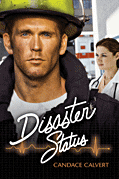
Disaster Status by Candace Calvert

It is time for a FIRST Wild Card Tour book review! If you wish to join the FIRST blog alliance, just click the button. We are a group of reviewers who tour Christian books. A Wild Card post includes a brief bio of the author and a full chapter from each book toured. The reason it is called a FIRST Wild Card Tour is that you never know if the book will be fiction, non~fiction, for young, or for old…or for somewhere in between! Enjoy your free peek into the book!

You never know when I might play a wild card on you!


Today’s Wild Card author is:


and the book:


Disaster Status (Book #2 in Mercy Hospital series)

Tyndale House Publishers, Inc. (March 4, 2010)

***Special thanks to Mavis Sanders of Tyndale House Publishers, Inc. for sending me a review copy.***

ABOUT THE AUTHOR:

Candace Calvert is an ER nurse who landed on the “other side of the stethoscope” after the equestrian accident that broke her neck and convinced her that love, laughter—and faith—are the very best medicines of all. The inspirational account of her accident and recovery appears in Chicken Soup for the Nurse’s Soul and launched her writing career. The author of a madcap cruise mystery series in the secular market, Candace now eagerly follows her heart to write Christian fiction for Tyndale House. Her new medical drama series, launched with Critical Care in 2009, offers readers a chance to “scrub in” on the exciting world of emergency medicine, along with charismatic characters, pulse-pounding action, tender romance, humor, suspense—and a soul-soothing prescription for hope. Born in northern California and the mother of two, Candace now lives in the Hill Country of Texas.

Visit the author’s website.

Product Details:

List Price: $12.99
Paperback: 352 pages
Publisher: Tyndale House Publishers, Inc. (March 4, 2010)
Language: English
ISBN-10: 1414325444
ISBN-13: 978-1414325446

AND NOW…THE FIRST CHAPTER:

Fire captain Scott McKenna bolted through the doors of Pacific Mercy ER, his boots thudding and heart pounding as the unconscious child began to stiffen and jerk in his arms. He cradled her close as her small spine arched and her head thumped over and over against his chest. “Need help here. Seizure!”


“This way.” A staff person beckoned. “The code room. Someone page respiratory therapy stat!”

Scott jogged behind a trio of staff in green scrubs to a glassed-in room, laid the child on a gurney, and stepped back, his breath escaping in a rush of relief. He swiped a trickle of sweat from his forehead and tried to catch a glimpse of the girl’s face. He’d swept her up too fast to get a good look at her. Now, with merciful distance, Scott’s heart tugged. Six or seven years old with long black braids, frilly clusters of hair ribbons, little hoop earrings, she looked disturbingly pale despite her olive skin. Her dark eyes rolled upward, unfocused, as the ER team closed in to suction her airway, start oxygen, and cut away her flowered top and pants.

The alarms of the cardiac monitor beeped as a technician attached gelled electrodes to her tiny chest. Thankfully, the seizure ended, although saliva—foamy as a salted garden snail—still bubbled from her parted lips.

Scott inhaled slowly, the air a sour mix of illness, germicidal soap, and anxious perspiration. He thought of his nephew, Cody, lying in a pediatrics bed two floors above.

The ER physician, a vaguely familiar woman, gestured to a nurse. “Get an IV and pull me some labs. I’ll need a quick glucose check and a rectal temp. Let’s keep lorazepam handy in case she starts up again. What’s her O2 saturation?”

“It’s 98 percent on the non-rebreather mask, Dr. Stathos.”

Leigh Stathos. Golden Gate Mercy Hospital. Scott nodded, recognizing her—and the irony. She left San Francisco. I’ve applied for a job there . . . and everywhere else.

“Good. Now let’s see if I can get a medic report.” Dr. Stathos whirled to face Scott, her expression indicating she was trying to place him as well. Her gaze flickered to his badge. “Oh yes. McKenna. Didn’t recognize you for a second there. So what’s the history? And where’s the rest of your crew? Are they sending you guys out solo now?”

“No. But no crew. And no report. I was here as a visitor, until some guy waved me down in the parking lot. I took one look at this girl and decided to scoop and run.” Scott nodded toward a woman crying near the doorway. “That could be family. They were in the truck with her.”

“Seizure history?”

“Don’t know. My Spanish isn’t the best. I think they said ‘sick’ and ‘vomiting,’ but—”

One of the nurses called out for the doctor. “She’s starting to twitch again. IV’s in, and the blood glucose is good at 84. No fever. How much lorazepam are you going to want? She weighs about 20 kilos.”

Dr. Stathos moved back to the gurney. “We’ll start with one milligram slowly. But let me get a look at her first, listen to her lungs, and check her eyes.” She looked up as a blonde nurse appeared in the doorway. “Yes, Sandy?”

“Sorry, Doctor. I couldn’t get much, but her name’s Ana Galvez. Six years old. No meds, no allergies, and no prior seizure history. I think. There’s a language barrier, and I don’t have an official interpreter yet. But thought you should know I’ve got a dozen more people signing in for triage, all with gastric complaints and headaches. The parking lot’s full of farm trucks, and—” She stopped as the child began a second full-blown seizure.

Two respiratory therapists rushed through the doorway.

Scott tensed. A dozen more patients? Then his Spanish was good enough to have understood one last thing the terrified family had said before he took off running with their child: “Hay muchos más enfermos”—There are many more sick people.

He glanced back at the child convulsing on the gurney. What was going on?

+++

Muscle it. Punch through it. Control it. Be bigger than the bag.

Erin Quinn’s fist connected in one last spectacular, round-winning right hook, slamming the vinyl speed bag against the adjacent wall. And causing a tsunami in her grandmother’s goldfish tank. Water sluiced over the side.

“Whoa! Hang on, buddy. I’ve got you.” She dropped to her knees, steadying the tank with her red leather gloves. Everything she’d done in the last six months was focused on keeping Iris Quinn safe, secure, and happy, and now she’d nearly KO’d the woman’s only pet.

Erin watched the bug-eyed goldfish’s attempts to ride out the wave action. She knew exactly how he felt. Her own situation was equally unsettling: thirty-one and living with her grandmother and a geriatric goldfish named Elmer Fudd in a five-hundred-square-foot beach house. With two mortgages and a stubborn case of shower mold. She caught a whiff of her latest futile bout with bleach and grimaced.

But moving back to Pacific Point was the best option for her widowed grandmother, emotionally as well as financially. Erin was convinced of that, even if her grandmother was still skeptical . . . and the rest of the family dead set against it. Regardless, Erin was determined to put the feisty spark back in Nana’s eyes, and she had found the change surprisingly good for herself as well. After last year’s frustrating heartaches, being back in a house filled with warm memories felt a lot like coming home. She needed that more than she’d known.

Erin tugged at a long strand of her coppery hair and smiled. The fact that her grandmother was down at the chamber of commerce to inquire about volunteer work was proof they were finally on the right track. Meanwhile, she had the entire day off from the hospital. March sunshine; capris instead of nursing scrubs; time to catch up with her online course work, jog on the beach, and dawdle at the fish market with her grandmother.

She turned at the sound of her cell phone’s Rocky theme ring tone, then struggled, teeth against laces, to remove a glove in time to answer.

She grabbed the phone and immediately wished she hadn’t. The caller display read Pacific Mercy ER. “Yes?”

“Ah, great. We caught you.”

“Not really,” Erin said, recognizing the relief charge nurse’s voice and glancing hopefully toward the door. “In fact, I was just heading out.”

“Dr. Stathos said she’s sorry, but she needs you here. Stat. We’ve got kind of a mess.”

Mess? Erin’s breath escaped like a punctured balloon. In the ER, a mess could mean anything. All of it bad. She’d heard the TV news reports of a single-engine plane crash early this morning, but the pilot had been pronounced dead on the scene, and there were no other victims. The hospital shouldn’t be affected. Then . . . “What’s going on?”

“Eighteen sick farm workers,” the nurse explained, raising her voice over a cacophony of background noise. “Maybe a few more now; they keep coming in. We’re running out of gurneys, even in the hallway.”

“Sick with what?” Erin asked. The sheer number of patients qualified as a multicasualty disaster, but only if it were a motor vehicle accident, an explosion, or a similar tragedy.

“Dr. Stathos isn’t sure. But she’s thinking maybe food poisoning. They’re all from the same ranch. Everyone’s vomiting, and—”

“It’s a real mess,” Erin finished, sighing. “I got that part. But how come the ambulances are bringing them all to us? Dispatch should be sending some to Monterey.”

“They’re not in ambulances. They’re arriving in work vehicles. A couple of guys were even sprawled out on a flatbed truck. They’re lucky no one rolled onto the highway. The police are at the ranch investigating, but meanwhile we’re overwhelmed. And of course the media got wind of it, so now we have reporters showing up. You know how aggressive they get. I’m sorry, but I feel like I’m in over my head with this whole thing.”

The nurse was new at taking charge, and Erin remembered how scary that felt when things went south in the ER. Monday shifts were usually fairly tame, but this sounded like . . . “Tell the nursing supervisor I’m on my way in and that we’ll probably need to go on disaster status and . . . Hold on a second, would you?” She yanked off her other glove and strode, phone to her ear, toward the miniscule closet she shared with her grandmother. “Close the clinic and use that for overflow. Get security down there to help control things, the chaplain too. And see if the fire department can spare us some manpower.”

Erin pulled a set of camouflage-print scrubs from a hanger, then began peeling off her bike shorts with one hand. “I’ll get there as soon as I can. Just need to take a quick shower and leave my grandmother a note.” And kiss my free day good-bye?

No, she wasn’t going to think that way. As a full-time charge nurse, the welfare of the ER staff was a huge priority. Besides, Leigh Stathos wouldn’t haul her in on her day off if it weren’t important. Erin had dealt with far worse things. Like that explosion at the day care center near Sierra Mercy Hospital last year. In comparison, food poisoning wasn’t such a big deal, even two dozen cases. Messy, yes. Life-altering, no. Central service would find more basins, she’d help start a few IVs, they’d give nausea meds and plenty of TLC, and they’d get it all under control.

“No problemo,” she murmured as she hung up, then realized the inarticulate phrase was pretty much the extent of her Spanish. She made a mental note to be sure they had enough interpreters. Interpreters, basins, more manpower, and a full measure of TLC to patients—and her staff. That should do it.

Ten minutes later she snagged an apple for the road, wrote Nana a note, and stowed her boxing gloves on the rack beneath the TV. She wouldn’t need battle gear for this extra stint in the ER. And then she’d be back home. In a couple of hours, tops.

+++

When Erin turned in to the hospital parking lot, she realized she’d forgotten her name badge. Good thing security knew her. Her eyes widened as she approached the ambulance entrance. She braked to a stop, her mouth dropping open as she surveyed the scene at the emergency department’s back doors: four dusty and battered trucks—one indeed a flatbed—at least three news vans, a fire truck, an ambulance, and several police cars. She quickly put the Subaru in park, then opened her door and squinted up at the sky. Oh, c’mon, was that a helicopter? A plane crash wasn’t big enough news today?

Several nurses stood outside the doors holding clipboards and dispensing yellow plastic emesis basins to a restless line of a least a dozen patients in long sleeves, heavy trousers, and work boots. Including one elderly man who seemed unsteady on his feet as he mopped his forehead with a faded bandanna. A young uniformed firefighter paramedic, the husband of their ER triage nurse, was also helping out. Good, Erin’s request for extra manpower had been accepted.

Reporters in crisp khakis and well-cut jackets leaned across what appeared to be a hastily erected rope-and-sawhorse barricade. It was manned by a firefighter in a smoke-stained turnout jacket with the broadest shoulders she’d ever seen. And an expression as stony as Rushmore.

Erin locked the car, grabbed her tote bag, and jogged into the wind toward the barricade, trying to place the daunting firefighter. Tall, with close-cropped blond hair, a sturdy jaw, and a rugged profile. He turned, arms crossed, to talk with someone across the barricade, so she couldn’t see all of his face. But he wasn’t a full-time medic; she knew them all. An engine company volunteer? Maybe, but she hadn’t met him. She was sure of that. Because, even from what little she’d seen, this man would have been memorable. Her face warmed ridiculously as she slowed to a walk.

But her growing curiosity about his identity was a moot point. There wasn’t time for that now. She needed to slip between those sawhorses, hustle into the ER, touch base with the relief charge nurse, brainstorm with Leigh Stathos, and see what she could do to help straighten out this mess.

Erin stopped short as the big firefighter turned abruptly, blocking her way. “Excuse me,” she said, sweeping wind-tossed hair from her face as she peered up at him. Gray. His eyes were granite gray. “I need to get past you. Thanks. Appreciate it.” She attempted to squeeze by him, catching a faint whiff of citrusy cologne . . . mixed with smoke.

“Don’t thank me. And stop right where you are.” He stepped in front of her, halting her in her tracks. There was the slightest twitch at the corner of his mouth. Not a smile. He crossed his arms again. “No one can come through here. Those are the rules. And I go by the book. Sorry.”

By the book? As if she didn’t have policies to follow? Erin forced herself to take a deep breath. Lord, show me the humor in this. Called to work on her day off and then denied access. It was funny if you thought about it. She tried to smile and managed a pinched grimace. This was about as funny as the mold in her shower. She met his gaze, noticing that he had a small scar just below his lower lip. Probably from somebody’s fist.

“I work here, Captain . . . McKenna,” Erin explained, reading the name stenciled on his jacket. “In fact—” she patted the left breast pocket of her scrubs, then remembered her missing name badge—“I’m the day-shift charge nurse. But I forgot my badge.”

“I see,” he said, uncrossing his arms. He pointed toward the trio of reporters leaning over the barricade. “See that reporter over there—the tall woman with the microphone and bag of Doritos? Ten minutes ago she pulled a white coat out of one of those news vans and tried to tell me she was a doctor on her way to an emergency delivery. Premature twins.”

“But that’s unbelievable. That’s—”

“Exactly why I’m standing here,” the captain interrupted. “So without hospital ID or someone to corroborate, I can’t let you in.”

Her jaw tightened, and she glanced toward the ER doors. “One of your paramedics is back there somewhere; Chuck knows me. He’s married to my triage nurse. Find him and ask him.”

McKenna shook his head. “Can’t leave this spot.”

“Then call.” Erin pointed to the cell phone on his belt. “Better yet, ask for Dr. Leigh Stathos. Tell her I’m here. She’ll verify my identity. The number is—”

“I’ve got it,” he said, lifting his phone and watching her intently as he made an inquiry. He gave a short laugh. “Yes. A redhead in what looks like Army fatigues . . . Ah, let’s see . . . green eyes. And about—” his gaze moved discreetly over her—“maybe five foot nine?”

Erin narrowed her eyes. What was this, a lineup?

The captain lowered the phone. “Your name?”

“Erin Quinn,” she said, feeling like she should extend her hand or something. She resisted the impulse.

“Hmm. Yes,” he said into the phone. “I see. Okay, then.” He cleared his throat and disconnected the call.

She looked at him. “Did you get what you needed?”

“Well,” he said, reaching down to detach the rope from a sawhorse, “it seems you’re who you say you are. And that I shouldn’t expect a commendation for detaining you. Apparently it’s because of your request that I’m here. Not that I wanted to be. I still have men out on the plane crash, but . . .” He hesitated and then flashed the barest of smiles. Though fleeting, it transformed his face from Rushmore cold to almost human. “Go on inside, Erin Quinn. You’re late.” His expression returned to chiseled stone. “And for what it’s worth, I’m sorry. But that’s the way this has to work.”

“No problemo.” Erin hitched her tote bag over her shoulder and stepped through the barricade. Then she turned back. “What’s your first name, McKenna?”

“Scott.”

She extended her hand and was surprised by the warmth of his. “Well, then. Good job, Scott. But going by the book isn’t always the bottom line. Try to develop a little trust, will you? We’re all on the same team.”

Twenty minutes later, Erin finished checking on her staff and rejoined Leigh Stathos in the code room. They both looked up as the housekeeping tech arrived at the doorway.

“You wanted these?” Sarge asked.

“Yes. Great. Thank you.” Erin nodded at the tall, fortysomething man wearing tan scrubs, his brown hair pulled back into a short ponytail and arms full of plastic emesis basins. “Put those in the utility room, would you? And I think we could use some extra sheets and gowns too. If you don’t mind.”

His intense eyes met hers for an instant before glancing down. “Yes, ma’am, double time.”

Erin smiled at Sarge’s familiar and somber half salute, then watched him march away, his powerful frame moving in an awkward hitch to accommodate his artificial leg. She returned her attention to Leigh and the dark-eyed child on the gurney beside them. The ventilator, overriding her natural breathing, whooshed at regular intervals, filling the girl’s lungs. “She had two seizures but none before today?”

“Looks that way.” The ER physician, her long mahogany hair swept back loosely into a clip, reached down and lifted the sheet covering the child. “But see how her muscles are still twitchy? And her pupils are constricted. I’ll be honest: I don’t like this. The only thing I know for sure is that the X-ray shows an aspiration pneumonia. Probably choked while vomiting on the truck ride in. I’ve started antibiotics. Art’s coming in,” she added, referring to the on-call pediatrician. “And I paged the public health officer.”

“Good.” Erin’s brows scrunched. It was puzzling; an hour after arrival, Ana Galvez remained unresponsive, her skin glistening with perspiration. Though Leigh had inserted an endotracheal tube and the child was suctioned frequently, she was still producing large amounts of saliva. Her heart rate, barely 70, was surprisingly slow for her age. She’d had several episodes of diarrhea. Poor kid. What happened to you?

Erin glanced toward the main room of the ER, grateful things appeared to be settling down out there. “I still don’t get this, though. Ana came from home? Not the ranch where everybody got sick?”

“Yes, but—” Leigh fiddled with the stethoscope draped across the shoulders of her steel gray scrub top—“she’d been there earlier. Felt sick after lunch and her father took her home.”

“So that goes right back to the food. But salmonella takes time. Still, the symptoms fit. Triage says most of the patients are complaining of headache, nausea, cramps, and diarrhea.” Erin checked the monitor: heart rate 58. Why so slow? “What did they eat?”

Leigh sighed. “Sack lunches. Every one different. That doesn’t fit at all. I wanted it to be huge tubs of chicken stew that everyone shared. That would make sense. But Sandy’s seen twenty-six patients in triage now, and the story from everybody sounds the same: picking strawberries since 6 a.m., lunch together around eleven, and—”

“I’m sorry to interrupt, but something’s . . . wrong.” Erin and Leigh turned at the sound of the triage nurse’s voice at the doorway.

Erin’s eyes widened. The triage nurse looked awful—pale, sweaty, teary-eyed. Sandy was holding her hand to her head, trembling. What happened?

Before she could ask, Sandy’s eyelids fluttered and her knees gave way.

MY REVIEW:

Disaster Status is a riveting and realistic drama that brings the world of the ER to life on its pages. Charge nurse Erin Quinn and firefighter Scott McKenna’s first encounter during a disaster response got them started off on the wrong foot. As they continue to work together, they fight their mutual attraction but find themselves drawn irresistibly closer. Each of them have personal issues with trust and commitment that are caused by unresolved family conflict and feelings of guilt. Will they be able to forgive themselves and others? Can they learn to trust God again? What about the possibility of a future together? These and other questions can be answered by picking up a copy of Disaster Status for yourself.

As Young As We Feel by Melody Carlson

This week, the
Christian Fiction Blog Alliance
is introducing
As Young As We Feel
David C. Cook; New edition (March 1, 2010)
by
Melody Carlson


ABOUT THE AUTHOR:

Over the years, Melody Carlson has worn many hats, from pre-school teacher to youth counselor to political activist to senior editor. But most of all, she loves to write! Currently she freelances from her home. In the past eight years, she has published over ninety books for children, teens, and adults–with sales totaling more than two million and many titles appearing on the ECPA Bestsellers List. Several of her books have been finalists for, and winners of, various writing awards. And her “Diary of a Teenage Girl” series has received great reviews and a large box of fan mail.

She has two grown sons and lives in Central Oregon with her husband and chocolate lab retriever. They enjoy skiing, hiking, gardening, camping and biking in the beautiful Cascade Mountains.

ABOUT THE BOOK:

Is there room in one little hometown for four very different Lindas to reinvent their lives … together?

Once upon a time in a little town on the Oregon coast lived four Lindas—all in the same first-grade classroom. So they decided to go by their middle names. And form a club. And be friends forever. But that was forty-seven years and four very different lives ago. Now a class reunion has brought them all together in their old hometown—at a crossroads in their lives.

Janie is a high-powered lawyer with a load of grief. Abby is a lonely housewife in a beautiful oceanfront empty nest. Marley is trying to recapture the artistic free spirit she lost in an unhappy marriage. And the beautiful Caroline is scrambling to cope with her mother’s dementia and a Hollywood career that never really happened. Together, they’re about to explore the invigorating reality that even the most eventful life has second acts … and friendship doesn’t come with a statue of limitations.

If you would like to read the first chapter of As Young As We Feel, go HERE.

Watch the Video:

MY REVIEW:

As Young As We Feel is the story of four women who happen to share the same first name and have known each other since first grade. When they reconnect at a high school reunion after many years of doing their own thing, their friendship is renewed. The death of a classmate inspires each of them to examine their own life and the hopes and dreams that have been unfulfilled. As the women spend time together and share more openly, they realize that all of them are very different from their external public facades.

As Young As We Feel is related through four points of view which sometimes detracts from the cohesiveness of the storyline. Fortunately each chapter is labeled with the subject’s name so there is no difficulty keeping up with the characters. Other than that, I found the book easy to read and because I am a member of the same era I could relate to many of the issues faced by the Lindas. One warning – the book did not end with everything tied up in a neat package but the first chapter of the next book in the series was included at the back. After reading it, I look forward to the next installment. Things could get very interesting for these ladies.

Deliver Us From Evil by Robin Caroll

It is time for a FIRST Wild Card Tour book review! If you wish to join the FIRST blog alliance, just click the button. We are a group of reviewers who tour Christian books. A Wild Card post includes a brief bio of the author and a full chapter from each book toured. The reason it is called a FIRST Wild Card Tour is that you never know if the book will be fiction, non~fiction, for young, or for old…or for somewhere in between! Enjoy your free peek into the book!

You never know when I might play a wild card on you!


Today’s Wild Card author is:


and the book:


Deliver Us From Evil

B&H Academic (February 1, 2010)

***Special thanks to Julie Gwinn of B&H Publishing Group for sending me a review copy.***

ABOUT THE AUTHOR:

Robin Caroll has authored eight previous books including Bayou Justice and Melody of Murder. She gives back to the writing community as conference director for the American Christian Fiction Writers organization. A proud southerner through and through, Robin lives with her husband and three daughters in Little Rock, Arkansas.

Visit the author’s website.

Product Details:

List Price: $14.99
Paperback: 320 pages
Publisher: B&H Academic (February 1, 2010)
Language: English
ISBN-10: 0805449809
ISBN-13: 978-0805449808

AND NOW…THE FIRST CHAPTER:

Tuesday, 3:30 p.m.
FBI Field Office
Knoxville, Tennessee


Jonathan’s throat closed as he stared at the building from the parking lot. He gripped the package tight in his arthritic hands. Could he do this? Turn over evidence that would implicate him?

His heart raced and he froze. Not the best time for his atrial fibrillation to make an appearance. Despite being on the heart transplant list for eight months, it looked like his progressed heart disease would do him in. The most important reason he couldn’t go to prison—he’d never get a heart and would die. While Carmen wanted him to confess his crimes, she wouldn’t want him to die. The memory of saying good-bye to his beloved mere hours ago scorched his soul.

Her eyes fluttered open. Those blue orbs, which had once sparkled even in the absence of light, now blinked flat and lifeless.

He swallowed hard.

“Jonathan,” her voice croaked, “it’s time.”

Tears burned the backs of his eyes, and he rested his hand over her parchmentlike skin. “No, Carmen. Please, let me get the medicine.”

Her eyelids drooped and she gasped. Air wheezed in her lungs. “Sweetheart, the fight’s . . . gone from me.” She let out a hiss, faint and eerie. “The cancer’s . . . won.”

Jonathan laid his lips against her cheek, her skin cold and clammy, as if in preparation for the morgue. How could she continue to refuse the medicine? Even though she didn’t approve of his means of acquisition, the drugs had kept her alive for five years. Five years he cherished every minute of. He’d do anything to keep her alive and the pain at bay—the intense pain that had become her constant companion these last two weeks. It killed him to witness her agony.

She licked her bottom lip, but no moisture soaked into the cracked flesh. “You’ve done . . . your best by me, Jonathan. I know . . . you meant . . . no harm to . . . anyone.” Her eyes lit as they once had. “Oh, how I’ve enjoyed loving you.”

His insides turned to oatmeal. Stubborn woman—she’d allow herself to die, all because she discovered how he’d gotten the money.

“Promise me . . . you’ll . . . tell the . . . truth. Admit what . . . you’ve done.” Her breath rattled. “What you’ve . . . all done.”

Pulling himself from the wretched memory, Jonathan breathed through the heat tightening his chest. He’d secure himself the best deal possible—immunity—or he wouldn’t decipher the papers. And without him no one could make sense of the accounting system he’d created more than five years ago. Officials hadn’t a clue.

With a deep breath he headed to the guardhouse in front of the fenced FBI building. His legs threatened to rebel, stiffening with every step. He forced himself to keep moving, one foot in front of the other.

At the guardhouse, a man behind bulletproof glass looked up. “May I help you?”

“I need to . . . see someone.”

“About what, sir?”

“I have some information regarding a crime.” He waved the file he held.

“One moment, sir, and someone will be with you.”

Jonathan stared at the cloudy sky. He could still turn back, get away scot-free. His heartbeat sped. The world blurred. No, he couldn’t lose consciousness now, nor could he go back on his promise. He owed it to Carmen. No matter what happened, he’d honor Carmen’s dying wish.

“Sir?” A young man in a suit stood beside the fenced entry, hand resting on the butt of his gun. “May I help you?”

Jonathan lifted the file. “I have some evidence regarding an ongoing crime ring.”

The agent motioned him toward a metal-detector arch. “Come through this way, sir.”

Jonathan’s steps wavered. He dragged his feet toward the archway.

A car door creaked. Jonathan glanced over his shoulder just as two men in full tactical gear stormed toward them. He had a split second to recognize one of the men’s eyes, just before gunfire erupted.

A vise gripped Jonathan’s heart, and he slumped to the dirty tile floor, the squeezing of his heart demanding his paralysis.

Too late. I’m sorry, Carmen.

Two Weeks Later—Wednesday, 3:45 p.m.
Golden Gloves Boxing of Knoxville

Ooof!

Brannon Callahan’s head jerked backward. She swiped her headgear with her glove.

“You aren’t concentrating on your form. You’re just trying to whale on me.” Steve Burroughs, her supervisor and sparring partner, bounced on the balls of his feet.

“Then why am I the one getting hit?” She threw a right jab that missed his jaw.

He brushed her off with his glove. “Don’t try to street fight me. Box.”

She clamped down on her mouthpiece and threw an uppercut with her left fist. It made contact, sending vibrations up her arm.

He wobbled backward, then got his balance. “Nice shot.”

It felt good to hit something. Hard. Sparring with Steve was the best form of venting. The energy had to be spent somehow—why not get a workout at the same time? She ducked a right cross, then followed through with a left-right combination. Both shots made full contact.

Steve spit out his mouthpiece and leaned against the ropes. “I think that’s enough for today, girl. I’m an old man, remember?”

She couldn’t fight the grin. Although only in his late forties, the chief ranger looked two decades older. With gray hair, hawk nose, and skin like tanned leather, Steve had already lived a lifetime.

She removed her mouthpiece, gloves, and headgear before sitting on the canvas. “Old? You’re still kickin’ me in the ring.”

He tossed her a towel and sat beside her. “So you wanna tell me what’s got you all hot and bothered this afternoon?”

She shrugged.

“Come on, spit it out. I know something’s gnawing at you, just like you were picking a fight with me in the ring. What’s up?”

How could she explain? “I’m not exactly keen that the district feels there’s a need for another pilot in the park.” She tightened the scrunchie keeping her hair out of her face.

“That’s a compliment—having you on staff has been so successful they want to expand.”

“But I have to train him. Did you notice his arrogance?” She ripped at the tape bound around her knuckles. “He’s nothing more than a young upstart with an ego bigger than the helicopter.” While only thirty-six, she often felt older than Steve looked.

“You’re so good, you can come across a bit intimidating at first, girl.” Steve grabbed the ropes and pulled to standing, then offered her a hand. “Give him a chance.”

She let Steve tug her up. “Yeah, yeah, yeah. Even if he had maturity, I still have to train him. With all the rescues we’ve been called out on of late . . . well, I really don’t have the time.” She exited the ring. “Like those kids yesterday.” She shook her head as she waited for Steve to join her on the gym floor. “Their stupidity almost cost them their lives.”

“They were young, Brannon.”

“Please. Any amateur with half a brain should know better than to try to climb Clingmans Dome in winter.” Didn’t people realize if something happened to them they’d leave behind devastated family and friends? Loved ones who would mourn them forever? She fought against the familiar pain every time she participated in a search and rescue. All because people hadn’t taken necessary precautions.

“They didn’t know any better.”

“It takes a special kind of stupid not to have researched your climb.” Most SARs could be avoided if people planned a little more. It ripped her apart that so many parents, grandparents, siblings . . . fiancées . . . survived to deal with such grief. She’d tasted the bitterness of grief—twice—and the aftertaste still lingered.

Steve paused outside the locker rooms and shifted his sparring gear to one hand. “I agree, but most people don’t see the dangers we do every day.” He tapped her shoulder. “Hit the showers, champ. You stink.”

She laughed as she headed into the ladies’ locker room. Maybe Steve was right and the new pilot just made a lousy first impression. Maybe he’d be easy to train.

Please, God, let it be so.

Friday, 2:15 p.m.
US Marshals Office, Howard Baker Federal Courthouse
Knoxville, Tennessee

“You want me to escort a heart?” Roark struggled to keep his voice calm. He tapped the butt of his Beretta, welcoming it back to its rightful place on his hip.

Senior US Marshal Gerald Demott glared. “Look, I know you think this is a slight, but it’s important. And for your first assignment back on the job . . .”

“IA cleared me of all wrongdoing. I’m seeing the shrink and everything.” He gritted his teeth and exhaled. “I’ve been released to return to active duty.”

“This is active. It’s a field assignment, and it’s important. Here’s the case information.” Demott passed him a folder, then glanced at his watch. “You’d better hurry or you’ll miss your flight.”

Roark grabbed the file and turned to go.

“Holland.”

He looked back at his boss. “Yeah?”

Demott held out Roark’s badge. “You might want to take this with you, too.”

Roark accepted the metal emblem, then clipped it to his belt before marching out of Demott’s office. A heart. His job was to escort a human heart from North Carolina to Knoxville. Any rookie could handle that. But no, they still didn’t trust him enough to handle a real assignment.

He’d done everything they asked—took a medical leave of absence while Internal Affairs went over every painful minute
of his failed mission, saw the shrink they demanded he speak to every week since Mindy’s death, answered their relentless questions. The shrink reiterated he’d been forgiven for acting on his own.

Maybe one day he’d forgive himself. How many innocent lives would he have to save for his conscience to leave him be?

Roark slipped into the car, then headed to the airport. But to be assigned a heart transport? Not only was it wrong, it was downright insulting. After almost fifteen years as a marshal, he’d earned the benefit of the doubt from his supervisors. Especially Demott. His boss should know him better, know he’d only disregard orders if it was a matter of life and death.

But Mindy Pugsley died. They’d all died.

He pushed the nagging voice from his mind. Even Dr. Martin had advised him not to dwell on the past. On what had gone wrong. On disobeying a direct order.

If only Mindy didn’t haunt his dreams.

Roark touched the angry scar that ran along his right cheekbone to his chin. A constant reminder that he’d failed, that he’d made a mistake that took someone’s life. He’d have to live with the pain for the rest of his life.

He skidded the car into the airport’s short-term parking lot. After securing the car and gathering the case folder, Roark grabbed his coat. Snowflakes pelted downward, swirling on the bursts of wind and settling on the concrete. The purple hues of the setting sun streaked across the mountain peaks beyond the runways, making the January snow grab the last hope of light.

Yes, he’d handle this mundane assignment, then tell Demott he wanted back on real active duty. Making a difference would be the best thing for him. Would make him feel whole again.