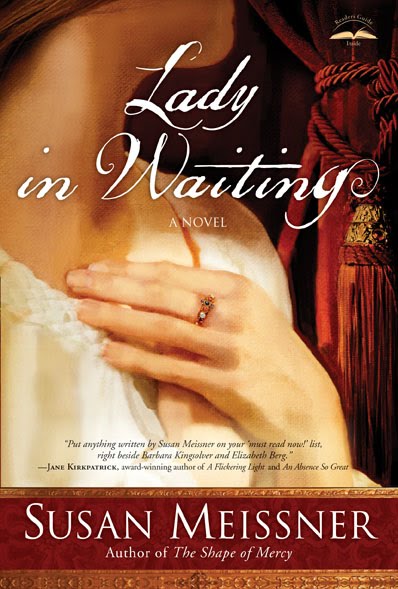
Lady in Waiting by Susan Meissner

It is time for a FIRST Wild Card Tour book review! If you wish to join the FIRST blog alliance, just click the button. We are a group of reviewers who tour Christian books. A Wild Card post includes a brief bio of the author and a full chapter from each book toured. The reason it is called a FIRST Wild Card Tour is that you never know if the book will be fiction, non~fiction, for young, or for old…or for somewhere in between! Enjoy your free peek into the book!

You never know when I might play a wild card on you!


Today’s Wild Card author is:


and the book:


Lady In Waiting

WaterBrook Press; Original edition (September 7, 2010)

***Special thanks to Cindy Brovsky of WaterBrook Press, a division of Random House, Inc., for sending me a review copy.***

ABOUT THE AUTHOR:


Susan Meissner has spent her lifetime as a writer, starting with her first poem at the age of four. She is the award-winning author of The Shape of Mercy, White Picket Fences, and many other novels. When she’s not writing, she directs the small groups and connection ministries at her San Diego church. She and her pastor husband are the parents of four young adults.

Visit the author’s website.

Product Details:

List Price: $13.99
Paperback: 352 pages
Publisher: WaterBrook Press; Original edition (September 7, 2010)
Language: English
ISBN-10: 0307458830
ISBN-13: 978-0307458834

AND NOW…THE FIRST CHAPTER:
Jane


Upper West Side, Manhattan

ONE

The mantle clock was exquisite even though its hands rested in silence at twenty minutes past two.

Carved—near as I could tell—from a single piece of mahogany, its glimmering patina looked warm to the touch. Rosebuds etched into the swirls of wood grain flanked the sides like two bronzed bridal bouquets. The clock’s top was rounded and smooth like the draped head of a Madonna. I ran my palm across the polished surface and it was like touching warm water.

Legend was this clock originally belonged to the young wife of a Southampton doctor and that it stopped keeping time in 1912, the very moment the Titanic sank and its owner became a widow. The grieving woman’s only consolation was the clock’s apparent prescience of her husband’s horrible fate and its kinship with the pain that left her inert in sorrow. She never remarried and she never had the clock fixed.

I bought it sight unseen for my great aunt’s antique store, like so many of the items I’d found for the display cases. In the year and half I’d been in charge of the inventory, the best pieces had come from the obscure estate sales that my British friend Emma Downing came upon while tooling around the southeast of England looking for oddities for her costume shop. She found the clock at an estate sale in Felixstowe and the auctioneer, so she told me, had been unimpressed with the clock’s sad history. Emma said he’d read the accompanying note about the clock as if reading the rules for rugby.

My mother watched now as I positioned the clock on the lacquered black mantle that rose above a marble fireplace. She held a lead crystal vase of silk daffodils in her hands.

“It should be ticking.” She frowned. “People will wonder why it’s not ticking.” She set the vase down on the hearth and stepped back. Her heels made a clicking sound on the parquet floor beneath our feet. “You know, you probably would’ve sold it by now if it was working. Did Wilson even look at it? You told me he could fix anything.”

I flicked a wisp of fuzz off the clock’s face. I hadn’t asked the shop’s resident and unofficial repairman to fix it. “It wouldn’t be the same clock if it was fixed.”

“It would be a clock that did what it was supposed to do.” My mother leaned in and straightened one of the daffodil blooms.

“This isn’t just any clock, Mom.” I took a step back too.

My mother folded her arms across the front of her Ann Taylor suit. Pale blue, the color of baby blankets and robins’ eggs. Her signature color. “Look, I get all that about the Titanic and the young widow, but you can’t prove any of it, Jane,” she said. “You could never sell it on that story.”

A flicker of sadness wobbled inside me at the thought of parting with the clock. This happens when you work in retail. Sometimes you have a hard time selling what you bought to sell.

“I’m thinking maybe I’ll keep it.”

“You don’t make a profit by hanging onto the inventory.” My mother whispered this, but I heard her. She intended for me to hear her. This was her way of saying what she wanted to about her aunt’s shop—which she’d inherit when Great Aunt Thea passed—without coming across as interfering.

My mother thinks she tries very hard not to interfere. But it is one of her talents. Interfering when she thinks she’s not. It drives my younger sister Leslie nuts.

“Do you want me to take it back to the store?” I asked.

“No! It’s perfect for this place. I just wish it were ticking.” She nearly pouted.

I reached for the box at my feet that I brought the clock in along with a set of Shakespeare’s works, a pair of pewter candlesticks, and a Wedgwood vase. “You could always get a CD of sound effects and run a loop of a ticking clock,” I joked.

She turned to me, childlike determination in her eyes. “I wonder how hard it would be to find a CD like that!”

“I was kidding, Mom! Look what you have to work with.” I pointed to the simulated stereo system she’d placed into a polished entertainment center behind us. My mother never used real electronics in the houses she staged, although with the clientele she usually worked with—affluent real estate brokers and equally well-off buyers and sellers—she certainly could.

“So I’ll bring in a portable player and hide it in the hearth pillows.” She shrugged and then turned to the adjoining dining room. A gleaming black dining table had been set with white bone china, pale yellow linen napkins, and mounds of fake chicken salad, mauvey rubber grapes, and plastic croissants and petit fours. An arrangement of pussy willows graced the center of the table. “Do you think the pussy willows are too rustic?” she asked.

She wanted me to say yes so I did.

“I think so, too,” she said. “I think we should swap these out for that vase of Gerbera daisies you have on that escritoire in the shop’s front window. I don’t know what I was thinking when I brought these.” She reached for the unlucky pussy willows. “We can put these on the entry table with our business cards.”

She turned to me. “You did bring yours this time, didn’t you? It’s silly for you to go to all this work and then not get any customers out of it.” My mother made her way to the entryway with the pussy willows in her hands and intention in her step. I followed her.

This was only the second house I’d helped her stage, and I didn’t bring business cards the first time because she hadn’t invited me to until we were about to leave. She’d promptly told me then to never go anywhere without business cards. Not even to the ladies room. She’d said it and then waited, like she expected me to take out my BlackBerry and make a note of it.

“I have them right here.” I reached into the front pocket of my capris and pulled out a handful of glossy business cards emblazoned with Amsterdam Avenue Antiques and its logo—three As entwined like a Celtic eternity knot. I handed them to her and she placed them in a silver dish next to her own. Sophia Keller Interior Design and Home Staging. The pussy willows actually looked wonderful against the tall jute-colored wall.

“There. That looks better!” she exclaimed as if reading my thoughts. She turned to survey the main floor of the townhouse. The owners had relocated to the Hamptons and were selling off their Manhattan properties to fund a cushy retirement. Half the décor—the books, the vases, the prints—were on loan from Aunt Thea’s shop. My mother, who’d been staging real estate for two years, brought me in a few months earlier when she discovered a stately home filled with charming and authentic antiques sold faster than the same home filled with reproductions.

“You and Brad should get out of that teensy apartment on the West Side and buy this place. The owners are practically giving it away.”

Her tone suggested she didn’t expect me to respond. I easily let the comment evaporate into the sunbeams caressing us. It was a comment for which I had had no response.

My mother’s gaze swept across the two large rooms she’d furnished and she frowned when her eyes reached the mantle and the silent clock.

“Well, I’ll just have to come back later today,” she spoke into the silence. “It’s being shown first thing in the morning.” She swung back around. “Come on. I’ll take you back.”

We stepped out into the April sunshine and to her Lexus parked across the street along a line of townhouses just like the one we’d left. As we began to drive away, the stillness in the car thickened, and I fished my cell phone out of my purse to see if I’d missed any calls while we were finishing the house. On the drive over I had a purposeful conversation with Emma about a box of old books she found at a jumble sale in Oxfordshire. That lengthy conversation filled the entire commute from the store on the seven-hundred block of Amsterdam to the townhouse on East Ninth, and I found myself wishing I could somehow repeat that providential circumstance. My mother would ask about Brad if the silence continued. There was no missed call, and I started to probe my brain for something to talk about. I suddenly remembered I hadn’t told my mother I’d found a new assistant. I opened my mouth to tell her about Stacy but I was too late.

“So what do you hear from Brad?” she asked cheerfully.

“He’s doing fine.” The answer flew out of my mouth as if I’d rehearsed it. She looked away from the traffic ahead, blinked at me, and then turned her attention back to the road. A taxi pulled in front of her, and she laid on the horn, pronouncing a curse on all taxi drivers.

“Idiot.” She turned to me. “How much longer do you think he will stay in New Hampshire?” Her brow was creased. “You aren’t going to try to keep two households going forever, are you?”

I exhaled heavily. “It’s a really good job, Mom. And he likes the change of pace and the new responsibilities. It’s only been two months.”

“Yes, but the inconvenience has to be wearing on you both. It must be quite a hassle maintaining two residences, not to mention the expense, and then all that time away from each other.” She paused but only for a moment. “I just don’t see why he couldn’t have found something similar right here in New York. I mean, don’t all big hospitals have the same jobs in radiology? That’s what your father told me. And he should know.”

“Just because there are similar jobs doesn’t mean there are similar vacancies, Mom.”

She tapped the steering wheel. “Yes, but your father said . . .”

“I know Dad thinks he might’ve been able to help Brad find something on Long Island but Brad wanted this job. And no offense, Mom, but the head of environmental services doesn’t hire radiologists.”

She bristled. I shouldn’t have said it. She would repeat that comment to my dad, not to hurt him but to vent her frustration at not having been able to convince me she was right and I was wrong. But it would hurt him anyway.

“I’m sorry, Mom,” I added. “Don’t tell him I said that, okay? I just really don’t want to rehash this again.”

But she wasn’t done. “Your father has been at that hospital for twenty-seven years. He knows a lot of people.” She emphasized the last four words with a pointed stare in my direction.

“I know he does. That’s really not what I meant. It’s just Brad has always wanted this kind of job. He’s working with cancer patients. This really matters to him.”

“But the job’s in New Hampshire!”

“Well, Connor is in New Hampshire!” It sounded irrelevant even to me to mention the current location of Brad’s and my college-age son. Connor had nothing to do with any of this. And he was an hour away from where Brad was anyway.

“And you are here,” my mother said evenly. “If Brad wanted out of the city, there are plenty of quieter hospitals right around here. And plenty of sick people for that matter.”

There was an undercurrent in her tone, subtle and yet obvious, that assured me we really weren’t talking about sick people and hospitals and the miles between Manhattan and Manchester. It was as if she’d guessed what I’d tried to keep from my parents the last eight weeks.

My husband didn’t want out of the city.

He just wanted out.

MY REVIEW:

Lady in Waiting is an intriguing book that contains two parallel stories that take place centuries apart with a ring as the common connection. Jane Lindsay’s husband has left her because “he needs some space to think” and she didn’t see it coming. While sorting through a box of goods for her antique shop, she finds a mysterious ring with the name Jane inscribed on it. Her quest to discover the original owner of the ring helps to distract her from her husband’s absence. The story of Lady Jane Grey is told through the viewpoint of Lucy who cares for her wardrobe. As she and Lucy become friends, Lucy is privy to Jane’s secrets that include a ring given Jane by the first young man she plans to marry.

Even with the wide gulf between their time periods, it was easy to become involved in the stories of both Janes. Although Lady Jane Grey is a historical figure, Lucy’s account made it a much more personal story than the facts found in history books. Each of the Janes learned that life is primarily about choices and that in the end, they could choose to be victims or could choose their own direction. Their choices had widely diverse consequences but each made the wise choice for her own circumstances.

The Waiting by Suzanne Woods Fisher


MY REVIEW:

Set during the Vietnam war, The Waiting primarily features members of the Zook family and Jorie King, a close friend and neighbor. Jorie’s life is somewhat on hold as she waits for Ben Zook’s return from Vietnam. Although hoping to marry, the pair parted on less than ideal terms. Meanwhile Jorie has taken on the job of teaching the local Amish school, with a board that holds great expectations of her abilities. Caleb Zook, the oldest member of the Zook siblings, has his hands full with running his deceased parents’ farm, caring for his own wife and child as well as his younger brothers. When multiple tragedies strike in close succession and he is elected as a new minister, Caleb is nearly overwhelmed with grief and stress.

To the casual reader, it may seem that the author has given her characters an inordinate amount of problems to bear. But when you think about it, real life can actually be that way at times. Sometimes it seems as if we can’t overcome one thing before several more are heaped on top. I felt that the characters and situations in The Waiting were both believable and realistic. The plot was interwoven with both highs and lows, joy and grief, love, anger, hate, and an all abiding faith in God. One thing I particularly enjoyed about the story was that it was unpredictable. Just when I thought I had everything figured out, an unexpected twist would change everything. This is one book you just have to read for yourself.

This book was provided for review by Revell, a division of Baker Publishing Group.


ABOUT THE BOOK:

Amish and Awaiting True Love

Will she ever find the love that she’s been looking for in her Amish community?

From author Suzanne Woods Fisher, who has written extensively about the Amish in books like Amish Peace and Amish Proverbs, comes The Waiting, an endearing fictional story about an Amish girl, looking for love.

Jorie King has been waiting for Benjamin Zook to return home to Lancaster County so they can marry. When news arrives that Ben has been killed, Jorie finds comfort in the friendship of his brother Caleb. That friendship ripens into love, and it seems that they are meant to be together.

But when the unexpected happens, their worlds are turned upside down once more. Will Jorie trust God to lead her into the arms of a new man?

A multifaceted story about complex people living the simple life, The Waiting is the second book in the Lancaster County Secrets series. Readers will find themselves transported into the world of the Amish and deeply invested in these wonderful characters.

Available October 2010 at your favorite bookseller from Revell, a division of Baker Publishing Group.

ABOUT THE AUTHOR:

Suzanne Woods Fisher is the CBA bestselling author of The Choice, The Waiting, Amish Peace, and Amish Proverbs. Her interest in the Anabaptist cultures can be directly traced to her grandfather, W. D. Benedict, who was raised in the Old Order German Baptist Brethren Church in Franklin County, Pennsylvania. Benedict eventually became publisher of Christianity Today magazine. Suzanne is the host of a radio show called Amish Wisdom and her work has appeared in many magazines. She lives in California.

Embers of Love by Tracie Peterson

This week, the
Christian Fiction Blog Alliance
is introducing
Embers of Love
Bethany House (October 1, 2010)

by
Tracie Peterson


ABOUT THE AUTHOR:

Tracie Peterson is the bestselling, award-winning author of more than 85 novels. She received her first book contract in November, 1992 and saw A Place To Belong published in February 1993 with Barbour Publishings’ Heartsong Presents. She wrote exclusively with Heartsong for the next two years, receiving their readership’s vote for Favorite Author of the Year for three years in a row.

In December, 1995 she signed a contract with Bethany House Publishers to co-write a series with author Judith Pella. Tracie now writes exclusively for Bethany House Publishers.

She teaches writing workshops at a variety of conferences on subjects such as inspirational romance and historical research.

Tracie was awarded the Romantic Times Career Achievement Award for 2007 Inspirational Fiction and her books have won numerous awards for favorite books in a variety of contests.

Making her home in Montana, this Kansas native enjoys spending time with family–especially her three grandchildren–Rainy, Fox and Max. She’s active in her church as the Director of Women’s Ministries, coordinates a yearly writer’s retreat for published authors, and travels, as time permits, to research her books

ABOUT THE BOOK:

The logging industry in eastern Texas is booming, and Deborah Vandermark plans to assist her family’s business now that she’s completed college. Unexpectedly, her best friend, Lizzie Decker, accompanies her back home–fleeing a wedding and groom she has no interest in.

Deborah, the determined matchmaker, puts her sights on uniting her brother and dear friend in a true love match. Deborah soon meets Dr. Christopher Clayton, a much-needed addition to the town. As their lives intersect, Deborah realizes that she has a much greater interest in medicine and science than the bookkeeping she was trained in.

But when typhoid begins to spread and Lizzie’s jilted fiance returns, Deborah wonders if true love can overcome such obstacles…for those dearest to her, and for herself.

If you would like to read the first chapter of Embers of Love, go HERE.

Learn more about Tracie and her books on her Website.

MY REVIEW:

Introducing the new  Striking a Match series, Embers of Love is set primarily in the pine hills of east Texas. In this volume, the reader gets a bonus of two romances for the price of one. When Deborah rescues her good friend Lizzie from a potentially disastrous marriage, she talks the runaway bride into going home to Texas with her. As she watches the hoped for romance develop between her brother and Lizzie, Deborah refuses to even consider a romance for herself because she feels obliged to help with her family’s logging business.  Once Deborah gets to know and helps the new doctor in town, Christopher Clayton, she finds that he is the only person in town who understands her desire to learn . . . and he actually encourages her. Their friendship develops into mutual attraction; however both deny their developing feelings due to their assumed responsibility to their families.

Embers of Love is the kind of book I have come to expect from Tracie Peterson – one that is well researched, full of historical and geographical facts, and contains both humor and drama, a good romantic story, and a strong spiritual message. I would recommend Embers of Love to those who are already fans of Tracie Peterson and also to those who enjoy a good historical romance.

Love Finds You Under the Mistletoe by Irene Brand & Anita Higman

This week, the

Christian Fiction Blog Alliance

is introducing

Love Finds You Under the Mistletoe
Summerside Press (September 1, 2010)

by
Irene Brand & Anita Higman


ABOUT THE AUTHORS:

Irene Brand has written Sunday School curriculum, edited a two-year series of mission curriculum, and her works have appeared in five program-material anthologies. Her publishers include Zondervan, Standard Publishing, Thomas Nelson Publishers, Fleming-Revell, Barbour Publishing, Kregel Publications, Steeple Hill (inspirational imprint of Silhouette), and Summerside Press. She has had 4 non-fiction books published, and 43 fiction works. Her first inspirational romance was published in 1984.

Award-winning author, Anita Higman, has twenty-six books published (several coauthored) for adults and children, and she has been honored as a Barnes & Noble Author of the Month for Houston. Anita has a BA degree, combining speech communication, psychology, and art. Her favorite things include exotic teas, movies, and all things Jane Austen.


ABOUT THE BOOK:
Two Christmas stories – one historical, one contemporary – under one cover!

Love Finds You under the Mistletoe: An Appalachian Christmas

A promise to her dying sister compels Julia Mayfield to take her young nephew to Mistletoe, Kentucky, a tiny town tucked away in the Appalachian Mountains. Sparks fly when she meets David Armstrong, a World War II veteran like herself. Even as shadows from the past weave a dangerous web around Julia and David, will their love flourish like the mistletoe that blankets the nearby hills?

Love Finds You under the Mistletoe: Once Upon a Christmas Eve

Hollie Goodnight’s store has just been voted best Christmas shop in America. All the new publicity draws flamboyant novelist Van Keaton to the cozy town of Noel, Missouri, demanding to write Hollie’s story – a dramatic tale of misfortune and triumph. She is swept up in his world of beautiful words and fanciful interludes. . .until Owen Quigly, her lifelong best friend, launches a plan to win her back.

If you would like to read an excerpt of Love Finds You Under the Mistletoe, go HERE.

Watch the book trailer:

MY REVIEW:

Here in west Tennessee, our temperatures have just now finally dropped below the nineties so it is hard to imagine that Christmas is right around the corner. The Christmas books have started showing up in my mailbox for review so it must be true. Love Finds You Under the Mistletoe is the first one on my list and its tour date is today so although I prefer to start reading Christmas stories Thanksgiving weekend, this year I’m getting an early start.

Love Finds You Under the Mistletoe is the perfect book for when you are in the mood for something light and entertaining. With two separate stories, it is ideal for those times in the midst of all the holiday hustle and bustle when you can find some time to put your feet up and relax for awhile. Each of the stories has a well paced plot, interesting characters, and just the right touch of romance.

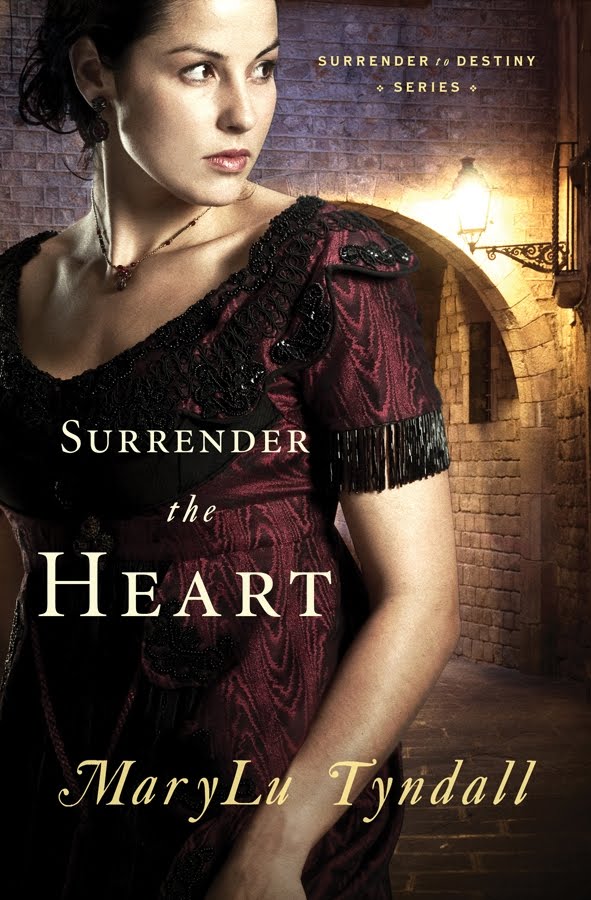
Surrender the Heart by MaryLu Tyndall – FIRST Wild Card Tour

It is time for a FIRST Wild Card Tour book review! If you wish to join the FIRST blog alliance, just click the button. We are a group of reviewers who tour Christian books. A Wild Card post includes a brief bio of the author and a full chapter from each book toured. The reason it is called a FIRST Wild Card Tour is that you never know if the book will be fiction, non~fiction, for young, or for old…or for somewhere in between! Enjoy your free peek into the book!

You never know when I might play a wild card on you!


Today’s Wild Card author is:


and the book:


Surrender the Heart

Barbour Books (August 1, 2010)

***Special thanks to MaryLu Tyndall and Camy Tang for sending me a review copy.***

ABOUT THE AUTHOR:

M.L. Tyndall, a Christy Award Finalist, and best-selling author of the Legacy of the King’s Pirates series is known for her adventurous historical romances filled with deep spiritual themes. She holds a degree in Math and worked as a software engineer for fifteen years before testing the waters as a writer. MaryLu currently writes full time and makes her home on the California coast with her husband, six kids, and four cats. Her passion is to write page-turning, romantic adventures that not only entertain but expose Christians to their full potential in Christ. For more information on MaryLu and her upcoming releases, please visit her website or her blog.

Visit the author’s website.
Visit the author’s blog.

Product Details:

List Price: $12.99
Paperback: 368 pages
Publisher: Barbour Books (August 1, 2010)
Language: English
ISBN-10: 1602601658
ISBN-13: 978-1602601659

AND NOW…THE FIRST CHAPTER:

June 18, 1812, Baltimore, Maryland


“I would rather boil in oil than marry Noah Brenin.” Marianne tossed the silver brooch onto her vanity.

“Hold your breath and stay still.” Rose said from behind her. “Besides, it is only an engagement party, not a wedding.”

“But it is one more step to that horrid destination.” Marianne sucked in her breath as Rose threaded the laces through the eyelets on her stays. “Why must women wear these contraptions?”

“To look our best for the gentlemen in our lives.” Cassandra appeared on Marianne’s left, a lacy petticoat flung over one arm. With shimmering auburn hair and eyes the color of emeralds, Cassandra had no trouble looking her best for anyone.

Marianne huffed. “I have no care what any gentleman thinks of my appearance.”

“Which is why you are still unmarried at five and twenty.”

“Then what is your excuse at three and twenty?” Marianne arched a brow, to which Cassandra responded with a shrug. “I have not yet met a man worthy of me.” She grinned.

“Where on earth is your chambermaid?” Rose grunted as she squeezed Marianne’s rounded figure into the stays and tied the final lace tight. “Shouldn’t she be doing this?”

“I dismissed her.” Marianne waved a hand through the air. “I prefer to dress myself.” She hoped they didn’t hear the slight quaver in her voice. If only they knew that her mother had been forced to let the entire staff go and the ones here today were hired just for her betrothal party.

“There.” Rose finished her work and stepped back as Marianne took the petticoat from Cassandra and slipped it over her head.

“Truth is, I do not wish to marry—ever.” Marianne squared her shoulders as Cassandra slid behind her and latched the petticoat hooks.

Rose put her hands on her waist. “Noah Brenin is a fine man and a good catch.”

Marianne gazed at her friend and couldn’t help but smile at the motherly reprimand burning in her crystal blue eyes. Tall and slender, with honey blond hair, Rose turned many a head in Baltimore. Just like Cassandra.

But not like Marianne.

“He is a boor.”

“Why so low an opinion of him? Haven’t you and he been friends since childhood?” Rose cocked her head and gave Marianne a look of censure.

“I wouldn’t call it friendship, more like forced acquaintance. And my knowledge of him is precisely why I know him for the churlish clod he is.”

Gathering a cream-colored silk-embroidered gown from Marianne’s bed, Rose and Cassandra tossed it over her head and assisted her as she wiggled into it. She adjusted the ruffled lace bordering her neckline and circling her puffy sleeves. Cassandra handed her a jeweled belt which Marianne strapped around her high waist and buckled in front. She pressed down the folds of her gown, admiring the pink lace trailing down the front and trimming the hemline. After slipping on her white satin slippers, Marianne moved to the full length looking glass and paused to eye her reflection.

Plain. Despite the shimmering, glamorous dress, plain was the first word that came to her mind. Perhaps because that was how she had always been described. Brown hair, brown eyes, average height, a bit plump. Nothing remarkable, nothing to catch an eye.

Simply plain.

Which was precisely why, when the other girls her age were being courted, Marianne had preferred to spend her time caring for her ailing mother and younger sister, particularly after their father died. No whirlwind romances, no soirees, no grand adventures lit up the horizon for her. She had resigned herself to lead an ordinary life. An ordinary life for an ordinary girl.

“Come now, it won’t be so bad.” Rose brushed a lock of hair from Marianne’s forehead and then straightened one of the curls dangling about her neck. “You look as though you were attending your own funeral.”

“I dare say I feel as though I am.” Tired of staring into the mirror with the hope her reflection would transform into that of a beautiful woman, Marianne turned aside, picked up her silk gloves from the vanity and sauntered toward the window.

“I, for one, cannot wait to get married,” Rose said. “To the right man of course. He must be a good, honest, god-fearing man. A man who stays home, not a seaman. And he must be agreeable in all respects.”

“What about handsome?” Cassandra asked, and Marianne turned to see a blush creep up Rose’s neck.

“Well, yes, I suppose I would not be opposed to that.” Her blue eyes twinkled.

Facing the window, Marianne slid the white gloves onto her hands and tugged them up her arms. Shouts echoed from the street below, accompanied by the clip clop of horse hooves and the grating of carriage wheels. She brushed aside the curtain to see people running to and fro darting between carriages. A warm breeze, heavy with moisture and the smells of the sea, stirred the curtains. A bell rang in the distance, drawing Marianne’s attention to the maze of ship’s masts thrusting into the blue sky like iron bars of a prison. A prison that could not constrain the ravenous blue waters from feeding upon the innocent—an innocent like her father.

Rose and Cassandra joined her at the window as more shouts blasted in with the wind. “What is all the commotion about?” Cassandra pushed back the other side of the curtains.

“There have been rumors that President Madison will soon declare war on Britain,” Marianne said.

“I hope it doesn’t come to that.” Rose peered over Marianne’s shoulder. “War is such horrid business.”

“But necessary if the British insist on stealing our men from land and sea and impressing them into their Navy.” Marianne felt her ire rising. “Not to mention how they rouse the Indians to attack us on the frontier.”

“They want their colonies back, I suppose.” Afternoon sunlight set Cassandra’s red hair aflame in ribbons of liquid fire. “England never was good at losing.”

“Well they can’t have them.” Marianne’s voice rose with a determination she felt building within. Though she’d been born after the Revolution, she had heard the stories of oppression and tyranny enforced upon them by a nation across the seas whose king thought he had the right to dictate laws and taxes without giving the people a voice. But no more. “We won our freedom from them. We are a nation now. A new nation that represents liberty to the entire world.”

“I couldn’t agree more.” Cassandra nodded with a smile. “Perhaps you should run for mayor?”

“A woman in public office?” Marianne chuckled. “That will never happen.”

The door creaked open, and Marianne turned to see her mother and younger sister slip inside.

Lizzie’s eyes widened and she rushed toward Marianne. “You look so beautiful, Marianne!”

Kneeling, Marianne embraced her sister. She held her tight and took a big whiff of the lavender soap with which their mother always scrubbed the little girl. “Thank you, Lizzie. I can always count on you for a compliment.”

“Now, Lizzie, don’t wrinkle your sister’s dress.” Marianne’s mother sank into one of the chairs by the fireplace and winced. The slight reminder of her mother’s pain caused Marianne’s heart to shrink. She squeezed her little sister again—the one beacon of joy in their house these past three years since Father died—and kissed her on the cheek. “You look very beautiful too.”

The little girl clutched her skirt and twirled around. “Do you really think so?” She drew her lips into a pout. “But when can I wear a dress like yours?”

“Come now, Lizzie,” Mother said. “You are only six. When you are a grown woman like Marianne, you may wear more elaborate gowns.” She gestured toward Rose and Cassandra. “Ladies, would you take Lizzie downstairs for a moment? I need a word with Marianne.”

“Of course, Mrs. Denton.” Rose took Lizzie’s hand. “Come along little one.”

Cassandra followed after them and closed the door.

Marianne sat in the chair beside her mother and gently grasped her hands. She flinched at how cold and moist they were. “How are you feeling, Mama?”

“Very well today, dear.” She looked down as if hiding something..

But Marianne didn’t need to look in her mother’s eyes to know she was lying. The sprinkles of perspiration on her forehead, the paleness of her skin, and the tightening of her lips when the pains hit spoke more clearly than any words.

Marianne squeezed her mother’s hands. “The medicaments are not working?”

“They will work. It takes time.” Her mother attempted a smile. “But let us not talk of that now. I have something more important to discuss with you.” She released a heavy sigh then lifted her gaze to Marianne’s. Though illness had stolen the glimmer from her eyes, it could not hide the sweet kindness of her soul. “You don’t have to do this, you know.”

The truth of her words sliced through Marianne. She stared at the floral pattern woven into the carpet. “You know I do.”

“It isn’t fair of me to ask this of you.” Her mother’s voice rang with conviction and deep sorrow.

“You didn’t ask, Mama. I want to do this.” A truth followed by a lie. Marianne hoped the good canceled out the bad.

“Come now. You cannot fool me.” Mama said. “I know this is not the match you would choose.”

Releasing her mother’s hands, Marianne rose from the chair and sauntered toward the window. The rustle of her gown crackled through the air with conviction. “In truth, I would choose no match.” She turned and forced a smile. “So if I must marry, why not this man?”

Her mother gazed at her with such love and sorrow that Marianne felt her heart would burst. Once considered the most beautiful woman in Baltimore, Jane Denton, now withered away with the sickness that robbed her of her glow and luster and stole the fat from her bones, leaving her but a frail skeleton of what she once had been. The physicians had no idea what ailed her save that without the medicaments they administered, she would die a quicker and more painful death.

Tearing her gaze from the tragic vision, Marianne glanced out the window where it seemed as though the approaching evening only heightened the citizens’ agitation. “Marrying Noah Brenin will save us. It will save you.”

“But what of saving you?” Her mother’s sweet plea caressed Marianne’s ears, but she forced down the spark of hope that dared to rise at her mother’s question. There was no room for hope now, only necessity.

“You know if we continue as is, all that is left of our fortune will be spent in one year on your medicaments. Then what will we do? Without my dowry, no man will look my way, since that and our good name is all that has caught this particular fish upon the hook.” And without a husband to unlock her inheritance, her father had ensured that the seven thousand dollars would remain as far from her reach as if she did not own it at all.

“Perhaps you will meet another man—someone you love?” Her mother said.

“Mama, I am five and twenty.” Marianne turned and waved her hands over herself. “And plain to look at.” She gave a bitter laugh. “Do you see suitors lining up at our door?”

“You are too beautiful for words, dearest.” Her mother’s eyes beamed in adoration. “You just don’t know it yet.”

Shrugging off her mother’s compliment as the obligation of a parent, Marianne stiffened her back before she attempted to rekindle an argument long since put to death. “We could take what’s left of our money and fund a privateer, Mama.” Marianne glanced out the window at a mob that had formed down the street. “War is certain and our fledgling navy will need all the help it can get.”

Her mother’s nervous huff drew Marianne’s gaze. “It is far too much of a gamble. And gambling destroys lives”—a glaze covered her mother’s eyes as she stared into the room—“and families.”

Marianne grimaced. “I am not like Papa. I have heard these privateers can make a fortune while helping to defend our country.”

A breeze stirred a curled wisp of her mother’s hair as she gazed at Marianne with concern.

Marianne twisted the ring on her finger. “Down at the docks, merchantmen are already outfitted their ships as privateers. The call for investors goes out daily.” If only she could convince her mother, not only would Marianne not have to marry that clod, Noah, but she could do something to help this great nation of hers.

Her mother’s boney hands perched in her lap began to tremble. “We could lose everything. And what of Lizzie? I could not bare it.”

Shame drummed upon Marianne’s hopes. She had upset her mother when the doctor strictly instructed her to keep her calm.

“Perhaps a trade of some sort?” Mama offered. “I hear that Mrs. Pickersgill makes a decent living sewing ensigns.”

A blast of warm wind stirred the gauzy curtains and cooled the perspiration forming on Marianne’s neck. “Mama you know I have no skills. I’m not like other ladies. The last gown I attempted to sew fell apart. My cooking would drive the hardiest frontiersman back to the woods, and the pianoforte runs when it sees me coming.”

Mother chuckled. “You exaggerate, dearest.”

But Marianne could tell by the look in her mother’s eyes that despite the humorous delivery, her words rang true. Though a governess in her younger years and her mother in her later years had strived to teach Marianne the skills every proper lady should acquire, she had found them nothing but tedious. She possessed no useful skills, no talents. As her father had so often declared before his death. In essence, Marianne had nothing to offer. If her mother would not agree to fund a privateer, Marianne would have to accept her fate in marriage.

“I’m an old woman and will die soon anyway,” Mama said with a sigh. “But I must ensure you and Lizzie are cared for.”

Gathering her skirts, Marianne dashed toward her mother and knelt at her feet. “You must never say such a thing.”

“Do not soil your beautiful gown.” Her mother smiled and wiped a tear from Marianne’s cheek. “Perhaps we should simply trust God with my health and let His will prevail.”

Marianne laid her head on her mother’s lap like she used to do as a child. She had trusted her father, she had trusted God.

And they had both let her down—her and her mother.

Trust no longer came so easily. “I will not let you die, Mother. I cannot.” Her eyes burned with tears. “As long as I have my inheritance and a man who is willing to marry me, I promise you will be well cared for. And Lizzie too. That is all that matters, now.” Marianne lifted her gaze to her mother’s, feeling strength surge through her.

“And mark my words, Mama. Nothing will stand in my way. Especially not Noah Brenin.”

MY REVIEW:

Surrender the Heart is another of Tyndall’s nautical adventures written with such vivid imagery  that you would swear you could hear the seagulls and waves and smell the briny sea. (BTW, if you visit her website, you will get the full audio experience.) Set primarily aboard ship on the high seas, the story takes the hero and heroine through danger, discouragement, fear, sacrifice, love, hate, forgiveness, and triumph.

Both Marianne and Noah have distanced themselves from God because of past circumstances in their lives. Noah’s guilt over his brother’s death and his inability to please his father has caused him to continuously strive to prove himself. The death of Marianne’s father and the lack of provision left for his family has resulted in Marianne’s inability to believe in herself or God’s love for her. As they experience trials and hardship aboard the British warship that holds them hostage, they begin to see themselves and each other in a different light. And as God breaks through their defenses, they each discover the destiny He has in store for them.

Surrender the Heart is a must read for anyone who loves historical fiction, a good adventure story, and a satisfying romance.

The House on Malcolm Street by Leisha Kelly


MY REVIEW:

Aunt Marigold’s house on Malcolm Street is a haven for tormented souls, a place of peace and love that enables the heart to heal. Leah and Josiah are two of those in need of a touch from both Marigold and the Lord. Each of them has lost a beloved spouse and child through accident and disease and when there was nowhere else to turn, Marigold provided a refuge.  In her wisdom, Marigold encouraged each of them to reach out to help others, knowing that in doing so they would find the healing so desperately needed.

The House of Malcolm Street is an emotional roller coaster that plumbs the depths of Josiah and Leah’s hearts. With a plot that contains more introspection than action, it still managed to hold my interest until the end. The author dropped enough hints along the way that I was not surprised at the source of Leah’s nightmares. I was generally pleased with the resolution of relationships but had hoped for more between Leah and Josiah. Could there be a sequel in the works?

For those who enjoy a thoughtful story, The House on Malcolm Street is a must read. Those who like more action, suspense, or romance should look elsewhere.


This book was provided for review by Revell, a division of Baker Publishing Group.

Available September 2010 at your favorite bookseller from
Revell, a division of Baker Publishing Group


ABOUT THE BOOK:

Beloved author Leisha Kelly releases long-anticipated novel about the story of a young widow and her journey to start over.

From the bestselling author of Emma’s Gift, comes The House on Malcolm Street, Leisha Kelly’s latest novel about finding healing in the most unexpected of places.

It is the autumn of 1920 and Leah Breckenridge is desperate to find a way to provide for her young daughter. After losing her husband and infant son in an accident, she is angry at God and fearful about the future. Finding refuge in a boardinghouse run by her late husband’s aunt, Leah’s heart begins the slow process of mending. Is it the people who surround her—or perhaps this very house—that reach into her heart with healing?

Delightful, realistic characters and skilled writing make The House on Malcolm Street by Leisha Kelly a treasure.

ABOUT THE AUTHOR:

Leisha Kelly is the author of several bestselling historical fiction books, including Emma’s Gift, Julia’s Hope, and Katie’s Dream. She has served many years on her local library board, continuing to bring good reads and educational opportunities to her community. Once a waitress, cafe manager, tutor, and EMT, Leisha is now a busy novelist and speaker who is active in the ministries of her church. She lives with her family in Illinois.