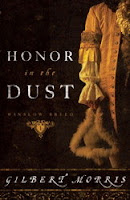
Honor in the Dust by Gilbert Morris
 It is time for a FIRST Wild Card Tour book review! If you wish to join the FIRST blog alliance, just click the button. We are a group of reviewers who tour Christian books. A Wild Card post includes a brief bio of the author and a full chapter from each book toured. The reason it is called a FIRST Wild Card Tour is that you never know if the book will be fiction, non~fiction, for young, or for old…or for somewhere in between! Enjoy your free peek into the book!
You never know when I might play a wild card on you!
and the book:
Howard Books (August 25, 2009)
|
ABOUT THE AUTHOR:
Gilbert Morris is the bestselling author of more than 200 novels, several of which won Christy and Silver Angel Awards. He is a retired English professor, who lives in Gulf Shores, AL, with his family. Visit the author’s website. |
| Product Details: List Price: $13.99 Paperback: 320 pages Publisher: Howard Books (August 25, 2009) Language: English ISBN-10: 1416587462 ISBN-13: 978-1416587460 |

AND NOW…THE FIRST CHAPTER:
Sussex County, England-
Claiborn Winslow leaned forward and patted his horse’s sweaty neck. “Well done, Ned.” He had pushed the stallion harder than he liked, but after so many months away he was hungry for home. He straightened in the saddle and gazed in pleasure at Stoneybrook, the Winslows’s ancestral castle. It had withstood seige and battle, and bore all the marks that time made upon structure——as well as upon men. There was nothing particularly beautiful about Stoneybrook. There were many castles in England that had more pleasing aspects, designed more for looks than for utility. But Claiborn loved it more than any other.
The spring had brought a rich emerald green growth to all the countryside, and verdant fields nuzzled up against the very walls of Stoneybrook. If they were any indication, the summer’s harvest would be good, indeed. The castle itself rose out of a hillside, and was dominated by an impenetrable wall, on the other side of which a small village thrived. Even now, late in the day, people and carts and horses moved in and out of the central gate, and from the battlements he saw the banner of Winslow fluttering in the late afternoon breeze, as if beckoning to him.
“My heaven it’s good to be home!”
He laughed at himself adding, “Well, I guess the next thing they’ll put me in Bedlam with the other crazy ones talking to myself. I must be worse off than I thought.” His mind cascaded back to the battles he had seen, rare but fierce, and the men he had encountered. Some dreaded battle, feared it, and could not force themselves forward. Others found joy in the clash of weapons and the shouts of victory when the battle was over. Claiborn was one of these, finding a natural rhythm to battle, a path from start to finish as if preordained for him. When the trumpets sounded, and the drums rolled, his heart burned with excitement. God help him, he loved it. Loved being a soldier. But this, returning to Stoneybrook, had its own charm.
“Come on, Ned.” Kicking his horse’s side Claiborn guided the animal toward the gate, and as he passed through, he ran across an old acquaintance, Ryland Tolliver, one of the blacksmiths who served Sir Edmund Winslow and the others of the family as well.
“Well, bless my soul,” Ryland boomed, “if it’s not the soldier home from the wars!” He was a bulky man, his shoulders broad, and his hands like steel hooks from his years at the forge. He laughed as Claiborn slipped off his horse and came forward, and he shook his hand. “Good to see you, man. You’re just getting home. All in one piece, I see.”
“All in one piece.” The two man shook hands, and Claiborn had to squeeze hard to keep his hand from being crushed by the burly blacksmith. “How are things here? My mother and my brother?”
“The same as they were when you left. What did you expect? We’d fall to pieces without you to keep us straight?”
“No, I’m not as vain as that. I’m sure the world would jog on pretty well without me.”
“Tell me about the wars, man.”
“Not now. I need to go see my family, but I’ll come back later. We’ll have enough ale to float a ship. I’ll tell you lies about how I won the battles. You can tell lies about how you’ve won over the virtue of poor Sally McFarland.”
“Sally McFarland? Why, she left here half a year ago.”
“I thought you were going to marry that girl.”
“She had other ideas. A blacksmith wasn’t good enough for her.” He looked at Ned and said, “Not much of a horse.”
“He’s a stayer. That’s what I like. He needs shoeing though. I’ll leave him with you and feed him something good. He’s had a hard journey.”
“That I’ll do.” He took the reins from Claiborn. “What about you, Master? What brings you home at long last?”
Claiborn glanced back at him, and a smile touched his broad lips. “Well, I’m thinking about taking a wife.”
“A wife? You? Why, you were made to be a bachelor man! Half the women in this village stare at you when you walk down the street.”
“You boast on my behalf, but even if it was God’s own truth, I’ll not have just any woman.”
“Ahh, I see. So have you got one picked out?”
“Of course! Grace Barclay had my heart when we courted and never let it go.”
“Oh, yes, Grace Barclay.” There was a slight hesitation in the blacksmith’s speech, and he opened his lips to speak, but then something came over him, and he clamped them together for a moment.
“Ryland, what is it? Grace is well?” Claiborn said, his heart seizing at the look on the blacksmith’s face.
“She is well. Still pretty as ever.” Ryland had ceased smiling, and he lifted the reins in his hand. “I best go and take care of the horse. He must have a thirst.”
“As do I. I’ll return on the morrow. Give him a good feed too. He’s earned it.”
. . . . . . . . . . . .
The servants were busy putting the evening meal together, and as he passed into the great hall Claiborn spoke to many of them. He was smiling and remembering their names, and they responded to him well. He had always been a favorite with the servants, far more than his brother Edmund, the master of Stoneybrook, and enjoyed his special status. He paused beside one large woman who was pushing out of her clothing and said, “Martha, your shape is more…womanly than when I departed.”
The cook giggled and said, “Away with you now, m’lord. None of your soldier’s ways around here.”
He grinned. “You are expecting a little one. It is nothing shameful, I assume.”
“Shush! Mind that we’re in public, Sir. Such conversation is unseemly!” Her face softened and she leaned closer. “I married George, you know. A summer past.”
“Well, good for George. With a good woman and a babe on the way; he must be content, indeed. What’s for supper?”
“Nothing special, but likely better than some of the meals you’ve had.”
“You’re right about that. Soldier’s fare is pretty rough stuff.”
Passing on, Claiborn felt a lightness in his spirit. There was something about coming home that did something inside a man. He thought of the many campfires he had huddled next to out in the fields, sometimes in drizzling rain and bitter cold weather— dreaming of the smells and the sounds of Stoneybrook, wishing he was back. And now, at last, he was.
“Edmund!” He turned to see his brother, emerging from one of the inner passages.
Claiborn hurried forward to meet him and said, “It’s good to see you, brother.”
“And you,” Edmund said, holding him at arm’s length again to get a good look. “No wounds, this round?”
“Nothing that hasn’t healed,” Claiborn returned.
“Good, good. Mother will be so relieved.”
The two turned to walk together, down a passageway that would lead to their mother’s apartments. Claiborn restrained his pace, accommodating his smaller older brother’s shorter stride. “All is well here, brother? You are well?”
“Never better. There is much to tell you. But it can wait until we sup.”
A servant had just departed, after breathlessly telling Lady Leah Winslow that her son had returned. She wished she had a moment to run a brush through her gray hair, but she could already hear her sons, making their way down the corridor. She rose, straightening her skirts. How many nights had she prayed for Claiborn’s return, feared for his very life? And here he was at last!
The two paused at her door, and Leah’s hand went to her chest as her eyes moved between her sons. Claiborn’s rich auburn hair with just a trace of gold; Edmund’s dull brown. Claiborn’s broad forehead, sparkling blue eyes, high cheekbones, generous lips that so easily curved into a smile, determined chin. Here, here was the true Lord Winslow, a far more striking figure than his sallow, flabby brother. Her eyes flitted guiltily toward her eldest, wondering if she read her traitorous thoughts within.
But Claiborn was already moving forward, arms out, and she rushed to him. He lifted her and twirled around, making her giggle and then flush with embarrassment. “Claiborn, Claiborn!”
He laughed, the sound warm and welcoming and then gently set her to her feet. “You are still lovely, Mother.”
“You are kind to an old woman,” she said. She reached up and cradled his cheek. “The wars…you return to us unhurt?”
“Only aching for home,” he returned.
He took the horsehide-covered seat she offered and Edmund took another. A servant arrived with tea and quickly poured.
“Are you hungry, Son?”
“Starved, but the tea will tide me over until we sup.”
“Well, tell us about the wars,” Edmund said.
“Like all wars—bloody and uncomfortable. I lost some good friends. God be praised, I came through all right.”
Edmund let out a scoffing sound. “Don’t tell me you turned religious!”
“Religious enough to seek my Maker when facing death.”
Edmund laughed and Leah frowned. He had a high-pitched laugh that sounded like the whinnying of a horse. “Not very religious when you were growing up. I had to thrash you for chasing the maids.”
Claiborn reddened and guiltily glanced at Leah. “I suppose I was a terrible.”
“You were young,” Leah put in. “Now you are a man.”
“She forgets just how troublesome you were,” Edmund said.
“You might have been the same, had you faced manhood and the loss of your father in the same year. You were fortunate, Edmund, to be a man full grown before you became Lord Winslow.”
Edmund pursed his narrow lips and considered her words. “Yes. I suppose there is a certain wisdom in that, Mother. A thousand apologies, Claiborn,” he said, with no true apology in his tone.
“None offense taken. So tell me, what’s the feeling here about the king?”
“Most are for Henry. He’s a strong man—but it troubles all that he seems to have a ghost haunting him.”
“A real ghost?”
“No, but it might be better if it were,” Edmund grinned. “Henry defeated Richard III at Bosworth, and he claimed the crown. But he’s always thinking that someone with a better claim to the crown will lead a rebellion and cut his head off.”
“Do you think that could happen?”
“No. Henry’s too clever to let that happen.”
Leah fidgeted in her seat, wondering when Edmund would tell his brother what he must. Would it be up to her? She kept silent for ten long minutes as the men continued to speak of Henry VII and his various campaigns. When it was silent, she blurted, “Has Edmund told you of his plans?”
Edmund shot her a quick, narrowed glance, but then turned to engage his brother again.
“Plans?” Claiborn’s bright, blue eyes lit up. “What is it?”
“I’m to be married,” he said, uncrossing his legs and crossing them again in a studied, casual way.
“Well, I assumed you already long married. Alice Williams is your intended bride, I suppose.”
Edmund’s face darkened, and he took two quick swallows of tea and then shook his head. “No,” he said in a spare tone. “That didn’t come to fruition. She married Sir Giles Mackson.”
“Why, he’s an old man!”
“I expect that’s why Alice married him. She expects to wear him out, then she’ll be in control of everything.”
“I didn’t think Alice was that kind of a woman.”
“Come now, most women are that kind of woman. Apart from our dear mother, of course.” He reached out a hand to Leah and she took it. He held it too tightly, as if warning her. “You truly haven’t learned more of women as you’ve traveled?”
“Not of what you speak.” His eyes moved to his brother’s hand, still holding their mother’s. “Well, who is it then? Who is the future Lady Winslow?”
Leah couldn’t bear it then, watching her handsome son’s face. She stared studiously at her tea, waiting for the words to come.
“Obviously, I’ve considered it for some time,” Edmund said, releasing their mother’s hand, setting down his cup and rising to stand behind her chair.
Claiborn frowned but forced a curious smile. Why was he hesitating? “Cease toying with me, Edmund. Who is she?”
“I have selected Grace Barclay.”
Claiborn’s fingers grew white as he gripped the tea cup. With a shaking hand, he set it down before he crushed it. “Grace Barclay,” he whispered.
“Yes. She’s comely enough, and I’ve come to a fine arrangement with her father. We shall obtain all the land that borders our own to the east. That’ll be her dowry. We’ll be able to put in new rye fields and carry more cattle. It’ll add a quarter to the size of Stoneybrook. You know how hard I tried to buy that land from her father, years ago. Well, he wouldn’t sell, never would I don’t think, but when he mentioned the match I thought, well, why not? It’s time I married and produced an heir for all of this. I’ll show you around the property tomorrow.”
Claiborn said nothing further, and felt frozen in place. Edmund prattled on about the new land that would soon be added, how it would benefit them all, and finally turned toward the door and said, “Come along, you two. They ought to have something to eat on the table by now. You can tell us about the wars in more detail, Claiborn, now that you know all that’s new here.”
“Edmund, may I have a word with your brother?” Leah said quietly.
Edmund stared, as if having forgotten she was there. After a moment’s hesitation, he said, “Certainly, Mother. I shall see you both in the dining hall.” Then straightening his coat, he exited the room.
Claiborn struggled to speak. At last he asked, “When will the marriage take place?”
“The date has not been set, but it will be soon.” Leah turned warm eyes on her son. She reached out to touch his arm, but he flinched. She had stood idly by! Watched this transgression unfold! “Claiborn, it is a business arrangement. Nothing more.”
“But she was mine. He knew I courted her.”
“And then you left her. She has been of marriable age for some time, now. For all we knew, you could have already died on foreign soil, never to return. Like it or not, life continues, for those of us left behind. Grace needed a husband; Edmund needed a wife. It was a natural choice.”
Claiborn rose. “What of love? What of passion? Grace and I shared those things.”
“Years ago, you shared those things. Now you must forget them. Your brother, Lord Winslow, has chosen.”
“Chosen my intended!” Claiborn thundered, rising.
“You did not make your intentions clear,” Leah said quietly, pain in every word.
“I could not leave Grace, with a promise to marry. It was a promise I could not be sure I could keep. Too many die on the battlefield…” He turned away to the window, running a hand through his hair, anguished at the thought of never holding Grace in his arms, never declaring his love, enduring the sight of her, with him. His brother. His betrayer.
His mother came up behind him, and this time, he allowed her touch on his arm. Slowly, quietly, she leaned her temple against his shoulder, simply standing beside him for time in solidarity. “I’m sorry, Son. But you are too late. You cannot stop what is to come, only make your peace with it. It will be well in time. But you must stand aside.”
Claiborn went through the motions of the returned soldier through the rest of the evening. He was not a particularly good actor, and many of the servants noticed how quiet he was. Edmund did not, however, continuing to fill the silence with endless chatter. After the meal was over Claiborn said, “I think I’ll go to bed. My journey was long today.”
“Yes, you’d better,” Edmund said, mopping the gravy from the trencher with a chunk of bread “Tomorrow we’ll look things over, find something for you to do while you are home. Will you return to the army?”
“I’m not quite sure, Edmund.”
“Bad business being a soldier! Out in the weather, always the danger of some Spaniard or Frenchman taking your head off. We’ll find something for you around here. Time you got a profession. Maybe you’d make a lawyer or even go into the church.” He laughed then and said, “No, not the church. Too much mischief in you for that! Go along then. Sleep well and we’ll discuss it further on the morrow.”
. . . . . . . . . . . .
As Claiborn rode up to the property owned by John Barclay, he felt as if he were coming down with some sort of illness. He had slept not at all, but had paced the floor until his mother sent a servant with a vessel of wine, which he downed quickly, and soon afterward, fell into a dream-laden sleep. As soon as the sun had come up, he had departed, only leaving word for Edmund that he had an errand to run.
Now as he pulled up in front of the large house where Barclay lived with his family, he dismounted, and a smiling servant came out. “Greetings, m’lord, shall I grain your horse?”
“No, just walk him until he cools.”
He walked up to the door, his eyes troubled and his lips in a tight line. He was shown in by a house servant, and five minutes later John Barclay, Grace’s father, came in. “Well, Claiborn, you’re back. All safe and sound, I trust?”
“Yes, Sir. Safe and sound.”
“How did the wars go? Here, let’s have a little wine.”
Claiborn’s head was splitting already from the hangover, but he took the mulled wine so that he might have something to do with his hands.
John Barclay was a small man, handsome in his youth, but now at the age of forty he was beginning to show his age poorly. He pumped Claiborn for news of the wars, customarily passed along the gossips of the court and of the neighborhood. Finally he got to what Claiborn had come to address. “I assume your brother has told you that he and my girl Grace are to be married?”
“Yes, Sir, he did.”
“Well, it’s a good match,” he rushed on. “She’s a good girl and your brother is a good man. Good blood on both sides! They’ll be providing me with some fine grandchildren. A future.”
Claiborn did not know exactly how to proceed. He had hoped to find Grace alone, but Barclay did not mention her, so finally he said, “I wonder if I might see Miss Grace? Offer my future sister-in-law my thoughts on her impending nuptials?”
“Certainly! She’s up out in the garden. Let her welcome you home. She’ll tell you all about the wedding plans, I’m sure.”
“Thank you, Sir.” Getting up, Claiborn walked out of the castle. He knew where the garden was, for he had visited Grace more than once in this place. He turned the corner, and his first sight of her seemed to stop him in his tracks. She was even more beautiful than he remembered. A tall woman with blonde hair and well-shaped green eyes, with a beautiful smile. He stood there looking at her, and finally she turned and saw him. She was holding a pair of shears in her hands, and she dropped them and cried out, “Claiborn—!”
Moving forward, Claiborn felt as if he were in some sort of dream world. He came to stand in front of her and could not think of what to say. It was so different from what he had imagained it would be like when he first saw her after his long absence. How many times had he imagined taking her into his arms, turning her face up, kissing her and whispering his love, and her own whispered declarations…
But that was not happening. Grace had good color in her cheeks as a rule, but now they were pale, and he could see her lips were trembling. “Claiborn, you’re—you’re home.”
“Aye, I am.”
A silence seemed to build a wall between them, and it was broken only when she whispered, “You know? About Edmund and me?”
“I knew nothing until yesterday when Edmund told me.”
“I thought he might send you word.”
“He’s not much of a one for writing.” Claiborn suddenly reached out and took her by the upper arm. He squeezed too hard and saw pain rise and released his grip. “I can’t believe it, Grace! I thought we had an understanding.”
Grace turned her shoulders more toward him. “An understanding, of sorts,” she said quietly. “But that was a long time ago, Claiborn. Much has transpired since you left.”
He couldn’t stop himself. He reached out his hand to take her own, gently. “I’m sorry. I was a fool.”
“You were young. We both were. Perhaps it is best that we leave it as that.” She turned her wide, green eyes up to meet his.
He frowned. “Is that all it was to you? The passion of youth? Frivolity? Foolishness?”
“Nay,” she sais softly, so softly he wondered if he had misheard her. But then she repeated it, squeezing his hand. His heart surged to doubletime. Her voice was unsteady as she said, “I did everything I could to get out of the marriage, Claiborn. I begged my father, but he wouldn’t take no for an answer. He’s determined…and so is your brother.”
“I know Edmund is stubborn, but there must have been some way, Grace.”
“No, both your brother and my father see a woman as something to be traded. I don’t think my father ever once thought of what I wanted, of what you and I once shared, of would make me happy. Nor Edmund. He’s never courted me. It is purely an arrangement that suits well…on the surface.”
Suddenly Claiborn asked, “Do you think you might come to love him, Grace?”
Tears came into Grace’s eyes. “No,” she whispered. “Of course not! I love you, Claiborn. You must know that.”
Then suddenly a great determination came to Claiborn. He could not see the end of what he planned to do, but he could see the beginning—which would undoubtedly bring a period of strife. And yet any great battle worth fighting began the same way. “We’ll have to go to them both, your father and my brother,” he said. “We’ll explain that we love each other, and we will have to make them understand.”
Grace shook her head. “It won’t do any good, Claiborn. Neither of them will listen. Their minds are made up.”
“They’ll have to listen!” Claiborn’s voice was fierce. “Come. We’ll talk to your father right now—and then I’ll go try to reason with Edmund. My mother will come to my aid, I am certain.”
“I fear it will do no good—”
“But we must try.”
She accepted his other hand and met his gaze again. “Yes,” she said with a nod, “we must try.”
“Grace Barclay, if we manage this feat, would you honor me by becoming my bride?”
“Indeed,” she said, smiling with fear and hope in her beautiful eyes.
“Come, then,” he said, tucking her hand into the crook of his arm. “Let us see to it then.”
The two of them went inside, and found Grace’s father eating grapes. Claiborn knew there was no simple manner to enter the discussion at hand so he said, “Mr. Barclay, forgive me for going against you and your arrangement with my brother, but I must tell you that Grace and I love each other. We want your permission to marry.”
John Barclay stared at the two, then hastily swallowed a mouthful of grapes. The juice ran down his chin, and his face was scarlet. “What are you talking about, man? I’ve told you, she’s to marry your brother!”
“Father, I never cared for Edmund,” Grace said at once. She held her head up high, and added, “I’ve loved Claiborn for a long time.”
“Have you lost your senses, girl? Sir Edmund is the lord of Stoneybrook. He has the money and the title. What does this man have? A sword and the clothes he has on his back!”
“But father—!”
“Not another word, Grace! You’re marrying Edmund Winslow, and I’ll hear no more about it!” Barclay turned to Claiborn, and his face was contorted with rage. “And you! What sort of brother are you? Coming between your brother and the woman he’s sought for his wife! You’re a sorry excuse for a man! Get out of here, and never come back, you understand me?” He turned to Grace and shouted, “As for you, girl, go to your room! I’ll have more words for you later…!”
. . . . . . . . . . . .
As Claiborn rode out of the environs of Barclay Castle, he felt as if he had been in a major battle. He loitered on the way home, trying to put together a speech that might move Edmund after so utterly failing with John Barclay. When he reached the castle he saw his brother out in the field with one of the hired hands. He was pointing out some fences, no doubt, that needed to be built, and he turned as Claiborn rode up and dismounted.
“Well, you ran off early this morning. What was so pressing that you could not even stop to break your fast?.”
“I must have a word with you, Edmund.”
His brother said something else to the field hand and then turned to walk beside him. “Well, what is it? Have you given thought to your profession?”
“No, no, it’s about Grace.”
Edmund’s eyes narrowed. “Grace? What about her?”
Claiborn faced his brother and said, “Grace and I love each other. We have for a long time. Forgive me for this, but we wish to be married, Edmund.”
Edmund’s face contorted into a look of confusion. “Have you lost your mind, Claiborn? She’s engaged to me! Everyone knows about it.”
Claiborn began to try to explain, to reason, and even to plead with Edmund, but Edmund scoffed, “You were always a romantic dreamer, boy. But you are a man grown now. You must embrace life and all its practicalities, as I have. Think if it. The woman is handsome, yes, but what she brings to this estate is even more attractive. There will be another girl for you.”
“Perhaps Barclay will still give the land as Grace’s dowry if she marries me.”
“Of course he won’t! Are you daft? I’m the master here! Now don’t be difficult about this, Claiborn. It’s for the good of the House of Winslow. Let’s hear no more about it.”
. . . . . . . . . . . .
The thing could not be kept a secret, and soon everyone at both houses knew what had happened. Edmund made no secret of his displeasure, and finally, after three days, he found Claiborn, and his anger had hardened, but he gave Claiborn one more chance to change his mind. “Look you now, Claiborn,” he said. “You know you have no way to provide for a wife, without me. And if you stubbornly pursue this one as your wife, I shall turn you out. What kind of a life would a woman have with you then? You know as well as I she’d be miserable. Grace has always the best of everything. What would she have with you, outside of the House of Winslow? Dirt, poverty, sickness, misery, that’s what she’d have. You must see that.”
“But Edmund, we love each other. If you’d help me fit myself for a profession—”
“I will help you! I’ve said so already—but I’d be made to look ridiculous if my own brother took my choice for a wife from me. A lord cannot be made to look the fool. It will bind me in every future arrangement I make. No, the die has been cast. You must live with what has transpired in your absence.”
Claiborn had never asked his brother for anything, and he hated to beg, but he pleaded with Edmund until he saw that it was useless.
“You cannot remain here,” Edmund said flatly. “Not feeling the way you do about my intended. Refusing to act as a man. Refusing the way of honor.”
“I cannot be the man God made me, honor what he has placed on my heart, and do anything but this!” Claiborn cried, arms out, fingers splayed.
Edmund stared at him for a moment and said coldly, “I never want to see you again, Claiborn. You have betrayed me, turned away from all I’ve given you!”
“And you did not betray me? You knew I courted Grace!”
“Once upon a time, as a young whelp! How was I to know you fancied a grand return, a romantic reunion? No, I deal with a man’s responsibilities, and I shall move forward as that, as a man.”
Claiborn stared hard at him. “Mother will—”
“Mother will side with me. With the Lord of Winslow. She knows her place.”
“Just as Grace will know it, right? Pretty, and placed in a corner, until you have need of her in your bed.”
“Get out. My bride is my family, my business. And you, you are no longer kin to me.”
. . . . . . . . . . . .
“Grace, I’ve hoped you’d show more sense,” her father said. “You don’t see life the way it is, so I can’t let you make such a terrible mistake.”
“It would be a terrible mistake if I married a man I didn’t love.”
“Nonsense! You’ve been unfairly influenced by those French romances. I knew I should not have allowed them in my house!”
Grace sighed. To be fair, she had placed him in a terrible position, and never challenged him on anything of note. Up until now. “Father, I believe in love. Did you not once love my mother?”
“There was no nonsense. She understood how things progress, between a man and a woman. She…” He colored, growing so frustrated in choosing his words that he shook his finger in her face. “My father and her father saw that there were advantages to our marriage, and we were obedient. We had a good life.”
Grace lost her mother to the fevers when she was fourteen, just as Claiborn had lost his father at the same age—but she well remembered how unhappy she had been, how she longed for affection, but got very little from her husband. John had loved her mother, just as she knew he loved her, but he seemed incapacitated when it came to showing it. “I love Claiborn, Father,” she repeated. “I beg you, don’t force me to marry a man I don’t love.”
John opened his mouth as if to say something in fury, then abruptly closed it, turning away from her. He took a step toward the fire, burning in the hearth, and ran a hand through his thinning hair. “We shall discuss it no further. You are marrying Sir Edmund Winslow. I shall see to it myself.”
. . . . . .
“We’ll have to leave here, Grace.” Claiborn had come under cover of darkeness to meet with her in the garden. The air was heavy for the rain had come earlier and soaked the earth.
“Yes, we will.”
“I have nothing to offer you.”
Grace looked up. “But I have something to offer you. You remember my Aunt Adella?”
“She married an Irishman when we were but children, didn’t she?”
“Yes, and he died, and now she’s dead. She left the farm in Ireland to me. That’s where we must go and make our lives.”
It sounded like a dream—an unfavorable dream since Claiborn had no good opinion of Ireland. But it seemed they had little choice. Perhaps it was of God, this provision.
“This asks much of you, Grace. You’d have the life you were born to, here, if you married Edmund.”
“No, my life would be tragic, living with a man I didn’t love and never again seeing the man I do. There is no choice. Come for me, in two days’ time. I shall meet you by the side gate, when all are deeply asleep.
.. . . . . .
Two days later, Claiborn waited outside the Barclay estate in the dark, nervously shifting from foot to foot. He had stolen away from Stoneybrook as soon as even the lightest sleeper was deep into his dreams. But if she didn’t emerge soon…if Edmund discovered he was gone, and here, or if Grace’s father came upon them…his hand went to his sword. He would do what it took to get his intended away from here. But if anyone died as they departed, it would haunt them forever. “Please Lord,” he muttered under his breath. “Make a way for us. Help us depart in peace.”
Two men approached and Claiborn narrowly ducked around a copse of trees in time. But the lads had been too deep into the ale to notice him—-nor Ned’s soft whinny in greeting to their own horses. They trotted past, laughing so giddily Claiborn wondered how they stayed astride their mounts. His eyes moved back to the side door, where he had sent word for her to meet him. “Make haste, Grace,” he begged through gritted teeth. “Make haste!”
Edmund was not a fool. He was certain to have encouraged servants to keep an eye out for him and any suspicious actions within Stoneybrook. With each minute that ticked by, their risk of exposure increased. Claiborn’s eyes traced the outline of the side door, willing it to open. Had she changed her mind? Or been intercepted? His mind leapt through different options, should she not emerge within a few minutes. Steal inside? Summon a servant and demand he see her? Or walk away?
But then, there she was. He hesitated for a moment, wondering if his mind was playing tricks upon him. No, it was her. She had come! He hurried forward, wincing as the cart behind Ned creaked in protest. Her head swung toward the sound and she hurriedly shut the door behind her, turning a key in the lock and pocketing it.
He took her hands in his. “All right, sweetheart. We’ll find someone to marry us straight away, and then we’ll make a life together in Ireland. Thank you for this honor. Thank you for trusting me.”
“I’m trusting you and God, Claiborn.”
Claiborn was well aware that he did not really know God in the way that Grace did She had a firm faith in the Lord, and his religion had been more of a formality, but now he put his arms around her and kissed her. “I hope you’re right, Grace. At least we’ll have each other.”
“Yes,” Grace smiled up, tears in her eyes. “We’ll have each other.”
MY REVIEW:
Let the enemy persecute my soul, and take it; yea, let him tread down
my life upon the earth, and lay mine honour in the dust.
Psalm 7:5
Honor in the Dust is the first book in the new Winslow Breed trilogy by Gilbert Morris and is a prequel to the popular House of Winslow series. As I have come to expect from other Morris historical novels I have read, Honor in the Dust seems to be well researched and filled with facts about the period in which it is set. Characters and events are fictional as well as historical and are melded together in such a way that history comes to life. Honor in the Dust takes place primarily in Tudor England – on the Winslow Stoneybrook estate, on the streets and countryside around London, and in the court of King Henry III. The indulgent, morally lax atmosphere of King Henry’s court is contrasted with the lives of honor portrayed in the characters of Claiborn and Grace Winslow, Heather Evans, and William Tyndale, all followers of Christ.
As the reader follows the story of Stuart Winslow from his parents’ marriage to his participation in the royal courts and beyond, they will be intrigued by his experiences and concerned about the decisions he will be forced to make. To get the whole story, you can purchase a copy of Honor in the Dust for yourself at CHRISTIANBOOK or AMAZON.COM. Or you can check my next post and enter to win the copy I have to give away.
 The future is clearly mapped out for New York socialite Eugenia “Gennie” Cooper, but she secretly longs to slip into the boots of her favorite dime-novel heroine and experience just one adventure before settling down. When the opportunity arises, Gennie jumps at the chance to experience the Wild West, but her plans go awry when she is drawn into the lives of silver baron Daniel Beck and his daughter and finds herself caring for them more than is prudent–especially as she’s supposed to go back to New York and marry another man.
 Kathleen is a best-selling author of more than thirty books. In all, over 850,000 copies of her books are currently in print in the US and abroad. She has been named as a finalist in the American Christian Fiction Writers Book of the Year contest every year since its inception in 2003, often for more than one book.


 Elizabeth Duncan has nowhere to turn. In charge of her younger brother and sister after their parents die, her options are limited. When she hears that the Shaker community in the next county takes in orphans, she presents herself and her siblings at Harmony Hill. Despite the hard work and strange new beliefs around her, Elizabeth is relieved to have a roof overhead and food to eat. But when she feels a strong attachment to a handsome young Believer named Ethan, life gets complicated. Ethan has never looked on the opposite sex as anything but sisters, but he can’t shake the new feelings that Elizabeth has awakened in him. Will Elizabeth be forced to leave the village to keep Ethan from stumbling? Or will Ethan’s love for her change their lives forever? Following on the heels of the successful book The Outsider, The Believer is Ann H. Gabhart’s newest exploration of love and devotion in this quiet Shaker community.
 Living just thirty miles from a restored Shaker village in Kentucky, Ann H. Gabhart has walked the same paths that her characters might have walked in generations past. Her thorough research provides a convincing and colorful backdrop for her Shaker novels. Gabhart is also the author of Orchard of Hope and Summer of Joy.
 Elizabeth Barrett is a published poet–and a virtual prisoner in her own home. Blind family loyalty ties her to a tyrannical father who forbids any of his children to marry. Bedridden by chronic illness, she has resigned herself to simply existing. That is, until the letter arrives…
 Nancy Moser is the author of three inspirational humor books and a eighteen novels, including Mozart’s Sister, Just Jane, and Time Lottery, a Christy Award winner. She is an inspirational speaker, giving seminars around the country. She has earned a degree in architecture; run a business with her husband; traveled extensively in Europe; and has performed in various theaters, symphonies, and choirs. She and her husband have three grown children and make their home in the Midwest. Read more about her books at