***Special thanks to Maegan Roper, Marketing/PR Manager, Christian Fiction, Abingdon Press for sending me a review copy.***
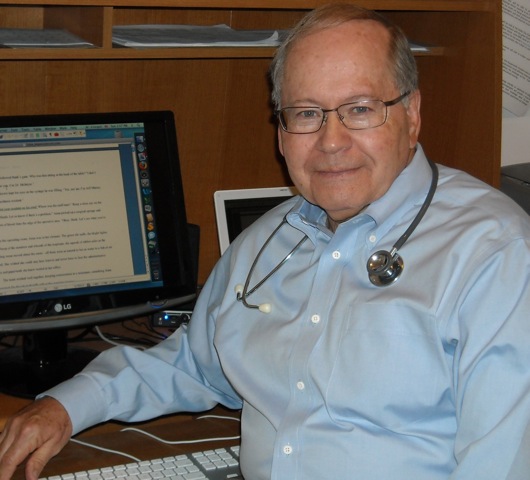
Richard describes his work as “medical suspense with heart.” Medical Error is his second novel. His first novel, Code Blue, was published by Abingdon Press in April of 2010, and will be followed next spring by the third book in the Prescription For Trouble series, Diagnosis Death.
He and his wife, Kay, live in North Texas.
Eric Hatley’s last day alive began routinely enough.
He paused beside his brown delivery truck, shifted the bulky package, and turned in a tight circle to search for the right apartment.
Shouts filled the air. Firecrackers exploded all around him. A dozen red-hot pokers bored holes through his gut.
The package flew from his arms. He crumpled into a privet hedge at the edge of the sidewalk, clutching his midsection and recoiling when his fingers encountered something wet and slimy.
A wave of nausea swept over him. Cold sweat engulfed him.
Eric managed one strangled cry before everything faded to black.
* * *
Dr. Anna McIntyre bumped the swinging door with her hip and backed into Parkland Hospital’s Operating Room Six, her dripping hands held in front of her, palms inward. “Luc, tell me what you’ve got.”
Chief surgical resident, Dr. Luc Nguyn, didn’t look up from the rectangle of abdomen outlined by green draping sheets and illuminated by strong surgical lights. “UPS driver, making a delivery in the Projects. Got caught in the crossfire of a gang rumble. Took four bullets in the belly. Pretty shocky by the time he got here.”
“Find the bleeding source?”
“Most of it was from the gastric artery. Just finished tying it off.”
Anna took a sterile towel from the scrub nurse and began the ritual of gowning and gloving made automatic by countless repetitions. “How about fluids and blood replacement?”
Luc held out his hand, and the nurse slapped a clamp into it. “Lactated Ringer’s, of course—still running wide open. We’ve already pushed one unit of unmatched O negative. He’s finishing his first unit of cross-matched blood. We’ve got another one ready and four more holding in the blood bank.”
“How’s he responding?”
“BP is still low but stable, pulse is slower. I think we’re catching up with the blood loss.”
Anna plunged her hands into thin surgical gloves. “Lab work?”
“Hematocrit was a little over ten on admission, but I don’t think he’d had time to fully hemodilute. My guess is he was nine or less.”
Anna turned slightly to allow the circulating nurse to tie her surgical gown. “Bowel perforations?”
“So far I see four holes in the small intestine, two in the colon.”
“Okay, he’ll need antibiotic coverage. Got that started?”
Luc shrugged. “Not yet. We don’t know about drug allergies. His wallet had ID, but we’re still working on contacting next of kin. Meanwhile, I have Medical Records checking his name in the hospital computer for previous visits.”
“And if he’s allergic—“
The nursing supervisor pushed through the swinging doors, already reading from the slip of paper in her hand. “They found one prior visit for an Eric Hatley, same address and date of birth as on this man’s driver’s license. Seen in the ER two weeks ago for a venereal disease. No history of drug allergy. They gave him IM Omnilex. No problems.”
The medical student who’d been assisting moved two steps to his left. Anna took his place across the operating table from Luc.
Luc glanced toward the anesthesiologist. “Two grams of Omnilex IV please.”
Anna followed Luc’s gaze to the head of the operating table. “I don’t believe I know you. I’m Dr. McIntyre.”
The doctor kept his eyes on the syringe he was filling. “Yes, ma’am. I’m Jeff Murray, first year anesthesia resident.”
A first year resident on his own? Where was the staff man? “Keep a close eye on the blood and fluids. Let us know if there’s a problem.” Anna picked up a surgical sponge and blotted a bit of blood from the edge of the operative area. “Okay, Luc. Let’s see what you’ve got.”
In the operating room, Anna was in her element. The green tile walls, the bright lights, the soft beep of the monitors and whoosh of the respirator, the squeak of rubber soles as the circulating nurse moved about the room—all these were as natural to her as water to a fish or air to a bird. Under Anna’s direction, the team worked smoothly together. Conversation was at a minimum, something she appreciated. Do the job in the OR, talk in the surgeons’ lounge.
“I think that’s got it,” Luc said.
“Let’s check.” Anna’s fingertips explored the depths of the patient’s belly with the delicate touch of a concert violinist. Her eyes roamed the operative field, missing nothing. Luc had done an excellent job. He’d do well in practice when he finished his training in three months.
Anna stepped away from the table. “I think you’re through. Routine closure, leave a couple of drains in. Keep him on antibiotic coverage for the next few days.”
Luc didn’t need to hear that, but she figured the medical student did. She might as well earn her Assistant Professor’s salary with a little low-key teaching.
She stripped off her gloves and tossed them in the waste bucket at the end of the operating table. “If you need me—“
“Luc, we’ve got a problem. Blood pressure’s dropping, pulse is rapid.” A hint of panic rose in the anesthesiologist’s voice.
The scrub nurse held out fresh gloves, and Anna plunged her hands into them. “He must be bleeding again. Maybe one of the ligatures slipped off.”
“No way,” Luc said. “Everything was double-tied, with a stick-tie on the major vessels. You saw yourself, the wound was dry when we finished.”
“Well, we’ve got to go back in and look.” Anna turned to the anesthesiologist. “Run the IV wide open. Hang another unit of blood and send for at least two more. Keep him oxygenated. And get your staff man in here. Now!”
He snapped out a couple of requests to the circulating nurse before turning back to Anna. “He’s getting hard to ventilate. Do you think we might have overloaded him with fluid and blood? Could he be in pulmonary edema?”
“I want your staff doctor in here now! Let him evaluate all that. We’ve got our hands full.” Anna snatched a scalpel from the instrument tray and sliced through the half-dozen sutures Luc had just placed. “Deavor retractor.” She shoved the curved arm of the instrument into the edge of the open wound and tapped the medical student’s hand. “Hold this.”
Anna grabbed a handful of gauze sponges, expecting a gusher of blood from the abdomen. There was none. No bleeding at all within the wound. So why was the blood pressure dropping?
“Pressure’s down to almost nothing.” The anesthesia resident’s voice was strained. “And I’m really having trouble ventilating him.”
Dr. Buddy Jenkins, one of the senior anesthesiologists, pushed through the swinging doors. “What’s going on?”
Anna gave him the short version. “Blood pressure’s dropping, pulse is climbing. We’ve gone back into the belly, but there’s no bleeding. And there’s a problem ventilating him.”
Jenkins moved his resident aside, then slipped a stethoscope under the drapes and listened for a moment. “Wheezes. And no wonder. Look at his face.”
Anna peeked over the screen that separated the patient’s head and upper body from the operative field. Her heart seemed to skip a beat when she saw the swelling of the lips and the red blotches on the man’s face.
“It’s not blood loss,” Jenkins said. “He’s having an anaphylactic reaction. Most likely the blood. Did you give him an antibiotic? Any other meds?”
Anna’s mind was already churning, flipping through mental index cards. Anaphylaxis—a massive allergic reaction, when airways closed off and the heart struggled to pump blood. Death could come quickly. Treatment had to be immediate and aggressive.
“He had two grams of Omnilex,” Luc said. “But his old chart showed—“
Jenkins was in action before Luc stopped speaking. “I’ll give him a cc. of diluted epinephrine by IV push now, then more in a drip.” He turned to the anesthesia resident. “Get that ready— one milligram of epinephrine in a hundred milliliters of saline.”
“Luc, you two close the abdominal wound,” Anna said. “I’m going to break scrub and help Dr. Jenkins.”
Jenkins handed her a syringe. “Give him this Decadron, IV push. I need to adjust the ventilator.”
Anna injected the contents into the patient’s intravenous line. She said a quick prayer that the epinephrine and steroid would turn the tide, that they hadn’t been too late in starting treatment.
The team battled for almost half an hour, at first gaining ground, then losing it steadily. Finally, Jenkins caught Anna’s eye. They exchanged glances. There was no need for words.
She sighed and stepped away from the table. “I’m calling it.” Her voice cracked. “Time of death is eleven oh seven.”
Luc let the instrument he’d been holding drop back onto the tray. Jenkins picked up the anesthesia record and began to scribble. Murray, the anesthesia resident, turned back to his supply table and started straightening the mess. The medical student looked at Anna. She nodded toward the door, and he slipped out of the room. She didn’t blame him. This was probably the first patient he’d seen die.
Anna tossed her gloves and mask into the waste container. She shrugged, but the tension in her shoulders didn’t go away. “Any idea why this happened? The blood was supposed to be compatible. He’d tolerated Omnilex before. What else could have caused it?”
No one offered an answer. And she certainly had none. But she intended to find out.
The OR charge nurse directed Anna to the family room, where she found Hatley’s mother huddled in a corner, twisting a handkerchief and occasionally dabbing at her eyes. The room was small and quiet, the lighting was soft, the chairs as comfortable as possible. A box of tissues sat on the table, along with a Bible and several inspirational magazines. Soft music playing in the background almost covered the hospital sounds drifting in from the nearby surgical suite.
Anna whispered a silent prayer. She’d done this dozens of times, but it never got any easier. She knelt in front of the woman. “Mrs. Hatley, I have bad news for you.”
Anna stumbled through the next several minutes, trying to explain, doing her best to make sense of a situation that she herself couldn’t fully understand. When it came to the matter of permission for an autopsy, Anna wasn’t sure of the medico-legal situation here. Hatley had died after being shot, but his injuries weren’t the cause of death. Would she have to call the County Medical Examiner and get him to order one? The weeping mother solved the problem by agreeing to allow a post-mortem exam.
There was a light tap at the door, and the chaplain slipped into the room. “I’m sorry. I was delayed.” He took the chair next to Mrs. Hatley and began speaking to her in a low voice.
Anna was happy to slip out of the room with a last “I’m so sorry.” Outside, she paused and took several deep breaths.
It took another half-hour for Anna to write a chart note, dictate an operative report and final case summary, and change into clean scrubs. She was leaving the dressing room when her pager sounded. The display showed her office number followed by the suffix “911.” A “stat” page—respond immediately.
As she punched in the number, Anna wondered what else could possibly go wrong today. “Lisa, what’s up?”
“Dr. McIntyre, there are two policemen here. They want to talk with you. And they say it’s urgent.”
* * *
Nick Valentine looked up from the computer and grimaced when he heard the morgue attendant’s rubber clogs clomping down the hall. The summons he knew was coming wasn’t totally unexpected. After all, he was the pathologist on autopsy call this week, which was why he was sitting in this room adjacent to the morgue of Parkland Hospital instead of in his academic office at the medical school. But he’d hoped for some undisturbed time to get this project done.
The attendant stuck his head through the open door. “Dr. Valentine, you’ve got an autopsy coming up. Unexpected death in the OR. Dr. McIntyre’s case. She asked if you could do it as soon as possible. And please page her before you start. She’d like to come down for the post.” The man’s head disappeared like that of a frightened turtle. More clomps down the hall signaled his departure.
There was nothing new about an attending wanting a post-mortem done ASAP. You’d think they’d realize there was no hurry any more, but that didn’t seem to stop them from asking. At least she was willing to come down and watch instead of just reading his report. Nick turned to the shelf behind his desk and pulled out a dog-eared list headed “Frequently Needed Pager Numbers.” He ran his finger down the page. Here it was: Department of General Surgery. Anna E. McIntyre, Assistant Professor. He picked up the phone and punched in her number. After he heard the answering beeps, he entered his extension and hung up.
While he waited, Nick looked first at the pile of papers that covered half his desk, then at the words on his computer screen. He’d put this off far too long. Now he had to get it done. To his way of thinking, putting together this CV, the curriculum vitae that was so important in academics, was wasted effort. Nick had no interest in a promotion, didn’t think he’d get one even if his chairman requested it from the dean. But his chairman wanted the CV. And what the chairman wanted, the chairman got.
The phone rang. Probably Dr. McIntyre calling back.
“Dr. Valentine.”
“Nick, this is Dr. Wetherington. Do you have that CV finished yet?”
“I’m working on it.”
“Well, I need it soon. I want you to get that promotion to Associate Professor, and I have to be able to show the committee why I’ve nominated you. Don’t let me down.”
Nick hung up and riffled through the pile on his desk. Reprints of papers published, programs showing lectures delivered at medical meetings, textbooks with chapters he’d written, certificates from awards received. His professional résumé was pitifully small, but to Nick it represented the least important part of his job. What mattered most to him was what he was about to do: try to find out why the best efforts of a top-notch medical staff failed to save the life of some poor soul. If he did his job well, then maybe those doctors would be able to snatch some other patient from the jaws of the grim reaper.
His phone rang. “Dr. Valentine, are you about ready?” the morgue attendant said.
Nick looked at his watch. Almost half an hour, and Dr. McIntyre hadn’t responded to the page. He hated to start without her, but he might have to. “Give me another ten minutes.”
While he waited, Nick figured he might as well try to make Dr. Wetherington happy. Now when did he deliver that paper before the American Society of Clinical Pathology? And who cared, anyway?
* * *
Her administrative assistant met Anna at the doorway to the outer office. “Dr. McIntyre, I didn’t know what to do.”
“That’s all right, Lisa. I’ll talk with them.” Anna straightened her white coat and walked into her private office, where two people stood conversing in low tones. Lisa had said, “Two policemen,” but Anna was surprised to see that one of them was a woman.
The man stepped forward to meet Anna. “Doctor McIntyre?”
Anna nodded.
He pulled a leather folder from his pocket and held it open for her inspection. Anna could see the gold and blue badge pinned to the lower part of the wallet, but couldn’t read the words on it. The card in the top portion told her, though. It carried a picture beside the words, US Drug Enforcement Administration.
Lisa had been wrong. These people were from the DEA, not the police. Still, an unannounced visit from that agency made most doctors sweat. You never knew when some innocent slip might get you into trouble.
The man flipped the credential wallet closed. “This won’t take long.”
“Good. I’ve just finished an emergency case, and I still have a lot to do.” Anna moved behind her desk and sat.
“Your chairman said you’d give us as much time as we need.”
Anna glanced pointedly at her watch. “Well, have a seat and let’s get to it. What do you need from me?”
The man lowered himself into the chair, his expression slightly disapproving. His partner followed suit. “We have some things we need for you to clear up.”
“Could I see those credentials again?” Anna said. “Both of you.”
They obliged, laying the open wallets on the desk. Anna pulled a slip of notepaper toward her and began copying the information, occasionally glancing up from her writing to match the names and faces on the ID’s with the people sitting across from her. The spokesman was Special Agent John Hale, a chunky, middle-aged man wearing an off-the rack suit that did nothing to disguise his ample middle. Anna thought he looked more like a seedy private eye than an officer of the law.
The woman, the silent half of the pair so far, was Special Agent Carolyn Kramer, a woman who reminded Anna of a California surfer bunny, complete with perfect tan and faultlessly styled short blonde hair. The resemblance stopped there, though. Kramer’s eyes gleamed with a combination of intelligence and determination that told Anna she’d better not underestimate the woman. Kramer wore a stylish pants suit that had probably cost more than Anna made in a week, How could a DEA agent have money for an outfit like that?
Anna handed the badge wallets back to Hale and Kramer. “All right, how can I help you?”
Hale pulled a small notebook from his inside coat pocket and flipped through the pages. “Doctor, recently you’ve been writing a large number of Vicodin prescriptions, all of them for an excessive amount of the drug. Can you explain that?”
“I don’t know what you mean,” Anna said. “I’m pretty sure I haven’t written any more Vicodin ‘scripts than usual, and I certainly haven’t changed my prescribing practices.”
Hale nodded, stone-faced. “What are those practices?”
“I prescribe Vicodin for post-operative pain in many of my patients, but always in carefully controlled amounts, usually thirty pills at a time. By the time they’ve exhausted that first prescription I can generally put them on a non-narcotic pain reliever. It’s rare that I refill a Vicodin ‘script.”
Apparently it was Kramer’s turn in the tag-team match. She picked up a thick leather folder from the floor beside her chair, unzipped it, and extracted a sheaf of papers held together by a wide rubber band. “Would you care to comment on these?” Her soft alto was a marked contrast to Hale’s gruff baritone,
Anna’s eyes went to the clock on her desk. “Will this take much longer? I really have things I need to do.”
Kramer seemed not to hear. She held out the bundle of papers.
“Okay, let me have a look.” Anna recognized the top one in the stack as a prescription written on a form from the faculty clinic. She pulled it free and studied it. The patient’s name didn’t stir any memory, but that wasn’t unusual. She might see twenty or thirty people in a day. The prescription read:
VICODIN TABS
Disp. [#100]
Sig: 1 tab q 4 h PRN pain
At the bottom of the page, three refills were authorized. The DEA number had been written into the appropriate blank on the lower right-hand corner.
Anna squinted, closed her eyes, then looked again. There was no doubt about it. The DEA number was hers. And the name scrawled across the bottom read: Anna McIntyre, MD.
“Can you explain this?” Kramer asked.
A familiar vibration against her hip stopped Anna before she could reply. She pulled her pager free and looked at the display. The call was from the medical center, but she didn’t recognize the number. Not the operating room. Not the clinic. She relaxed a bit when she saw there was no “911” entry after the number. If this was about the autopsy, she’d have to miss it.
Hale picked up the questioning as though there had been no interruption. “What can you tell us about all these prescriptions for Vicodin?”
“I suppose the most important thing I can tell you is that I didn’t write them.” She riffled through the stack, paying attention only to the signature at the bottom of each sheet. “None of these are mine.”
“That’s your number and name. Right?” Kramer said.
“Right. But that’s not my signature. It’s not even close.”
“Can you explain how someone else could be writing prescriptions on your pads using your DEA number?” Hale asked.
“I have no idea.” Anna made no attempt to keep the bitterness out of her words. “Sorry, I’ve just lost a patient, and I’m not in the best of moods. Can’t we wind this up? I didn’t write those ‘scripts, and I don’t know who did.”
Obviously, Hale didn’t want to let the matter go. “You’re sure there’s nothing you want to tell us?”
“What would I have to tell you? I said I don’t know anything about this.”
Kramer spoke, apparently filling the role of good cop. “Take a guess. Help us out here.”
Anna felt her jaw muscles clench. These people were relentless. She had to give them something, or this would never end. “I really don’t know. I mean, we’ve got an established routine, and all the doctors here are pretty careful.”
Kramer pulled a silver ballpoint from the leather folder and began twirling it between her fingers. “Why don’t you walk us through that routine?”
Anna wanted to follow up on Hatley’s autopsy, talk with her department chair about today’s events, eventually sit down and try to relax. She was drained. The agents, on the other hand, seemed to have unlimited time and energy.
“Doctor?” Kramer’s voice held no hint of irritation. Patient, understanding, all the time in the world. Just two women chatting.
“Sorry.” Anna tried to organize her thoughts. “The prescription pads in the faculty clinic are kept in a drawer in each treatment room. That way they’re out of sight, although I guess if someone knew where they were he could latch onto one when no one was in the room.” She looked at the agents. Kramer simply nodded. Hale scowled. “Hey, we know it’s not perfect, but that’s the way we have to do it. Otherwise, we’d waste all our time hunting for a pad.”
“And do you ever forget and leave the pads sitting out when you’ve finished writing a prescription?” Kramer asked.
“Sure. Especially when we’re in a hurry.” Anna’s cheeks burned.
Hale turned a page in his notebook and frowned. “How about your DEA number?”
“You’ll notice those aren’t printed on the forms. Each of us has to fill in our number.”
“Maybe someone else had access to your number. Do nurses ever write the prescriptions for you?” This came from Kramer. Anna felt as though she was watching a tennis match, going back and forth between the two agents.
“When we have a nurse in the room with us, yes, she’ll write the prescription. I don’t know what the other doctors do, but I sign the prescriptions after she writes them. And I add the DEA number to the narcotic ‘scripts myself.”
The questioning went on for another half hour. Anna’s throat was dry, her eyes burned, she felt rivulets of sweat coursing between her shoulder blades. Finally, she’d had enough. “Look, am I being charged with something? Because if I am, I’m not saying another word without a lawyer.”
Hale replaced his notebook in his pocket. Kramer picked up her folder and purse. They let the silence hang for a moment more before exchanging glances, then standing.
“Right now, we’re simply investigating, Doctor,” Hale said. “You may be hearing from the Texas Department of Public Safety and the Dallas Police as well. Also, since your DEA number and identity have been compromised, I’d advise you not to prescribe any controlled substances for now. You’ll receive formal notification in writing tomorrow about applying for a new permit.”
The agents walked out, leaving Anna with her hands pressed to her throbbing temples.
* * *
Nick stepped back from the autopsy table, pressed the pedal under his right foot, and spoke into the microphone hanging near his head. “No other abnormalities noted. The balance of findings will be dictated after review of the histopathology specimens and the results of the toxicology tests. Usual signature. Thanks.” He turned away from the body and gestured to the morgue assistant to close the incisions. “I’ll be in the office if you need me. Thanks for your help.”
Nick removed his goggles and stripped off his mask, gown, and gloves. He was standing at the sink outside the autopsy room, drying his hands, when he heard footsteps hurrying down the corridor toward him. He turned to see a woman approaching. The attractive redhead wore surgical scrubs, covered by a white coat. As she neared him, he could make out the embroidered name above the breast pocket: Anna McIntyre, MD. She stopped in front of him, and the set of her jaw and the flash of her green eyes told Nick she was in no mood for light banter.
“Dr. McIntyre?”
She nodded.
“Nick Valentine. I paged you, but when you didn’t answer I had to go ahead and get started. Sorry.”
She waved away his apology. “No, it’s my fault. I couldn’t break free to answer your page. What can you tell me?”
“Why don’t I buy you a cup of coffee and I’ll tell you what I’ve found so far? If we go to the food court, we can get away from the smell down here. I hardly notice it anymore, but I’ve learned that my visitors aren’t too fond of the odor of chemicals.”
She hesitated for a few seconds. “Okay. Lead the way.”
It seemed to Nick there was a Starbucks on every corner of every major city in the US. Most important to him, however, was the one here in the basement of the Clinical Sciences Building at Southwestern Medical Center. As he waited to order, he sniffed the rich aromas that filled the air. The smell of coffee never failed to lift his spirits. Maybe it would do the same for the woman who stood stoop-shouldered beside him. For most doctors, caffeine was the engine that helped propel them through long days and longer nights. Maybe all she needed was a booster shot.
When they were seated at a corner table with their venti lattes Nick filled her in on his findings at the autopsy he’d just completed. “That’s about it,” he concluded. “I’ll sign the death certificate with the preliminary cause of death as anaphylaxis due to an unknown cause.”
“But you won’t have a final diagnosis until—“
“Right. I’ll review the tissue samples and the results of the toxicology screen, but I doubt that we’ll find anything there. I’m going to have some tests run on the blood samples I took, and maybe that will help us. I’ll need to research whether there’s a good blood test for a drug reaction or latex allergy. The long and short of it is that we may never know the real reason he developed anaphylaxis and died.”
“I hadn’t even thought of latex allergy,” she said. “But that’s pretty rare, isn’t it?”
“Less than one percent of the population. Seen in people chronically exposed to latex: surgeons and nurses, industrial workers, patients with lifelong indwelling catheters.” He felt himself slipping into his lecture mode and made an effort to pull back. “I mean, we could talk about all these uncommon things, but I’ll bet you learned the same thing in medical school that I did. When you hear hoof beats—“
“Think horses, not zebras.” She managed a tiny smile. “Yes, I know. So we should concentrate on the blood or the antibiotic. If it was the blood, there’s a problem in the blood bank because he got one unit of unmatched O negative, which should have been okay, and one unit that was supposedly compatible by cross-match.”
“The residuals in both bags of blood are being re-typed and cross-matched against your patient’s blood as we speak. We’ll know the answer by the time we finish our coffee.” He drank deeply from his cup. “Don’t you think an antibiotic reaction is the most likely cause?”
She took a sip of coffee. “Probably, although I hope not. Choosing an antibiotic wasn’t a routine matter, because we didn’t know if Hatley had any drug allergies. The resident—one of our sharpest ones, by the way—thought he’d see if we could get the information another way. He had medical records check for a previous visit for the patient. They found a recent emergency room visit by the patient where he tolerated Omnilex. Since that antibiotic’s the best choice to cover spillage from a perforated bowel, I agreed with Luc when he ordered it.”
“But—“
“I know. If you give that drug to a patient who’s allergic to it or to penicillin, their reaction is likely to be severe—like this one. But I thought, since we had that history of tolerance, it was okay.” She blinked hard. “I should have known better. Should have made him use a different drug.”
Nick sensed he was treading on thin ice here. Maybe he should change the subject. Besides, he wanted to know more about this woman. “You know, I’ve seen you in the halls, but we’ve never actually met. Did you train here?”
She hesitated before reeling off what had apparently become a stock answer. “Raised in Oklahoma. Graduated from med school in North Carolina. Duke, actually. Lucky enough to get a surgery residency here at Parkland, and when I finished I was offered a faculty position in the Surgery Department. I’ve been here a little less than a year now.”
Nick held up a hand, palm out. “I know better. You don’t get a surgery residency here because you’re ‘lucky.’ You get one because you’re good. Let me guess. AOA at Duke?” If Anna was Alpha Omega Alpha, she must have been in the top ten percent of her class.
“Right. But I don’t guess it’s enough to be bright if you foul up and cost a patient his life.” She drank from her cup, and Nick noticed that she kept swallowing several more times after that.
Nick was barely aware of the activity around him, the ebb and flow of people, the sounds of pagers punctuating dozens of conversations. All he saw was Anna. She was one of the prettiest women he’d encountered in quite a while. But he was certain there was more to this trim, green-eyed redhead than striking good looks. Right now she was focused on medicine—it was obvious she cared a great deal about her patients, and this loss hit her hard—but Nick had a sense that in a different setting she’d be fun to know. And he intended to see if he couldn’t arrange that. Anna shifted in her chair. He couldn’t let her leave yet.
“Wait a minute,” he said. “Aren’t you curious about me at all? There may be a prize if you can answer all the questions later.”
Did he see the ghost of a grin? “Sure. Why not? What’s your story—the Reader’s Digest version?”
Nick moved his cup aside and leaned forward with his elbows on the table. He wasn’t sure how much longer he could draw out their time together, but he was determined to give it his best shot. “My roots are Italian. Named for my grandfather. He was Nicolo Valentino when he got off the boat, changed his name when he got his citizenship. I’m Nicolo the Third.” He ticked off the points on his fingers. “Worked my way through pre-med at Texas Tech. Got into the med school there by the skin of my teeth. Managed to get a residency in pathology here at Southwestern. When I finished, they had an opening in the department.” He held out his hand, palm up, fingers spread, thumb tucked under. “So here I am—four years in the department, still an Assistant Professor. Up for promotion now, and I suspect that if I don’t make it they’ll cut me like a dead branch from a tree.”
Nick’s last sentence rang a faint alarm bell in his head. He had to finish that project or the chairman would be royally ticked off, but it only took Nick a second to put that chore out of his mind. He was sitting with the most beautiful woman he’d ever met. He wanted to get to know her better, and he intended to keep her here as long as possible, even if it meant incurring Dr.. Wetherington’s wrath.
After a patient dies on the operating table on her watch, Dr. Anna McIntyre soon finds that is the least of her troubles. She also learns that she is under investigation by both the FBI and the city police force, her identity has been stolen, and it is up to her to find some answers. As Anna works with Dr. Nick Valentine, a pathologist and her attorney Ross Donovan to solve the mystery, she finds herself drawn to both men.
Why has someone stolen Anna’s identity and how did they manage to do it? How is her stolen identity connected with mysterious deaths and forged prescriptions? Who could be setting her up? Will Anna choose Nick or Ross? You can find the answers to these and other questions if you pick up a copy of Medical Error for yourself. I highly recommend that you do so.