Book Giveaway – Thirsty by Tracey Bateman

thirstyI have one copy of Thirsty by Tracey Bateman to give away this weekend. If you would like to be entered, please leave a comment telling me your opinion on Christian “vampire” novels. Entry deadline will be Tuesday, November 24. I will announce the winner Wednesday, November 25.

U. S. residents only please.

Love Finds You in Lonesome Prairie Montana

It is time for a FIRST Wild Card Tour book review! If you wish to join the FIRST blog alliance, just click the button. We are a group of reviewers who tour Christian books. A Wild Card post includes a brief bio of the author and a full chapter from each book toured. The reason it is called a FIRST Wild Card Tour is that you never know if the book will be fiction, non~fiction, for young, or for old…or for somewhere in between! Enjoy your free peek into the book!

You never know when I might play a wild card on you!


Today’s Wild Card authors are:


and the book:


Love Finds You In Lonesome Prairie, Montana

Summerside Press (December 1, 2009)

***Special thanks to Amy Lathrop of LitFUSE Publicity Group for sending me a review copy.***

ABOUT THE AUTHOR:


Tricia Goyer was named Mount Hermon Christian Writers Conference “Writer of the Year” in 2003. Her book Night Song won Book of the Year from ACFW in the Long Historical Fiction category. Her book Life Interrupted: The Scoop On Being a Young Mom was a Gold Medallion Finalist. Tricia has written hundreds of articles, Bible Study notes, and both fiction and non-fiction books.

Visit the author’s website.


Ocieanna Fleissis a published writer and has edited six of Tricia Goyer’s historical novels. She lives with her husband and their four children in the Seattle area. Connect with Ocieanna on Facebook!

Product Details:

List Price: $12.99
Paperback: 320 pages
Publisher: Summerside Press (December 1, 2009)
Language: English
ISBN-10: 1935416294
ISBN-13: 978-1935416296

AND NOW…THE FIRST CHAPTER:

The sound of little girls’ voices and the sight of the sun streaming through the tall, second-story window of the Open Door Home for Destitute Girls, a privately owned orphanage on upper Manhattan, told nineteen-year-old Julia Cavanaugh that the day had started without her. Julia, an orphan herself, now running the place for the owner, brushed a strand of dark hair from her eyes. She submitted to a second yawn as a twelve-year-old girl hopped onto her bed.


“He’s gonna ask her to marry him, don’t you think, Miss Cavanaugh?”

“Oh, Shelby.” Julia wiped the sleep from her eyes and smiled into the freckled face staring eagerly at her. “Give me a moment to wake before you go asking such things.” Julia stroked the girl’s cheek, her heart seeming to double within her chest with love for the youngster.

The embroidery sampler she’d fallen asleep working on still lay at the end of her bed. She picked it up and eyed the image of a small house she’d copied from Godey’s Lady’s Book. Above the house, she’d stitched the words Home Sweet Home in fancy script. Gazing around the broad room lined with small metal cots and bustling with little-girl chatter, Julia noted the embroidered pillowslips, carefully pressed—albeit dingy—curtains, and dandelions smiling from scavenged jam-jar vases. She’d done her best to make the room pleasant for the girls—and herself. She glanced at their faces and smiled, gladly embracing her role as caretaker.

A less-than-subtle “ahem” from Shelby reminded Julia she’d been asked a question. She glanced at her young charge, still perched on the end of her bed. “What did you ask?”

“Finally.” Shelby eyed her with mock frustration. “I said, do you think they will get married—Mrs. Hamlin and Mr. Gaffin? Haven’t you noticed the way they look at each other?” Shelby’s cheeks hinted of red. Her golden hair was already fixed in a proper bun, her hands and face washed, and her simple dress clean and pressed despite its patches and stray threads.

“Shelby Bruce.” Julia shook her head, as Shelby’s two-year-old sister Beatrice wiggled onto Julia’s lap with a squeal. Julia planted a firm kiss on the top of Bea’s head.

“Married? I don’t think so,” Julia continued. “Mrs. Hamlin would’ve told us—told me—if she was being courted. Mr. Gaffin’s just an old family friend.” Julia wondered where on earth the girl got the notion that their headmistress wished to marry.

Although they have been spending a lot of time together. Julia pushed the thought out of her mind as little Bea shuffled to a stand, planting her pint-sized feet on Julia’s thighs. “Fammy fend!” She pointed a chubby finger at her older sister, Shelby.

“All right, Bea.” Julia plopped the toddler on the floor and swiveled her toward the small bed she shared with Shelby. “Time to straighten your bed.” Then Julia eyed the twins. “Charity, Grace, would you two virtuous girls fetch fresh water for the basin?”

Shelby pushed away from the bed, wrinkled her brow, and thrust her hand behind her as if to support her back—a perfect imitation of their middle-aged headmistress. “Now where did I put my spectacles?” Shelby clucked her tongue as she waddled forward.

Laughter spilled from the lips of the girls around the room. Encouraged, Shelby scratched her head. She plopped down on her bed then hopped up again as if surprised, pulling imaginary spectacles from under her rump. “Oh!” she squealed. “There they are.”

The laughter grew louder, and Julia pursed her lips together to smother the impulse to laugh along with them. She planted her fists on her hips. “That’s enough. All of you know what must be done before breakfast.” The girls’ laughter quieted to soft giggles hidden behind cupped palms as they scattered to do their chores.

Shelby lingered behind, her form now straight and her eyes pensive. “Maybe she forgot to tell you, Miss Cavanaugh.” The young girl gazed up at her. “The way they look at each other—it’s like my ma and pa used to, that’s all.”

Julia folded a stray sandy blond curl behind the girl’s ear. “Don’t worry, my sweet. If Mrs. Hamlin was getting married, we’d be the first to know.”

Julia hoped her own gaze didn’t reflect the sinking disquiet that draped her. Mr. Gaffin was a rich world traveler. If there was any truth to Shelby’s suspicion, Julia couldn’t imagine he’d let Mrs. Hamlin continue to work with orphans. Perhaps they’d get a new headmistress.

Or maybe the girls would be separated, moved to new homes…

If Mrs. Hamlin got married, all their lives would be radically changed. And if Julia had to leave the orphanage, she had no idea what she would do. Julia swept that painful thought away and steadied her gaze at Shelby. She couldn’t hide her true feelings from this girl. Julia took Shelby’s hand and answered as honestly as she could.

“I don’t think she’ll get married, but if she does, God will take care of us, like He always has.” Julia lifted her chin in a smile. “And really, Mrs. Hamlin may be forgetful, but no one could forget that. I sure wouldn’t.”

Ardy, a shy Swedish girl, removed her dirty sheets from a small bed and then approached, taking Julia’s hand. “Don’t ya think you’ll ever be gettin’ married?”

“Actually, there is something I’ve been wanting to tell you all….” Julia leaned forward, resting her hands on her knees.

The two girls eyed each other in surprise, and Shelby’s brow furrowed.

“Come closer.” Julia curled a finger, bidding them.

“What is it?” Shelby asked, her eyes glued to Julia.

The girls leaned in. “I’d like to tell you…that there’s a wonderful man who’s asked me to marry him!”

The squeals of two girls erupted, followed by the cheers of nearly three dozen others who’d been quietly listening from the stairwell.

“There is?” Shelby reached forward and squeezed Julia’s hand.

Julia let out a hefty sigh and giggled. “No, you sillies. Well, at least not yet. Someday. Maybe.”

Shelby pouted “But you said… ”

“I said I’d like to tell you I had a man. I’d sure like to, but of course since I don’t, I’m happy to stay here with all of you.”

The girls moaned.

The squeak of the front door down on the first floor of the Revolutionary War–era home-turned-orphanage drew their attention. They waited as Mrs. Hamlin’s familiar chortle filled the air, along with a bash and clang of items—hopefully food and supplies that she’d picked up.

“Julia!” Mrs. Hamlin yelped. “Julia, dear, where are you?”

“Coming.” Julia hurried down the stairs to help the older woman.

Julia neared the bottom of the steps and paused, trying to stifle a laugh at the sight of the twinkly-eyed woman sprawled flat on her back. Scattered boxes and bags covered the donated rug.

“Mrs. Hamlin! What on earth? Why didn’t you get a steward to help you?”

“Oh, I didn’t want to be a bother.” She cheerfully picked herself up. “I was in such a hurry to show you all what I’d bought. And to tell you my surprise. Such a wonderful surprise.” Julia eyed the boxes and noted they were from R.H. Macy & Co. More than a dozen boxes waited to be opened, and she couldn’t imagine the cost.

“I found just what the girls need, and on sale!” the headmistress exclaimed.

What they need is more food—vitamin drops, too—and maybe a few new schoolbooks. But Julia didn’t dare say it. And somehow God’s hand of providence always provided.

“New clothes, I gather. That is a surprise.”

“But only half of it, dear.” Mrs. Hamlin rubbed her palms expectantly. “I also must tell you my news. The best news an old widow could hope for.”

Julia followed Mrs. Hamlin’s gaze toward the idle youngsters who’d gathered on the staircase to watch. Her eyes locked with Shelby’s, then she quickly looked away. “News?” The muscles in Julia’s stomach tightened.

“Girls,” Julia shooed them away with a wave of her hand, “you know better than to eavesdrop. Off to chores with you. We’ll have breakfast soon.”

The girls started to scurry off, but Mrs. Hamlin halted them with her words.

“No, no,” her high-pitched voice hailed. “Come back. This news is for all of you.” They circled around her, and she tenderly patted their bobbing heads.

“What is it?” Julia wasn’t sure she’d ever seen Mrs. Hamlin’s cheeks so rosy or her eyes so bright.

“I’m getting married!”

MY REVIEW:

Love Finds You in Lonesome Prairie Montana is a curl up by the fire story for those times when you would just like to relax. A historical novel, it takes the reader back to the days of orphan trains and wide open prairies where friends and neighbors are few and far between.

When Julie accompanies several orphans to their new homes in Lonesome Prairie, she not only finds that she has missed the train back home but she has been promised in marriage to an old, unkempt miner. Pastor Ike saves the day by encouraging the miner to wait and sending Julia home with his sister. From that point on the story is filled with chuckles, drama, misunderstandings, and new friendships. As her time in Lonesome Prairie is extended, Julia finds herself with a growing faith and a new feeling of being part of a family.

Will Julia make Lonesome Prairie her home? Will she and Pastor Ike overcome the barriers that keep them apart? I’ll never tell. Pick up a copy of Love Finds You in Lonesome Prairie Montana and find out for yourself.

Thirsty by Tracey Bateman

MY REVIEW:

Christian “vampire” novels seem to be showing up more frequently – no doubt a result of the overwhelming success of the Twilight series. Having read and reviewed a couple of them during the past year, I was not too excited about another one. I am happy to say that Thirsty is not another typical vampire tale.

The primary plot of Thirsty revolves around Nina Parker who is once again trying to live her life sober after another session in alcohol rehab. Her many failures have cost her pretty much everything – her marriage, a once close relationship with her teen daughter, her veterinary practice and her self-respect. When she returns to her home town to try to get her life back together, she is confronted with the past she ran from and someone she doesn’t remember who remembers her to the point of obsession. That person just happens to be a vampire who wants to be loved in spite of what he is.

The vampires in Thirsty serve to add some danger and suspense to the story that could have been done with a normal serial killer, etc. However, the author has chosen to use the contrast of Nina’s thirst for alcohol with the vampire’s thirst for blood.

Thirsty is an easy to read story once the reader figures out the differing points of view. It tells Nina’s story in first person  through journal entries and second person for  current events, and her husband Hunt’s point of view is told in first person. The vampire’s story is related to Nina by Markus as he tells her the local legends. Good points throughout which include reaping what you sow, forgiveness, restoration, and dependence on the Lord. Would recommend this book in spite of the vampires.


thirstyThere’s no place like home, they say.

“Hello, I’m Nina Parker…and I’m an alcoholic.” For Nina, it’s not the weighty admission but the first steps toward recovery that prove most difficult. She must face her ex-husband, Hunt, with little hope of making amends, and try to rebuild a relationship with her angry teenage daughter, Meagan. Hardest of all, she is forced to return to Abbey Hills, Missouri, the hometown she abruptly abandoned nearly two decades earlier–and her unexpected arrival in the sleepy Ozark town catches the attention of someone–or something–igniting a two-hundred-fifty-year-old desire that rages like a wildfire. Unaware of the darkness stalking her, Nina is confronted with a series of events that threaten to unhinge her sobriety. Her daughter wants to spend time with the parents Nina left behind. A terrifying event that has haunted Nina for almost twenty years begins to surface. And an alluring neighbor initiates an unusual friendship with Nina, but is Markus truly a kindred spirit or a man guarding dangerous secrets? As everything she loves hangs in the balance, will Nina’s feeble grasp on her demons be broken, leaving her powerless against the thirst? The battle between redemption and obsession unfold to its startling, unforgettable end.

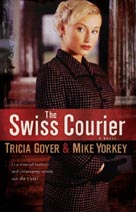
The Swiss Courier by Tricia Goyer and Mike Yorkey – FIRST Blog Tour

It is time for a FIRST Wild Card Tour book review! If you wish to join the FIRST blog alliance, just click the button. We are a group of reviewers who tour Christian books. A Wild Card post includes a brief bio of the author and a full chapter from each book toured. The reason it is called a FIRST Wild Card Tour is that you never know if the book will be fiction, non~fiction, for young, or for old…or for somewhere in between! Enjoy your free peek into the book!

You never know when I might play a wild card on you!


Today’s Wild Card authors are:


and the book:


The Swiss Courier

Revell (October 1, 2009)

***Special thanks to Amy Lathrop of the LitFUSE Publicity Group for sending me a review copy.***

ABOUT THE AUTHORS:


Tricia Goyer is the author of several books, including Night Song and Dawn of a Thousand Nights, both past winners of the ACFW’s Book of the Year Award for Long Historical Romance. Goyer lives with her family in Montana.

Visit the author’s website.


Mike Yorkey is the author or coauthor of dozens of books, including the bestselling Every Man’s Battle series. Married to a Swiss native, Yorkey lived in Switzerland for 18 months. He and his family currently reside in California.

Visit the author’s website.

Product Details:

List Price: $13.99
Paperback: 336 pages
Publisher: Revell (October 1, 2009)
Language: English
ISBN-10: 0800733363
ISBN-13: 978-0800733360

AND NOW…THE FIRST CHAPTER:


To the Reader


In the early afternoon of July 20, 1944, Colonel Claus Graf von Stauffenberg confidently lugged a sturdy briefcase into Wolfsschanze—Wolf’s Lair—the East Prussian redoubt of Adolf Hitler. Inside the black briefcase, a small but powerful bomb ticked away, counting down the minutes to der Führer’s demise.

Several generals involved in the assassination plot arranged to have Stauffenberg invited to a routine staff meeting with Hitler and two dozen officers. The one o’clock conference was held in the map room of Wolfsschanze’s cement-lined underground bunker. Stauffenberg quietly entered the conference a bit tardy and managed to get close to Hitler by claiming he was hard of hearing. While poring over detailed topological maps of the Eastern Front’s war theater, the colonel unobtrusively set the briefcase underneath the heavy oak table near Hitler’s legs. After waiting for an appropriate amount of time, Stauffenberg excused himself and quietly exited the claustrophobic bunker, saying he had to place an urgent call to Berlin. When a Wehrmacht officer noticed the bulky briefcase was in his way, he inconspicuously moved it away from Hitler, placing it behind the other substantial oak support. That simple event turned the tide of history.

Moments later, a terrific explosion catapulted one officer to the ceiling, ripped off the legs of others, and killed four soldiers instantly. Although the main force of the blast was directed away from Hitler, the German leader nonetheless suffered burst eardrums, burned hair, and a wounded arm. He was in shock but still alive—and unhinged for revenge.

Stauffenberg, believing Hitler was dead, leaped into a staff car with his aide Werner von Haeften. They talked their way out of the Wolfsschanze compound and made a dash for a nearby airfield, where they flew back to Berlin in a Heinkel He 111. When news got out that Hitler had survived, Stauffenberg and three other conspirators were quickly tracked down, captured, and executed at midnight by a makeshift firing squad.

An enraged Hitler did not stop there to satisfy his bloodlust. For the next month and a half, he instigated a bloody purge, resulting in the execution of dozens of plotters and hundreds of others remotely involved in the assassination coup. The Gestapo, no doubt acting under Hitler’s orders, treated the failed attempt on the Führer’s life as a pretext for arresting 5,000 opponents of the Third Reich, many of whom were imprisoned and tortured.

What many people do not know is that Hitler’s manhunt would dramatically alter the development of a secret weapon that could turn the tide of the war for Nazi Germany—the atomic bomb.

This is that story . . .

1

Waldshut, Germany

Saturday, July 29, 1944

4 p.m.

He hoped his accent wouldn’t give him away. The young Swiss kept his head down as he sauntered beneath the frescoed archways that ringed the town square of Waldshut, an attractive border town in the foothills of the southern Schwarzwald. He hopped over a foot-wide, waterfilled trench that ran through the middle of the cobblestone square and furtively glanced behind to see if anyone had detected his presence.

Even though Switzerland lay just a kilometer or two away across the Rhine River, the youthful operative realized he no longer breathed free air. Though he felt horribly exposed—as if he were marching down Berlin’s Kurfürstendamm screaming anti-Nazi slogans—he willed himself to remain confident.

His part was a small but vital piece of the larger war effort. Yes, he risked his life, but he was not alone in his passion. A day’s drive away, American tanks drove for the heart of Paris—and quickened French hearts for libération. Far closer, Nazi reprisals thinned the ranks of his fellow resisters. The young man shuddered at the thought of being captured, lined up against a wall, and hearing the click-click of a safety being unlatched from a Nazi machine gun. Still, his legs propelled him on.

Earlier that morning, he’d introduced himself as Jean- Pierre to members of an underground cell. The French Resistance had recently stepped up their acts of sabotage after the Allies broke out of the Normandy beachhead two weeks earlier, and they’d all taken nom de guerres in their honor.

Inside the pocket of his leather jacket, Jean-Pierre’s right hand formed a claw around a Mauser C96 semiautomatic pistol. His grip tightened, as if squeezing the gun’s metallic profile would reduce the tension building in his chest. The last few minutes before an operation always came to this.

His senses peaked as he took in the sights and sounds around him. At one end of the town square, a pair of disheveled older women complained to a local farmer about the fingerling size of the potato crop. A horse-drawn carriage, transporting four galvanized tin milk containers, rumbled by while a young newsboy screamed out, “Nachrichten!” The boy’s right hand waved day-old copies of the Badische Zeitung from Freiburg, eighty kilometers to the northwest.

Jean-Pierre didn’t need to read the newspaper to know that more men and women were losing their lives by the minute due to the reprisals of a madman.

Though the planned mission had been analyzed from every angle, there were always uncertain factors that would affect not only the outcome of the mission but who among them would live. Or die.

Their task was to rescue a half-dozen men arrested by local authorities following the assassination attempt on Reichskanzler Adolf Hitler. If things went as Jean-Pierre hoped, the men would soon be free from the Nazis’ clutches. If not, the captives’ fate included an overnight trip to Berlin, via a cattle car, where they would be transported to Gestapo headquarters on Prinz-Albrecht-Strasse 8. The men would be questioned—tortured if they weren’t immediately forthcoming— until names, dates, and places gushed as freely as the blood spilling upon the cold, unyielding concrete floor.

Not that revealing any secrets would save their lives. When the last bit of information had been wrung from their minds, they’d be marched against a blood-spattered wall or to the gallows equipped with well-stretched hemp rope. May God have mercy on their souls.

Jean-Pierre willed himself to stop thinking pessimistically. He glanced at his watch—a pricey Hanhart favored by Luftwaffe pilots. His own Swiss-made Breitling had been tucked inside a wooden box on his nightstand back home, where he had also left a handwritten letter. A love note, actually, to a woman who had captured his heart—just in case he never returned. But this was a time for war, not love. And he had to keep reminding himself of that.

Jean-Pierre slowed his gait as he left the town square and approached the town’s major intersection. As he had been advised, a uniformed woman—her left arm ringed with a red armband and black swastika—directed traffic with a whistle and an attitude.

She was like no traffic cop he’d ever seen. Her full lips were colored with red lipstick. Black hair tumbled upon the shoulder epaulettes of the Verkehrskontrolle’s gray-green uniform. She wielded a silver-toned baton, directing a rambling assortment of horse-drawn carriages, battered sedans, and hulking military vehicles jockeying for the right of way.

She looked no older than twenty-five, yet acted like she owned the real estate beneath her feet. Jean-Pierre couldn’t help but let his lips curl up in a slight grin, knowing what was to come. “Entschuldigung, wo ist das Gemeindehaus?” a voice said beside him. Jean-Pierre turned to the rotund businessman in the fedora and summer business suit asking for directions to City Hall.

“Ich bin nicht sicher.” He shrugged and was about to fashion another excuse when a military transport truck turned a corner two blocks away, approaching in their direction.

“Es tut mir Leid.” With a wave, Jean-Pierre excused himself and sprinted toward the uniformed traffic officer. In one quick motion, his Mauser was drawn.

He didn’t break stride as he tackled the uniformed woman to the ground. Her scream blasted his ear, and more cries from onlookers chimed in.

Jean-Pierre straddled the frightened traffic officer and pressed the barrel of his pistol into her forehead. Her shrieking immediately ceased.

“Don’t move, and nothing will happen to you.”

Jean-Pierre glanced up as he heard the mud-caked transport truck skid to a stop fifty meters from them.

A Wehrmacht soldier hopped out. “Halt!” He clumsily drew his rifle to his right shoulder.

Jean-Pierre met the soldier’s eyes and rolled off the female traffic officer.

A shot rang out. The German soldier’s body jerked, and a cry of pain erupted from his lips. He clutched his left chest as a rivulet of blood stained his uniform.

“Nice shot, Suzanne.” Jean-Pierre jumped to his feet, glancing at the traffic cop, her stomach against the asphalt with her pistol drawn.

Suzanne rose from the ground, crouched, and aimed.

Her pistol, which had been hidden in an ankle holster, was now pointed at the driver behind the windshield. The determined look in her gaze was one Jean-Pierre had come to know well.

One, two, three shots found their mark, shattering the truck’s glass into shards. The driver slumped behind the wheel.

As expected, two Wehrmacht soldiers jumped out of the back of the truck and took cover behind the rear wheels.

Before Jean-Pierre had a chance to take aim, shots rang out from a second-story window overlooking the intersection.

The German soldiers crumbled to the cobblestone pavement in a heap.

“Los jetzt!” He clasped Suzanne’s hand, and they sprinted to the rear of the truck. Two black-leather-coated members of their resistance group had already beaten them there.

Jean- Pierre couldn’t remember their names, but it didn’t matter.

What mattered was the safety of the prisoners in the truck. Jean-Pierre only hoped the contact’s information had been correct.

With a deep breath, he lifted the curtain and peered into the truck. A half-dozen frightened men sat on wooden benches with hands raised. Their wide eyes and dropped jaws displayed their fear.

“Don’t shoot!” one cried.

The sound of a police siren split the air.

“Everyone out!” Jean-Pierre shouted. “I’ll take this one. The rest of you, go with them.” He pointed the tip of his Mauser at the men in leather jackets.

The sirens increased in volume as the speeding car gobbled up distance along the Hauptstrasse, weaving through the autos and pedestrians. An officer in the passenger’s seat leaned out, rifle pointed.

Jean-Pierre leaned into the truck and yanked the prisoner’s arm. Suzanne grabbed the other. “Move it, come on!”

Bullets from an approaching vehicle whizzed past Jean- Pierre’s ear. The clearly frightened prisoner suddenly found his legs, and the three sprinted away from the speedingcar.

Jean-Pierre’s feet pounded the pavement, and he tugged on the prisoner’s arm, urging him to run faster. He could hear the screech of the tires as the police car stopped just behind the truck. Jean-Pierre hadn’t expected the local Polizei to respond so rapidly.

They needed to find cover—

More gunfire erupted, and as if reading his thoughts, Suzanne turned the prisoner toward a weathered column. Jean-Pierre crumbled against the pillar, catching his breath.

The columns provided cover, but not enough. Soon the police would be upon them. They had to make a move. Only ten steps separated them from turning the street corner and sprinting into Helmut’s watch store. From there, a car waited outside the back door.

Another hail of gunfire struck the plaster. Jean-Pierre mouthed a prayer under his breath.

“Suzanne, we have to get out of here!”

She crouched into a trembling ball, all confidence gone. “They’re surrounding us!” The terror in her uncertain timbre was clear. “But what can we do? We can’t let them see us run into the store.”

“Forget that. We have no choice!” Jean-Pierre raised his pistol and returned several volleys, firing at the two policemen perched behind a parked car.

“Listen to me,” he said to Suzanne, taking his eyes momentarily off the police car. “You have to go. You take this guy, and I’ll cover you. Once you turn the corner, it’s just twenty more meters to Helmut’s store.” His hands moved as he spoke, slamming a new clip of ammunition into his pistol.

“But what if—”

“I’ll join you. Now go!”

Jean-Pierre jumped from behind the protection of the column and rapidly fired several shots. One cop dared expose himself to return fire—not at Jean-Pierre but at the pair running for the corner.

No!

Jean-Pierre turned just in time to see Suzanne’s body lurch. The clean hit ripped into her flesh between the shoulder blades. She staggered for a long second before dropping with a thud. The gangly prisoner didn’t even look back as he disappeared around the corner.

I can’t lose him, Jean-Pierre thought, remembering again the importance of this mission.

Yet to chase after the prisoner meant he’d have to leave his partner behind.

Suzanne . . .

He emptied his Mauser at the hidden policemen, ducking as he scrambled toward his partner. Sweeping up her bloody form, he managed to drag her around the corner to safety.

“Go,” Suzanne whispered.

“I can’t leave you. Stay with me—”

Her eyelids fluttered. “You need to go . . .” A long breath escaped, and her gaze fixed on a distant point beyond him.

Jean-Pierre dropped to his knees and ripped open Suzanne’s bloodstained woolen jacket. Her soaked chest neither rose nor fell. He swore under his breath and brushed a lock of black hair from her face.

Jean-Pierre cocked his head. Incessant gunfire filled the air. His colleagues were apparently keeping the German soldiers and local Polizei at bay, at least for the time being. He knew only a few valuable seconds remained to escape with the prisoner.

He planted a soft kiss on Suzanne’s forehead. “Until we see each other in heaven,” he whispered.

Jean-Pierre darted to a trash can, where the shaken prisoner had hunkered down, covering his head. The resistance fighter clutched the man’s left arm and hustled him inside the watch store, pushing past two startled women. The rear door was propped open, and a black Opel four-door idled in the alley.

With a few quick steps, they were inside the vehicle.

Before the rear door was shut, the driver jerked the car into gear, and the Opel roared down the tight alley. The door slammed shut, and Jean-Pierre glanced back. No one followed.

The car merged onto a busier street, and only then did Jean-Pierre sink in his seat and close his eyes.

Soon they’d arrive at a safe house pitched on the Rhine River. And later, with the dark night sky as their protection, a skiff would sneak them into the warm arms of Mother

Switzerland—a skiff piloted by the mentor who’d recruited him. His nom de guerre: Pascal.

Jean-Pierre’s mission would soon be complete, but at what cost? Another agent—a good woman and a friend—had been sacrificed.

He had followed orders for the greater good, to save the life of a nameless prisoner. He only hoped this mission was worth it.

Tricia Goyer and Mike Yorkey, The Swiss Courier: A Novel,

Revell Books, a division of Baker Publishing Group, © 2009. Used by permission

MY REVIEW:

I reviewed The Swiss Courier for an earlier CFBA blog tour. Read my review here.

Eternity Falls by Kirk Outerbridge

This week, the
Christian Fiction Blog Alliance
is introducing
Eternity Falls
Marcher Lord Press (October 1, 2009)
by
Kirk Outerbridge

ABOUT THE AUTHOR:

Kirk Outerbridge developed a passion for storytelling at an early age. Through years of reading Fantasy and Science Fiction novels, comics, table top gaming and watching endless hours Japanese anime, he developed a keen sense for what made stories enjoyable and more importantly—what didn’t.

While pursuing an engineering degree in college, Kirk endeavored to tell his own stories, choosing writing as the easiest and cheapest medium to master—or so he thought. Several years and several hundred thousand words later, he produced a Sci-fi trilogy that shall never (God willing) see the light of day, but that did teach him much needed lessons about the craft of writing fiction.

After college Kirk returned to his homeland of Bermuda where he reunited with his childhood friend and future wife, Ria. But before marrying his lovely wife, Kirk entered an even greater marriage and devoted his life to Christ in 2002.

With a new found direction in life, writing fell by the wayside but the urge to tell futuristic stories never left. After much prayer and contemplation, Kirk purposed his writing for God’s Will, seeking to draw to Christ those who shared his passions for all things futuristic and Sci-fi.

Kirk currently lives with his wife Ria and 18 month old son Miles in beautiful Bermuda. He is a faithful member of the Church of Christ and is a professional engineer employed by the government.

ABOUT THE BOOK:
In the future, death is only a problem if you can’t afford the price. Such is the promise of Gentec Corporation’s “Miracle Treatment”, a genetic anti-aging elixir that grants eternal life—or does it?

When a Gentec client suddenly dies of natural causes, the powers that be will stop at nothing to ensure their version of eternity remains unchallenged; even if it means concocting a religious sabotage conspiracy to cover a lie.

With the media about to blow the story wide open, the credibility of Gentec and the lives of millions of clients rest on one man’s ability to uncover the truth. Enter detective Rick Macey, religious counterterrorist expert and Gentec executive Sheila Dunn’s last hope for salvation.

Now with the clock ticking and the corporate brass seeking their own solution at any cost, Macey must track down a religious zealot out to destroy the Miracle Treatment for good.

But when Macey finds himself not only falling for his client, but confronted with the possibility that the culprit could hold a connection to his shaded past, the truth suddenly becomes a dangerous thing.

Only through a test of faith can he stop the crisis before it’s all too late and eternity falls.

If you would like to read an excerpt from Chapter 1 of Eternity Falls, go HERE.
Learn more about Kirk and his books on his Website.

MY REVIEW:

Eternity Falls is a fast paced, extremely readable tale of a futuristic Los Angeles only too easy to believe – the signs are already here. Filled with plenty of action, danger, cyborgs with human brains, 80-year-old humans in 30-year-old bodies, cyberweapons, gunfights, superhuman exploits, and yes, even a little romance, Eternity Falls has a little something for everyone. Good character development and a plot that moves along with a few surprises are just a couple of reasons to read this book.

Not only is Eternity Falls a great story for those who crave plenty of action but it manages to raise some pretty serious issues to think about. What happens when humans are enabled to live forever? Are their lives really any happier or more productive? Who has the authority to choose who lives, who dies, and when? In a future where God is largely ignored, the answers may be surprising – or maybe not.