Don’t Look Back by Lynette Eason


MY REVIEW:

Don’t Look Back is an absolutely can’t-stop-reading, heart-pounding book. The plot starts with a bang and accelerates to a breath-taking finale. This is one book that will have you looking over your shoulder for awhile after you read it.

When a buried body is discovered, forensic anthropologist Jamie Cash is called in to work on the case. To her horror, she recognizes similarities to her own brutal kidnapping twelve years earlier. With the discovery of other bodies, it is evident that a serial killer is responsible and several threatening incidents make it clear that he and Jamie’s kidnapper are the same person who is determined to finish what he started with Jamie. FBI agent Dakota Richards, secretly in love with Jamie for quite awhile, is equally determined to protect Jamie at any cost.

Although I suspected the identity of the ‘Hero’ well before he was revealed, there were enough surprises and twists in the story to keep me from being 100% certain.  With a fast paced plot, realistic and engaging characters, tender romance, over-the-top suspense, and a message of faith woven throughout,  Don’t Look Back is a must read for lovers of suspense and modern crime novels. Don’t miss it!


This book was provided for review by Revell, a division of Baker Publishing Group.


ABOUT THE BOOK:

a riveting combination of  heart-stopping
suspense and heartwarming romance

Twelve years ago, forensic anthropologist Jamie Cash survived a brutal kidnapping, torture, and rape. After years of therapy, she has made a life for herself—though one that is haunted by memories of her terrifying past.

She finally lets herself get close to a man, FBI agent Dakota Richards, when signs start appearing that point to one frightening fact—her attacker is back and ready to finish the job he started all those year ago. Can she escape his grasp a second time? And will she ever be able to let down her guard enough to find true love?

Filled with heart-stopping suspense, gritty realism, and a touch of romance, Don’t Look Back is the second book in the Women of Justice series.

Readers will be hooked from the beginning, finding that once you are in Lynette Eason’s world, you’re trapped until you turn the very last page.

ABOUT THE AUTHOR:

Lynette Eason is the author of Too Close to Home and three other romantic suspense novels. She is a member of American Fiction Christian Writers and Romance Writers of America. A homeschooling mother of two, she has a master’s degree in education from Converse College. She lives in South Carolina.

Two Tickets to the Christmas Ball by Donita K. Paul

It is time for a FIRST Wild Card Tour book review! If you wish to join the FIRST blog alliance, just click the button. We are a group of reviewers who tour Christian books. A Wild Card post includes a brief bio of the author and a full chapter from each book toured. The reason it is called a FIRST Wild Card Tour is that you never know if the book will be fiction, non~fiction, for young, or for old…or for somewhere in between! Enjoy your free peek into the book!

You never know when I might play a wild card on you!


Today’s Wild Card author is:


and the book:


Two Tickets to the Christmas Ball

WaterBrook Press (October 5, 2010)

***Special thanks to Ashley Boyer and Staci Carmichael of Waterbrook Multnomah for sending me a review copy.***

ABOUT THE AUTHOR:

Expertly weaving together fantasy, romance and Biblical truths, Donita K. Paul penned the best-selling, fan-favorite DragonKeeper Chronicles series. After retiring early from teaching, she began a second career as an award-winning author and loves serving as a mentor for new writers of all ages. And when she’s not putting pen to paper, Donita makes her home in Colorado Springs and enjoys spending time with her grandsons, cooking, beading, stamping, and knitting.

Visit the author’s website.


Product Details:

List Price: $14.99
Hardcover: 240 pages
Publisher: WaterBrook Press (October 5, 2010)
Language: English
ISBN-10: 0307458997
ISBN-13: 978-0307458995

AND NOW…THE FIRST CHAPTER:

Christmas. Cora had been trying to catch it for four years. She scurried down the sidewalk, thankful that streetlights and brightly lit storefronts counteracted the gloom of early nightfall. Somewhere, sometime, she’d get a hold of how to celebrate Christmas. Maybe even tonight.


With snowflakes sticking to her black coat, Christmas lights blinking around shop windows, and incessant bells jingling, Cora should have felt some holiday cheer.

And she did.

Really.

Just not much.

At least she was on a Christmas errand this very minute. One present for a member of the family. Shouldn’t that count for a bit of credit in the Christmas-spirit department?

Cora planned out her Christmas gift giving in a reasonable manner. The execution of her purchasing schedule gave her a great deal of satisfaction. Tonight’s quest was a book for Uncle Eric—something about knights and castles, sword fights, shining armor, and all that.

One or two gifts purchased each week from Labor Day until December 15, and her obligations were discharged efficiently, economically, and without the excruciating last-minute frenzy that descended upon other people…like her three sisters, her mother, her grandmother, her aunts.

Cora refused to behave like her female relatives and had decided not to emulate the male side of the family either. The men didn’t buy gifts. They sometimes exchanged bottles from the liquor store, but more often they drank the spirits themselves.

Her adult ambition had been to develop her own traditions for the season, ones that sprouted from the Christianity she’d discovered in college. The right way to celebrate the birth of Christ. She avoided the chaos that could choke Christmas. Oh dear. Judgmental again. At least now she recognized when she slipped.

She glanced around Sage Street. Not too many shoppers. The quaint old shops were decked out for the holidays, but not with LED bulbs and inflated cartoon figures.

Since discovering Christianity, she’d been confused about the trappings of Christmas—the gift giving, the nativity scenes, the carols, even the Christmas tree. Every year she tried to acquire some historical background on the festivities. She was learning. She had hope. But she hadn’t wrapped her head around all the traditions yet.

The worst part was shopping.

Frenzy undid her. Order sustained her. And that was a good reason to steer clear of any commercialized holiday rush. She’d rather screw red light bulbs into plastic reindeer faces than push through a crowd of shoppers.

Cora examined the paper in her hand and compared it to the address above the nearest shop. Number 483 on the paper and 527 on the building. Close.

When she’d found the bookstore online, she had been amazed that a row of old-fashioned retailers still existed a few blocks from the high-rise office building where she worked. Truthfully, it was more like the bookstore found her. Every time she opened her browser, and on every site she visited, the ad for the old-fashioned new- and used-book store showed up in a banner or sidebar. She’d asked around, but none of her co-workers patronized the Sage Street Shopping District.

“Sounds like a derelict area to me,” said Meg, the receptionist. “Sage Street is near the old railroad station, isn’t it? The one they decided was historic so they wouldn’t tear it down, even though it’s empty and an eyesore?”

An odd desire to explore something other than the mall near her apartment seized Cora. “I’m going to check it out.”

Jake, the security guard, frowned at her. “Take a cab. You don’t want to be out too late over there.”

Cora walked. The brisk air strengthened her lungs, right? The exercise pumped her blood, right? A cab would cost three, maybe four dollars, right?

An old man, sitting on the stoop of a door marked 503, nodded at her. She smiled, and he winked as he gave her a toothless grin. Startled, she quickened her pace and gladly joined the four other pedestrians waiting at the corner for the light to change.

Number 497 emblazoned the window of an ancient shoe store on the opposite corner. She marched on. In this block she’d find the book and check another item off her Christmas list.

Finally! “Warner, Werner, and Wizbotterdad, Books,” Cora read the sign aloud and then grasped the shiny knob. It didn’t turn. She frowned. Stuck? Locked? The lights were on. She pressed her face against the glass. A man sat at the counter. Reading. How appropriate.

Cora wrenched the knob. A gust of wind pushed with her against the door, and she blew into the room. She stumbled and straightened, and before she could grab the door and close it properly, it swung closed, without the loud bang she expected.

“I don’t like loud noises,” the man said without looking up from his book.

“Neither do I,” said Cora.

He nodded over his book. With one gnarled finger, he pushed his glasses back up his nose.

Must be an interesting book. Cora took a quick look around. The place could use stronger lights. She glanced back at the clerk. His bright lamp cast him and his book in a golden glow.

Should she peruse the stacks or ask?

She decided to browse. She started to enter the aisle between two towering bookcases.

“Not there,” said the old man.

“I beg your pardon?” said Cora.

“How-to books. How to fix a leaky faucet. How to build a bridge. How to mulch tomatoes. How to sing opera. How-to books. You don’t need to know any of that, do you?”

“No.”

“Wrong aisle, then.” He placed the heavy volume on the counter and leaned over it, apparently absorbed once more.

Cora took a step toward him. “I think I saw a movie like this once.”

His head jerked up, his scowl heavier. He glared over the top of his glasses at the books on the shelves as if they had suddenly moved or spoken or turned bright orange.

“A movie? Here? I suppose you mean the backdrop of a bookstore. Not so unusual.” He arched an eyebrow. “You’ve Got Mail and 84 Charing Cross Road.”

“I meant the dialogue. You spoke as if you knew what I needed.”

He hunched his shoulders. The dark suspenders stretched across the faded blue of his shirt. “Reading customers. Been in the business a long time.”

“I’m looking for a book for my uncle. He likes castles, knights, tales of adventure. That sort of thing.”

He sighed, closed his book, and tapped its cover. “This is it.” He stood as Cora came to the desk. “Do you want me to wrap it and send it? We have the service. My grandson’s idea.”

Cora schooled her face and her voice. One of the things she excelled in was not showing her exasperation. She’d been trained by a dysfunctional family, and that had its benefits. She knew how to take guff and not give it back. Maintaining a calm attitude was a good job skill.

She tried a friendly smile and addressed the salesclerk.

“I want to look at it first and find out how much it costs.”

“It’s the book you want, and the price is eleven dollars and thirteen cents.”

Cora rubbed her hand over the cover. It looked and felt like leather, old leather, but in good repair. The book must be ancient.

“Are you sure?” she asked.

“Which?” the old man barked.

“Which what?”

“Which part of the statement am I sure about? It doesn’t matter because I’m sure about both.”

Cora felt her armor of detachment suffer a dent. The man was impossible. She could probably order a book online and get it wrapped and delivered right to her uncle with less aggravation. But dollar signs blinked in neon red in her mind as she thought how much that would cost. No need to be hasty.

Curtain rings rattled on a rod, and Cora looked up to see a younger version of the curmudgeon step into the area behind the counter.

The younger man smiled. He had the same small, wiry build as the older version, but his smile was warm and genuine. He looked to be about fifty, but his hair was still black, as black as the old man’s hair was white. He stretched out his hand, and Cora shook it.

“I’m Bill Wizbotterdad. This is my granddad, William Wizbotterdad.”

“Let me guess. Your father is named Will?”

Bill grinned, obviously pleased she’d caught on quickly. “Willie Wizbotterdad. He’s off in Europe collecting rare books.”

“He’s not!” said the elder shop owner.

“He is.” Bill cast his granddad a worried look.

“That’s just the reason he gave for not being here.” William shook his head and leaned across the counter. “He doesn’t like Christmas. We have a special job to do at Christmas, and he doesn’t like people and dancing and matrimony.”

Bill put his arm around his grandfather and pulled him back. He let go of his granddad and spun the book on the scarred wooden counter so that Cora could read the contents. “Take a look.” He opened the cover and flipped through the pages. “Colored illustrations.”

A rattling of the door knob was followed by the sound of a shoulder thudding against the wood. Cora turned to see the door fly open with a tall man attached to it. The stranger brushed snow from his sleeves, then looked up at the two shop owners. Cora caught them giving each other a smug smile, a wink, and a nod of the head.

Odd. Lots of oddness in this shop.

She liked the book, and she wanted to leave before more snow accumulated on the streets. Yet something peculiar about this shop and the two men made her curious. Part of her longed to linger. However, smart girls trusted their instincts and didn’t hang around places that oozed mystery. She didn’t feel threatened, just intrigued. But getting to know the peculiar booksellers better was the last thing she wanted, right? She needed to get home and be done with this Christmas shopping business. “I’ll take the book.”

The newcomer stomped his feet on the mat by the door, then took off his hat.

Cora did a double take. “Mr. Derrick!”

He cocked his head and scrunched his face. “Do I know you?” The man was handsome, even wearing that comical lost expression. “Excuse me. Have we met?”

“We work in the same office.”

He studied her a moment, and a look of recognition lifted the frown. “Third desk on the right.” He hesitated, then snapped his fingers. “Cora Crowden.”

“Crowder.”

He jammed his hand in his pocket, moving his jacket aside. His tie hung loosely around his neck. She’d never seen him looking relaxed. The office clerks called him Serious Simon Derrick.

“I drew your name,” she said.

He looked puzzled.

“For the gift exchange. Tomorrow night. Office party.”

“Oh. Of course.” He nodded. “I drew Mrs. Hudson. She’s going to retire, and I heard her say she wanted to redecorate on a shoestring.”

“That’s Mrs. Wilson. Mrs. Hudson is taking leave to be with her daughter, who is giving birth to triplets.”

He frowned and began looking at the books.

“You won’t be there, will you?” Cora asked.

“At the party? No, I never come.”

“I know. I mean, I’ve worked at Sorenby’s for five years, and you’ve never been there.”

The puzzled expression returned to Serious Simon’s face. He glanced to the side. “I’m looking for the how-to section.”

Cora grinned. “On your left. Second aisle.”

He turned to stare at her, and she pointed to the shelves Mr. Wizbotterdad had not let her examine. Mr. Derrick took a step in that direction.

Cora looked back at the shop owners and caught them leaning back in identical postures, grins on their faces, and arms crossed over their chests.

Bill jerked away from the wall, grabbed her book, rummaged below the counter, and brought out a bag. He slid the book inside, then looked at her. “You didn’t want the book wrapped and delivered?”

“No, I’ll just pay for it now.”

“Are you sure you wouldn’t like to look around some more?” asked Bill.

“Right,” said William. “No hurry. Look around. Browse. You might find something you like.”

Bill elbowed William.

Simon Derrick had disappeared between the stacks.

William nodded toward the how-to books. “Get a book. We have a copy of How to Choose Gifts for Ungrateful Relatives. Third from the bottom shelf, second case from the wall.”

The statement earned him a “shh” from his grandson.

Cora shifted her attention to the man from her office and walked a few paces to peek around the shelves. “Mr. Derrick, I’m getting ready to leave. If you’re not coming to the party, may I just leave the gift on your desk tomorrow?”

He glanced at her before concentrating again on the many books. “That’s fine. Nice to see you, Miss Crowden.”

“Crowder,” she corrected, but he didn’t answer.

She went to the counter and paid. Mr. Derrick grunted when she said good-bye at the door.

“Come back again,” said Bill.

“Yes,” said William. “We have all your heart’s desires.”

Bill elbowed him, and Cora escaped into the blustering weather.

She hiked back to the office building. Snow sprayed her with tiny crystals, and the sharp wind nipped her nose. Inside the parking garage, warm air helped her thaw a bit as she walked to the spot she leased by the month. It would be a long ride home on slippery roads. But once she arrived, there would be no one there to interrupt her plans. She got in the car, turned the key, pushed the gearshift into reverse, looked over her shoulder, and backed out of her space.

She would get the gift ready to mail off and address a few cards in the quiet of her living room. There would be no yelling. That’s what she liked about living states away from her family. No one would ambush her with complaints and arguments when she walked through the door.

Except Skippy. Skippy waited. One fat, getting fatter, cat to talk to. She did complain at times about her mistress being gone too long, about her dinner being late, about things Cora could not fathom. But Cora never felt condemned by Skippy, just prodded a little.

_

Once inside her second-floor apartment, she pulled off her gloves, blew her nose, and went looking for Skippy.

The cat was not behind the curtain, sitting on the window seat, staring at falling snow. Not in her closet, curled up in a boot she’d knocked over. Not in the linen closet, sleeping on clean towels. She wasn’t in any of her favorite spots. Cora looked around and saw the paper bag that, this morning, had been filled with wadded scraps of Christmas paper. Balls of pretty paper and bits of ribbon littered the floor. There. Cora bent over and spied her calico cat in the bag.

“Did you have fun, Skippy?”

The cat rolled on her back and batted the top of the paper bag. Skippy then jumped from her cave and padded after Cora, as her owner headed for the bedroom.

Thirty minutes later, Cora sat at the dining room table in her cozy pink robe that enveloped her from neck to ankles. She stirred a bowl of soup and eyed the fifteen packages she’d wrapped earlier in the week. Two more sat waiting for their ribbons.

These would cost a lot less to send if some of these people were on speaking terms. She could box them together and ship them off in large boxes.

She spooned chicken and rice into her mouth and swallowed.

The soup was a tad too hot. She kept stirring.

She could send one package with seven gifts inside to Grandma Peterson, who could dispense them to her side of the family. She could send three to Aunt Carol.

She took another sip. Cooler.

Aunt Carol could keep her gift and give two to her kids. She could send five to her mom…

Cora grimaced. She had three much older sisters and one younger. “If Mom were on speaking terms with my sisters, that would help.”

She eyed Skippy, who had lifted a rear leg to clean between her back toes. “You don’t care, do you? Well, I’m trying to. And I think I’m doing a pretty good job with this Christmas thing.”

She reached over and flipped the switch on her radio. A Christmas carol poured out and jarred her nerves. She really should think about Christmas and not who received the presents. Better to think “my uncle” than “Joe, that bar bum and pool shark.”

She finished her dinner, watching her cat wash her front paws.

“You and I need to play. You’re”—she paused as Skippy turned

a meaningful glare at her—“getting a bit rotund, dear kitty.”

Skippy sneezed and commenced licking her chest.

After dinner, Cora curled up on the couch with her Warner, Werner, and Wizbotterdad bag. Skippy came to investigate the rattling paper.

Uncle Eric. Uncle Eric used to recite “You Are Old, Father William.” He said it was about a knight. But Cora wasn’t so sure. She dredged up memories from college English. The poem was by Lewis Carroll, who was really named Dodson, Dogson, Dodgson, or something.

“He wrote Alice’s Adventures in Wonderland,” she said. “There’s a cat in the story, but not as fine a cat as you. He smiles too much.”

Skippy gave her a squint-eyed look.

Cora eased the leather-bound book out of the bag. “The William I met at the bookstore qualifies for at least ancient.”

She put the book in her lap and ran her fingers over the embossed title: How the Knights Found Their Ladies.

She might have been hasty. She didn’t know if Uncle Eric would like this. She hefted the book, guessing its weight to be around four pounds. She should have found a lighter gift. This would cost a fortune to mail.

Skippy sniffed at the binding, feline curiosity piqued. Cora stroked her fur and pushed her back. She opened the book to have a peek inside. A piece of thick paper fell out. Skippy pounced on it as it twirled to the floor.

“What is it, kitty? A bookmark?” She slipped it out from between Skippy’s paws, then turned the rectangle over in her hands. Not a bookmark. A ticket.

Admit one to the Wizards’ Christmas Ball

Costumes required

Dinner and Dancing

and your Destiny

Never heard of it. She tucked the ticket in between the pages and continued to flip through the book, stopping to read an occasional paragraph.

This book wasn’t for Uncle Eric at all. It was not a history, it was a story. Kind of romantic too. Definitely not Uncle Eric’s preferred reading.

Skippy curled against her thigh and purred.

“You know what, cat? I’m going to keep it.”

Skippy made her approval known by stretching her neck up and rubbing her chin on the edge of the leather cover. Cora put the book on the sofa and picked up Skippy for a cuddle. The cat squirmed out of her arms, batted at the ticket sticking out of the pages, and scampered off.

“I love you too,” called Cora.

She pulled the ticket out and read it again: Wizards’ Christmas Ball. She turned out the light and headed for bed. But as she got ready, her eye caught the computer on her desk. Maybe she could find a bit more information.

MY REVIEW:

Two Tickets to the Christmas Ball is a  splendid fantastical tale filled with all the magic and wonder of the Christmas season. Confused by all the Christmas traditions and not sure how Christmas should really be celebrated, Cora plods through the weeks before the holiday, systematically purchasing gifts for her relatives. She hopes the gifts will make a difference to her dysfunctional family but knows in her heart that nothing will ever change. When she wanders into a quaint off the beaten track bookstore, she runs into Simon, the boss of her boss. Upon arriving at their respective homes, both Cora and Simon find a mysterious ticket to the Wizards’ Christmas Ball. Shortly thereafter, the two coworkers continue to experience coincidental meetings as well as many unexplained mysterious occurrences. What does it all mean? Will Cora discover the true way to celebrate Christmas? Will the shopkeepers on Sage Street succeed in their matchmaking efforts?

I truly enjoyed Two Tickets to the Christmas Ball. Although it was filled with mystical events, it never ventured away from its message of faith.  The characters are wonderfully realistic with a superb hero and heroine. The supporting cast (including the cat) adds so much to the story that none of them could have been left out. I am sure that I could read this one again and again and discover more hidden gems each time.

A Very Private Grave by Donna Fletcher Crow

This week, the

Christian Fiction Blog Alliance
is introducing
A Very Private Grave

Monarch Books (August 1, 2010)
by
Donna Fletcher Crow


ABOUT THE AUTHOR:

Donna Fletcher Crow is author of more than thirty-five novels. She has twice won first place in the Historical Fiction category from the National Association of Press Women, and has also been a finalist for “Best Inspirational Novel” from the Romance Writers of America. She is a member of The Arts Centre Group and Sisters in Crime. Find out more at www.donnafletchercrow.com.

Endorsements:

“History and mystery and murders most foul keep the pages turning … A fascinating read.” –Liz Curtis Higgs, bestelling author of Thorn in My Heart

“A Knickerbocker Glory of a thriller, a sweeping, page-turning quest served up with dollops of Church history and lashings of romance. Donna Fletcher Crow has created her own niche within the genre of clerical mysteries.” – Kate Charles, author of Deep Waters

“As in Glastonbury, Donna Fletcher Crow’s descriptions of the English and Scottish settings in her new mystery are drawn with real artistry. Lovers of British history and church history will be impressed by her grasp of both.”—Sally Wright, Edgar Award finalist and author of the Ben Reese Mysteries

ABOUT THE BOOK:

Felicity Howard, a young American studying for the Anglican priesthood at the College of the Transfiguration in Yorkshire, is devastated when she finds her beloved Fr. Dominic bludgeoned to death and Fr. Antony, her church history lecturer, soaked in his blood.

Following the cryptic clues contained in a poem the dead man had pressed upon her minutes before his death, she and Fr. Antony—who is wanted for questioning by the police—flee the monastery to seek more information about Fr. Dominic and end up in the holy island of Lindisfarne, former home of Saint Cuthbert.

Their quest leads them into a dark puzzle…and considerable danger.

If you would like to read the Prologue and first Chapter of A Very Private Grave, go HERE.

Watch the book video:

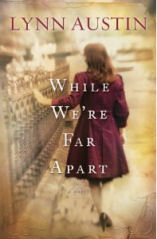
While We’re Far Apart by Lynn Austin

This week, the

Christian Fiction Blog Alliance

is introducing

While We’re Far Apart

Bethany House (October 1, 2010)

by

Lynn Austin

ABOUT THE AUTHOR:

It was during the long Canadian winters at home with her children that Lynn made progress on her dream to write, carving out a few hours of writing time each day while her children napped. Lynn credits her early experience of learning to write amid the chaos of family life for her ability to be a productive writer while making sure her family remains her top priority.

Along with reading, two of Lynn’s lifelong passions are history and archaeology. While researching her Biblical fiction series, Chronicles of the Kings, these two interests led her to pursue graduate studies in Biblical Backgrounds and Archaeology through Southwestern Theological Seminary. She and her son traveled to Israel during the summer of 1989 to take part in an archaeological dig at the ancient city of Timnah. This experience contributed to the inspiration for her novel Wings of Refuge.

Lynn resigned from teaching to write full-time in 1992. Since then she has published twelve novels. Five of her historical novels, Hidden Places, Candle in the Darkness, Fire by Night, A Proper Pursuit, and Until We Reach Home have won Christy Awards in 2002, 2003, 2004, 2008, and 2009 for excellence in Christian Fiction. Fire by Night was also one of only five inspirational fiction books chosen by Library Journal for their top picks of 2003, and All She Ever Wanted was chosen as one of the five inspirational top picks of 2005. Lynn’s novel Hidden Places has been made into a movie for the Hallmark Channel, starring actress Shirley Jones. Ms Jones received a 2006 Emmy Award nomination for her portrayal of Aunt Batty in the film.

ABOUT THE BOOK:

In an unassuming apartment building in Brooklyn, New York, three lives intersect as the reality of war invades each aspect of their lives. Young Esther is heartbroken when her father decides to enlist in the army shortly after the death of her mother.

Penny Goodrich has been in love with Eddie Shaffer for as long as she can remember; now that Eddie’s wife is dead, Penny feels she has been given a second chance and offers to care for his children in the hope that he will finally notice her and marry her after the war.

And elderly Mr. Mendel, the landlord, waits for the war to end to hear what has happened to his son trapped in war-torn Hungary. But during the long, endless wait for victory overseas, life on the home front will go from bad to worse.

Yet these characters will find themselves growing and changing in ways they never expected–and ultimately discovering truths about God’s love…even when He is silent.

If you would like to read the first chapter of While We’re Far Apart, go HERE.

Learn more about Lynn and her books on her Website.

MY REVIEW:

While We’re Far Apart is historical fiction at its best. Set in Brooklyn, New York during World War II, the book tells the story of four lonely people whose lives intersect at their apartment building. As they spend time together, positive changes occur for each of them. While We’re Far Apart is filled with rich historical details and character development that brings a lifelike quality to the story. Descriptions of Jewish tradition and history add even more depth and understanding of the era. Although not a historical romance,  there is a little romance to be found. While We’re Far Apart is filled with surprises and has a totally unexpected ending. As always, I recommend anything written by Lynn Austin.

Catching Moondrops by Jennifer Erin Valent

It is time for a FIRST Wild Card Tour book review! If you wish to join the FIRST blog alliance, just click the button. We are a group of reviewers who tour Christian books. A Wild Card post includes a brief bio of the author and a full chapter from each book toured. The reason it is called a FIRST Wild Card Tour is that you never know if the book will be fiction, non~fiction, for young, or for old…or for somewhere in between! Enjoy your free peek into the book!

You never know when I might play a wild card on you!


Today’s Wild Card author is:


and the book:


Catching Moondrops

Tyndale House Publishers, Inc. (September 20, 2010)

***Special thanks to Maggie Rowe of Tyndale House Publishers, Inc.
for sending me a review copy.***

ABOUT THE AUTHOR:

Jennifer Erin Valent is the 2007 winner of the Christian Writers Guild’s Operation First Novel contest. A lifelong resident of the South, her surroundings help to color the scenes and characters she writes. In fact, the childhood memory of a dilapidated Ku Klux Klan billboard inspired her portrayal of Depression-era racial prejudice in Fireflies in December. She has spent the past 15 years working as a nanny and has dabbled in freelance, writing articles for various Christian women’s magazines. She still resides in her hometown of Richmond, Virginia.

Visit the author’s website.


Product Details:

List Price: $12.99
Paperback: 384 pages
Publisher: Tyndale House Publishers, Inc. (September 20, 2010)
Language: English
ISBN-10: 1414333277
ISBN-13: 978-1414333274

AND NOW…THE FIRST CHAPTER:

There’s nothing in this whole world like the sight of a man swinging by his neck.

Folks in my parts liked to call it “lynching,” as if by calling it another word they could keep from feeling like murderers. Sometimes when they string a man up, they gather around like vultures looking for the next meal, staring at the cockeyed neck, the sagging limbs, their lips turning up at the corners when they should be turning down. For some people, time has a way of blurring the good and the bad, spitting out that thing called conscience and replacing it with a twisted sort of logic that makes right out of wrong.

Our small town of Calloway, Virginia, had that sort of logic in spades, and after the trouble it had caused my family over the years, I knew that better than most. But the violence had long since faded away, and my best friend Gemma would often tell me that made it okay—her being kept separate from white folks. “Long as my bein’ with your family don’t bring danger down on your heads, I’ll keep my peace and be thankful,” she’d say.

But I didn’t feel so calm about it all as Gemma did. Part of that was my stubborn temperament, but most of it was my intuition. I’d been eyeball to eyeball with pure hate more than once in my eighteen years, and I could smell it, like rotting flesh. Hate is a type of blindness that divides a man from his good sense. I’d seen it in the eyes of a Klansman the day he tried to choke the life out of me and in the eyes of the men who hunted down a dear friend who’d been wrongly accused of murder.

And, at times, I’d caught glimpses of it in my own heart.

The passage of time had done nothing to lessen its stench. And despite the relative peace, I knew full well that hearts poisoned by hateful thinking can only simmer for so long before boiling over.

In May of that year, 1938, that pot started bubbling.

I was on the front porch shucking corn when I saw three colored men turn up our walk, all linked up in a row like the Three Musketeers. I stood up, let the corn silk slip from my apron, and called over my shoulder. “Gemma! Come on out here.”

She must have been nearby because the screen door squealed open almost two seconds after my last words drifted in through the screen. “What is it?”

“Company. Only don’t look too good.” I walked to the top of the steps and shielded my eyes from the sun. “Malachi Jarvis! You got yourself into trouble again?”

The man in the middle, propped up like a scarecrow, lifted his chin wearily but managed to flash a smile that revealed bloodied teeth. “Depends on how you define trouble.”

Gemma gasped at the sight of him and flew down the steps, letting the door slam so loud the porch boards shook. “What in the name of all goodness have you been up to? You got some sort of death wish?”

A man I’d never seen before had his arm wound tightly beneath Malachi’s arms, blood smeared across his shirt front. Malachi’s younger brother, Noah, was on his other side, struggling against the weight, and Gemma came in between them to help.

“He ain’t got the good sense to keep his mouth shut, is all,” Noah said breathlessly.

I went inside to grab Momma’s first aid box, and by the time I got back out, Gemma had Malachi seated in the rocker.

Gemma gave him the once-over and shook her head so hard I thought it might fly off. “I swear, if you ain’t a one to push a body into an early grave. Your poor momma’s gonna lose her ever-lovin’ mind.”

Along with his younger brother and sister, Malachi lived down by the tracks with his widowed momma—as the man of the house, so to speak. He’d taken up being friends with Luke Talley some two years back when they’d both worked for the tobacco plant, and they’d remained close even though Luke had struck out on his own building furniture. Malachi was never one to keep his peace, a fact Gemma had no patience for, and she made it good and clear many a time. Today would be no exception.

“Goin’ around stirrin’ up trouble every which way,” she murmured as she pulled fixings out of the first aid box. “It’s one thing to pick fights with your own kind. Can’t say as though you wouldn’t benefit by a poundin’ or two every now and again. But this foolin’ around with white folks’ll get you into more’n you’re bargainin’ for.”

The man who’d helped Noah shoulder the burden of Malachi reached out to take the gauze from Gemma. “Why don’t you let me get that?”

Gemma didn’t much like being told what to do, and she glared at him. “I can clean up cuts and scrapes. I worked for a doctor past two years.”

Malachi nodded towards the man. “This here man is a doctor.”

I was putting iodine on a piece of cotton, and I near about dropped it on the floor when I heard that. Never in all my born days had I seen a colored man claiming to be a doctor. Neither had Gemma by the looks of her.

“A doctor?” she murmured. “You sure?”

He laughed and extended his hand to her. “Last I checked. Tal Pritchett. Just got into town yesterday. Gonna set up shop down by the tracks.”

Gemma handed the gauze over to him, still dumbfounded.

“What d’you think about that?” Malachi grinned and then grimaced the minute his split lip made its presence known. “A colored doc in Calloway. Shoo-whee. There’s gonna be talkin’ about this!”

The doctor went to work cleaning up Malachi’s wounds. “I ain’t here to start no revolution. I’m just aimin’ to help the colored folks get the help they deserve.”

“Well, you’re goin’ to start a revolution whether you want to or not.” Malachi shut his eyes and gritted his teeth the minute the iodine set to burning. “Folks in these parts don’t much like colored folk settin’ themselves up as smart or nothin’.”

Gemma watched Tal Pritchett like she was analyzing his every move, finding out for herself if he was a doctor or not. I stood by and let her assist him as she’d been accustomed to doing for Doc Mabley until he passed on two months ago. After he’d bandaged up Malachi’s right hand, she seemed satisfied that he was who he said.

Noah slumped down into the other rocker and watched. “It’s one thing to get yourself an education and stand for your right to make somethin’ of yourself. It’s another to go stirrin’ up trouble for the sake of stirrin’ up trouble.”

“I ain’t doin’ it for the sake of stirrin’ up trouble. I done told you that!” Malachi flexed his left hand to test how well his swollen fingers moved. Ain’t no colored man ever goin’ to be free in this here county . . . in this here state . . . in this here world unless somebody starts fightin’ for freedom.”

“Slaves was freed decades ago,” Noah said sharply. “We ain’t in shackles no more.”

“But we ain’t free to live our lives as we choose, neither. You think colored people are ever gonna be more’n house help and field help so long as we let ourselves be treated like less than white people? No sir. We’re less than human to them white folks. They don’t think nothin’ about killin’ so long as who they’re killin’ is colored.”

“Don’t you go bunchin’ all white people together, Malachi Jarvis,” I argued. “Ain’t all white folk got bad feelin’s about coloreds.”

Malachi waved me off in exasperation. “You know I ain’t talkin’ about you, Jessilyn.”

Noah had his hands tightly knotted in his lap and was staring at them like they held all the answers to the world’s problems. “All’s you’re doin’ is gettin’ yourself kicked around.” He looked up at me pleadingly. “This here’s the second time in a week he’s come home banged up.”

I put a hand on Noah’s shoulder and set my eyes on Malachi. “Who did it?”

He put his bandaged right hand into the air, palm up. “Who knows? Some white boys. You get surrounded by enough of ‘em, they all just blend in together like a vanilla milkshake.”

“How’s it you didn’t see them? They jump you or somethin’?”

“Don’t ask me, Jessie. I was just mindin’ my own business in town and then on my way home, they start hasslin’ me.”

“What he was doin’,” Noah corrected, “was tryin’ to get into the whites-only bar.”

Gemma sniffed in disgust. “Shouldn’t have been in no bar in the first place. There’s your first mistake.”

“Whites-only, too.” Noah kicked his foot against the porch rail and then looked up at me quickly. “Sorry.”

I smiled at him and turned my attention back to Malachi. “It’s a good thing Luke ain’t here to see this. He don’t like you drinkin’ and you know it.”

His eyeballs rolled between swollen lids. “I don’t know why he gets his trousers in a knot over it anyhow. Ain’t like there’s prohibition no more. And he’s been known to take a swig or two himself.”

“Luke says you’re a nasty drunk.”

“He is.” Noah knotted his hands back in his lap. “And he’s been at the bottle more often than not of late.”

“Quit tellin’ tales!” his brother barked.

“I ain’t tellin’ tales; I’m tellin’ truth. They can ask anybody at home how late you come in, and how you come in all topsy turvy. He comes home in the middle of the mornin’ and sleeps in till all hours the next day.”

“What about your job at the plant?” Gemma asked.

Malachi closed his eyes and waved her off, but his brother provided the answer for him. “Lost it!” He loosened his grip on his hands and snapped his fingers. “Like that. There’s goes his income.”

“I said I’ll get another job.”

“Oh, like there’s jobs aplenty around these parts for colored folk. And anyways, if you find one, how you gonna’ keep that one?”

Gemma had her hands on her hips, and I knew what that meant. I leaned back against the house and waited for the lecture to commence.

“You talk a fine talk about colored folks needin’ to stand up for equality, but you ain’t doin’ it in any way that’s right and good. You’re goin’ about town gettin’ people’s goat, and tryin’ to get in where you ain’t wanted, and gettin’ yourself all liquored up and useless. Now your family ain’t got the money they depend on you for, and why? Because you walk around livin’ like you ain’t got to do nothin’ for nobody but yourself.”

“I’m standin’ up for the rights of colored folks everywhere.” Malachi was angry now, pink patches spreading on his busted-up cheeks. “You see anyone else in this town willin’ to go toe to toe with the white boys in this county?”

“Don’t put a noble face on bein’ an upstart.”

Malachi pushed Tal’s hand away and sat up tall. “You call standin’ up to white folks bein’ an upstart?”

Doc Pritchett tried to dress the wound on Malachi’s temple, but Malachi pushed his hand away again. That was when the doctor had enough, and he smacked his hands on his thighs and stood up tall and determined in front of Malachi. “I ain’t Abraham Lincoln. I’m just Doc Pritchett tryin’ to fix up an ornery patient, and I ain’t got all day to do it. So I’m goin’ to settle this argument once and for all.” He pointed at Gemma. “She’s right. There ain’t no fightin’ nonsense with more nonsense, and all’s you’re doin’ by gettin’ in the faces of white folks with your smart attitude is bein’ as bad as they’re bein’.” Then he pointed at Malachi. “And he’s right, too. There ain’t never a change brought about that should be brought about without people standin’ up for such change. And sometimes that means bein’ willin’ to fight for what’s right.”

Gemma swallowed hard and didn’t even try to argue. My eyes must have bugged out of my head at the sight of her being tamed so easily.

“Now, I’m all for civil uprisin’,” Tal continued. “I don’t see nothin’ wrong with colored folk sayin’ they won’t be walked on no more. I don’t see nothin’ wrong with wantin’ to use the same bathroom as white folks or sit in the same chairs as white folks. Way I see it, none of that’s goin’ to change unless someone says it has to.” He squatted down in front of Malachi again and stared him down nose to nose. “But all this hot-shottin’ and show-boatin’ ain’t goin’ to do nothin’ but get your rear end kicked. Or worse. You aim to stand tall for somethin’? Fine. Stand tall for it. But don’t you go around thinkin’ these battle scars say somethin’ for you. You ain’t got them by bein’ noble; you got them by bein’ stupid. All’s these scars say is you’re an idiot.”

It was one of the best speeches I’d heard from anyone outside my daddy, and if I’d ever thought for two seconds put together to see a colored man run for governor, I figured Tal Pritchett would be the man for the job. As it was, I knew he was the best man for the job he had now. Sure enough, being a colored doc in Calloway would be a challenge. But I figured he was up for it.

Regardless, he shut Malachi up, and for the next five minutes we all watched him finish his job with skill and finesse. When he’d fixed the last of Malachi’s face, he stood up and clapped his hands. “Suppose that should do it. Don’t see need for any stitchin’ up today. Let’s hope there’s no cause for it in future.” Then he looked at me. “You got someplace out here where I can wash up?”

I held my hand out toward the front door. “Bathroom’s upstairs.”

He hesitated. “I’d just as soon wash up out here.”

I caught the reason for his hesitation but didn’t know what to say. As usual, Gemma did.

“I done lived in this here house for six years now, and I’m just as brown as you. You can feel free to go on up to the bathroom, you hear?”

He looked from Gemma to me, then back to Gemma before nodding. “Yes’m.” And then he disappeared inside.

“Ma’am,” Gemma muttered under her breath. “Ain’t old enough to be called ma’am, least of all by a man no more’n a few years older’n me.”

“You know what happens once you start gettin’ them crows feet . . .”

Gemma whirled about and gave Malachi the evil eye. “Don’t go thinkin’ I won’t hurt you just because you’re all bandaged up.”

Noah got up and paced the porch until Tal came back outside. “Doc, you have any problem gettin’ your schoolin’?”

Tal shrugged and leaned against the porch rail. “No more’n most, I guess. There’s a lot to learn. Why? You thinkin’ about goin’ to college?”

You could have heard a pin drop on that front porch. Never, and I mean never, in all the days Calloway had been on the map, had there ever been a single person, white or black, to step foot at a college. The very idea of that mark being made by a colored boy was a surefire way to start war.

And Noah knew it.

He looked at his feet and kicked the heel of one shoe against the toe of another. “Ain’t possible. I was just wonderin’ aloud, is all.”

“What do you mean it ain’t possible? All’s you’ve got to do is work hard. You can get scholarships and things.”

But Noah took a look at his brother, whose face was hard and tight-lipped, and nodded off toward the road. “Nah, there ain’t no use talkin’ over it. We’d best get home anyhow.”

Tal didn’t push the subject. He just picked his hat up off the porch swing and plopped it on his head. “Miss Jessie. Miss Gemma. It was a fine pleasure to meet you, and a kindness for you to give us a hand.”

“You should stop by sometime and meet my parents,” I said. “They’re off visitin’, but I’m sure they’d be right happy to know you.”

“I’m sure I’d be right happy to know them, too.” He turned his attention to Gemma. “You said you worked for a doctor?”

“I worked for Doc Mabley. He was a white doctor. Died some two months ago.”

“He let you assist?”

“Only with the colored patients. Doc Mabley was kind enough to help some of them out when they needed it. Otherwise I kept his records, kept up his stock.”

“Well, I’ll tell you, Miss Gemma, I could sure use some help if you’d be obliged. An assistant would be a good set of extra hands, and I could use someone known around here to make my introductions.”

Gemma eyed him up before slowly nodding her head. “Reckon I could.”

“Wouldn’t be much pay, now, you know. Ain’t likely to get much in the way of fees from the patients I’ll be treatin’.”

“Don’t matter so long as I have good work to put my hands to.”

“That it would be. My office is right across the street from the Jarvis house.”

Malachi snorted. “Shack’s more like it.”

“Room enough for me,” Tal said. Then to Gemma, “You think you could stop in sometime this week to talk it over?”

“I can come day after tomorrow if that suits.”

“Nine o’clock too early?”

“No, sir! I’ve kept farm hours all my life.”

He grinned at her. “Nine o’clock then?”

“Nine o’clock.”

Malachi watched the two of them with his swollen eyes, a look of disgust growing more evident on his face. He’d made no secret over the past year about his admiration for Gemma, and the unmistakable attraction that was growing between her and Tal was clearly turning his stomach.

“Mind if we go home?” he muttered. “Before I fall down dead or somethin’?”

Gemma tore her eyes away from Tal to roll them at Malachi. “Would serve you right if you did.”

“And on that cheery note . . .” Malachi groaned on his way down the steps. “I’ll bid you ladies a fine evenin’.”

I gave Noah a playful whack to the head, but he ducked so it only clipped the top. “Luke will be back home tomorrow evenin’. He’ll be itchin’ to see you, I’m sure.”

“I’m itchin’ to see him.” He took the steps in one leap, tossing dust up when he landed. “You tell him to come on by and see us real soon.”

“And tell him to bring his cards,” Malachi added. “He owes me a poker rematch.”

I squinted at him suspiciously. “Only if you play for beans.”

“I hate beans.”

Malachi leaned on Tal for support and Noah scurried to catch up and help. I watched them go, but I wasn’t thinking much about them. I was thinking about Luke. It had been two months since he’d left to collect customers for his furniture-making business, and every day had seemed like an eternity.

The very thought of him got my stomach butterflies to fluttering, but one look at Gemma told me it was another man who had stolen her attention. “That

Doc Pritchett’s a fine man.” I looked at her sideways with a smirk. “Looks about twenty-five or so.”

“So?”

“Good marryin’ age.”

She crossed her arms defiantly. “Jessilyn Lassiter, what’s that got to do with anythin’?”

“Only what I said. I’m only statin’ fact.”

“Mm-hm. I hear ya. You’d be better off keepin’ your facts to yourself.”

She grabbed the first aid box and headed inside, but the sound of that door slamming told me I’d got to her.

It told me Tal Pritchett had got to her, too.

MY REVIEW:

Catching Moondrops, the third book in the Calloway Summers series, takes place in Calloway, Virginia during the summer of 1938. Jessilyn and Gemma have grown into young women and their lives have been relatively peaceful for awhile. Then about the time their friend Malachi begins to lash out at racial prejudice, Tal Pritchett, a young black doctor sets up his practice in town. It isn’t long before Klan activity begins to escalate and violence quickly erupts.

With each incident, Jessilyn’s anger and bitterness festers. Although she believes in God, she doesn’t understand the ‘light’ she sees in the people she loves – her parents, Gemma, Luke, and Miss Cleta. A frightening encounter ends with a serious accident and Jessilyn’s reactions reveal how hardened she has let herself become.

Valent’s characters are realistic with strengths and flaws with which most people can identify. The plot accurately relates events and sentiments of that time period. The book is filled with an abundance of  human emotions such as love, hate, bitterness, anger, joy, prejudice,  faith, and forgiveness. Catching Moondrops as well as the entire Calloway Summers series is well worth your time.