Twice Loved by Lori Copeland – CFBA

This week, the

Christian Fiction Blog Alliance

is introducing

Twice Loved

Avon Inspire (July 22, 2008)

by

Lori Copeland

ABOUT THE AUTHOR:

Lori lives in the beautiful Ozarks with her husband Lance. Lance and Lori have three sons, two daughter-in-laws, and five wonderful grandchildren. They are very involved in their church, and active in supporting mission work in Mali, West Africa.

Lori began her writing career in 1982, writing for the secular book market. In 1995 after many years of writing, Lori sensed that God was calling her to use her gift of writing to honor Him. It was at that time that Lori began writing for the Christian book market. To date, she has more than 95 books published including Now And Always
and Bluebonnet Belle.

ABOUT THE BOOK

Texas, 1865 Willow Madison and her friends, Copper and Audrey taught school in neighboring Texas communities until the Yankees rode into the area and burned them out. In the midst of fear and chaos, survivors banded together to fight for what remained of their homes. Then word reached the people that the terrible war was over.

Now penniless but still hopeful, Willow vows she will take care of her friends, Copper and Audrey, and her ailing uncle, in Thunder Ridge, Texas, even if it means having to marry wealthy Silas Sterling, a man thirty years her senior. But standing in her way is handsome sawmill owner Tucker Gray, with his enticing eyes and infuriating headstrong manner—the man Willow cannot get out of her head . . . or her heart. Even though her friends beg her not to give up her dream of happiness, Willow is determined to do the right thing for those who are dearest to her. But which path does God want Willow to take: a life of duty and commitment . . . or a life of everlasting love?

If you would like to read the first chapter of Twice Loved, go HERE

MY REVIEW:

Twice Loved literally begins and ends with a bang and the pages between contain enough action, humor, conflict, and romance to keep the reader engaged. Set in the appropriately named town, Thunder Ridge, Texas, Twice Loved is filled with well developed characters who are essential to the appeal of the story.

It is difficult to add to the description from the back cover without revealing too much about the plot. Willow’s determination to sacrifice her own happiness to help her friends and family is tested as she and Tucker battle their unwelcome attraction. Will Willow rely on God or her own strength to decide her future? I suggest that you get a copy of Twice Loved and enjoy Willow’s story in order to find the answer.

Fans of Lori Copeland will not be disappointed by Twice Loved and those unfamiliar with her books would do well to start with this series.

The Book of Names (Legends of Karac Tor) by D. Barkley Briggs

It’s the 21st, time for the Teen FIRST blog tour!(Join our alliance! Click the button!) Every 21st, we will feature an author and his/her latest Teen fiction book’s FIRST chapter!

and his book:

NavPress Publishing Group (July 15, 2008)

ABOUT THE AUTHOR:

Dean Barkley Briggs is an author, father of eight, and prone to twisting his ankle playing basketball. He grew up reading J.R.R. Tolkien, C.S. Lewis, Patricia McKillip, Guy Gavriel Kay, Stephen R. Donaldson, Ursila K. Leguin, Susan Cooper, Madeline L’Engle, Terry Brooks, Andre Norton and Lloyd Alexander (just to name a few)…and generally thinks most fantasy fiction pales in comparison. (Yes, he dabbled in sci-fi, too. Most notably Bradbury, Burroughs and Heinlein).

After losing his wife of 16 years, Briggs decided to tell a tale his four sons could relate to in their own journey through loss. Thus was born The Legends of Karac Tor, a sweeping adventure of four brothers who, while struggling to adjust to life without mom, become enmeshed in the crisis of another world. Along the way they must find their courage, face their pain, and never quit searching for home.

Briggs is remarried to a lovely woman, who previously lost her husband. Together with her four children, their hands are full.

Product Details

List Price: $12.99
Reading level: Young Adult
Paperback: 397 pages
Publisher: NavPress Publishing Group (July 15, 2008)
Language: English
ISBN-10: 160006227X
ISBN-13: 978-1600062278

Watch the Trailer:

Enter the Contest:

AND NOW…THE FIRST CHAPTER:

In final days / Come final woes
Doors shall open / Doors shall close
Forgotten curse / Blight the land
Four names, one blood / Fall or stand
If lost the great one / Fallen low
Rises new / Ancient foe
Darkest path / River black
Blade which breaks / Anoint, attack
If once and future / Lord of war,
Queen la Faye / Mighty sword,
Rises ‘gain / As warrior king,
Prepare / For day of reckoning
If Aion’s breath / For music cursed
Sings making things / Made perverse,
Fate shall split / Road in twain
One shall lose / One shall gain
If secret lore / Then be found
Eight plus one / All unbound
Beast shall come / Six must go
Doors shall open / Doors shall close
If buried deep / Hidden seen
Ancient tomb / Midst crim
son green
Nine shall bow / Nine more rise
Nine horns blow / Nine stars shine
If falling flame / Burning pure
Ten thousand cries / For mercy heard
Then plagues, peril / Horns of dread
End of days / Land be red
When final days / Bring final woes
Doors shall open / Doors shall close
Fate for one / For all unleashed
Come the Prince / Slay the beast
Cross the water / Isgurd’s way
White horse / Top the waves
Aion, fierce! / Aion, brave!
Aion rides / To save the day

— The Ravna’s Last Riddle

Chapter 1

BLACK BIRDS

The day was gray and cold, mildly damp. Perfect for magic. Strange clouds overhead teased the senses with a fragrance of storm wind and lightning and the faint, clean smell of ozone. Invisible energy sparkled like morning dew on blades of grass.

Standing alone in an empty field on the back end of their new acreage, Hadyn Barlow only saw the clouds. By definition, you can’t see what’s invisible, and as for smelling magic? Well, let’s just say, unlikely. Hadyn saw what was obvious for late November, rural Missouri: leafless trees, dead grass, winter coming on strong. Most of all he saw (and despised) the humongous briar patch in front of him, feeling anew each and every blister and callous earned hacking through its branches.

Making room for cattle next spring, or so he was told; this, even though his dad had never owned a cow in his life. He was a history teacher for crying out loud. A college professor. Hadyn’s shoulders slumped. It didn’t matter. Everything was different now. Mr. Barlow didn’t let his boys curse, but low under his breath, Hadyn did, mildly, just to prove the point. Life stunk. That was the brutal truth.

All true for the most part. Yet standing alone in the field, bundled in flannel, something else prickled his skin—something hidden in the rhythm of the day, at its core—and it wasn’t just the chill wind. He couldn’t shake it. A sense of something. Out-of-placeness. Faced with a friendless sophomore year, Hadyn knew that feeling all too well. It attacked him every morning, right before school.

But this was something more, more than the usual nervousness and name-calling stuff. His intuition was maddeningly vague. Hadyn sniffed the air, eyeing the field. A fox scampered in the distance. Bobwhites whistled softly. This had been his routine for weeks. Go to school, come home, do chores. Today was no different. Except for the clouds.

He looked upwards, struck again by the strange hues. The colors were still there; kinda creepy. They had lingered since the bus ride home. He had seen it happen with his own eyes, though he didn’t think much of it at the time. Right about the time school let out and the yellow buses began winding home, the skies had opened and spilled. Low banks of clouds came tumbling from the horizon like old woolen blankets. Like that scene from Independence Day, when the alien ships first appeared. Hues of purple, cobalt and charcoal smeared together. Not sky blue. Not normal. Riding on the bus, face pressed against the cold window, he didn’t know what to think. Only that it looked…otherworldly. Like God had put Van Gogh in charge for the day.

Strange.

Earlier, the day hadn’t felt weird. If anything, he had felt relief. Two days until Friday…until Thanksgiving Break. Only two days. He could make it. Standing by the mailbox with his three brothers, waiting for the bus—he couldn’t wait to get his own car—mild winds had stirred from the south, scampering through row after row of brittle stalks in the neighbor’s cornfield across the road. He heard them in the leafless oak and elm of his own yard, hissing with a high, dry laughter. Warm winds, not cold. But about noon, the wind shifted. Again, no big deal for Missouri, always caught in the middle between the gulf streams of Mexico and Canada’s bitter cold. Temperamental weather was normal in these parts.

Yet there it was. From the winding ride home to this very moment, he couldn’t rid himself of that dry-mouthed, queasy feeling. It was more than a shift in wind. It was a shift in energy. Yes, the dark clouds and strange colors reminded him of the thickening air before a big, cracking Midwestern storm, but that wasn’t it. This was different.

Hadyn being Hadyn, more than anything else, wanted to identify the moment. To name it.

Though he didn’t actually verbalize until age three, Hadyn was born with a question mark wrinkled into his brows. Always searching, always studying something. He couldn’t speak a word before then—refused to, his dad always said—yet he knew the letters of the alphabet at a precocious 12 months. When he finally did decide to talk, words gushed. Full sentences. Big vocabulary. Not surprisingly, it was clear early on that Hadyn was one of those types bent toward structure, patterns. He hated incongruities, hated not knowing how to pinpoint the strange twist in sky and mood right in the middle of an otherwise typically dreary day. If it was just nasty weather, name it! What did it feel like? Wet fish guts? Not quite. A full wet diaper? He remembered those well enough from when the twins were little, but no. A three day old slice of cheese?

Yes, that was it. Cold, damp, moldy.

Velveeta, actually, he decided, feeling a small measure of satisfaction. He fumbled for the zipper of his coat as another icy breeze prickled his skin. Yep, another lousy Velveeta day in the life of Hadyn Barlow.

He thought of the roaring wood stove back home. Hot cocoa. Little consolation. Until dusk, the oldest Barlow boy was stuck outside in a field with hatchet and hedge shears. Stuck in a foul mood, stuck with a knot in his throat. Just plain stuck. His task, his life, seemed endless and pointless.

“Just a little bit every day, however much you can manage after school,” his father would remind him. “And don’t look so grumpy. The days are shorter and shorter.”

But not any warmer.

“Grr!” Hadyn grumbled aloud, snapping at the cold in his thoughts. He had chosen to “clear” the massive beast by carving tunnels in it, not just hacking mindlessly. Probably not exactly what Dad had in mind, but, well, to be honest, he didn’t really care. He was the one stuck out here in the cold. He had already carved several tunnels, and reentered the biggest one now, loping and clicking his shears at the endless mess of thorns and branches, alternated by halfhearted swings of the hatchet. The briar patch sprawled a couple hundred feet in every direction, comprised of dense, overgrown nettles, blackberry bushes and cottonweed. Untended for generations, the underbrush was so thick and tall a person could easily get lost in it, especially toward the center, where the land formed a shallow ravine that channeled wet weather rains toward the pond on the lower field. Hadyn guessed the height at the center point would be a good 12 feet or more. Enormous.

Really, it was a ridiculous task. Dad had to know that.

“Why not just burn the thing?” Hadyn had asked him. Burn it, then brush-hog it. Throw a hand grenade in and run.

Mr. Barlow never really answered, just said he wanted him to clear it by hand. After the first day of grumbling and complaining (which proved none too popular with his father), Hadyn started carving tunnels. His plan was to craft a maze out of it, maybe create a place to escape…at least have some fun before his dad made him level the whole thing

Fun? He caught himself, tasting the word like a spoonful of Nyquil. Fun is soccer with the guys back home.

He paused for a moment to wipe his brow. Home was no longer a city, not for four months now. It was a cow pasture. Home had been Independence, the suburb of Kansas City whose chief claim to fame (other than being the birthplace of Harry S. Truman) was that Jesus would return there, at least according to one of numerous Mormon splinter groups. For Hadyn, it was all about skateboards and traffic and rows of houses. Noise. Friends. Now, all that—everything familiar and good—was exactly three hours and nineteen minutes straight across I-70 on the opposite end of the state. Might as well have been on the opposite side of the planet. Home now: three hundred acres in the middle of nowhere, away from all he had ever known.

The town was called Newland. The name seemed like a smack in the face.

New town. New school. New faces. New troubles to deal with. New disappointments. His dad had tried to make a big deal of the “new” thing. This would be a new start for their family, a new chapter, blah, blah, blah. A change, from sadness to hope, he said. Hadyn hated change.

He didn’t want new. He wanted it how it used to be.

How it used to be was happy. Normal. Right. Fair. How it used to be meant they were a family of six, not five. Hadyn felt a familiar pang slice across his chest. He would have traded all the unknown magic in the world for five more minutes with—

Mom…

It had been a year since she died. His mental images of her remained vivid, of a beautiful woman with porcelain smooth skin, naturally blonde, witty, vivacious. All four Barlow brothers shared her spunky attitude, as well as an even mix of their parents’ coloring: mom’s fairness, dad’s darker hair and complexion, the boys somewhere in between. Hadyn, rapidly entering his adult body, was tall for his age, muscular, lean, possessed of a sometimes uncomfortably aristocratic air. Some days his eyes were smoky jade, others, iron gray. But he had Anna’s cleverness.

His parents had been saving money for several years, studying the land all around Newland. Hadyn could not fathom why. What was so special about Podunk, America? But he knew his mom had been happy to think about life in the country. Once upon a time, that was enough. But now? Without her, what was the point? Why couldn’t they have just stayed in Independence? Moving wasn’t going to bring her back. Didn’t Dad know that?

For the second time that afternoon, a tidal wave of loneliness nearly drowned him, left him in a goo of self-pity, the sort of sticky feeling he didn’t want anyone to spoil by cheering him up. He took one more angry swing. Done or not, he was done for the day. Work could wait. Dad would just have to deal with it. Already, he had built a pretty impressive maze, though. Six unconnected tunnels so far.

Like I give a rip about these stupid tunnels, he thought as he crawled from the center toward the mouth of the largest, longest shaft. Or this stupid land, or town, or patch of—his knee jammed against a thorn protruding from the soil—thorny! ridiculous!…

He clenched his jaw, flashing through dozens of choice words, using none. Honoring his dad. Pain streamed as tears down his cheek, and it wasn’t just the thorn in his knee. It was life. Crawling forty more feet, he emerged to face the slowly westering sun melting down the sky. The otherworldly colors he had seen earlier were gone. Only the cold remained. And now, a bleeding, sore knee.

Behind him, he heard heard rustling grass and the high pitched, lilting notes of his brother’s tin whistle. He wiped his eyes on his sleeve and grimaced. Ewan, like his mother, was musical. Even more like her, he was sentimental. He often carried the whistle she had brought him as a gift from Ireland. It would, no doubt, have seemed humorous to some, to see him wandering the field, playing a spritely little tune. It only annoyed Hadyn. Thankfully, as Ewan drew closer, the song trailed away.

“Hey, Hadyn.”

Hadyn grunted. “What do you want?”

Ewan shrugged, tucking the flute into his back pocket. He wore blue jeans, and a blue embroidered ball cap, initialed ‘ECB’.

“Wondered how things were going.”

“Dad sent you to help, didn’t he?”

Ewan frowned. “Yep. Got done with my chores sooner than planned.”

“Bummer.”

“Major bummer,” Ewan emphasized. “Looks like you’re near the center, though. That’s pretty cool.”

Hadyn didn’t reply. With only two years between them, the two brothers had always been the closest of friends, the fiercest competitors, the quickest of combatants. They understood each other’s rhythms like no one else in the family. Whereas Hadyn was studied, wise and cautious, Ewan was quick, fearless and comfortable with long odds. No one could make Ewan laugh—gasping-for-air, fall-on-the-ground-cackling—like Hadyn. Likewise, Ewan could frustrate Hadyn to no end, or, with the sheer power of silliness, cheer him up when a sullen moment was about to strike. Not much wanting to be rescued from his mood at the moment, however, Hadyn let his silent response wrap around him like a barrier against further penetration. He didn’t notice that Ewan’s gaze had drifted from the briar patch to the low sky and paused there.

“What do you make of that?” he dimly heard his brother say, distracted, curious. Through the haze of his own thoughts, Hadyn followed Ewan’s line of sight, his pointing finger, straight into the sunset. At first, he saw nothing. Then it was obvious. Several large, black birds were swooping low on the horizon. Even at a distance, it appeared they were headed straight for the two boys, unveering over the slope of the ground, drawing swiftly nearer, a hundred yards or so away. From the sound of their raucous cry, they were like ravens, only larger, throatier, and if possible, blacker.

“Cawl-cawl,” they cried.

Hadyn counted four total, wings outstretched, unflapping, like stealth bombers in formation. There was something organized and determined about their flight. It lacked animal randomness.

“Do they look strange to you?” Ewan asked, cocking his head.

Hadyn pretended to be uninterested. It didn’t last. “What is that in their claws? What’re they carrying?”

“Yeah, I see it. Sticks?”

“Too thick. It would be too heavy. Wouldn’t it?”

“Hard to tell at this angle. Are they heading for us?” Ewan held up his hand to shield his eyes. “Man, they’re fast. What are they?”

“I don’t know, but they’re still—”

“Look out!” Ewan dove to the side, tripping Hadyn in the process. Both boys hit the ground on a roll, turning just in time to see the birds swoop suddenly upward, arcing high into the sky, turn, then turn again. The lead bird, larger than the others, croaked loudly; the other three responded. Over and over, the same phrase, like a demand: “Cawl!”

All four were pitch black, having none of the deep blue sheen of a crow’s feathers, or so it seemed in the failing light. They flew as black slashes in the sky, all wing and beak, not elegant in the air, but fast. Disappearing completely against the lightless eastern expanse, they reappeared again as silhouettes skimming the western horizon. At first it seemed to Hadyn the birds would fly away, as they swept up and out in a wide arc. But the curve of their path soon came full circle. They were attempting another pass. Both boys nervously scooted further outside the angle of the birds’ approach.

“What in the world?” Hadyn said, hatchet raised and ready. It was clearer now in silhouette form. Each bird carried the form of a long, thick tube in their talons.

The brothers hunched on the ground, motionless, muscles tensed, watching as the birds continued their second approach. Hadyn held his breath. The birds didn’t veer, nor aim again for the boys. Instead, they formed a precise, single-file line, a black arrow shooting toward the main tunnel of the thicket. With a final loud croak—“Cawl!”—and not a single flap of wing, all four swooped straight into the hole, one after the other. As they did, each released the object clutched in its talons. The tubes clattered together with a light, tinny sound at the mouth of the tunnel, literally at the boys’ feet. The birds were already beyond sight. Their throaty noise echoed for a moment, evaporating into an obvious silence marked only by the faint breeze of wings passing over broken grass.

Hadyn and Ewan stared first at the tunnel, then at the objects. Then at each other. Then back at the tunnel. In the same instant, each of them leaped toward what the birds had left behind: four thin, black metallic tubes, trimmed with milky white bands at top and bottom.

Hadyn slowly stretched out his hand and picked up a tube. He rolled it between his fingers. It was about the length of Ewan’s Irish whistle, but thicker, maybe the circumference of a quarter. Not heavy at all. In the middle of each tube, finely wrought in scripted gold filigree, the letter ‘A’ appeared.

Ewan lightly shook his tube, listening for clues to its contents. It sounded hollow.

“They didn’t even have us sign for delivery,” he deadpanned. “What do we do with these? They look important.”

“How should I know?” Hadyn said contemptuously, flicking his eyes cautiously toward the tunnel. “Where’d they even go? I mean, really. Are they just hiding back there until we leave?”

“Who cares!” Ewan said. His disgust was obvious. Hadyn’s was being an analyst again. “This isn’t hard, Hadyn. Some big birds dive bombed us. They dropped these cool tubes. It makes no sense. It’s awesome. Totally, factor 10 cool.”

Hadyn mulled it over. “Maybe they’re some sort of carrier pigeon, but…do carrier pigeons even fly anymore?

“Only on Gilligan’s Island. TV Land. Listen to me, you’re just guessing.”

“Have you got a better idea?” Hadyn demanded.

Ewan waited, considered. Hadyn knew he hated being put on the spot like that, in the inferior position. Now it was Ewan’s turn to think.

“Okay, maybe you’re right. Maybe those birds really are carriers of some sort?—” Ewan held up a tube, “—obviously they are. What if they need to carry these things farther still? What if they’re just resting? What if they are trained to do this when they need to rest? Drop their packages, find a hole, rest, then grab their stuff and carry on?”

“So…are you suggesting we flush them out? Cause there is no way I’m going to crawl back there. They can get out later on their own.”

Ewan didn’t reply. Instead he dug into his pocket, pulled out a small flashlight, and scuttled into the tunnel the birds had entered. “Wait here,” he ordered.

“Hey, watch it back there!” Hadyn cautioned. Secretly, he wanted him to go, knew how to punch his brother’s buttons to make it happen. “Those claws looked sharp!”

While he waited for Ewan to return, Hadyn examined the tubes further. He shook one tube, flicked it, smelled another; picked up and twirled the third and fourth tubes. His efforts yielded the same muffled sensation of something barely shifting inside. Maybe a rolled up piece of paper? If the ravens (or crows, or whatever they were) were carriers of some sort, a written message did make the most sense. But who in the world still sent paper messages…by bird? By raven, no less. Hello, email anyone?

Presently, Ewan reappeared, breathing hard.

“They’re gone,” he said simply. “Must have flown out one of the other tunnels.”

Hadyn creased his brow. “No way. None of the tunnels connect yet.”

“They don’t?” Ewan’s eyes widened as it dawned on him that he hadn’t seen any other tunnels. “No…they don’t.”

The two boys stared at one another in silence. Evening enfolded them; soon, darkness. “They must have crawled through the branches,” Hadyn surmised, but he hardly sounded convinced. “Are you sure you didn’t see them?”

Ewan rolled his eyes. “Hello? Big, black flappy things. Yes, I’m sure.” He grabbed one of the tubes, shook it again. “This band looks like ivory, but it’s hard to tell in this light.”

“Reminds me of one of mom’s necklaces.”

Ewan grabbed the end and twisted. “Only one way to find out.”

This time Hadyn didn’t argue or analyze. Curiosity had gotten the best of him. The lid twisted off with surprising ease, followed by a thin hiss of sealed air. Ewan wrinkled his face. “Smells old. Yuck. Turn on your flashlight. Mine is getting weak.”

He tapped the open end against the palm of his left hand. The coiled edge of a piece of thick, cream-colored parchment slipped out. Hadyn leaned in closer. Ewan gingerly teased the scroll out. It had a heavy grain of woven cotton, with rough edges trimmed in gold foil. Both boys let out a long slow breath. Neither the silver moon hung off the treeline, nor the winking stars, provided light enough to clearly see. Hadyn turned on his flashlight as his brother unrolled the parchment. The paper was larger than normal, rich to the touch. Pinning both ends to the ground, both boys read at once the simple message beautifully scripted on the inside in golden ink: “You have been chosen for a life of great purpose. Adventure awaits you in the Hidden Lands.”

“Dude!” Ewan whistled softly. “Looks like something from King Arthur. What in the world are the Hidden Lands?”

Hadyn, who actually loved the lore of King Arthur—and Ewan knew it—was already reaching for another tube. Ewan followed his lead. Within twenty seconds, all four tubes were opened, and four identical parchments lay spread on the ground in the dark, illuminated only by flashlights. Golden ink glimmered, subtly shifting hues. Each bore the exact same message.

“You have been chosen for a life of great purpose. Adventure awaits you in the Hidden Lands.”

Hadyn grabbed the four sheets, quickly rolled them up, and inserted each back into its thin metal sleeve. “We need to head home before Dad gets worried,” he said. “You take two and I’ll take two. Stick them under your shirt and act cool. I have no idea what these are. But for now, they’re our little secret.”

He puffed up for a moment, the older brother. Still out of sorts with the world.

“And none of your games, either, Ewan. I mean it. I’m not in the mood.”

MY REVIEW:

The pure beauty of Briggs’ lyrical style instantly drew me into the story on the very first page. It is not often that I find a writer so skilled in making me “feel” the very atmosphere of the story. The Book of Names is a beautifully written story of courage in the face of great evil- a story of finding one’s true calling in a world that discourages individuality.

The Book of Names is a fantastical adventure of ancient portals, alternate worlds, mystical powers, and heroic quests. When Hadyn and Ewan Barlow suddenly find themselves in Karac Tor with no clue about how to return to their home, they become unwitting participants in an attempt to save the kingdom. On their journey across Karac Tor, they encounter the unique inhabitants of the land including both heroes and villains.

D. Barkley Briggs is a master storyteller and The Book of Names will appeal to both his target teen audience and adults. I highly recommend it to all.


House of Wolves by Matt Bronleewe – CFBA

This week, the
Christian Fiction Blog Alliance
is introducing

House Of Wolves

Thomas Nelson (August 12, 2008)
by

Matt Bronleewe

ABOUT THE AUTHOR:

Matt Bronleewe is a recognized producer, songwriter and author. The former member of the band Jars of Clay, has earned numerous awards producing and co-writing albums that have sold a combined total of over 20 million copies. His songs have recently been recorded by Disney pop sensations Aly & AJ, American Idol finalist Kimberley Locke, and more. Bronleewe has worked with Grammy Award-winning artists such as Michael W. Smith, International pop singer Natalie Imbruglia and Heroes star Hayden Panettiere.

Born in Dallas, Texas, Bronleewe was raised on a farm in Kansas, where he lived until he left for college in 1992. At Greenville College in Illinois, Bronleewe formed the band Jars of Clay with his dorm roommate and two neighbors, and the group soon found success. Though Bronleewe opted to leave Jars of Clay early on to pursue an academic career, he soon found himself in Nashville, co-writing, producing, and playing music professionally.

To add to his list of accomplishments, Bronleewe has expanded his love of story telling beyond music into authorship. He is currently penning a 5 book series for Thomas Nelson Fiction. His first book Illuminated began the adventurous series about rare manuscripts and the mysteries within.

Bronleewe currently resides in Brentwood, Tenn., with his wife and three children. He continues to write and produce music, and he also volunteers through his church to help disadvantaged youth in the community. Bronleewe enjoys reading, taste-testing good food and watching sports, as well as indulging his interests in art, architecture, design and science.

ABOUT THE BOOK:

A mysterious book with a dangerous secret.

An evil brotherhood out to conquer the world.

One man stands between them . . . with his family in the balance.

In the twelfth century, Henry the Lion collected the rarest relics in Christendom. And to protect his most precious acquisitions, he encoded the whereabouts in a gorgeous illuminated manuscript called The Gospels of Henry the Lion.

The manuscript has been showing up and disappearing ever since. No one knows where the relic has been hidden . . . or its ultimate power.

Only one man holds the key to the mystery.

He’s carrying it in his briefcase at his son’s school for show-and-tell, and he thinks it’s a fake. But he’s about to find out just how real it is.

Because the wolves are rapidly closing in. And if August Adams can’t decode the secret in time, the world’s balance of power will forever be altered.

If you would like to read an excerpt of House Of Wolves, it will be HERE

MY REVIEW:

Once again, Matt Bronleewe has taken well researched historical facts, added his well developed imagination, and  has deftly woven them into another blockbuster tale. In House Of Wolves, rare book dealer August Adams suddenly finds himself in a race against time to uncover the mysteries of yet another ancient manuscript in order to save his family.

A fitting follow-up to Illuminated, House Of Wolves is a fast paced, action packed, international thriller filled with secret societies, rare manuscripts, mystery, intrigue and a small dose of humor.  Laced with violence necessary to the plot, the book illustrates the measures men (and women) are willing to take to gain power.

As a lifetime book lover, the plot was especially interesting to me. In addition, the way the author used real manuscripts and the facts and myths surrounding them made the story even more appealing.  I enjoyed both Illuminated and House Of Wolves and look forward to the next installment in the series.

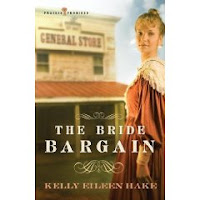
The Bride Bargain by Kelly Eileen Hake – FIRST Wild Card

It is time to play a Wild Card! Every now and then, a book that I have chosen to read is going to pop up as a FIRST Wild Card Tour. Get dealt into the game! (Just click the button!) Wild Card Tours feature an author and his/her book’s FIRST chapter!

You never know when I might play a wild card on you!

Today’s Wild Card author is:

KELLY EILEEN HAKE

and her book:

The Bride Bargain

Barbour Publishing, Inc (September 1, 2008)

ABOUT THE AUTHOR:

Life doesn’t wait, and neither does Kelly Eileen Hake. In her short twenty-three years of life, she’s achieved much. Her secret? Embracing opportunities and multitasking. Kelly received her first writing contract at the tender age of seventeen and arranged to wait three months until she was able to legally sign it. Since that first contract five years ago, she’s reached several life goals. Aside from fulfilling fourteen contracts ranging from short stories to novels, she’s also attained her BA in English Literature and Composition and earned her credential to teach English in secondary schools. If that weren’t enough, she’s taken positions as a college preparation tutor, bookstore clerk, and in-classroom learning assistant to pay for the education she values so highly. Currently, she is working toward her MA in Writing Popular Fiction. No matter what goal she pursues, Kelly knows what it means to work for it!

Kelly’s dual careers as English teacher and author give her the opportunity explore and share her love of the written word. A CBA bestselling author and dedicated member of American Christian Fiction Writers, Kelly is a reader favorite of Barbour’s Heartsong Presents program, where she’s been privileged to earn numerous Heartsong Presents Reader’s Choice Awards; including Favorite New Author 2005, Top 5 Favorite Historical Novel 2005, and Top Five Favorite Author Overall 2006 in addition to winning the Second Favorite Historical Novel 2006!

Her Prairie Promises trilogy, set in the 1850s Nebraska Territory, features her special style of witty, heartwarming historical romance. Barbour plans to release the first of this collection, The Bride Bargain, in fall 2008.

Visit the author’s website.

Product Details:

List Price: $10.97

Paperback: 288 pages

Publisher: Barbour Publishing, Inc (September 1, 2008)

Language: English

ISBN-10: 1602601755

ISBN-13: 978-1602601758

AND NOW…THE FIRST CHAPTER:

Chapter One

Nebraska Territory, Oregon Trail, two weeks journey past Fort Laramie, 1855

“That does it!” Clara Field gritted her teeth and tugged harder on her leather glove, which was currently clamped between the jaws of a cantankerous ox. She didn’t know whether to laugh or cry.

“I’ll get him in a headlock for you, Miss Field, and cut off his air so he’ll open his mouth.” Burt Sprouse sauntered over. “That should take care of things quick enough.”

“Oh, choking him wouldn’t be the right answer.” Clara struggled to hide her disgust at the very suggestion. “I have to marvel at how similar animals and humans can be. Neither group likes to be forced into anything, and try as I might, I can’t seem to convince him we’re trudging toward freedom.”

“Well, I reckon I could knee him in the chest to make him let go.” Sprouse shuffled closer. “Hickory’s got an eye on you.”

“Thank you, Mr. Sprouse. I’ll handle this.” Clara waited until the burly ex-lumberjack wandered away before pleading with the ox. “Your antics are going to get us kicked off the wagon train, Simon!”

At the sound of his name, the ox perked his ears and his mouth went slack, allowing Clara to yank away her glove. How an ox had a taste for leather escaped her, but bovine cannibalism counted as the least of her worries at the moment. She held up the mangled thing and sighed.

Thank You, Lord, that I brought an extra pair just in case I lost one. Her lips quirked at the tooth marks on the leather. Though I never thought things would come to this.

Yanking on the length of rope she’d tied around Simon’s neck, Clara urged him toward the makeshift corral the trail boss had set up for the night. The obstinate animal refused to budge, his eyes fixed on her glove with a greedy gleam.

“There’s lots of good forage and fresh water,” she tempted. “And plenty of rest.” Oooh, how good that sounded. A verse from Psalms floated into memory: “He leadeth me beside the still waters. He restoreth my soul.”

For it being a river, the Platte came as close to still water as any running water could ever hope. Wide, shallow, and dark with mud, it was their constant guide and water source. Clara tried not to compare it to babbling brooks, flowing streams, or any other clear, flowing water with a friendly rush of sound.

As for the earlier part of that scripture. . .well, they’d only just stopped for the night. Until she got this last ox to the corral, gathered enough fuel for the campfire, and cooked dinner for herself, Aunt Doreen, and the blessedly helpful Burt, she wouldn’t be lying beside anything.

But we’re one day closer to Oregon. Eleven miles farther toward a new start. Not even Simon’s snacking can take that away.

Tension eased from her shoulders as Simon ambled toward the enclosure. She and Aunt Doreen had already lost two oxen on the trail, and when they settled in Oregon, the remaining stock would be used for food or trade. The sadness creeping over her at the thought explained, at least in part, why Clara wasn’t an accomplished driver. Even after weeks on the trail, she couldn’t bear to use a whip harshly.

With Simon safely tucked away with the rest of the train’s livestock, Clara began hunting for buffalo chips. The tall, dry grass rustled around her skirts as she searched. Typically, the prairie held a large and ready supply of the quick-burning fuel. But the recalcitrant ox had cost her valuable time. The areas closest to the circled wagons were picked over by the other women on the train whose husbands saw to the animals. She needed to go farther, though never too far, to scrape together a fair-sized load.

By the time she got back to camp and started their fire, Aunt Doreen already had vegetables—the same supply of potatoes, carrots, and an onion that they’d been using since the stop at Fort Laramie—chopped and in the pot for cooking and the batter ready for Petecake. Once the fire burned hot enough to heat the Dutch oven and cook the stew, Clara gratefully sank down beside the makeshift kitchen.

A healthy breeze carried away the smoke from the fire, bringing welcome coolness as the sun faded. The moon came into view, its modest glow bathing the plains in whitish blue light.

“Grub ready yet, Miz Field?” Burt Sprouse’s head tilted forward as he sniffed the air like a hopeful bear. In exchange for their cooking, alongside a bit of washing and mending, the ex-lumberjack provided them with fresh meat whenever possible, took on the night watches assigned to their wagon, and lent a hand when he could.

“Not quite, Mr. Sprouse.” Apologies wouldn’t make the rabbit cook any faster. “I had difficulty finding enough buffalo chips tonight.”

“Looked like the oxen gave you some trouble tonight.” Burt’s voice held no censure as he squatted down. “I’ll take on your watch tonight, like we agreed, but Hickory’s getting antsy about having you and your aunt in your own wagon. You were last in the row and last to set up camp tonight.”

“Sure were.” The trail boss, Hickory McGee, stomped over to glower at them. Disgust filled his tone. “Same as every day on this trail. I warned you gals I didn’t want to take on two women with no menfolk to shoulder the night watches, wagons, and livestock. You know the law of the trail—pull your weight or be left behind.”

“We know.” Clara forced the words through gritted teeth. Men who believed women to be inferior in every way put up her back as little else could. If you spent more time helping and less time harping, things would get done faster. As it is, you accomplish nothing with threats, yet Aunt Doreen and I hold things together in spite of them. A true gentleman—the kind of man a mother would be proud to raise and a woman would be glad to claim as husband—would be respectful and helpful.

She kept the thoughts to herself. Speaking her mind was a luxury she couldn’t afford if it angered the trail boss. A quick prayer for patience, and she swallowed her ire.

“I haven’t completely mastered the art of unhitching the oxen,” Clara admitted before staring him down. “But Mr. Sprouse makes sure our watches aren’t shirked, and you know it.” She cast a grateful look at Burt.

“You ain’t the ones doin’ it,” Hickory groused. “No call for a man with his own wagon and responsibilities to shoulder yours.”

“I don’t mind taking the extra watch in exchange for their cooking,” Burt put in.

“Don’t recall askin’ you, Sprouse.” Hickory turned his glare from Clara to the lumberjack. “But anyone causin’ problems can be left behind.”

“Worse comes to worse”—Mr. Sprouse shrugged—“I can sear some meat. Got an iron stomach, I do.”

“Glad to hear it.” The guide returned his attention to Clara. “You’re lagging behind as it is. Not being able to control your animals is one more hassle to endanger the train. One rampaging ox can set off a stampede.”

“We managed to sort it out.” Aunt Doreen tugged a bucket of water toward them. “We always do.”

“It didn’t put anyone else out.” Clara shoved aside her remorse over Mr. Sprouse’s late dinner. “We’ll be ready to pull out at dawn, same as everyone else.”

“Better be.” The disagreeable guide punctuated that statement by launching spittle toward their cookfire. It hissed as he stalked away.

When we get to Oregon, it will be worth it, she vowed to herself for the thousandth time since they left Independence and started out on the trail. The Lord will see us to a new life and a happy home.

“The johnnycake should be about ready.” Clara pushed the ashes off the top of the Dutch oven with her ladle handle, wrapped her hand in a dishcloth, and lifted the lid. The sweet smell of warm cornbread wafted toward them. “Let me slice a piece for you to have now while the stew finishes.”

“Mmmph.” A moment later, Mr. Sprouse plunked himself down and set to munching the hot bread. His obvious enjoyment didn’t soothe Clara as it usually did—not when he’d made it clear that their agreement wasn’t as strong as Hickory’s warnings.

“Here, Aunt Doreen.” Clara made sure her aunt got a large portion. After weeks on the trail, not only did their simple dresses boast enough dust to plant a garden, but the calico also hung from her aunt’s thin frame. After a grueling day of travel, any moment they could use for a good night’s rest was another small loss her aunt didn’t deserve to bear. Unacceptable.

Aunt Doreen passed Mr. Sprouse another piece before he asked. Their success on the trail depended on keeping the man well fed. So long as they did that and kept pressing onward, the trail boss couldn’t leave them behind.

Clara filled a tin with the steaming stew. Onions came from their supply, greens they’d gathered along the way, and the rabbit came courtesy of Mr. Sprouse’s shotgun. If it weren’t for their little arrangement with him, she and her aunt would be surviving on jerky.

“Best deal I ever made.” His grunt made both of them smile. Burt made no bones about the fact he liked to eat but couldn’t cook. Another’s misfortune was rarely cause for prayers of gratitude, but. . .

“I was just thinking the same thing.” Clara knew Aunt Doreen’s reply came from the heart, to say the least.

Until now, Mr. Sprouse was just one more example of how the Lord watched over them and would see them through this arduous journey, which had become more wearing than Clara anticipated. A continuous stream of mishaps drained their supplies and energy. And they’d yet to make it past the prairie to the hardships of the mountains.

“When we reach the mountains, things will go more slowly.” She meant the words as a comfort to her own aching bones and her aunt’s worries, but Burt Sprouse didn’t see it that way.

“Yep. Snow can make us lose days, get off the trail, have so many delays food runs out and animals freeze. Everything’s harder once you hit the Rockies.”

“Our oxen are too ornery to freeze.” Clara couldn’t help smiling even as she muttered the words.

“Even so, we’ll all probably lighten our loads.” Burt shrugged. “I hear the mountains are littered with furniture and heirlooms abandoned by travelers so they can get free of a snow bank or make it up a steep pass.”

Her aunt’s gasp made Clara wrack her brain for something positive to say.

“After that rough river crossing, we already lost several items.” She quelled the sense of loss that overcame her at the memory of her childhood trunk, filled with her doll and doll’s clothes. The last thing her father gave her, lost in the Platte forever. “So we probably won’t need to leave anything else behind.” She forced a smile.

“For all those reasons, you have to be careful not to get on the trail boss’s bad side.” Burt waved his spoon in the air. “We won’t make it without him, and he’s dead serious about leaving behind anyone who causes problems.”

He does care. Surely Burt said that nonsense about having an iron stomach just to placate Hickory. She eyed him fondly as he made his way back to his own wagon. Who would have thought a burly ex-lumberjack looking to make his fortune gold mining would be their saving grace?

“You go on ahead and get to bed,” Clara encouraged her aunt after they’d eaten their fill. “I’ll clean up and join you in a few moments.”

Aunt Doreen’s lack of protest and grateful nod spoke of her weariness more eloquently than if she’d carped over the long day. Yet the older woman never uttered so much as a word of complaint. Not that she ever had, even throughout the long years of living under Uncle Uriah’s thumb.

No matter how many verses her uncle warped out of context, how often he misinterpreted her own words or actions, Clara held firm to the conviction that Uriah’s chauvinism was personal prejudice, not truth. Oft-repeated lectures against the frail values and fragile mindsets of the so-called weaker sex only underscored the quiet strength of the woman who’d raised her.

The few months when she’d had Doreen’s sole attention soothed her soul, pulling her from the endless cycle of guilt and anger over Ma’s and Pa’s deaths. Clara owed everything to the self-sacrificing love of Doreen. Then she’d married Uriah Zeph, and their world tilted once more. For the worse.

Hopes ahead; regrets behind. Grandma’s saying had become their motto over the years and seemed more appropriate with each passing day. Tonight, as Clara fell into her quilt, she added one more phrase. . . .

And God alongside.

Outskirts of Baltimore

Filth everywhere. Dr. Saul Reed shook his head as he made his way from the room he rented to the area of the Baltimore outskirts that housed businesses. Brackish water and mud splotched the street. The odor of stale urine in the alleyways fought for dominance over the smell of stewed cabbages and onions.

To think, this was the better area of town, where most of the residents had roofs over their heads and cabbage to eat at all. There were others less fortunate, left to burrow under garbage or be chased away from bridges until pneumonia or fever took them away. The illness he could treat, the neglect of hygiene and sanitation he could fight, but all he could do was pray for the indifference neighbors showed for one another.

That’s why he’d chosen this place. A cozy practice in a whitewashed building in the heart of Baltimore would bring affluent clients, respectable standing, and a nice living. Here, though, he could put his knowledge to the best use. These were the areas where people otherwise denied medical attention needed his help.

If only You will open their ears, Lord, he prayed as he entered the post office. His youth became an impediment in the eyes of some, who saw more value in years than in his Edinburgh education. They didn’t take into account the school’s reputation as he had when making his choice. The university’s renown for technological advancement didn’t transmit beyond the medical community.

“Letter come for ya, Doc.” The post office worker thrust the note at him.

“Any packages?” Saul peered into the cubbyholes behind the desk to no avail. “Those forceps I ordered should be coming in any day now.”

“Any day ain’t today.” The man chewed his tobacco before sending a thick stream of sludge onto the floor beside an obviously oft-missed spittoon. “While yer here an’ all, though. . .”

“What’s ailing you?” Saul prayed the man wouldn’t do as he had the last time he’d asked for help and pull down his britches to display a carbuncle on his hip.

“M’ mouth.” The tobacco tucked into his cheek, he opened wide.

Holding his breath to avoid the foul blast of air, Saul tilted his head and surveyed browned teeth, yellowed gums, and a sore the size of his thumb on the man’s tongue. Saul pulled back to a safe distance and inhaled.

“You’ve got an open sore on your tongue.”

“Heck, Doc, even I knowed that much.” The man rolled his eyes. “What can I do about the thing?”

“I’ll make you a rinse of witch hazel to clean it out. Be sure to drink a lot of water and use the rinse after you eat anything.” Saul set his jaw. “Most of all, you must stop using the tobacco.”

“Wha’?” His jaw gaped, treating the doctor to another view of that open sore and losing the tobacco altogether. It landed with a soft thud on the dusty floor.

“Good. The tobacco is what’s causing the problem.”

“Naw.” The man stooped down, scooped up the wad, dusted it off as best he could, and plopped it right back in his mouth.

“Yes.” Saul closed his eyes. “Though taking things from the ground and putting them in your mouth doesn’t help, either.”

“Dirt don’t hurt.” Crossing his arms over his chest, he rolled the chaw in his mouth, sending another stream toward the ground. This time it landed perilously close to Saul’s boot. “Even a quack’d know that.”

“People track in more than dirt.” Saul’s voice became more stern. “The more you chew, the worse it’ll get. Keep on, and you’ll see more sores until they spread down your throat and you can’t speak.”

The man’s laughter followed Saul outside—another example of the ignorance that ruled this area. How can I make a difference if they won’t let me? What do I have to do, Lord, to make them see how to take care themselves? Give me the chance to make a difference.

As he rounded a corner, a shaky voice sounded. “Young and untouched. I’ll give ya a good time, sir.”

“No.” He made to move on, but her gaunt face stopped him in his tracks. The girl couldn’t be more than eleven. Shadows smudged her eyes, and bony wrists protruded from beneath too-short sleeves.

“I swear it’s true.” She drew closer, obviously misinterpreting his pause for interest. In the brighter light, livid bruises bloomed along her throat. Whether they’d been pressed there by a violent customer or an enraged pimp was impossible to say.

“Stay there.” He held out a hand to stay her progress. Between her youth, her assertion of innocence, and those bruises, he couldn’t walk away. “What is your name?”

“Whatever ya like.” She raised a nervous hand to the marks on her throat. “Whatever ya want.”

Enraged pimp then. Saul peered down the alleyway to see if the brute lingered behind. No one there.

“What can you do—no, not that.” He stopped her hastily as she prepared to speak. “Can you sew? Cook? Clean?”

“What?” Astonishment replaced the desperation in her gaze.

“I know a lady who runs a boardinghouse and is in need of some help.” Saul kept his voice muted. “If you’re an honest sort and not afraid of solid work, you might do.”

“I sews real fine—it’s what he used to have me do.” The glow of pride left her abruptly. “He’d find me.” The whisper almost floated past him unheard, but when her hand fluttered toward her neck again, Saul understood her fear.

“Where is he now?”

“Pub.” She jerked her head toward a side street.

“Come with me now, and he’ll never know.” Saul shifted his doctor’s bag so it came into a more prominent view, hoping the symbol of trusted authority would put her at ease.

“You’re one of them what purges babes when one of us gets unlucky?” Suspicion blazed to life in her pinched face. “Like him that came last night? He took the baby, right, but m’ sister hasn’t stopped bleeding since.”

“Absolutely not.” Saul closed his eyes at the image she evoked. “Where’s your sister?” Obviously the woman needed immediate help—if it wasn’t too late.

“Inside.” She backed away a step. “Be on yore way, sir. M’ sister don’t need any more help from no doctors. She didn’t want the first one to come, but he didn’t give ’er no choice.”

“The quack who did that to her was no doctor.” Rage boiled in Saul’s chest. “If she keeps bleeding, your sister will die.”

“And I’ll be alone wif”—her gaze darted in the direction of the pub she’d indicated earlier as her voice went hoarse—“him.” Though Saul wouldn’t have thought it possible, her face became even more pale. “He said he’d take care of us, but he turned Nancy out within a week. After last night he said I’d have to take her place.”

“No, you won’t. Take me to Nancy.”