The Preacher’s Bride by Jody Hedlund

This week, the

Christian Fiction Blog Alliance

is introducing

The Preacher’s Bride

Bethany House; Original edition (October 1, 2010)

by

Jody Hedlund

ABOUT THE AUTHOR:

Jody has written novels for the last 16 years (with a hiatus when her children were young. In May of 2009 she double-finaled in the Genesis contest, a national fiction-writing contest for unpublished writers, sponsored by American Christian Fiction Writers (ACFW.Shortly after the final, Jody acquired an agent, Rachelle Gardner of Word Serve Literary. Her agent spent the summer of 2009 working on selling her books. In September of that year, Jody signed a three-book deal with Bethany House Publishers. Jody’s debut novel, The Preacher’s Bride, releases in Oct. 2010. Her next book will release in 2011 and a third in 2012.


ABOUT THE BOOK:

In 1650s England, a young Puritan maiden is on a mission to save the baby of her newly widowed preacher–whether her assistance is wanted or not. Always ready to help those in need, Elizabeth ignores John’s protests of her aid. She’s even willing to risk her lone marriage prospect to help the little family. Yet Elizabeth’s new role as nanny takes a dangerous turn when John’s boldness from the pulpit makes him a target of political and religious leaders. As the preacher’s enemies become desperate to silence him, they draw Elizabeth into a deadly web of deception. Finding herself in more danger than she ever bargained for, she’s more determined than ever to save the child–and man–she’s come to love.

If you would like to read the first chapter of The Preacher’s Bride, go HERE.


MY REVIEW:

The Preacher’s Bride is an interesting historical fiction novel about English Puritans during the mid 1600’s. Based loosely on the life of John Bunyan, the story graphically illustrates the persecution of the Puritans by the Royalists during the time period near the end of John Cromwell’s rule. Related primarily from Elizabeth’s point of view, The Preacher’s Bride tells her story with all the emotions she experienced including compassion, fear, pain, love and joy. The Preacher’s Bride is a well-written and powerful tale that provides the reader with a first-hand look at the social issues that led to the Puritan immigration to America. It is a promising first novel from a talented author.

The Black Madonna by Davis Bunn

It is time for a FIRST Wild Card Tour book review! If you wish to join the FIRST blog alliance, just click the button. We are a group of reviewers who tour Christian books. A Wild Card post includes a brief bio of the author and a full chapter from each book toured. The reason it is called a FIRST Wild Card Tour is that you never know if the book will be fiction, non~fiction, for young, or for old…or for somewhere in between! Enjoy your free peek into the book!

You never know when I might play a wild card on you!


Today’s Wild Card author is:


and the book:


The Black Madonna

Touchstone; 1st edition (September 7, 2010)

***Special thanks to Libby Reed, Publicity Assistant, HOWARD BOOKS, a division of Simon & Schuster for sending me a review copy.***

ABOUT THE AUTHOR:

Davis Bunn is an award winning author who serves as writer in residence at Regent’s Par College, Oxford University. His novels have sold more than six million copies in sixteen languages.

Photograph by I.D. Bunn

Visit the author’s website.


Product Details:

List Price: $14.99
Paperback: 336 pages
Publisher: Touchstone; 1st edition (September 7, 2010)
Language: English
ISBN-10: 1416556338
ISBN-13: 978-1416556336

AND NOW…THE FIRST CHAPTER:

FROM THE CREST OF THE Herodium dig, Harry Bennett could look out and see three wars.

The isolated, cone-shaped hill rose two thousand feet over the Judean Desert. Herodium, the palace-fortress built by Herod the Great, had been erected on the site of his victory against the Parthians in 40 BCE. Herod had then served as king of Judea under his Roman masters, but he had been utterly despised by the Judeans. When Herod’s sons were finally vanquished, Herodium had been evacuated. Over the centuries, the city became a legend, its location a myth.

Modern excavations had begun in the sixties, only to be interrupted by wars and intifadas and disputes over jurisdiction. Harry Bennett was part of a group excavating the original palace fortress. The current project was supervised by a woman professor from the Sorbonne. She had fought for six years to gain the license, and nothing so minor as somebody else’s war was going to stop her work.

The volunteers came from a dozen nations, to dig and learn and bury themselves in history. Most were in their twenties and tried to keep up a brave face despite the rumbles of conflict and the brutal heat. The day Harry arrived at Herodium, three Scandinavian backpackers had perished hiking above the Ein Gedi National Forest. With water in their packs. Just felled by the ferocious heat.

And here Harry was, huddled under the relentless glare of that same deadly sun, using his trowel and his brush to scrape two thousand years of crud off a stone.

Officially Harry and the other volunteers were restricted to the dig and their hilltop camp. With Hamas missiles streaking the nighttime sky, none of the other unpaid staff were much interested in testing their boundaries. But twice each week the Sorbonne professor traveled to Jerusalem and delivered her finds to the ministry. When she departed that particular afternoon, Harry signaled to the Palestinian operating the forklift. Ten minutes later, they set off in Hassan’s decrepit pickup.

The angry wind blasting through his open window tasted of sand as dry as volcanic ash. Hassan followed the pitted track down an incline so steep Harry gripped the roof and propped one boot on the dashboard. He tried to ignore the swooping drop to his right by studying the horizon, which only heightened his sense of descending into danger. North and east rose the Golan hills and sixty years of struggle with Syria. Straight north was the Lebanese border, home to the Hezbollah hordes. To the southwest lay Gaza, provider of their nightly firework displays.

All West Bank digs were required to employ a certain number of locals. Hassan was one of the few who arrived on time, did an honest day’s work, and showed a keen interest in every new discovery. On Harry’s first day at the site, he had put the man down for a grave robber and a smuggler.

The West Bank was the richest area for artifacts in all Judea. There were thousands of sites, many dating from the Iron Age, others from the Roman era, and more still from Byzantium. Many sites remained undiscovered by archeologists but were well known to generations of Palestinians, who fiercely guarded their troves and passed the locations down from generation to generation.

Hassan’s former job wouldn’t have sat well with the Israeli authorities. But people like Hassan took the long view. Eventually things would settle down, and when they did, Hassan would return to his real trade. In the meantime, Hassan hid his profession from the Israeli authorities, lay low, and remained open to a little persuasion. In Harry’s case, that amounted to a thousand dollars.

They arrived in Hebron three hours later. The city crawled up the slopes of two hills and sprawled across a dull desert bowl. Entering Hebron around sunset, in the company of a Palestinian smuggler, was an act of total lunacy.

Harry Bennett wouldn’t have had it any other way.

Clustered on hilltops to the north of the old city rose the UN buildings, the university, and a huddle of government high-rises built with international relief funding. Other hills were dominated by Jewish settlements. These were rimmed by fences and wire and watchtowers that gleamed in the descending light. The rest of Hebron was just your basic war zone.

Sunset painted Hebron the color of old rust. The city held the tightly sullen feel of a pot that had boiled for centuries. Even the newer structures looked run-down. Most walls were pockmarked with bullet holes and decorated with generations of graffiti. Harry saw kids everywhere. They bore such tight expressions they resembled old people in miniature. Looking into their eyes made Harry’s chest hurt.

The streets were calm, the traffic light. Which was good, because it allowed them to make it to the city center early. It was also bad, because the Israel Defense Forces soldiers had nothing better to do than watch Hassan’s truck. Two IDF soldiers manning a reinforced guard station tracked the pickup with a fifty-caliber machine gun.

Hassan said, “This idea is not so good, maybe.”

Harry nodded slowly. He smelled it too, the biting funk of cordite not yet lit. But he would trust his driver. “You say go, we go.”

Hassan’s gaze flitted over to Harry. “You pay?”

“The deal’s the same. You get the other five hundred when we’re done.”

Hassan wiped his face with a corner of his checkered head-kerchief. “We stay.”

Harry halfway wished the man’s nerve would fail and he would turn his rattling truck around. “Better to come in twice than not go home at all.”

“You know danger?”

“Some.”

“I think maybe more than some. I think you see much action.”

“That was then and this is now,” Harry replied. “You’re my man on the ground here. I’m relying on your eyes and ears. I can’t tell what’s real and what’s just your normal garden-variety funk.”

Hassan skirted a pothole large enough to swallow the neighboring Israeli tank. “Say again, please.”

“Let’s assume for a second that you and I can do business together.”

Hassan pointed at Harry’s shirt pocket holding the five bills—the rest of his fee. “This is not business?”

“I’d call it a first step. Say your man shows up like you promised. Say he’s got the goods and the buy goes well. What happens next?”

“If the first buy goes well, you trust me for more.”

“Right. But I need someone who can sniff out traps and see through walls. There’s so much danger around here, my senses are on overload.”

The man actually smiled. “Welcome to Hebron.”

“I didn’t go to all this trouble for just one item, no matter how fine this guy’s treasure might be. I need you to tell me if we’re safe or if we should pull out and return another time.”

Hassan did not speak again until he parked the truck and led Harry into a cafÉ on Hebron’s main square. “What you like?”

“You mean, other than getting out of here with my skin intact? A mint tea would go down well.”

Hassan placed the order and settled into the rickety chair across from Harry. “There are many Americans like you?”

“I’m one of a kind.”

“Yes. I think you speak truth.” Hassan rose to his feet. “Drink your tea. I go ask what is happening.”

All Harry could do was sit there and watch the only man he knew in Hebron just walk away. From his spot by the bullet-ridden wall, isolated among the patrons at other tables who carefully did not look his way, Harry felt as though he had a bull’s-eye painted on his forehead. Even the kid who brought his tea and plate of unleavened bread looked scared. Harry stirred in a spoonful of gray, unrefined sugar and lifted the tulip-shaped glass by its rim. All he could taste was the flavor of death.

AFTER SUNSET, THE HEBRON AIR cooled at a grudging pace. Harry watched as the city square filled with people and traffic and shadows. The cafÉ became crowded with people who avoided looking Harry’s way. Across the plaza, the Tomb of the Patriarchs shone pearl white. Beside the cave complex stood the Mosque of Abraham, a mammoth structure dating back seven hundred years.

The caves had been bought by the patriarch Abraham for four hundred coins, such an astronomical sum that the previous owner had offered to throw in the entire valley. But Abraham had insisted upon overpaying so that his rightful ownership would never be questioned. He had wanted the caves as his family’s burial site because supposedly they were also where Adam and Eve had been laid to rest. Besides Abraham himself, the caves also held the remains of his wife, Sarah, along with Rebecca, Isaac, and Jacob.

The guy who made his way toward Harry’s table resembled an Arab version of the Pillsbury Doughboy. The man waddled as he walked. His legs splayed slightly from the knees down. His round face was topped by flattened greasy curls that glistened in the rancid lights of the cafÉ. He walked up, slumped into the chair across the table from Harry, and demanded, “You have money?”

Harry kept his gaze on the square and the crawling traffic. “Where’s Hassan?”

“Hassan is not my business. He is your business. You must answer my question. You have money?”

Harry was about to let the guy have it when he spotted Hassan returning across the plaza. When he reached the cafÉ’s perimeter, Hassan seated himself at an empty table, facing outward toward the plaza, placing himself between Harry and any incoming threat. Harry relaxed slightly. It was always a pleasure doing business with a pro.

Harry said, “Let’s take this from the top. I’m—”

“I know who you are. Harry Bennett seeks treasure all over the world. You see? We meet because I check you out.”

“What’s your name?”

“Wadi Haddad.”

“Wadi, like the word for oasis?”

“Yes, is same.” He wore a rumpled linen jacket, its armpits wet and darkened with sweat. He reached in a pocket and came up with a pack of filterless Gitanes. “You want?”

“Never learned to use them, thanks.”

Wadi Haddad lit the cigarette with a gold lighter. The stench of black tobacco encircled the table. “I have much interesting items. Very nice.”

“I didn’t come to Hebron for nice, Mr. Haddad. I came for exceptional. You understand that word?”

“Exceptional is also very expensive.”

“One of a kind,” Harry went on. “Unique. Extremely old. And I have always been partial to gold.”

Wadi Haddad revealed a lizard’s tongue, far too narrow for his globular face. It flitted in and out several times, tasting the air. “How much money you have?”

“Not a cent with me.”

“Then I also have nothing. Business is finished.” But Wadi Haddad did not move.

“Here’s how it’s going to work,” said Harry. “You show me the item. I photograph it.”

“No. Photographs absolutely not to happen.”

“I show the photographs to my clients. If they like, they transfer the money to an escrow account at the Bank of Jordan in Amman. You understand, escrow?”

“I know.”

“Good. Then you bring the item to Jerusalem and we make the exchange.”

“Not Jerusalem. Too much police everyplace.”

“Okay, Mr. Haddad. Where would you prefer?”

“Petra.”

“Too small. I like bright lights, big city.”

“Then Amman.”

Which had been Harry’s choice all along. Even so, he pretended to give that some thought. “Okay, Amman. Hotel Inter-Continental. You got an account at the Bank of Jordan?”

“I make one happen.”

“Then we’re ready to roll. All we need is the merchandise.”

“No photographs.”

“Then no business. Sorry, Charlie.”

“My name is Wadi.”

“Whatever. I don’t shoot, I don’t buy.”

“Photographs cost you a thousand dollars.”

Suddenly Harry was very tired of this two-step. “Fine. But I take the thousand from the final purchase price. And don’t even think of arguing.”

Wadi Haddad did not rise so much as bounce from the seat. “Okay, we go. Not your man.” He nodded toward Hassan. “Just you.”

“Be right with you.” Harry walked to Hassan’s table and squatted down beside the man’s chair. “You find anything?”

“Hebron is one tense city. People very worried.”

“Yeah, I caught that too.” Harry liked how the guy never stopped searching the shadows. “Where’d you see action, Hassan?”

“Nowhere. I see nothing, I do nothing. In the West Bank there is only IDF and terrorists.”

“Wadi’s taking me to check out the merchandise. He says I’ve got to do this alone. You think maybe you could watch my back?”

“Is good.” Hassan held to a catlike stillness. “I see something, I whistle. I can whistle very loud.”

Harry rose to his feet, patted the guy’s shoulder, and said, “You just earned yourself another five bills.”

WADI HADDAD MOVED SURPRISINGLY FAST on his splayed legs. He led Harry deep into the old city. The West Bank crisis was etched into every Hebron street, every bullet-ridden wall, every building topped by an IDF bunker. The streets were either dimly lit or not at all. But walking behind the wheezing Haddad, Harry had no trouble picking his way through the rubble. Behind him, the mosque and the cave complex shone like beacons. And up ahead loomed the wall.

The barrier separating the Jewish sector from Hebron’s old city was thirty feet high and topped with razor wire. Searchlights from the guard towers and nearby IDF bunkers serrated the night. The wall gleamed like a massive concrete lantern.

Somewhere in the distance a truck backfired. Wadi Haddad froze. A searchlight illuminated the man’s trembling jowls. Harry said, “You’re not from here.”

“My mother’s family only. I live sometimes Damascus, sometimes Aqaba.”

Aqaba was Jordan’s portal to the Red Sea, a haven for tourists and smugglers’ dhows. “Must be nice.”

Wadi Haddad started off once more, Harry following close. But when Haddad entered a dark, narrow alley, Harry dug in his heels. “Hold up there.”

“What’s the matter, treasure man?”

The buildings to either side reached across to form a crumbling arch. The windows fronting the street were both barred and dark. The alley was black. Harry had spent a lifetime avoiding alleys like this. Then he saw a cigarette tip gleam. “That your buddy down there?”

“Is guard, yes. In Hebron, many guards.”

“Ask him to step out where I can see him.”

Wadi didn’t like it, but he did as Harry said. The man emerged and flipped on a flashlight. In the dim rays reflected from the walls, Harry could see a face like a parrot, with too-narrow features sliding back from a truly enormous nose. The man’s eyes were set very close together and gleamed with the erratic light of an easy killer.

“Ask him to light up that alley for us.”

The man smirked at Harry’s nerves but did not wait for Wadi’s translation. The flashlight showed an empty lane that ended about eighty feet back with double metal doors. “What’s behind the doors, Wadi?”

“Where we go. My mother’s cousin’s house.”

Harry motioned to the man holding the light. “Lead on, friend.”

The guard spoke for the first time. “You have guns?”

Harry lifted his shirt and turned around. “Make business, not war. That’s my motto.”

“He can search you?”

“Sure thing.” Harry gestured at the doors. “Inside.”

• • •

THE DOORS RATTLED IN ALARM as the guard pushed them open. Wadi called out and, on hearing no response, stepped into a neglected courtyard with Harry close behind. The dusty compound appeared empty. A pair of plastic chairs sprawled by a rusty outdoor table, their upended legs jutting like broken teeth. From inside the house a dog barked. In the distance Harry both heard and felt the grinding tremor of an IDF tank on road patrol.

Wadi led Harry to a flat-roofed side building of unfinished concrete blocks and opened a door with flaking paint. The interior was an astonishment. The front room was a well-appointed display chamber about twelve feet square. Two walls were stuccoed a light peach. A third wall was covered by a frieze of mythical birds carved from what Harry suspected was olive wood. The fourth wall held a narrow steel door with a central combination lock.

“Looks like I found the guy I’ve been looking for,” Harry said.

Wadi held out his hand. “Thousand dollars.”

Harry was about to insist he see the item first, then decided there was no reason to get off on the wrong sandal.

Wadi counted in the Arab fashion, folding the bills over and peeling the oily edges with his thumb and forefinger. He slipped the money into his pocket and motioned with his chin to the guard.

The steel door swung open on greased hinges. The guard stepped inside and emerged with a black velvet stand shaped like a woman’s neck. What was draped on the stand took Harry’s breath away.

The concept of women’s ornamentation was as old as civilization itself. The earliest forms were fashioned as temple offerings and were considered to have magical properties. Many ancient cultures revered such jewelry for its talismanic power either to ward off evil or bring good health and prosperity.

In the very earliest days of Christianity, new believers drawn from Hellenistic temple cults often brought with them such ideas about the powers of jewelry. The necklace dated from the second century AD. The chain was a series of gold tubes, each stamped with a Christian design. It ended in an emerald the size of Harry’s thumb. The gemstone had been sanded flat and carved with the Chi-Rho symbol.

Without asking, Wadi handed Harry a pair of white gloves and a jeweler’s loupe. Closer inspection only confirmed Harry’s first impression. This was a museum-quality piece.

The problem was, Harry could not identify it as a fake. Which was troubling, because Harry knew for a fact the item was not genuine.

Harry Bennett had nothing against a little smuggling. He would certainly not have helped anyone track down another treasure dog.

Counterfeiters, though, were a different breed of lice.

After nearly three years of roiling conflict, the Israeli Antiquities Authority had basically lost control of smuggling in the West Bank. In the past, the IAA had nabbed about ninety thieves each year for pilfering tombs, ruined cities, palaces, and forts. Since the latest political troubles began, however, arrests had slumped to almost nothing. The IAA knew without question that the worst culprits were getting away. The international arts market was being flooded with ancient Hebrew treasure. What was more, a growing number of these items were bogus. Extremely well crafted, their workmanship often able to fool museum directors and other supposed experts, but phony just the same.

The Israeli government had needed somebody with Harry Bennett’s credentials, known throughout the world as a dedicated treasure dog. Somebody capable of infiltrating the system and identifying the source of the fake artifacts.

Only when Harry looked up did he realize he had been holding his breath. He handed the loupe and gloves back to Wadi and unsnapped the case of his pocket camera. “Okay if I shoot a few?”

Wadi smirked as he pulled the cigarettes from his pocket. The man knew a buyer’s lust when he saw it. “Sure, sure, many as you like. You want tea?”

DICKERING OVER PRICE TOOK UNTIL well after midnight. Even so, when Harry stepped through the compound’s steel door, the city remained noisily alive. Such was the manner of every Middle Eastern city Harry had ever visited, and it was one of the reasons why he relished the Arab world. These lands were full of pirates and their love of dark hours.

Wadi Haddad wore his sourest done-in-by-the-deal frown. “You give me no profit. My daughters starve.”

Harry clamped down on his first thought, which was that this guy definitely hadn’t missed a lot of meals. “Phone you in four days, right?”

“Four, maybe five. These days the border is very tight.”

“Then maybe you ought to bring out the other items you’re holding here for sale.”

“You buy more?”

“If they’re as fine as what you just showed me, sure, I think I can find buyers.”

“Not same price,” Wadi complained. “Too much hard bargain.”

Harry was about to say what he thought of Wadi’s poor-boy tactic when, from the distance, he heard a shrill whistle pierce the night.

The guard stood at the alley’s mouth, searching in all directions. Wadi remained intent upon business, sucking on his cigarette and grumbling through the smoke as he walked past where Harry stood tense and rooted to the dusty earth. “Next time your price plus thirty percent. You pay or I go find—”

Harry leaned forward and gripped Wadi’s shoulder and pulled him back. He slammed Wadi onto the alley wall, placing himself between the trader and the road. Wadi’s breath whooshed out in a fetid cloud. His eyes registered surprise and rising protest. But Harry kept him pinned where he was.

Then the world of Hebron roared in rage and flames.

© 2010 T. Davis Bunn

For more information please visit www.SimonandSchuster.com

MY REVIEW:

The Black Madonna is a fast paced, suspense filled tale that takes the reader on a whirlwind journey through the world of antiquities along with primary characters Storm Syrrell, Emma Webb, and Harry Bennett. From the mideastern desert, to a monastery in Poland, to the streets of London, to the mountains of Switzerland, and other locations along the way, the three friends seek to unravel the mystery surrounding an escalating bidding war for religious artifacts and the possibly related counterfeiting of similar relics. As the danger escalates and others become involved, they realize that everything revolves around a stolen icon known as the Black Madonna and that international repercussions could result if it is not recovered.

I thoroughly enjoyed The Black Madonna. I do hope that the unresolved relationship of a certain two characters will continue in another installment of this series.


Uncertain Heart by Andrea Kuhn Boeshaar

It is time for a FIRST Wild Card Tour book review! If you wish to join the FIRST blog alliance, just click the button. We are a group of reviewers who tour Christian books. A Wild Card post includes a brief bio of the author and a full chapter from each book toured. The reason it is called a FIRST Wild Card Tour is that you never know if the book will be fiction, non~fiction, for young, or for old…or for somewhere in between! Enjoy your free peek into the book!

You never know when I might play a wild card on you!


Today’s Wild Card author is:


and the book:


Uncertain Heart (Seasons of Redemption, Book 2)

Realms (October 5, 2010)

***Special thanks to Anna Coelho Silva | Publicity Coordinator, Book Group | Strang Communications for sending me a review copy.***

ABOUT THE AUTHOR:

Andrea Kuhn Boeshaar is a certified Christian life coach and speaks at writers’ conferences and for women’s groups. She has taught workshops at such conferences as: Write-To-Publish; American Christian Fiction Writers (ACFW); Oregon Christian Writers Conference; Mount Hermon Writers Conference and many local writers conferences. Another of Andrea’s accomplishments is co-founder of the American Christian Fiction Writers (ACFW) organization. For many years she served on both its Advisory Board and as its CEO.

Visit the author’s website.


Product Details:

List Price: $12.99
Paperback: 304 pages
Publisher: Realms (October 5, 2010)
Language: English
ISBN-10: 1616380233
ISBN-13: 978-1616380236

AND NOW…THE FIRST CHAPTER:

Milwaukee, Wisconsin, June 1866


Stepping off the train, her valise in hand, Sarah McCabe eyed her surroundings. Porters hauled luggage and shouted orders to each other. Reunited families and friends hugged while well-dressed businessmen, wearing serious expressions, walked briskly along.

Mr. Brian Sinclair . . .

Sarah glanced around for the man she thought might be him. When nobody approached her, she ambled to the front of the train station where the city was bustling as well. What with all the carriages and horse-pulled streetcars coming and going on Reed Street, it was all Sarah could do just to stay out of the way. And yet she rejoiced in the discovery that Milwaukee was not the small community she’d assumed. There was not a farm in sight, and it looked nothing like her hometown of Jericho Junction, Missouri.

Good. She breathed a sigh and let her gaze continue to wander. Milwaukee wasn’t all that different from Chicago, where she’d visited and hoped to teach music in the fall. The only difference she could see between the two cities was that Milwaukee’s main streets were cobbled, whereas most of Chicago’s were paved with wooden blocks.

Sarah squinted into the morning sunshine. She wondered which of the carriages lining the curb belonged to Mr. Sinclair. In his letter he’d stated that he would meet her train. Sarah glanced at her small watch locket: 9:30 a.m. Sarah’s train was on time this morning. Had she missed him somehow?

My carriage will be parked along Reed Street, Mr. Sinclair had written in the letter in which he’d offered Sarah the governess position. I shall arrive the same time as your train: 9:00 a.m. The letter had then been signed: Brian Sinclair.

Sarah let out a sigh and tried to imagine just what she would say to her new employer once he finally came for her. Then she tried to imagine what the man looked like. Older. Distinguished. Balding and round through the middle. Yes, that’s what he probably looked like.

She eyed the crowd, searching for someone who matched the description. Several did, although none of them proved to be Mr. Sinclair. Expelling another sigh, Sarah resigned herself to the waiting.

Her mind drifted back to her hometown of Jericho Junction, Missouri. There wasn’t much excitement to be had there. Sarah longed for life in the big city, to be independent and enjoy some of the refinements not available at home. It was just a shame the opportunity in Chicago didn’t work out for her. Well, at least she didn’t have to go back. She’d found this governess position instead.

As the youngest McCabe, Sarah had grown tired of being pampered and protected by her parents as well as her three older brothers?Benjamin, Jacob, and Luke?and her older sisters, Leah and Valerie. They all had nearly suffocated her?except for Valerie. Her sister-in-law was the only one who really understood her. Her other family members loved her too, but Sarah felt restless and longed to be out on her own. So she’d obtained a position at a fine music academy in Chicago?or so she’d thought. When she arrived in Chicago, she was told the position had been filled. But instead of turning around and going home, Sarah spent every last cent on a hotel room and began scanning local newspapers for another job. That’s when she saw the advertisement. A widower by the name of Brian Sinclair was looking for a governess to care for his four children. Sarah answered the ad immediately, she and Mr. Sinclair corresponded numerous times over the last few weeks, she’d obtained permission from her parents?which had taken a heavy amount of persuasion?and then she had accepted the governess position. She didn’t have to go home after all. She would work in Milwaukee for the summer. Then for the fall, Mr. Withers, the dean of the music academy in Chicago, promised there’d be an opening.

Now, if only Mr. Sinclair would arrive.

In his letter of introduction he explained that he owned and operated a business called Sinclair and Company: Ship Chandlers and Sail-makers. He had written that it was located on the corner of Water and Erie Streets. Sarah wondered if perhaps Mr. Sinclair had been detained by his business. Next she wondered if she ought to make her way to his company and announce herself if indeed that was the case.

An hour later Sarah felt certain that was indeed the case!

Reentering the depot, she told the baggage man behind the counter that she’d return shortly for her trunk of belongings and, aft er asking directions, ventured off for Mr. Sinclair’s place of business.

As instructed, she walked down Reed Street and crossed a bridge over the Milwaukee River. Then two blocks east and she found herself on Water Street. From there she continued to walk the distance to Sinclair and Company.

She squinted into the sunshine and scrutinized the building from where she stood across the street. It was three stories high, square in shape, and constructed of red brick. Nothing like the wooden structures back home.

Crossing the busy thoroughfare, which was not cobbled at all but full of mud holes, Sarah lifted her hems and climbed up the few stairs leading to the front door. She let herself in, a tiny bell above the door signaling her entrance.

“Over here. What can I do for you?”

Sarah spotted the owner of the voice that sounded quite automatic in its welcome. She stared at the young man, but his gaze didn’t leave his ledgers. She noted his neatly parted straight blond hair~as blond as her own~and his round wire spectacles.

Sarah cleared her throat. “Yes, I’m looking for Mr. Sinclair.”

The young man looked up and, seeing Sarah standing before his desk, immediately removed his glasses and stood. She gauged his height to be about six feet. Attired nicely, he wore a crisp white dress shirt and black tie, although his dress jacket was nowhere in sight and his shirtsleeves had been rolled to the elbow.

“Forgive me.” He sounded apologetic, but his expression was one of surprise. “I thought you were one of the regulars. They come in, holler their orders at me, and help themselves.”

Sarah gave him a courteous smile.

“I’m Richard Navis,” he said, extending his hand. “And you are . . . ?”

“Sarah McCabe.” She placed her hand in his and felt his firm grip.

“A pleasure to meet you, Mrs. McCabe.”

“Miss,” she corrected.

“Ahhh . . . ” His deep blue eyes twinkled. “Then more’s the pleasure, Miss McCabe.” He bowed over her hand in a regal manner, and Sarah yanked it free as he chuckled.

“That was very amusing.” She realized he’d tricked her in order to check her marital status. The cad. But worse, she’d fallen for it! The oldest trick in the book, according to her three brothers.

Richard chuckled, but then put on a very businesslike demeanor. “And how can I help you, Miss McCabe?”

“I’m looking for Mr. Sinclair, if you please.” Sarah noticed the young man’s dimples had disappeared with his smile.

“You mean the captain? Captain Sinclair?”

“Captain?” Sarah frowned. “Well, I don’t know . . . ”

“I do, since I work for him.” Richard grinned, and once more his dimples winked at her. “He manned a gunboat on the Mississippi during the war and earned his captain’s bars. When he returned from service, we all continued to call him Captain out of respect.”

“ I see.” Sarah felt rather bemused. “All right . . . then I’m looking for Captain Sinclair, if you please.”

“Captain Sinclair is unavailable,” Richard stated with an amused spark in his eyes, and Sarah realized he’d been leading her by the nose since she’d walked through the door. “I’m afraid you’ll have to do with the likes of me.”

She rolled her eyes in exasperation. “Mr. Navis, you will not do at all. I need to see the captain. It’s quite important, I assure you. I wouldn’t bother him otherwise.”

“My apologies, Miss McCabe, but the captain’s not here. Now, how can I help you?”

“You can’t!”

The young man raised his brows and looked taken aback by her sudden tone of impatience. This couldn’t be happening. Another job and another closed door. She had no money to get home, and wiring her parents to ask for funds would ruin her independence forever in their eyes.

She crossed her arms and took several deep breaths, wondering what on Earth she should do now. She gave it several moments of thought. “Will the captain be back soon, do you think?” She tried to lighten her tone a bit.

Richard shook his head. “I don’t expect him until this evening. He has the day off and took a friend on a lake excursion to Green Bay. However, he usually stops in to check on things, day off or not . . . Miss McCabe? Are you all right? You look a bit pale.”

A dizzying, sinking feeling fell over her.

Richard came around the counter and touched her elbow. “Miss McCabe?”

She managed to reach into the inside pocket of her jacket and pull out the captain’s last letter-the one in which he stated he would meet her train. She looked at the date . . . today’s. So it wasn’t she that was off but he!

“It seems that Captain Sinclair has forgotten me.” She felt a heavy frown crease her brow as she handed the letter to Richard.

He read it and looked up with an expression of deep regret. “It seems you’re right.”

Folding the letter carefully, he gave it back to Sarah. She accepted it, fretting over her lower lip, wondering what she should do next.

“I’m the captain’s steward,” Richard offered. “Allow me to fetch you a cool glass of water while I think of an appropriate solution.”

“Thank you.” Oh, this was just great. But at least she sensed Mr. Navis truly meant to help her now instead of baiting her as he had before.

Sitting down at a long table by the enormous plate window, Sarah smoothed the wrinkles from the pink-and-black skirt of her two-piece traveling suit. Next she pulled off her gloves as she awaited Mr. Navis’s return. He’s something of a jokester, she decided, and she couldn’t help but compare him to her brother Jake. However, just now, before he’d gone to fetch the water, he had seemed very sweet and thoughtful . . . like Ben, her favorite big brother. But Richard’s clean-cut, boyish good looks and sun-bronzed complexion . . . now they were definitely like Luke, her other older brother.

Sarah let her gaze wander about the shop. She was curious about all the shipping paraphernalia. But before she could really get a good look at the place, Richard returned with two glasses of water. He set one before Sarah, took the other for himself, and then sat down across the table from her.

He took a long drink. “I believe the thing to do,” he began, “is to take you to the captain’s residence. I know his housekeeper, Mrs. Schlyterhaus.”

Sarah nodded. It seemed the perfect solution. “I do appreciate it, Mr. Navis, although I hate to pull you away from your work.” She gave a concerned glance toward the books piled on the desk.

Richard just chuckled. “Believe it or not, Miss McCabe, you are a godsend. I had just sent a quick dart of a prayer to the Lord, telling Him that I would much rather work outside on a fine day like this than be trapped in here with my ledgers. Then you walked in.” He grinned. “Your predicament, Miss McCabe, will have me working out-of-doors yet!”

Sarah smiled, heartened that he seemed to be a believer. “But what will the captain have to say about your abandonment of his books?” She arched a brow.

Richard responded with a sheepish look. “Well, seeing this whole mess is his fault, I suspect the captain won’t say too much at all.”

Sarah laughed in spite of herself, as did Richard. However, when their eyes met-sky blue and sea blue-an uncomfortable silence settled down around them.

Sarah was the first to turn away. She forced herself to look around the shop and then remembered her curiosity. “What exactly do you sell here?” She felt eager to break the sudden awkwardness.

“ Well, exactly,” Richard said, appearing amused, “we are ship chandlers and sail-makers and manufacturers of flags, banners, canvas belting, brewers’ sacks, paulins of all kinds, waterproof horse and wagon covers, sails, awnings, and tents.” He paused for a breath, acting quite dramatic about it, and Sarah laughed again. “We are dealers in vanilla, hemp, and cotton cordage, lath yarns, duck of all widths, oakum, tar, pitch, paints, oars, tackle, and purchase blocks . . . exactly!”

Sarah swallowed the last of her giggles and arched a brow. “That’s it?”

Richard grinned. “Yes, well,” he conceded, “I might have forgotten the glass of water.”

Still smiling, she took a sip of hers. And in that moment she decided that she knew how to handle the likes of Richard Navis- tease him right back, that’s how. After all, she’d had enough practice with Ben, Jake, and Luke.

They finished up their cool spring water, and then Richard went to hitch up the captain’s horse and buggy. When he returned, he unrolled his shirtsleeves, and finding his dress jacket, he put it on. Next he let one of the other employees know he was leaving by shouting up a steep flight of stairs, “Hey, there, Joe, I’m leaving for a while! Mind the shop, would you?”

She heard a man’s deep reply. “Will do.”

At last Richard announced he was ready to go. Their first stop was fetching her luggage from the train station. Her trunk and bags filled the entire backseat of the buggy.

“I noticed the little cross on the necklace you’re wearing. Forgive me for asking what might be the obvious, but are you a Christian, Miss McCabe?” He climbed up into the driver’s perch and took the horse’s reins.

“Why, yes, I am. Why do you ask?”

“I always ask.”

“Hmm . . . ” She wondered if he insulted a good many folks with his plain speech. But in his present state, Richard reminded her of her brother Luke. “My father is a pastor back home in Missouri,” Sarah offered, “and two of my three brothers have plans to be missionaries out West.”

“And the third brother?”

“Ben. He’s a photographer. He and his wife, Valerie, are expecting their third baby in just a couple of months.”

“How nice for them.”

Nodding, Sarah felt a blush creep into her cheeks. She really hadn’t meant to share such intimacies about her family with a man she’d just met. But Richard seemed so easy to talk to, like a friend already. But all too soon she recalled her sister Leah’s words of advice: “Outgrow your garrulousness, lest you give the impression of a silly schoolgirl! You’re a young lady now. A music teacher.”

Sarah promptly remembered herself and held her tongue-until they reached the captain’s residence, anyway.

“What a beautiful home.” She felt awestruck as Richard helped her down from the buggy.

“A bit ostentatious for my tastes.”

Not for Sarah’s. She’d always dreamed of living in house this grand. Walking toward the enormous brick mansion, she gazed up in wonder.

The manse had three stories of windows that were each trimmed in white, and a “widow’s walk” at the very top of it gave the struca somewhat square design. The house was situated on a quiet street across from a small park that overlooked Lake Michigan. But it wasn’t the view that impressed Sarah. It was the house itself.

Richard seemed to sense her fascination. “Notice the brick walls that are lavishly ornamented with terra cotta. The porch,” he said, reaching for her hand as they climbed its stairs, “is cased entirely with terra cotta. And these massive front doors are composed of complex oak millwork, hand-carved details, and wrought iron. The lead glass panels,” he informed her as he knocked several times, “hinge inward to allow conversation through the grillwork.”

“Goodness!” Sarah felt awestruck. She sent Richard an impish grin. “You are something of a walking textbook, aren’t you?”

Before he could reply, a panel suddenly opened, and Sarah found herself looking into the stern countenance of a woman who was perhaps in her late fifties.

“Hello, Mrs. Schlyterhaus.” Richard’s tone sounded neighborly.

“Mr. Navis.” She gave him a curt nod. “Vhat can I do for you?”

Sarah immediately noticed the housekeeper’s thick German accent.

“I’ve brought the captain’s new governess. This is Miss Sarah McCabe.” He turned. “Sarah, this is Mrs. Gretchen Schlyterhaus.”
“A pleasure to meet you, ma’am.” Sarah tried to sound as pleasing as possible, for the housekeeper looked quite annoyed at the interruption.

“The captain said nussing about a new governess,” she told Richard, fairly ignoring Sarah altogether. “I know nussing about it.”

Richard grimaced. “I was afraid of that.”

Wide-eyed, Sarah gave him a look of disbelief.

“Let’s show Mrs. Schlyterhaus that letter . . . the one from the captain.”

Sarah pulled it from her inside pocket and handed it over. Richard opened it and read its contents.

The older woman appeared unimpressed. “I know nussing about it.” With that, she closed the door on them.
Sarah’s heart crimped as she and Richard walked back to the carriage.

“Here, now, don’t look so glum, Sarah . . . May I call you Sarah?”

“Yes, I suppose so.” No governess position. No money. So much for showing herself an independent young woman. Her family would never let her forget this. Not ever!

Suddenly she noticed Richard’s wide grin. “What are you smiling at?”

“It appears, Sarah, that you’ve been given the day off too.”

MY REVIEW:

After growing up on a Missouri farm with three older brothers, Sarah McCabe was eager for adventure and to prove her independence. Certain that city life was the only life for her, she accepted a job as governess to Captain Brian Sinclair’s four children after an opportunity in Chicago fell through. Sarah soon found herself torn between Richard Navis who exemplified Sarah’s idea of a perfect man and Captain Sinclair who turned the charm on and off as needed to manipulate Sarah. She could easily love Richard but his desire to run his family farm convinced her that he could not be the man for her. Captain Sinclair could offer her the life she desired but was it possible for him to be interested in anyone other than himself?

Uncertain Heart is an enjoyable story with a wide range of characters. Richard, always a faithful friend and the proper gentleman is the perfect hero. Captain Sinclair is the epitome of a self-centered cad who uses people for his own purposes. And Sarah is a young woman with a caring heart but who is still naive enough to be taken in by Captain Sinclair’s charm and overlook the true prize she has in Richard. The book is kept interesting by many plot twists and a surprise ending the reader doesn’t see coming. With a theme that stresses integrity and a strong message of faith, Uncertain Heart is well worth reading.

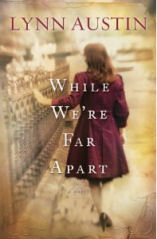
While We’re Far Apart by Lynn Austin

This week, the

Christian Fiction Blog Alliance

is introducing

While We’re Far Apart

Bethany House (October 1, 2010)

by

Lynn Austin

ABOUT THE AUTHOR:

It was during the long Canadian winters at home with her children that Lynn made progress on her dream to write, carving out a few hours of writing time each day while her children napped. Lynn credits her early experience of learning to write amid the chaos of family life for her ability to be a productive writer while making sure her family remains her top priority.

Along with reading, two of Lynn’s lifelong passions are history and archaeology. While researching her Biblical fiction series, Chronicles of the Kings, these two interests led her to pursue graduate studies in Biblical Backgrounds and Archaeology through Southwestern Theological Seminary. She and her son traveled to Israel during the summer of 1989 to take part in an archaeological dig at the ancient city of Timnah. This experience contributed to the inspiration for her novel Wings of Refuge.

Lynn resigned from teaching to write full-time in 1992. Since then she has published twelve novels. Five of her historical novels, Hidden Places, Candle in the Darkness, Fire by Night, A Proper Pursuit, and Until We Reach Home have won Christy Awards in 2002, 2003, 2004, 2008, and 2009 for excellence in Christian Fiction. Fire by Night was also one of only five inspirational fiction books chosen by Library Journal for their top picks of 2003, and All She Ever Wanted was chosen as one of the five inspirational top picks of 2005. Lynn’s novel Hidden Places has been made into a movie for the Hallmark Channel, starring actress Shirley Jones. Ms Jones received a 2006 Emmy Award nomination for her portrayal of Aunt Batty in the film.

ABOUT THE BOOK:

In an unassuming apartment building in Brooklyn, New York, three lives intersect as the reality of war invades each aspect of their lives. Young Esther is heartbroken when her father decides to enlist in the army shortly after the death of her mother.

Penny Goodrich has been in love with Eddie Shaffer for as long as she can remember; now that Eddie’s wife is dead, Penny feels she has been given a second chance and offers to care for his children in the hope that he will finally notice her and marry her after the war.

And elderly Mr. Mendel, the landlord, waits for the war to end to hear what has happened to his son trapped in war-torn Hungary. But during the long, endless wait for victory overseas, life on the home front will go from bad to worse.

Yet these characters will find themselves growing and changing in ways they never expected–and ultimately discovering truths about God’s love…even when He is silent.

If you would like to read the first chapter of While We’re Far Apart, go HERE.

Learn more about Lynn and her books on her Website.

MY REVIEW:

While We’re Far Apart is historical fiction at its best. Set in Brooklyn, New York during World War II, the book tells the story of four lonely people whose lives intersect at their apartment building. As they spend time together, positive changes occur for each of them. While We’re Far Apart is filled with rich historical details and character development that brings a lifelike quality to the story. Descriptions of Jewish tradition and history add even more depth and understanding of the era. Although not a historical romance,  there is a little romance to be found. While We’re Far Apart is filled with surprises and has a totally unexpected ending. As always, I recommend anything written by Lynn Austin.

Catching Moondrops by Jennifer Erin Valent

It is time for a FIRST Wild Card Tour book review! If you wish to join the FIRST blog alliance, just click the button. We are a group of reviewers who tour Christian books. A Wild Card post includes a brief bio of the author and a full chapter from each book toured. The reason it is called a FIRST Wild Card Tour is that you never know if the book will be fiction, non~fiction, for young, or for old…or for somewhere in between! Enjoy your free peek into the book!

You never know when I might play a wild card on you!


Today’s Wild Card author is:


and the book:


Catching Moondrops

Tyndale House Publishers, Inc. (September 20, 2010)

***Special thanks to Maggie Rowe of Tyndale House Publishers, Inc.
for sending me a review copy.***

ABOUT THE AUTHOR:

Jennifer Erin Valent is the 2007 winner of the Christian Writers Guild’s Operation First Novel contest. A lifelong resident of the South, her surroundings help to color the scenes and characters she writes. In fact, the childhood memory of a dilapidated Ku Klux Klan billboard inspired her portrayal of Depression-era racial prejudice in Fireflies in December. She has spent the past 15 years working as a nanny and has dabbled in freelance, writing articles for various Christian women’s magazines. She still resides in her hometown of Richmond, Virginia.

Visit the author’s website.


Product Details:

List Price: $12.99
Paperback: 384 pages
Publisher: Tyndale House Publishers, Inc. (September 20, 2010)
Language: English
ISBN-10: 1414333277
ISBN-13: 978-1414333274

AND NOW…THE FIRST CHAPTER:

There’s nothing in this whole world like the sight of a man swinging by his neck.

Folks in my parts liked to call it “lynching,” as if by calling it another word they could keep from feeling like murderers. Sometimes when they string a man up, they gather around like vultures looking for the next meal, staring at the cockeyed neck, the sagging limbs, their lips turning up at the corners when they should be turning down. For some people, time has a way of blurring the good and the bad, spitting out that thing called conscience and replacing it with a twisted sort of logic that makes right out of wrong.

Our small town of Calloway, Virginia, had that sort of logic in spades, and after the trouble it had caused my family over the years, I knew that better than most. But the violence had long since faded away, and my best friend Gemma would often tell me that made it okay—her being kept separate from white folks. “Long as my bein’ with your family don’t bring danger down on your heads, I’ll keep my peace and be thankful,” she’d say.

But I didn’t feel so calm about it all as Gemma did. Part of that was my stubborn temperament, but most of it was my intuition. I’d been eyeball to eyeball with pure hate more than once in my eighteen years, and I could smell it, like rotting flesh. Hate is a type of blindness that divides a man from his good sense. I’d seen it in the eyes of a Klansman the day he tried to choke the life out of me and in the eyes of the men who hunted down a dear friend who’d been wrongly accused of murder.

And, at times, I’d caught glimpses of it in my own heart.

The passage of time had done nothing to lessen its stench. And despite the relative peace, I knew full well that hearts poisoned by hateful thinking can only simmer for so long before boiling over.

In May of that year, 1938, that pot started bubbling.

I was on the front porch shucking corn when I saw three colored men turn up our walk, all linked up in a row like the Three Musketeers. I stood up, let the corn silk slip from my apron, and called over my shoulder. “Gemma! Come on out here.”

She must have been nearby because the screen door squealed open almost two seconds after my last words drifted in through the screen. “What is it?”

“Company. Only don’t look too good.” I walked to the top of the steps and shielded my eyes from the sun. “Malachi Jarvis! You got yourself into trouble again?”

The man in the middle, propped up like a scarecrow, lifted his chin wearily but managed to flash a smile that revealed bloodied teeth. “Depends on how you define trouble.”

Gemma gasped at the sight of him and flew down the steps, letting the door slam so loud the porch boards shook. “What in the name of all goodness have you been up to? You got some sort of death wish?”

A man I’d never seen before had his arm wound tightly beneath Malachi’s arms, blood smeared across his shirt front. Malachi’s younger brother, Noah, was on his other side, struggling against the weight, and Gemma came in between them to help.

“He ain’t got the good sense to keep his mouth shut, is all,” Noah said breathlessly.

I went inside to grab Momma’s first aid box, and by the time I got back out, Gemma had Malachi seated in the rocker.

Gemma gave him the once-over and shook her head so hard I thought it might fly off. “I swear, if you ain’t a one to push a body into an early grave. Your poor momma’s gonna lose her ever-lovin’ mind.”

Along with his younger brother and sister, Malachi lived down by the tracks with his widowed momma—as the man of the house, so to speak. He’d taken up being friends with Luke Talley some two years back when they’d both worked for the tobacco plant, and they’d remained close even though Luke had struck out on his own building furniture. Malachi was never one to keep his peace, a fact Gemma had no patience for, and she made it good and clear many a time. Today would be no exception.

“Goin’ around stirrin’ up trouble every which way,” she murmured as she pulled fixings out of the first aid box. “It’s one thing to pick fights with your own kind. Can’t say as though you wouldn’t benefit by a poundin’ or two every now and again. But this foolin’ around with white folks’ll get you into more’n you’re bargainin’ for.”

The man who’d helped Noah shoulder the burden of Malachi reached out to take the gauze from Gemma. “Why don’t you let me get that?”

Gemma didn’t much like being told what to do, and she glared at him. “I can clean up cuts and scrapes. I worked for a doctor past two years.”

Malachi nodded towards the man. “This here man is a doctor.”

I was putting iodine on a piece of cotton, and I near about dropped it on the floor when I heard that. Never in all my born days had I seen a colored man claiming to be a doctor. Neither had Gemma by the looks of her.

“A doctor?” she murmured. “You sure?”

He laughed and extended his hand to her. “Last I checked. Tal Pritchett. Just got into town yesterday. Gonna set up shop down by the tracks.”

Gemma handed the gauze over to him, still dumbfounded.

“What d’you think about that?” Malachi grinned and then grimaced the minute his split lip made its presence known. “A colored doc in Calloway. Shoo-whee. There’s gonna be talkin’ about this!”

The doctor went to work cleaning up Malachi’s wounds. “I ain’t here to start no revolution. I’m just aimin’ to help the colored folks get the help they deserve.”

“Well, you’re goin’ to start a revolution whether you want to or not.” Malachi shut his eyes and gritted his teeth the minute the iodine set to burning. “Folks in these parts don’t much like colored folk settin’ themselves up as smart or nothin’.”

Gemma watched Tal Pritchett like she was analyzing his every move, finding out for herself if he was a doctor or not. I stood by and let her assist him as she’d been accustomed to doing for Doc Mabley until he passed on two months ago. After he’d bandaged up Malachi’s right hand, she seemed satisfied that he was who he said.

Noah slumped down into the other rocker and watched. “It’s one thing to get yourself an education and stand for your right to make somethin’ of yourself. It’s another to go stirrin’ up trouble for the sake of stirrin’ up trouble.”

“I ain’t doin’ it for the sake of stirrin’ up trouble. I done told you that!” Malachi flexed his left hand to test how well his swollen fingers moved. Ain’t no colored man ever goin’ to be free in this here county . . . in this here state . . . in this here world unless somebody starts fightin’ for freedom.”

“Slaves was freed decades ago,” Noah said sharply. “We ain’t in shackles no more.”

“But we ain’t free to live our lives as we choose, neither. You think colored people are ever gonna be more’n house help and field help so long as we let ourselves be treated like less than white people? No sir. We’re less than human to them white folks. They don’t think nothin’ about killin’ so long as who they’re killin’ is colored.”

“Don’t you go bunchin’ all white people together, Malachi Jarvis,” I argued. “Ain’t all white folk got bad feelin’s about coloreds.”

Malachi waved me off in exasperation. “You know I ain’t talkin’ about you, Jessilyn.”

Noah had his hands tightly knotted in his lap and was staring at them like they held all the answers to the world’s problems. “All’s you’re doin’ is gettin’ yourself kicked around.” He looked up at me pleadingly. “This here’s the second time in a week he’s come home banged up.”

I put a hand on Noah’s shoulder and set my eyes on Malachi. “Who did it?”

He put his bandaged right hand into the air, palm up. “Who knows? Some white boys. You get surrounded by enough of ‘em, they all just blend in together like a vanilla milkshake.”

“How’s it you didn’t see them? They jump you or somethin’?”

“Don’t ask me, Jessie. I was just mindin’ my own business in town and then on my way home, they start hasslin’ me.”

“What he was doin’,” Noah corrected, “was tryin’ to get into the whites-only bar.”

Gemma sniffed in disgust. “Shouldn’t have been in no bar in the first place. There’s your first mistake.”

“Whites-only, too.” Noah kicked his foot against the porch rail and then looked up at me quickly. “Sorry.”

I smiled at him and turned my attention back to Malachi. “It’s a good thing Luke ain’t here to see this. He don’t like you drinkin’ and you know it.”

His eyeballs rolled between swollen lids. “I don’t know why he gets his trousers in a knot over it anyhow. Ain’t like there’s prohibition no more. And he’s been known to take a swig or two himself.”

“Luke says you’re a nasty drunk.”

“He is.” Noah knotted his hands back in his lap. “And he’s been at the bottle more often than not of late.”

“Quit tellin’ tales!” his brother barked.

“I ain’t tellin’ tales; I’m tellin’ truth. They can ask anybody at home how late you come in, and how you come in all topsy turvy. He comes home in the middle of the mornin’ and sleeps in till all hours the next day.”

“What about your job at the plant?” Gemma asked.

Malachi closed his eyes and waved her off, but his brother provided the answer for him. “Lost it!” He loosened his grip on his hands and snapped his fingers. “Like that. There’s goes his income.”

“I said I’ll get another job.”

“Oh, like there’s jobs aplenty around these parts for colored folk. And anyways, if you find one, how you gonna’ keep that one?”

Gemma had her hands on her hips, and I knew what that meant. I leaned back against the house and waited for the lecture to commence.

“You talk a fine talk about colored folks needin’ to stand up for equality, but you ain’t doin’ it in any way that’s right and good. You’re goin’ about town gettin’ people’s goat, and tryin’ to get in where you ain’t wanted, and gettin’ yourself all liquored up and useless. Now your family ain’t got the money they depend on you for, and why? Because you walk around livin’ like you ain’t got to do nothin’ for nobody but yourself.”

“I’m standin’ up for the rights of colored folks everywhere.” Malachi was angry now, pink patches spreading on his busted-up cheeks. “You see anyone else in this town willin’ to go toe to toe with the white boys in this county?”

“Don’t put a noble face on bein’ an upstart.”

Malachi pushed Tal’s hand away and sat up tall. “You call standin’ up to white folks bein’ an upstart?”

Doc Pritchett tried to dress the wound on Malachi’s temple, but Malachi pushed his hand away again. That was when the doctor had enough, and he smacked his hands on his thighs and stood up tall and determined in front of Malachi. “I ain’t Abraham Lincoln. I’m just Doc Pritchett tryin’ to fix up an ornery patient, and I ain’t got all day to do it. So I’m goin’ to settle this argument once and for all.” He pointed at Gemma. “She’s right. There ain’t no fightin’ nonsense with more nonsense, and all’s you’re doin’ by gettin’ in the faces of white folks with your smart attitude is bein’ as bad as they’re bein’.” Then he pointed at Malachi. “And he’s right, too. There ain’t never a change brought about that should be brought about without people standin’ up for such change. And sometimes that means bein’ willin’ to fight for what’s right.”

Gemma swallowed hard and didn’t even try to argue. My eyes must have bugged out of my head at the sight of her being tamed so easily.

“Now, I’m all for civil uprisin’,” Tal continued. “I don’t see nothin’ wrong with colored folk sayin’ they won’t be walked on no more. I don’t see nothin’ wrong with wantin’ to use the same bathroom as white folks or sit in the same chairs as white folks. Way I see it, none of that’s goin’ to change unless someone says it has to.” He squatted down in front of Malachi again and stared him down nose to nose. “But all this hot-shottin’ and show-boatin’ ain’t goin’ to do nothin’ but get your rear end kicked. Or worse. You aim to stand tall for somethin’? Fine. Stand tall for it. But don’t you go around thinkin’ these battle scars say somethin’ for you. You ain’t got them by bein’ noble; you got them by bein’ stupid. All’s these scars say is you’re an idiot.”

It was one of the best speeches I’d heard from anyone outside my daddy, and if I’d ever thought for two seconds put together to see a colored man run for governor, I figured Tal Pritchett would be the man for the job. As it was, I knew he was the best man for the job he had now. Sure enough, being a colored doc in Calloway would be a challenge. But I figured he was up for it.

Regardless, he shut Malachi up, and for the next five minutes we all watched him finish his job with skill and finesse. When he’d fixed the last of Malachi’s face, he stood up and clapped his hands. “Suppose that should do it. Don’t see need for any stitchin’ up today. Let’s hope there’s no cause for it in future.” Then he looked at me. “You got someplace out here where I can wash up?”

I held my hand out toward the front door. “Bathroom’s upstairs.”

He hesitated. “I’d just as soon wash up out here.”

I caught the reason for his hesitation but didn’t know what to say. As usual, Gemma did.

“I done lived in this here house for six years now, and I’m just as brown as you. You can feel free to go on up to the bathroom, you hear?”

He looked from Gemma to me, then back to Gemma before nodding. “Yes’m.” And then he disappeared inside.

“Ma’am,” Gemma muttered under her breath. “Ain’t old enough to be called ma’am, least of all by a man no more’n a few years older’n me.”

“You know what happens once you start gettin’ them crows feet . . .”

Gemma whirled about and gave Malachi the evil eye. “Don’t go thinkin’ I won’t hurt you just because you’re all bandaged up.”

Noah got up and paced the porch until Tal came back outside. “Doc, you have any problem gettin’ your schoolin’?”

Tal shrugged and leaned against the porch rail. “No more’n most, I guess. There’s a lot to learn. Why? You thinkin’ about goin’ to college?”

You could have heard a pin drop on that front porch. Never, and I mean never, in all the days Calloway had been on the map, had there ever been a single person, white or black, to step foot at a college. The very idea of that mark being made by a colored boy was a surefire way to start war.

And Noah knew it.

He looked at his feet and kicked the heel of one shoe against the toe of another. “Ain’t possible. I was just wonderin’ aloud, is all.”

“What do you mean it ain’t possible? All’s you’ve got to do is work hard. You can get scholarships and things.”

But Noah took a look at his brother, whose face was hard and tight-lipped, and nodded off toward the road. “Nah, there ain’t no use talkin’ over it. We’d best get home anyhow.”

Tal didn’t push the subject. He just picked his hat up off the porch swing and plopped it on his head. “Miss Jessie. Miss Gemma. It was a fine pleasure to meet you, and a kindness for you to give us a hand.”

“You should stop by sometime and meet my parents,” I said. “They’re off visitin’, but I’m sure they’d be right happy to know you.”

“I’m sure I’d be right happy to know them, too.” He turned his attention to Gemma. “You said you worked for a doctor?”

“I worked for Doc Mabley. He was a white doctor. Died some two months ago.”

“He let you assist?”

“Only with the colored patients. Doc Mabley was kind enough to help some of them out when they needed it. Otherwise I kept his records, kept up his stock.”

“Well, I’ll tell you, Miss Gemma, I could sure use some help if you’d be obliged. An assistant would be a good set of extra hands, and I could use someone known around here to make my introductions.”

Gemma eyed him up before slowly nodding her head. “Reckon I could.”

“Wouldn’t be much pay, now, you know. Ain’t likely to get much in the way of fees from the patients I’ll be treatin’.”

“Don’t matter so long as I have good work to put my hands to.”

“That it would be. My office is right across the street from the Jarvis house.”

Malachi snorted. “Shack’s more like it.”

“Room enough for me,” Tal said. Then to Gemma, “You think you could stop in sometime this week to talk it over?”

“I can come day after tomorrow if that suits.”

“Nine o’clock too early?”

“No, sir! I’ve kept farm hours all my life.”

He grinned at her. “Nine o’clock then?”

“Nine o’clock.”

Malachi watched the two of them with his swollen eyes, a look of disgust growing more evident on his face. He’d made no secret over the past year about his admiration for Gemma, and the unmistakable attraction that was growing between her and Tal was clearly turning his stomach.

“Mind if we go home?” he muttered. “Before I fall down dead or somethin’?”

Gemma tore her eyes away from Tal to roll them at Malachi. “Would serve you right if you did.”

“And on that cheery note . . .” Malachi groaned on his way down the steps. “I’ll bid you ladies a fine evenin’.”

I gave Noah a playful whack to the head, but he ducked so it only clipped the top. “Luke will be back home tomorrow evenin’. He’ll be itchin’ to see you, I’m sure.”

“I’m itchin’ to see him.” He took the steps in one leap, tossing dust up when he landed. “You tell him to come on by and see us real soon.”

“And tell him to bring his cards,” Malachi added. “He owes me a poker rematch.”

I squinted at him suspiciously. “Only if you play for beans.”

“I hate beans.”

Malachi leaned on Tal for support and Noah scurried to catch up and help. I watched them go, but I wasn’t thinking much about them. I was thinking about Luke. It had been two months since he’d left to collect customers for his furniture-making business, and every day had seemed like an eternity.

The very thought of him got my stomach butterflies to fluttering, but one look at Gemma told me it was another man who had stolen her attention. “That

Doc Pritchett’s a fine man.” I looked at her sideways with a smirk. “Looks about twenty-five or so.”

“So?”

“Good marryin’ age.”

She crossed her arms defiantly. “Jessilyn Lassiter, what’s that got to do with anythin’?”

“Only what I said. I’m only statin’ fact.”

“Mm-hm. I hear ya. You’d be better off keepin’ your facts to yourself.”

She grabbed the first aid box and headed inside, but the sound of that door slamming told me I’d got to her.

It told me Tal Pritchett had got to her, too.

MY REVIEW:

Catching Moondrops, the third book in the Calloway Summers series, takes place in Calloway, Virginia during the summer of 1938. Jessilyn and Gemma have grown into young women and their lives have been relatively peaceful for awhile. Then about the time their friend Malachi begins to lash out at racial prejudice, Tal Pritchett, a young black doctor sets up his practice in town. It isn’t long before Klan activity begins to escalate and violence quickly erupts.

With each incident, Jessilyn’s anger and bitterness festers. Although she believes in God, she doesn’t understand the ‘light’ she sees in the people she loves – her parents, Gemma, Luke, and Miss Cleta. A frightening encounter ends with a serious accident and Jessilyn’s reactions reveal how hardened she has let herself become.

Valent’s characters are realistic with strengths and flaws with which most people can identify. The plot accurately relates events and sentiments of that time period. The book is filled with an abundance of  human emotions such as love, hate, bitterness, anger, joy, prejudice,  faith, and forgiveness. Catching Moondrops as well as the entire Calloway Summers series is well worth your time.

Wrangler in Petticoats by Mary Connealy


MY REVIEW:

Mary Connealy has penned another rip roaring western romance full of action, drama, and fun. As usual, the women carry the story with heroine Sally McClellen whose ambition has been to be the best cowboy ever, her sister Mandy, known as the best shot in the west, and Wise Sister, an older Shoshone woman who can do everything from hunting for meat to cooking it. What man has a chance against strong women like these?

Artist Logan McKenzie has his hands full when  he rescues Sally after witnessing her fall over the edge of a cliff. He quickly realizes that she is the love of his life but their obvious differences convince him that a relationship is virtually impossible. Sally fights her growing attraction to Logan because she is determined not to make the same mistakes her mother and sister have made by marrying ‘no account’ men. There is just no way an artist can be the man she needs.

I thoroughly enjoyed reading Wrangler in Petticoats as well as most of Mary’s other books. I am beginning to wonder if she has a problem with men – there are so many ‘no account’ ones who show up in her books. Her heroines are all strong, self-sufficient women, almost to a fault. Even the manly men sometimes come across a little less than ideal – but maybe that’s what makes Mary’s books work. I still buy them – can’t resist a western romance with humor.


A digital copy of this book was provided for review by Barbour Books through NetGalley.


ABOUT THE BOOK:

Sally McClellen finds herself injured and in the care of the biggest wimp she’s ever met. Logan McKenzie paints pictures of the wild west—and claims he makes a living doing it. When the two of them see an elk she reaches for her rifle, he reaches for a sketch pad. The word DRAW means completely different things to them.

When Sally falls off a cliff practically into his arms, he decides he’s keeping her. So far her broken leg is keeping her close, but she’s a quick healer and she needs to get some tougher help, because outlaws are hunting hard for the one witness to their crime.


ABOUT THE AUTHOR:

Mary Connealy is an author, journalist, and teacher. She lives on a Nebraska farm with her husband, Ivan, and has four mostly grown daughters. If you hunt hard enough, you can find Mary on the Internet like a middle-aged, female “Where’s Waldo” at www.maryconnealy.com .