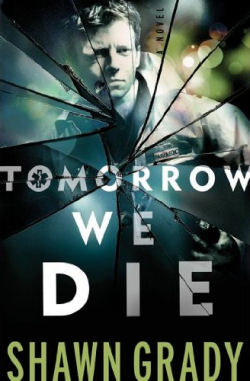
Tomorrow We Die by Shawn Grady


This week, the


Christian Fiction Blog Alliance


is introducing


Tomorrow We Die Bethany House (July 1, 2010)


by Shawn Grady


ABOUT THE AUTHOR:

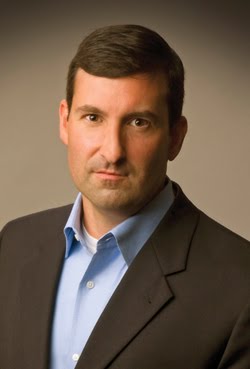
Shawn Grady signed with Bethany House Publishers in 2008. He was named “Most Promising New Writer” at the 39th Annual Mount Hermon Writers Conference. He is the author of the novels Through the Fire & Tomorrow We Die.

Shawn has served for over a decade as a firefighter and paramedic in northern Nevada. From fire engines and ambulances to tillered ladder trucks and helicopters, Shawn’s work environment has always been dynamic. The line of duty has carried him to a variety of locale, from high-rise fires in the city to the burning heavy timber of the eastern Sierras.

Shawn attended Point Loma Nazarene University as a Theology undergrad before shifting direction to acquire an Associate of Science degree in Fire Science Technology as well as Paramedic licensure through Truckee Meadows Community College.

Shawn currently lives in Reno, Nevada, just outside of Lake Tahoe. He enjoys spending time in the outdoors with his wife, three children and yellow Labrador.

ABOUT THE BOOK:

Chase the Angel of Death and You Might Catch Him
Jonathan Trestle is a paramedic who’s spent the week a few steps behind the angel of death. When he responds to a call about a man sprawled on a downtown sidewalk, Trestle isn’t about to lose another victim. CPR revives the man long enough for him to hand Trestle a crumpled piece of paper and say, “Give this to Martin,” before being taken to the hospital.

The note is a series of dashes and haphazard scribbles. Trestle tries to follow up with the patient later, but at the ICU he learns the man awoke, pulled out his IVs, and vanished, leaving only a single key behind. With the simple decision to honor a dying man’s last wish, Jonathan tracks the key to a nearby motel where he finds the man again–this time not just dead but murdered. Unwilling to just let it drop, Jonathan is plunged into a mystery that soon threatens not only his dreams for the future but maybe even his life. He must race for the truth before the Angel of Death comes calling for him.

If you would like to read the first chapter of Tomorrow We Die, go to HERE.

MY REVIEW:

Tomorrow We Die is a fast moving story about a paramedic who finds himself in the middle of a mystery after he is handed a cryptic note by a victim during an emergency call. After finding the same man dead, Jonathan’s curiosity leads him on a quest to find the truth. His investigation leads him into escalating danger that threatens his life and the lives of anyone who dares to help him.

I read Tomorrow We Die straight through because I was unable to put it down. Not only did the author keep the action flowing but his characters were well rounded and I could easily identify with them. The descriptions of the daily life of a paramedic were interesting and added a realistic dimension to the story. I really enjoyed this book and hope to see more from this author soon.

Claim by Lisa T. Bergren

It is time for a FIRST Wild Card Tour book review! If you wish to join the FIRST blog alliance, just click the button. We are a group of reviewers who tour Christian books. A Wild Card post includes a brief bio of the author and a full chapter from each book toured. The reason it is called a FIRST Wild Card Tour is that you never know if the book will be fiction, non~fiction, for young, or for old…or for somewhere in between! Enjoy your free peek into the book!

You never know when I might play a wild card on you!


Today’s Wild Card author is:


and the book:


Claim: A Novel of Colorado (The Homeward Trilogy)

David C. Cook; New edition (June 1, 2010)

***Special thanks to Audra Jennings of The B&B Media Group for sending me a review copy.***

ABOUT THE AUTHOR:


Lisa T. Bergren is a best-selling author who offers a wide array of reading opportunities ranging from children’s books (God Gave Us Love and God Found Us You) and women’s nonfiction (Life on Planet Mom) to suspense-filled intrigue (The Gifted Trilogy) and historical drama. With more than thirty titles among her published works and a deep faith that has weathered dramatic career and personal challenges, Bergren is excited to add the Homeward Trilogy to her resume as she follows God’s direction in her writing career. Bergren lives in Colorado Springs, Colorado, with her husband Tim (a graphic design artist and musician) and their three children.

Visit the author’s website.

Product Details:

List Price: $14.99
Paperback: 400 pages
Publisher: David C. Cook; New edition (June 1, 2010)
Language: English
ISBN-10: 143476706X
ISBN-13: 978-1434767066

AND NOW…THE FIRST CHAPTER:

1 August 1888


Gunnison, Colorado

“Keep doing that you’ll get yourself killed,” Nic said to the boy. Panting, Nic paused and wiped his forehead of sweat. For an hour now, as he moved sacks of grain from a wagon to a wheelbarrow and into the warehouse, he’d glimpsed the boy daring fate as he ran across the busy street, narrowly escaping horse hooves and wagon wheels.

“Where’s your mother?”

The brown-haired boy paused. “Don’t have a mother.”

“Well then, where’s your father?”

The boy cast him an impish grin and shrugged one shoulder.

“Around.”

“Is he coming back soon?” Nic persisted.

“Soon enough. You won’t tell ’im, will ya?”

“Tell him what?” Nic tossed back with a small smile. “Long as you stop doing whatever you’re not supposed to be doing.”

The boy wandered closer and climbed up to perch on the wagon’s edge, watching Nic with eyes that were as dark as his hair. Nic relaxed a bit, relieved that the kid wasn’t in imminent danger.

Nic hefted a sack onto his shoulder and carried it to the cart. It felt good to be working again. He liked this sort of heavy labor, the feel of muscles straining, the way he had to suck in his breath to heave a sack, then release it with a long whoosh. A full day of this sort of work allowed him to drop off into dreamless sleep—something he hungered for more than anything else these days.

The boy was silent, but Nic could feel him staring, watching his every move like an artist studying a subject he was about to paint. “How’d you get so strong?” the boy said at last.

“Always been pretty strong,” Nic said, pulling the next sack across the wooden planks of the wagon, positioning it. “How’d you get so fast?”

“Always been pretty fast,” said the boy, in the same measured tone Nic had used.

Nic smiled again, heaved the sack to his shoulder, hauled it five steps to the cart, and then dropped it.

“This your job?” the boy asked.

“For today,” Nic said.

Nic loaded another sack, and the boy was silent for a moment. “My dad’s looking for help. At our mine.”

“Hmm,” Nic said.

“Needs a partner to help haul rock. He’s been asking around here for days.”

“Miner, huh? I don’t care much for mining.”

“Why not? You could be rich.”

“More miners turn out dead than rich.” He winced inwardly, as a shadow crossed the boy’s face. It’d been a while since he’d been around a kid this age. He was maybe ten or eleven max, all wiry muscle and sinew. Reminded him of a boy he knew in Brazil.

Nic carried the next sack over to the wagon, remembering the heat there, so different from what Colorado’s summer held. Here it was bone dry. He was sweating now, after the morning’s work, but not a lot. In Brazil a man soaked his sheets as he slept.

“Listen, kid,” he said, turning back around to the wagon, intending to apologize for upsetting him. But the boy was gone.

Nic sighed and set to finishing his work. As the sun climbed high in the sky, he paused to take a drink from his canteen and eat a hunk of bread and cheese, watching the busy street at the end of the alleyway. He wondered if he’d see the boy again, back to his antics of racing teams of horses. The child was probably letting off steam, just as Nic had done all his life—he’d been about the child’s age when he’d first starting scrapping with others.

But that was in the past. Not since his voyage aboard the Mirabella had Nic indulged the need, succumbed to the desire to enter a fight. Several times now, he’d had the opportunity—and enough cause—to take another man down. But he had walked away. He knew, deep down he knew, that if he was ever to face his sisters, Odessa and Moira, again, if he was to come to them and admit he was penniless, everything would somehow be all right if he was settled inside. If he could come to a place of peace within, the kind of peace Manuel had known. It was the kind of thing that allowed a man to stand

up straight, shoulders back, the kind of thing that gave a man’s gut peace. Regardless of what he accomplished, or had in the past. Thing was, he hadn’t found that place of comfort inside, and he didn’t want what Manuel tried to sell him—God.

There had to be another way, another path. Something like this work. Hard manual labor. That might be what he needed most.

Nic heard a man calling, his voice a loud whisper, and his eyes narrowed as the man came limping around the corner, obviously in pain, his arm in a sling. “You, there!” he called to Nic. “Seen a boy around? About yea big?” he said, gesturing to about chest height.

“Yeah, he was here,” Nic called back. He set his canteen inside the empty wagon and walked to the end of the alleyway.

“Where’d he go?” the man said. Nic could see the same widow’s peak in the man’s brown hair that the boy had, the same curve of the eyes … the boy’s father, clearly.

“Not sure. One minute he was watching me at work, the next he was gone.”

“That’s my boy, all right.”

“I’ll help you find him.”

The man glanced back at him and then gave him a small smile. He stuck out his good arm and offered his hand. “I’d appreciate that. Name’s Vaughn. Peter Vaughn.”

“Dominic St. Clair,” he replied. “You can call me Nic.”

Peter smiled. His dimples were in the exact same spot as the boy’s. “Sure you can leave your work?”

“I’m nearly done. Let’s find your boy.”

“Go on,” Moira’s sister urged, gazing out the window. “He’s been waiting on you for a good bit now.”

“I don’t know what he sees in me,” Moira said, wrapping the veil around her head and across her shoulder again. It left most of her face visible but covered the burns at her neck, ear, and scalp. Did it cover them enough? She nervously patted it, making sure it was in place.

Odessa stepped away from washing dishes and joined her. “He might wonder what you see in him. Do you know what his story is? He seems wary.” Their eyes met and Odessa backtracked. “Daniel’s a

good man, Moira. I think highly of him. But I’d like to know what has burdened him so. Besides you.” She nudged her sister with her hip.

Moira wiped her hands on the dish towel and glanced out at him as he strode across the lawn with Bryce, Odessa’s husband. He was striking in profile, reminding her of the statues of Greek gods the French favored in their lovely tailored gardens. Far too handsome for her—since the fire, anyway. She shook her head a little.

“Moira.”

Irritated at being caught in thought, Moira looked at Odessa again.

“Trust him, Moira. He’s a good man. I can sense it.”

She nodded, but inwardly she sighed as she turned away and wrapped a scarf around her veiled head and shoulders. A good man. After Reid and Max and Gavin—could she really trust her choice in men? Odessa was fortunate to have fallen for her husband, Bryce, a good man through and through. Moira’s experiences with men had been less than successful. What made Odessa think this one was trustworthy?

But as Daniel ducked his head through the door and inclined it to one side in silent invitation to walk with him, Moira thought about how he had physically saved her more than once. And how his gentle pursuit both bewildered and calmed her. Daniel had done nothing to deserve her suspicions.

She moved over to the door. He glanced at her, and she noticed how his thick lashes made his brown eyes more pronounced. He shuffled his feet as if he were nervous. “You busy?” he asked.

“No.” Moira felt a nervous tension tighten her stomach muscles.

“Can we, uh …” His gaze shifted to Odessa, who quickly returned to her dishes. “Go for a walk?” he finally finished.

Moira smoothed her skirts and said, “I’d like that.” Then, meeting her sister’s surreptitious gaze, she followed him outside. It was a lovely day on the Circle M. The horses pranced in the distance. She could see her brother-in-law riding out with Tabito, the ranch’s foreman.

“So, you wanted to talk,” she ventured.

“There’s not a day that goes by that I don’t want to talk to you, Moira,” he said.

She looked up at him and then, when she saw the ardor in his gaze, she turned with a sigh.

“Don’t look away,” he whispered gently, pulling her to face him. He reached to touch her veil, as if he longed to cradle her cheek instead.

“No, Daniel, don’t,” she said and ran a nervous hand over the cover. He was tall and broad, and she did not feel physically menaced—it was her heart that threatened to pound directly out of her chest. Perhaps she wasn’t ready for this … the intimacies that a courtship brought.

She’d been dreaming about what it would be like to be kissed by him, held by him, but he never made such advances before. Never took the opportunity, leaving her to think that he was repulsed by

her burns, her hair, singed to just a few inches long, her past relationship with Gavin, or her pregnancy—despite what he claimed. Her hand moved to the gentle roundness of her belly, still small yet making itself more and more prominent each day. “I … I’m not even certain why you pursue me at all. Why you consider me worthy. ”

He seemed stunned by her words. “Worthy?” he breathed. He let out a hollow, breathy laugh and then looked to the sky, running a hand through his hair. He shook his head and then slowly brought his brown eyes down to meet hers again. “Moira,” he said, lifting a hand to cradle her cheek and jaw, this time without hesitation. She froze, wondering if he intended to kiss her at last. “I only hesitate because I am afraid,” he whispered.

“Afraid? You think I am not? I come to you scarred in so many ways, when you, you, Daniel, deserve perfection.…”

“No,” he said, shaking his head too. “It is I who carry the scars. You don’t know me. You don’t know who I am. Who I once was. What I’ve done …”

“So tell me,” she pleaded. “Tell me.”

He stared at her a moment longer, as if wondering if she was ready, wondering if she could bear it, and Moira’s heart pounded again. Then, “No. I can’t,” he said with a small shake of his head. He sighed heavily and moved up the hill. “Not yet.”

An hour after they began their search for Everett Vaughn, Peter sat down on the edge of the boardwalk and looked up to the sky. His face was a mask of pain. “That boy was hard to track when I wasn’t hurt.”

“He’ll turn up,” Nic reassured.

Peter nodded and lifted his gaze to the street.

“What happened to you?” Nic said gently, sitting down beside the man. His eyes scanned the crowds for the boy even as he waited for Peter’s response.

“Cave-in, at my mine. That’s why I’m here. Looking for a good man to partner with me. I’m onto a nice vein, but I’m livin’ proof that a man’s a fool to mine alone.” He looked at Nic and waited until he met his gaze. “You lookin’ for work?” He cocked his head to the side. “I’m offering a handsome deal. Fifty fifty.”

Nic let a small smile tug at the corners of his mouth. He glanced at the man, who had to be about his own age. There was an easy way about him that drew Nic, despite the pain evident in the lines of his face. “That is a handsome offer.” He cocked his own head. “But I don’t see you doing half the work, laid up like you are.”

“No, not quite. But I’ve already put a lot of work into it in the past three years, and I’m still good for about a quarter of the labor. To say nothing of the fact that my name’s on the claim.”

Nic paused, thinking about it, feeling drawn to help this man, but then shook his head. “I’m not very fond of small dark spaces.”

“So … make it bigger. Light a lamp.”

Nic shook his head, more firmly this time. “No. I’d rather find another line of work.”

Just then he spotted the boy, running the street again. “There he is,” Nic said, nodding outward. The boy’s father followed his gaze and with a grimace, rose to his feet. As they watched, the boy ran under a wagon that had temporarily pulled to a stop. Then he jumped up on the back of another, riding it for about twenty feet until he was passing by them. His face was a mask of elation.

“Everett! Ev! Come on over here!”

Everett’s eyes widened in surprise. He jumped down and ran over to them, causing a man on horseback to pull back hard on his reins and swear.

“Sorry, friend,” Peter said, raising his good arm up to the rider. The horseman shook his head and then rode on.

Peter grabbed his son’s arm and, limping, hauled him over to the boardwalk. “I’ve told you to stay out of the street.”

“So did I,” Nic said, meeting the boy’s gaze. The child flushed red and glanced away.

“We’d best be on our way,” Peter said. “Thanks for helpin’ me find my boy.” He reached out a hand and Nic rose to shake it. Peter paused. “It’s not often a man has a chance at entering a claim agreement once a miner has found a vein that is guaranteed to pay.”

Nic hesitated as he dropped Peter’s hand. “I’ve narrowly escaped with my life on more than one occasion, friend. I’m aiming to look up my sisters, but not from a casket.”

Peter lifted his chin, but his eyes betrayed his weariness and disappointment. What would it mean for him? For his boy, not to find a willing partner? Would they have to give up the mine just as they were finally on the edge of success? And what of the boy’s mother? His unkempt, too-small clothes told him Everett had been without a mother for some time.

He hesitated again, feeling a pang of compassion for them both. “Should I change my mind … where would I find you?”

A glimmer of hope entered Peter’s eyes. “A couple miles out of St. Elmo. Just ask around for the Vaughn claim up in the Gulch and someone’ll point you in our direction.” He reached out a hand. “I’d be much obliged, Nic. And I’m not half bad at cookin’ either. I’d keep you in grub. Give it some thought. But don’t be too put out if you get there, and I’ve found someone else.”

“Understood,” Nic said with a smile. “Safe journey.”

“And to you.” He turned away, tugging at his boy’s shoulder, but the child looked back at Nic, all big pleading eyes.

Hurriedly, Nic walked away in the opposite direction. He fought the desire to turn and call out to them. Wasn’t he looking for work? Something that would allow him to ride on to Bryce and Odessa’s ranch without his tail tucked between his legs? The man had said the mine was sure to pay.… I’m onto a nice vein.…

Was that a miner’s optimism or the truth?

Not yet?” Moira sputtered, following him. She frowned in confusion. He had been coaxing her forward, outward, steadily healing her with his kind attentions these last two months. But now it was as if they were at some strange impasse. What was he talking about? What had happened to him?

She hurried forward and grabbed his arm, forcing him to stop and turn again to face her. Her veil clung to her face in the early evening breeze. “Daniel.”

He slowly lifted his dark eyes to meet hers.

“This is about me, isn’t it?” she asked. “You attempt to spare my feelings but find me repulsive. I can hardly fault you, but—”

“No,” he said, with another hollow laugh. “Contrary to what you believe, Moira St. Clair, not everything boils down to you. You are braver than you think and more beautiful than you dare to believe. I believe we’re destined to be together.”

Moira held her breath. Then what—

“No,” he went on. “This is about something I need to resolve. Something that needs to be done, or at least settled in my mind, my heart, before I can properly court you.”

“What? What is it, Daniel?” she tried once more.

He only looked at her helplessly, mouth half open, but mute.

She crossed her arms and turned her back to him, staring out across the pristine valley, the land of the Circle M. It hurt her that he felt he couldn’t confide in her as she had with him. She stiffened when he laid his big hands on her shoulders. “I don’t need to be rescued, Daniel,” she said in a monotone. “God has seen me to this place, this time. He’ll see me through to the next … with or without you.”

“You don’t understand.”

“No. I don’t. We’ve been courting all summer, whether you realize it or not. And now you say that there is something else that needs to be resolved? You assume much, Daniel Adams. You think that I’ll wait forever?” She let out a scoffing laugh. “It’s clear you do not fear that any other man might pursue me. Not that I blame you …” She turned partly away and stared into the distance. “Please. Don’t let this linger on. I cannot bear it. Not if you do not intend to claim me as your own.”

He was silent for a long minute. Oh, that he would but turn her and meet her lips at last …

But he didn’t. “We both have a lot to think through, pray through, Moira,” he said quietly.

“Yes, well, let me know when that is accomplished,” she said over her shoulder, walking away as fast as she could, lest he see the tears that were already rolling down her cheeks.

©2010 Cook Communications Ministries. Claim by Lisa Bergren. Used with permission. May not be further reproduced. All rights reserved.

MY REVIEW:

The third and final book in Lisa Bergren’s The Homeward Trilogy, Claim is a fitting conclusion to the series, which in my opinion would make wonderful epic movies. Although it features Nic St. Clair, Moira’s story is also heavily featured and tied up nicely at the end. Bryce and Odessa take a back seat in this edition but their presence is still evident.

In Claim, Nic continues his journey to check on his sisters but becomes sidetracked in Gunnison, Colorado where he meets Peter and Everett Vaughn, then schoolteacher Sabine. More tragedy, mishaps, adventure and even romance are in store for Nic after he agrees to partner with the Vaughns at their gold mine. A real prodigal son story, Claim illustrates Nic’s spiritual journey as he learns to recognize God’s involvement in his life.

I loved the entire series and would recommend it to anyone who enjoys historical fiction. Although Claim can stand on its own, I suggest that Breathe and Sing be read first in order to appreciate the entire story.


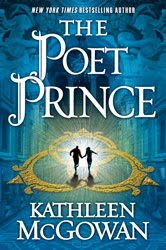
The Poet Prince by Kathleen McGowan

It is time for a FIRST Wild Card Tour book review! If you wish to join the FIRST blog alliance, just click the button. We are a group of reviewers who tour Christian books. A Wild Card post includes a brief bio of the author and a full chapter from each book toured. The reason it is called a FIRST Wild Card Tour is that you never know if the book will be fiction, non~fiction, for young, or for old…or for somewhere in between! Enjoy your free peek into the book!

You never know when I might play a wild card on you!


Today’s Wild Card author is:


and the book:


The Poet Prince

Touchstone; 1 edition (May 25, 2010)

***Special thanks to Mallika Dattatreya and Ashley Hewlett of Touchstone/Fireside Publicity Simon &Schuster, Inc. for sending me a review copy.***

ABOUT THE AUTHOR:


Kathleen McGowan is the New York Times bestselling author of The Expected One, an international bestseller published in more than 30 languages. She lives in Los Angeles with her husband and three sons.

Visit the author’s website.

Product Details:

List Price: $25.99
Hardcover: 407 pages
Publisher: Touchstone; 1 edition (May 25, 2010)
Language: English
ISBN-10: 0743299981
ISBN-13: 978-0743299985

AND NOW…THE FIRST CHAPTER:

Prologue


Rome, AD 161

The Roman emperor Antoninus Pius was not a butcher.

A scholar and philosopher, Pius did not want to be remembered by history as one of Rome’s cruel and intolerant tyrants. Yet here he stood, literally up to his ankles in the blood of Christians. While alive, the four brothers had been exceptionally beautiful young men. But after their terrible deaths brought about by beatings and torture, they were unrecognizable masses of blood and flesh. The sight made him want to retch, but he could not appear to be weak before his citizens.

Pius was, for the most part, tolerant of the irksome minority who called themselves Christians. He even found it stimulating to participate in debates with those who were educated and reasonable. However odd he personally found their beliefs–about the single messiah who rose from the dead and would come again–their ideas did appear to be spreading at an unnervingly steady pace throughout Rome. A number of Roman nobles had converted to Christianity openly, and their participation in Christian rituals was tolerated by his government. This growing sect was also finding particular popularity with highborn females; women were included as equals in all its rites and ceremonies. They could even be priests in this strange new world of Christian thought and practice.

The Roman priests who held court in the temples of Jupiter and Saturn were up in arms that these Christians were allowed to offend the gods with their ridiculous concept of a single deity. Emperor Pius generally ignored the priests’ wailings, and thus life in Rome went on in relative peace during much of his reign. It was only when some aberration developed to endanger lives in the Roman republic, some tragedy or natural disaster, that the Christians found themselves mortally threatened. The Roman priests, and their followers, were quick to blame the Christians for any and all misfortunes that might befall Rome. Surely it was their monotheistic insult to the true gods of the republic that caused divine retribution to fall on the other innocent and obedient citizens?

Emperor Pius had himself discovered in his debates that there were two types of Christians: the wild-eyed fanatics who often seemed anxious to die to prove their great piety, and the truly reasonable and compassionate adherents who were more devoted to helping the poor and healing the sick than they were to preaching and converting. Pius definitely preferred the latter type; they were making a positive contribution to their communities and were valuable citizens. These Christians, whom he called the Compassionates, were fond of telling stories of their messiah and his great healing ability and of quoting his very wise words about the need for charity. Most often, they spoke passionately about the power of love and its many forms. Indeed there were even some Christians here in Rome who claimed direct descent from their messiah himself, through his children who had settled in Europe. These claimants were the same Compassionates who worked tirelessly to help the suffering and the poor. Their undisputed leader was a stunning and charismatic noblewoman called Lady Petronella. The flame-haired Petronella was beloved by the people of Rome, despite her openly Christian practices, as she was the daughter and heiress of one of Rome’s oldest families. She used her wealth generously for the highest good of the republic and preached only of the need for love and tolerance. If Petronella and her Compassionates, had been the only kind of Christian in Rome, this onslaught of terrible bloodshed would likely never have begun.

But the group of Christians that Pius referred to as the Fanatics were another story altogether. In contrast to the Compassionates, who spoke of their messiah in warm and devoted tones as the great teacher of a spiritual path they called the Way of Love, the Fanatics screeched of the one true God who would eliminate all others and bring about a reign of terror for the unbelievers at a time of final judgment. The Romans were deeply offended by this perspective, and the Fanatics compounded the offense by insisting that life on earth did not matter and that only the afterlife was of importance. Such a philosophy, such a craven disregard for the gift of life that the gods bestowed upon mortals, was absolute sacrilege to the Roman priests and their followers. It was incomprehensible to a culture of people who celebrated the experience of the physical senses in their countless spiritual and civic festivals. To most Romans, the Fanatics were an enigma born out of madness, a group to be shunned if not feared.

Thus it was the Fanatics who raised the ire of the Roman people, even when there were no natural disasters to contend with. But when a deadly influenza outbreak struck an affluent Roman suburb, the priests of Saturn began to cry for the blood of Christians to appease their god.

In the center of this growing drama was a wealthy Roman widow, the Lady Felicita. Felicita had converted to Christianity when, overcome by grief following the sudden death of her noble and beloved husband, she had turned her back on the Roman gods. It was said that, left alone to raise seven sons without a father, she went mad with the anguish of her loss. Felicita was visited by Christians who offered her comfort in her mourning, and she ultimately found strength and solace in the Fanatics’ extreme perspective on the absolute importance of the afterlife. In this ideal, Felicita was consoled that her husband was in a better place where she would join him one day, and they would be together with their children as a family in heaven.

While Felicita burned with the passion of the newly converted, most of the nobles in her community were not overly upset by her behavior. Felicita would spend hours each day on her knees in prayer, but most felt that this was her own business. In addition, Felicita was charitable and generous, donating portions of her dead husband’s fortune to the building of a hospital and compelling her older sons to contribute physical labor to help the infirm. As a result, Felicita’s strong and beautiful children were very popular with the people of the Roman suburb in which they dwelled. The boys ranged in age from the golden-haired youngest, called Martial, who was in his seventh summer, to the tall and athletic eldest, Januarius, who was twenty years on earth.

The world in which Felicita and her sons lived remained relatively peaceful until the influenza swept into their town. It struck intermittently and at random, but those who were afflicted by it rarely survived the extreme fevers that accompanied the retching and convulsions. When the firstborn son of a Saturnian priest succumbed to the illness, the distraught man rallied the population to join him in accusing Felicita and her sons of bringing down the wrath of the gods upon them. Clearly, Saturn had punished his own priest to make his point clear: the Romans would need to be strong in their opposition to these Christian people who dared to regard their true gods as obsolete. The gods would not stand for it, and certainly not a god such as Saturn, who was the domineering and ruthless patriarch of the Roman pantheon. Hadn’t Saturn even devoured his own son when he found him to be disobedient?

Felicita and all seven of her children were subsequently brought before the regional magistrate, Publius. Because of Felicita’s noble status, they were not shackled by chains or tied but were allowed to enter the court of their own volition. Felicita was a handsome woman, tall and well built, with flowing dark hair and the walk of a queen. She stood straight and proud before the court, never wavering and showing no fear.

The proceedings began calmly and were carried out with due order. While Magistrate Publius was known to have a harsh streak when provoked, he was not as monstrous as some of the local jurists were known to be. He read out the charges against Felicita and her sons in measured tones.

“Lady Felicita, you and your children have been brought to this court today under suspicion. The citizens of Rome have grave concerns that you have angered our gods, most specifically, that you have offended Saturn, the great father of the gods. Saturn has taken vengeance upon your community, claiming the lives of a number of your neighbors, including innocent children, as a result. The laws of our people state that ‘refusal to accept the gods angers the gods and disrupts the forces of the universe. When the gods have been angered, those culprits who have caused their consternation must beg forgiveness by making sacrifices to them.’ Therefore you and your children are commanded to worship in the Temple of Saturn for eight days, making appropriate sacrifices as designated by the priests until the god has been appeased. Do you accept this as a fair and just sentence?”

Felicita stood mute before the court, her children standing in a line behind her, equally silent.

Publius repeated the question, adding,“You do understand that the alternative is death? Failure to appease the gods puts our entire nation at risk. Thus you will perform your sacrifices or you will die. The choice is yours.”

Publius’ exasperation grew as Felicita made him wait for what seemed an interminable amount of time. When it became clear that she did not have any intention of speaking, the magistrate eventually snapped. “You offend the authority of this court and the people of Rome with your silence. I demand your answer, or it will be beaten from you.”

Felicita raised her head to look directly at Publius. When she finally replied, it was with the fire of conviction in her eyes and in her words.

“Do not threaten me, heathen. The spirit of the One God is with me and will overcome every assault you make upon me and my family, as he can take us to a place where you will never go. I will not enter a pagan temple nor make sacrifices to your powerless gods. Nor will my children. Not ever. So do not waste your breath further with this request. If you would punish us, do so and be done with it. But I do not fear you, and my sons do not fear you. They are as strong in their conviction as I am, and will remain so.”

“Woman, do you dare to bring the lives of your children into jeopardy over your misguided ideals?”

Publius was dumbstruck by her response. The sentence he had passed upon this Christian family was unprecedented in its leniency by all Roman standards. He was certain she would breathe a sigh of relief and guide her brood of boys quietly to the temple to begin their shared penance. Was it possible that Felicita would risk the lives of her entire family over an eight-day temple requirement?

Publius continued, less measured now. His shock and growing irritation crept into his voice.“Beware before you speak again, as this court has the power to see all of you punished most severely for your crimes.”

Felicita very nearly spat her reply. “I said, do not threaten me, foul pagan. Your words are empty. You cannot punish me in any way that will change my mind, so spare your breath. If this means you must put me to death, then do so and be quick about it so that I may reach my God and be reunited with my husband. If my children must die with me, they will do so gladly, as they know what awaits them in the afterlife is far greater than anything you can imagine on this terrible earth.”

Publius was now utterly outraged. It was unnatural, even monstrous, for any mother to offer up her children for sacrifice. What twisted god was this that the Christians worshipped who would require the lives of seven children to appease his bloodlust?

The magistrate’s voice boomed through the court. “Unhappy woman, if you wish to die, so then die, but do not destroy your children in the process! Send them to the temple so that they may live.”

Felicita’s reply was a scream that shook the stones of the courtroom. “My children will live forever no matter what you do to them! You have no power over them or over me.”

Publius spluttered at her audacity before ordering Felicita to be placed in chains and sent into a holding cell. As she was dragged out of the court, she shouted to her sons, “My children, look up to heaven where Jesus Christ awaits you with the only true God. Be faithful and courageous so that we may all be united in heaven. If one of you falters, all is lost! Do not fail me!”

Once their mother had been removed, the magistrate spoke to the children. The youngest two were in tears but trying hard to keep them in check, chins buried in their chests and little bodies nearly convulsing with sobs. Publius, himself a father of boys, felt pity for these small ones, innocent victims of their mother’s madness. He addressed Fe-licita’s children as a group.

“Your mother is a misguided woman who would threaten the lives and security of all Rome with her offenses. You do not have to follow her terrible example. This court recognizes each of you individually and promises leniency and pardon to you. All you must do is renounce these words of your mother and agree to accompany the priests to the Temple of Saturn and make appropriate reparations to that god for having offended him. This will restore peace to the land and abolish the plague that has killed your innocent neighbors.”

He watched the silent seven, the younger ones all with eyes downcast, and addressed the final question to the elder four. “Do you not wish to see the end of suffering in your community? For this is in your power. Your actions have brought plague and death to your neighbors. You now have the opportunity to correct that and set things to right.”

The eldest son, Januarius, answered for all of them. He was the image of his mother both physically and spiritually. Januarius replied with her same fervor. He stated, voice steady and strong, that he would gladly die before entering a pagan temple and that he would take his brothers with him to heaven rather than see them corrupted by heathens. Further, he defended the honor of his pious mother, punctuating his last sentence by spitting on the shoes of the magistrate.

That final act of disrespect turned the heart of Publius to stone. He made his deadly decision in that moment. If Januarius was intent upon dying for his mother and her monster god, then he would be given the opportunity to do just that. Perhaps if Felicita was made to witness the gruesome death of her own firstborn son, she would recant and save the others.

This kind of flagrant disobedience to the Republic and its gods could not be allowed to go unpunished, particularly as it had been witnessed in a public forum. A bloody spectacle to warn other Christians against such crimes was most assuredly warranted and in the best interest of the peace and prosperity of Rome.

o

Januarius was dragged into the public forum and shackled to a whipping post. His mother and three older brothers were given seats near enough to be splattered by his blood with every blow that split his flesh. The younger children, still seen as victims by Publius and the other magistrates of the court, were held in custody away from the execution.

The first executioner was a huge man whose arm muscles bulged as he brought the whip down with all his strength across the prisoner’s back, over and over again. At intervals during this flogging of Januarius, the magistrates ordered the executioner to pause. They first asked the condemned if he would like to recant and accept his punishment–and live. Januarius spit on them the first three times. The fourth time he was closer to death than to life and was unable to respond. Thus the final appeal went out to his mother.

“Woman, this is your oldest child, the blood of your union with your husband. How can you watch his torment and not recant? If you accept your penance, he may still live and you will save your other children.”

Felicita refused to acknowledge the magistrates. She spoke only to Januarius, but her voice was loud and sure. “My son, embrace your father for me, for all of us, as he awaits you at the gates of heaven. Think no more about this earthly life which means nothing. Go to where God awaits, my child!”

It did not take many more lashes to end the life of Januarius. His blood seeped away into congealing pools as the lashes tore open what was left of his body. When he was declared dead, the executioner unshackled the corpse and dragged it just far enough to be out of the way yet still in sight of Felicita and her three elder sons.

This spectacle of horror repeated itself three more times as each of Felicita’s elder children refused to accept the judgment of the court. Several executioners had to be brought in, as the effort needed to beat each young man to death was too exhausting for any single man, regardless of his size and strength. By the fall of darkness, Felcitia had watched as four of her children were flogged to death. She had, in fact, encouraged their deaths by torture. There was no indication that she was going to recant, no matter how gruesome the methods used to kill her children. With each child lost, she appeared to be gaining strength in her twisted version of faith.

The magistrate Publius was now faced with a terrible dilemma. He had no desire to execute the younger boys, who were innocent victims of their mother’s madness. And yet Felicita, strangely, appeared to be winning in this battle. She had not broken during the execution of her children, not once. There were no tears and no wincing. Her condemnation of the court and of the pagan priests grew louder and more emphatic with each death. That she was mad was not in question. No mother in her right mind could endure what had occurred here today. Even the executioners were as horrified as they were exhausted by what they had done in the name of their father god, Saturn, and for the security of Rome.

But allowing Felicita’s three remaining little ones to live would show weakness. It would demonstrate that her will and faith were stronger than that of Rome and the gods.

This was how the emperor himself, Antoninus Pius, had come to be summoned to this affluent suburb for consultation, had come to be standing in the blood and gore that had once been Felicita’s elder sons. This matter had the potential to become a state crisis, and Magistrate Publius did not want the blood of the innocent younger children on his hands if such a thing went against the emperor’s will. Antoninus Pius was, himself, at a loss to determine the correct course of action in this hideous case. He considered the now infamous moment, generations earlier, when the Roman prefect Pontius Pilate had ordered the execution of Jesus the Nazarene, thereby creating the martyr around whom this strange cult was built. Pius did not want to create more martyrs whose ghosts would serve to weaken the might of Rome. He also did not want the blood of little children on his hands. But he was not certain how to avoid it. Indeed, the matter had already gone too far.

It was no doubt the most benevolent goddess of beauty and harmony, Venus herself, who smiled on him that evening by sending him an answer. When the alluring and graceful Lady Petronella arrived requesting an audience, Pius breathed a sigh of relief for the first time on that terrible day.

o

Lady Petronella did not have to plead her case with the emperor, although she had been fully prepared to do so. She was stunned that he seemed relieved to see her and to concede to her plan. Petronella was the popular wife of a senator, yet her status as an unapologetic, albeit gentle Christian could have made this mission difficult. Her beauty and elegance had gone far to win over the more hardened nobles of Rome, including this emperor, who was a great lover of attractive women. She came dressed in a simple cream gown, but one made from the highest-grade silk from the Orient. Her hair, the color of burnished copper in the sun, was plaited elaborately, strands of pearls woven through the coiffure. Around her long and delicate throat was an exquisite pendant with a large central ruby from which dangled three tear-shaped pearls. A smaller brooch, etched with the symbol of a rooster with ruby eyes, decorated one shoulder of her gown. To the uninitiated, Petronella’s adornments were merely the trappings of a rich woman. But those who knew her intimately understood that these precious stones were the symbols of her esteemed family. The rubies and pearls indicated descent from the ancestor they referred to as the Queen of Compassion–Mary Magdalene. The rooster emblem was the symbol of the other strand of her blood, that of her sanctified great-great-great-grandfather, who was no less than Saint Peter, the first apostle of Rome. She had, in fact, been called after the apostle Peter’s only child, given the name that was a feminized version of Peter.

According to the sacred family legend, Saint Peter’s only daughter, the first-century saint known as Petronella, had married the youngest son of the holy family, Yeshua-David. Mary Magdalene had been heavily pregnant at the time of the crucifixion, and was spirited away to safety in Alexandria immediately thereafter. In Egypt she gave birth to the son of Jesus, called Yeshua-David, whose own life was wondrous and powerful. It was said that on the day that Yeshua-David and the original Petronella first met as children, they became inseparable. They married and had many children, thus creating a legacy of pure Christian strength that preached the Way of Love throughout Europe. The women in this lineage subsequently married into powerful Roman families to protect their line. Staying alive to preserve the Way was their sole mission. It was their family legacy, as it had been delivered to their patriarch by Jesus Christ himself.

Jesus had given Peter his name, Petrus, meaning “the rock,” because he believed his friend the fisherman to be solid and unwavering in his commitment. He was the rock upon which Jesus could build a strong foundation for growth, one of the chosen successors to ensure that the teachings of the Way would not die. Jesus had commanded that Peter deny him so that he would escape persecution and live to preach another day. Sadly, Peter’s triple denial of Jesus was now infamous and often used to illustrate his weakness of character. It was just one of many injustices manufactured by the scribes who would twist Christian history for their own purposes. But Peter’s descendants knew the truth and remembered it with pride, adopting the rooster proudly as their family emblem. That Peter would deny Jesus three times before the cock crowed was their Lord’s own request. Contrary to the derogatory legend, Peter was showing his strength in following the sacred orders that Jesus had given to him.

The exact words, spoken privately by Jesus to Peter on that blessed night in Gethsemane, had been passed down and memorized by all Petrus children:

Live to preach another day. You must remain. Only then will the Way of Love survive.

The words of Jesus to Saint Peter, spoken in the Garden of Gethsemane, had been distilled into the sacred family motto:

I remain.

Lady Petronella was the remaining “rock” of the Christians, and as such she must now face this predicament that could prove dangerous to their Way of Love.

Indeed, Petronella hoped to represent the legacy of her most steadfast and compassionate ancestors today with this mission to the emperor to save Felicita and her remaining children. What concerned the lady now was how much confidence Pius appeared to have in her ability to reach Felicita and to turn this situation around for Rome. While she was determined to try, Petronella had deep reservations about the outcome of this venture. Felicita’s fanaticism was legendary among the Compassionate Christians, even before her inconceivable act of offering her children up for sacrifice. Would Felicita listen to her? It was hard to know. Petronella’s pedigree among Christians was pristine to the point that most nearly worshipped her. And beyond all else, she was the current guardian of the Libro Rosso, the sacred book that contained the true teachings and prophecies of the holy family. Her authority could not be argued by any reasonable Christian. But a woman who would cheer on the unspeakably brutal executions of her children as an act of faith was not a reasonable Christian.

Before requesting an audience with the emperor, Petronella had prayed long and hard for guidance. She prayed to her Lord for his strength and for the clarity to understand his will through the teachings of love. She invoked the Queen of Compassion and asked to be guided by her remarkable grace. She rubbed the central ruby of her pendant and said a final prayer.

“I remain,” she whispered aloud, then steeled herself for the inevitable confrontation to come.

o

“Good evening, sister.”

Petronella had been allowed, through intervention of the emperor, to meet with Felicita in one of the magistrate’s offices. It would have been unseemly for a lady of her status to descend into the depths of the dank, fetid cell where Felicita had been held. While the prisoner had been given a clean shift to wear during the visit, she was filthy and her skin was stained with the blood of her children. Petronella winced inwardly and prayed that her horror was not immediately apparent on the surface.

The two women greeted each other as all Christians did: as siblings of the spirit. After the formalities, Felicita asked with suspicion, “Why have you come?”

Petronella’s gaze was steady, her melodious voice soft. “I have come to offer my condolences for your loss and see if there is any comfort your community can provide for you in your time of grief.”

Felicita appeared not to hear her at first. Then she looked at the elegant woman in surprise. “Grief? What grief?” Petronella was taken aback. The woman must surely have lost whatever was left of her mind after what she had witnessed. “Lady Felicita, we are all heartbroken over the loss of your beautiful boys.”

Felicita was looking past Petronella now, as if she were not there– or as if it didn’t matter if she were. She shook her head slowly and replied as if entranced, “Heartbroken? Why, sister? I am joyous on this day as my brave children did not deny their God. Our Lord Jesus Christ will welcome them into heaven and celebrate their strength and faith. Don’t you see? This is a day for rejoicing! I can only hope that tomorrow the magistrates will give orders to take the rest of us, so that we may all be together in heaven by the time the sun goes down.”

Petronella cleared her throat to give herself a moment to think. This was worse than she had anticipated.

“Sister, while I understand your great faith in the power of the afterlife, if I may say so, Jesus taught us that we must celebrate the joy of life that we have here on earth. That it is God’s great gift to us. Your three youngest sons can and should be spared so that they may grow and live in this world that God has created for them.”

“Get thee behind me, Satan!” Felicita shrieked with a venom that caused Petronella’s head to snap back as if slapped. “You . . . ,” she spit at the calm woman standing before her as she continued to rage, “you stand here in your Roman finery, married to a foul pagan, and yet you dare to judge me? I will not betray my God for anyone or anything, and neither will any of my children. We are righteous and God will reward us for our courage. Our reward will be togetherness in heaven in the sight of that God.”

Petronella, praying inwardly that the blessed Magdalena would send her both patience and compassion, tried a different tactic. “Felicita, your death and the deaths of your remaining children will remove powerful voices from this earth, voices that can spread the good news of our teachings and serve to educate others. Do you not think that God wants this? These young boys will grow knowing that their brothers died for their beliefs, and it will make them strong in their resolve to continue our teachings. They must remain. They will be heroes for the Way. This is what God wants from them, and from you.”

“How dare you presume to tell me what God wants? I hear him clearly, and he tells me that he wants my children to be martyrs, not heroes. He requires them as a sacrifice to his greater glory. Just as Abraham was told to sacrifice Isaac.”

Petronella took a breath and explained patiently, “Yes, but Abraham was stopped before he could kill his own son. The Lord was testing him to determine his obedience, and yet once he was convinced of it, he sent the angel of mercy, Zadakiel, to stay the hand that was holding the sacrificial knife. For it is never God’s wish to see any of his children suffer. Felicita, the Lord is begging you to be that merciful angel who stays the hand of the executioner. Please, do not kill your remaining children. If you do, you will not be choosing the Way of Love. If Jesus were here with us now, he would not allow you to murder your babies. Of this, more than anything, I am most certain.”

Felicita turned feverish eyes on Petronella. “Jesus is waiting for me at the gates of heaven, waiting to embrace me and to reward my courage. It is you he will reject, you who married a pagan and who concedes to your heathen neighbors at every turn.” “I love and honor my neighbors as his commandment instructs. It is not concession, Felicita. It is the Way of Love. It is tolerance.”

“It is weakness!”

“There will be no Christians left if we do not embrace tolerance. Our Way will not survive if we do not learn how to live it in peace with others. The Way bids us to be patient with those who have not yet seen the light. Jesus tells us we must forgive those who do not see.”

“Then I pray he will forgive you, sister.” Felicita hissed the last word, making it clear that she no longer believed that Petronella was her sister. “I pray that God forgives you for your weakness and for your evil intent in coming here tonight. Only a devil would try to stop me from carrying out this ultimate sacrifice for the extreme glory of our Lord!”

Petronella had run out of patience, and there was no further need for it. It was clear that Felicita was too immersed in her twisted sacrificial fantasy to hear anything that resembled reason, or even sanity. How could she be anything else but completely invested, after sacrificing four of her children to that idea on this day?

Petronella stood to take her leave, saying quietly as she moved toward the door,“Then I shall pray for all of us, Felicita. And for everyone who dares to believe in the Way of Love.”

o

The following morning dawned dreary with a haze that covered the sun. The priests of Saturn were declaring it an evil omen even before the news came that the plague of influenza had continued to spread through the night, killing five more. Two of the dead were children of the temple priests.

The emperor Antoninus Pius was accosted by a cadre of angry holy men even before breakfast. They were certain that Felicita had caused this increased plague through her refusal to acknowledge the gods. She must be made to change her mind. They demanded that her surviving children be brought into court and threatened with execution one by one.

The pressure on the emperor grew more extreme as the day wore on, coming now from many regions of the republic as the legend of Felicita and her reign of terror began to spread. He finally succumbed to the weight of it, reconvening that terrible court of execution.

Felicita and her three remaining sons stood before the magistrate. She was a wild-eyed Medea now, completely diseased by the fevered fantasy in her brain, which had been fed by the blood of her eldest. The little boys were terrified, and the youngest cried openly, blond curls sticking to his wet cheeks. Pius had called Publius to his home and instructed him privately that these children must not suffer in death. If it was unavoidable for them to die, then so be it. They would die. But the torture of babies would not be his legacy.

One by one, each of the boys was called before the magistrates. Publius coaxed them, in his most gentle voice, to turn their backs on their mother and follow the priests to the temple. Felicita was chanting now, a terrible, high-pitched wail of a chant, over and over again. “Be not afraid, children. Your father and brothers await you in heaven.” One by one, the children shook their heads at the magistrates, as if under their mother’s hypnotic spell. As each was led forward to the chopping block, Felicita was asked if she would recant and save this child. Her response each time was a hideous laugh, a terrible parody of the sound of joy.

In the space of a single hour, three beautiful children, including one who was little more than a baby, lost their heads to the executioner’s sharpest sword. He was swift with each, ensuring that the boys did not feel any pain. But when it came to the death of their mother, he was not so lenient. He used an axe instead, and it took three blows to separate the lady from her head.

Emperor Antoninus Pius fled the hideous suburb that had been forsaken by the gods that same night, never to return to it. Felicita’s reign of terror was over. But he was certain that he would be forever haunted by the sound of her insane laughter and the images that accompanied it as that last, tiny, golden-haired child died on the chopping block under his command.

o

That evening, an exhausted Lady Petronella called a meeting of her closest brethren, the core group of Compassionates, in order to relate the terrible events of the day. She would need at least one to volunteer as a messenger, to be dispatched to Calabria. The Master of the Order of the Holy Sepulcher was in residence there, and they would need his sage guidance to navigate the storm that was about to descend upon the Christians in Rome.

Petronella explained to those gathered that she feared that Felic-ita’s reign of terror was just beginning, that it would mark danger to Christians throughout the empire and begin the terrible persecutions of previous generations anew. All the progress her family had made over a hundred years to be accepted as upstanding Roman citizens, to preserve the safety of Christians, may have just been washed away by the blood of Felicita’s children. The Fanatics would feed on it and become more outspoken, and the Romans would quash their uprising with the savagery that is born of fear.

She could see at the edge of her vision that something had been put into play here through these events, some terrible distortion of the teachings of their Lord that would take on a life of its own and grow into the future. It was a wicked vision, one that terrified her with the force of its darkness. She recounted it to the other Compassionates, all of whom shivered with the ring of truth in her sad prophecy.

“I fear it is the one we have called sister who has proven to be our greatest adversary. She has unleashed an unstoppable force for evil with these actions. The blood of those children will be used to rewrite the true teachings of our Lord. And words written in blood can only come from a place of utter darkness. The teachings of the Way of Love will drown in the blood of those innocents.”

Petronella shuddered as the words poured out, unbidden, from some secret place where the truth of the future is held in keeping. On a terrible night such as this, her family’s legacy of feminine prophecy was a most unwelcome gift.


Frenzy by Robert Liparulo

This week, the
Christian Fiction Blog Alliance
is introducing
Frenzy

Thomas Nelson
(May 18, 2010)
by
Robert Liparulo


ABOUT THE AUTHOR:

Robert Liparulo is a former journalist, with over a thousand articles and multiple writing awards to his name. His first novel, Comes a Horseman, released to critical acclaim. Each of his subsequent thrillers—Germ, Deadfall, and Deadlock—secured his place as one of today’s most popular and daring thriller writers.

He is known for investing deep research and chillingly accurate predictions of near-future scenarios into his stories. In fact, his thorough, journalistic approach to research has resulted in his becoming an expert on the various topics he explores in his fiction, and he has appeared on such media outlets as CNN and ABC Radio.

Liparulo’s visual style of writing has caught the eye of Hollywood producers. Currently, three of his novels for adults are in various stages of development for the big screen: the film rights to Comes A Horseman. were purchased by the producer of Tom Clancy’s movies; and Liparulo is penning the screenplays for GERM and Deadfall for two top producers. He is also working with the director Andrew Davis (The Fugitive, Holes) on a political thriller. Novelist Michael Palmer calls Deadfall “a brilliantly crafted thriller.” March 31st marked the publication of Deadfall’s follow-up, Deadlock, which novelist Gayle Lynds calls, “best of high-octane suspense.”

Liparulo’s bestselling young adult series, Dreamhouse Kings, debuted in 2008 with House of Dark Shadows and Watcher in the Woods. Book three, Gatekeepers, released in January 2009, and number four, Timescape, in July 2009, and number five, Whirlwind in December 2009. The series has garnered praise from readers, both young and old, as well as attracting famous fans who themselves know the genre inside and out. Of the series, Goosebumps creator R.L. Stine says, “I loved wandering around in these books. With a house of so many great, haunting stories, why would you ever want to go outside?”

With the next two Dreamhouse books “in the can,” he is currently working on his next thriller, which for the first time injects supernatural elements into his brand of gun-blazing storytelling. The story is so compelling, two Hollywood studios are already in talks to acquire it—despite its publication date being more than a year away. After that comes a trilogy of novels, based on his acclaimed short story, which appeared in James Patterson’s Thriller anthology. New York Times bestselling author Steve Berry calls Liparulo’s writing “Inventive, suspenseful, and highly entertaining . . . Robert Liparulo is a storyteller, pure and simple.” He lives with his family in Colorado.

Visit Robert Liparulo’s Facebook Fan page: http://www.facebook.com/LiparuloFans

ABOUT THE BOOK:

Their destiny is to fix history. Their dream is to get home.

When you live in a house that’s really a gateway between past and present, you have to be ready for anything. It’s a painful fact the Kings have faced since moving to Pinedale eight days ago. Desperately trying to rescue their mother from an unknown time and place, brothers Xander and David have lunged headlong into the chaos of history’s greatest–and most volatile–events. But their goal has continually escaped their grasp.

And worse: Finding Mom is only a small part of what they must do, thanks to the barbaric Taksidian. His ruthless quest to seize their house and its power from them has put not only the family, but all of mankind, in grave danger.

Somehow, the key to it all hinges on Uncle Jesse’s words to the boys: “Fixing time is what our family was made to do.” But how can they fix a world that has been turned upside down–much less ever find their way home?

At long last, the secrets of the house and the King family are revealed in the stunning conclusion to this epic series.

If you would like to read the Prologue and first Chapter of Frenzy, go HERE.

Sign up for the Frenzy Newsletter HERE.

MY REVIEW:

Frenzy is the final book in the Dreamhouse Kings series and what a conclusion it is! I could not have imagined how the story could get any more intense and frantic but believe me it did. I realize that Liparulo could probably have continued to up the ante in several more installments but I am just a little relieved that he decided to wrap it up with Frenzy. I don’t know how much more suspense I could have handled.

I hesitate to describe any of the plot for fear of spoiling it. I thought the author tied everything together admirably at the end while leaving just enough unanswered to leave the door open for a future series. The last portal entered was a truly special one that was particularly meaningful to me.

I recommend Frenzy and the entire Dreamhouse Kings series. Don’t read Frenzy before reading the preceding books of the series because you will miss pertinent background facts. This series is very intense with a lot of action, some creepy characters and some violence that might bother some people but it does not cross the line into the occult. The plot is infused with subtle guidance on faith, family values and character. If you enjoy this genre I am sure you will enjoy Frenzy and the rest of the Dreamhouse Kings series.

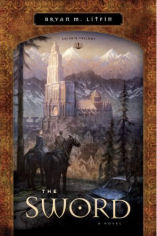
The Sword by Bryan M. Litfin

This week, the
Christian Fiction Blog Alliance
is introducing
The Sword
Crossway Books (April 30, 2010)
by
Bryan M. Litfin


ABOUT THE AUTHOR:

Bryan Litfin was born in Dallas, but lived in Memphis, Tennessee and Oxford, England, where he discovered that the house of his favorite author, J.R.R. Tolkien, was only five doors down from his own. Bryan still enjoys epic adventure stories, as well as historical fiction. However, most of his reading these days is taken up by academia.

After marrying his high school sweetheart, Carolyn (a true Southern belle), he went on to study for a master’s degree in historical theology at Dallas Theological Seminary. From there he went to the University of Virginia, taking a PhD in the field of ancient church history. He is the author of Getting to Know the Church Fathers: An Evangelical Introduction (Brazos, 2007), as well as several scholarly articles and essays.

In 2002, Bryan took a position on the faculty at Moody Bible Institute in downtown Chicago, where he is a professor in the Theology Department. He teaches courses in theology, church history, and Western civilization from the ancient and medieval periods.

On the morning of January 6, 2007, Bryan woke up with an epiphany. Having finished writing his primer on the ancient church, he had the idea of trying his hand at fiction. The thought occurred to him that the writer of speculative fiction typically has two options. He can create an imaginary land like Middle Earth (which offers great creative freedom but is unrealistic), or he can delve into genuine history (which is realistic, yet limited to what ‘actually occurred.’) However, if a writer were to create a future world as in the Chiveis trilogy, it could be both realistic and creatively unlimited.

This little dream stayed in Bryan’s mind while he researched how to write fiction, and also researched the European landscape where the novel would be set. He planned a trip to the story locations, then went there in the summer with a buddy from grad school. Bryan and Jeff rented a Beemer and drove all over Europe from the Alps to the Black Forest with a video camera in hand. With that epic setting fresh in his mind, Bryan returned home and began to write.

Today Bryan lives in downtown Wheaton in a Victorian house built in 1887. He is blessed by God to be married to Carolyn, and to be the father of two amazing children, William, 11, and Anna, 9. For recreation Bryan enjoys basketball, traveling, and hiking anywhere there are mountains (which means getting far away from the Midwest – preferably to his beloved Smokies).

ABOUT THE BOOK:

This novel of page-turning action and adventure poses the question, “If a society had no knowledge of Christianity, and then a Bible were discovered, what would happen?”

Four hundred years after a deadly virus and nuclear war destroyed the modern world, a new and noble civilization emerges. In this kingdom, called Chiveis, snowcapped mountains provide protection, and fields and livestock provide food. The people live medieval-style lives, with almost no knowledge of the “ancient” world. Safe in their natural stronghold, the Chiveisi have everything they need, even their own religion. Christianity has been forgotten—until a young army scout comes across a strange book.

With that discovery, this work of speculative fiction takes readers on a journey that encompasses adventure, romance, and the revelation of the one true God. Through compelling narrative and powerful character development, The Sword speaks to God’s goodness, his refusal to tolerate sin, man’s need to bow before him, and the eternality and power of his Word. Fantasy and adventure readers will be hooked by this first book in a forthcoming trilogy.

Visit the book website at The Sword to see amazing videos and a wealth of information about the trilogy!

If you would like to read the first chapter of The Sword, go to HERE

Dead Reckoning by Ronie Kendig (FIRST)

It is time for a FIRST Wild Card Tour book review! If you wish to join the FIRST blog alliance, just click the button. We are a group of reviewers who tour Christian books. A Wild Card post includes a brief bio of the author and a full chapter from each book toured. The reason it is called a FIRST Wild Card Tour is that you never know if the book will be fiction, non~fiction, for young, or for old…or for somewhere in between! Enjoy your free peek into the book!

You never know when I might play a wild card on you!


Today’s Wild Card author is:


and the book:


Dead Reckoning

Abingdon Press (March 1, 2010)

***Special thanks to Camy Tang and Ronie Kendig for sending me a review copy.***

ABOUT THE AUTHOR:

Ronie Kendig has a BS in Psychology and is a wife, mother of four, and avid writer. In addition to speaking engagements, Ronie volunteers with the American Christian Fiction Writers and contributes monthly to the highly acclaimed Novel Journey blog, and is a columnist for the International Christian Fiction Writers blog. Her espionage thriller, Dead Reckoning, releases March 01, 2010 through Abingdon Press and the first in a military thriller series, Nightshade, will release July 2010 from Barbour Publishing. Ronie can be found online at or at Facebook.

Visit the author’s website.
Visit the author’s Facebook.

Product Details:

List Price: $13.99
Paperback: 400 pages
Publisher: Abingdon Press (March 1, 2010)
Language: English
ISBN-10: 142670058X
ISBN-13: 978-1426700583

AND NOW…THE FIRST CHAPTER:

Mumbai Harbor, India


Shafts of yellow light pierced the blue-green waters, silhouetting the dive rig that hovered on the surface of the Arabian Sea. Shiloh Blake stopped and watched a wrasse scuttle past, its tiny fins working hard to ferry the brightly striped fish to safety.

Clad in her wetsuit, Shiloh squinted through her goggles and tucked the underwater camera into her leg pocket. Gripping a small stone artifact in her gloved hand, she propelled herself toward the surface. Ten meters and she would reveal her historic discovery to long-time rival Mikhail Drovosky.

Shiloh smiled. The guy would go ballistic. Score one for the girls. Between her and her new dive partner Edie Valliant, they had surged ahead in finds. Not that this was a competition. Not technically. But everyone with the University of California-San Diego dig team knew it was make or break time.

Shiloh broke the surface. As the warm sun bathed her face, she slid off her mask and tugged out her air regulator before hauling herself onto the iron dive flat. She squeezed the saltwater from her hair, the auburn glints catching in the sunlight. Her long auburn hair glowed in the sunlight.

“What did you find?” Khalid Khan knelt next to her.

With a smirk, she peeked at her best friend. Her own excitement was mirrored in his dark eyes. Then she noticed Edie’s absence.

“Where’d she go this time? And Dr. Kuntz?”

“She wasn’t feeling well.”

“More like she had another date.” Irritation seeped through her pores like the hot sun, boiling her to frustration. She couldn’t believe her dive partner kept cutting digs to flirt with locals.

Khalid reached over to remove her dive tanks.

With a hand held up, she shifted away. “No, I’m going back down.”

Footsteps thudded on the deck. “It’s my turn.” Mikhail’s glower fanned her competitive streak.

“Sorry.” Shiloh grinned. “Not for another ten minutes. You’re not going to stop me from qualifying for the Pacific Rim Challenge.” She nearly sighed, thinking about racking up enough dive hours for the deep-sea assignment—her dream.

On his haunches, Khalid swiveled toward her, cutting off her view of Mikhail. “What’d you find?” he whispered. Damp from his last dive, Khalid’s jet black hair hung into his face. “Please tell me you aren’t playing games.”

From a pouch hanging at her waist, she produced the lamp. “This for starters.”

He took the piece and traced the contours. “Soapstone.” His gaze darted back to hers. “You mapped it on the grid, right? And photographed it?”

Any first-year grad student would know to take a picture to verify its location and record it on the mapped grid of the site. “Of course.” She patted the camera in the pouch.

Not so many years ago a sunken city had been found in the area. Would she find another? Her heart thumped at the prospect. Tools. She would need better tools to safely remove the vase waiting at the bottom of the sea. Shiloh stood and hurried to the chest to remove an air pipe to suction the silt and sediment away and grabbed an airlift bag. As she plotted how to excavate the piece, she tucked the tools into holsters strapped around her legs and waist.

“I’m coming down there whether you’re done or not.” Mikhail bumped his shoulder against hers and pursed his lips. “If you find it in my time, I get to log it.”

Eyebrow quirked, she swept around him to the stern and sat on the ledge.

“I mean it, Blake!” Mikhail’s face reddened.

She slipped the regulator back in her mouth, nearly smiling. With a thumbs-up to Khalid, she nudged herself into the water. Glee rippled through her. The look of incredulity on Mikhail’s mug buoyed her spirits. Finding the lamp had been exhilarating, but one-upmanship had its own thrill. Besides, how many divers worked this dig in the last year? Like them, she found a piece of history. Divers and researchers had scoured this area and other sites along the coast of India.

Dr. Kuntz would have insisted on diving with her if not for ferrying Edie around Mumbai. Irritation at her new dive partner swelled. Why they had ever agreed to take on that useless woman, she’d never know. How could partying compare with the discovery of the past?

Although the silt and sand shrouded the lip of the vase, Shiloh spotted its outline easily where she had marked the place with a flag. She lifted the red vinyl square from the sandy floor and worked quickly, refusing to relinquish this relic to the overblown ego of Mikhail Drovosky. He’d beaten her out of top honors for her bachelor’s degree, relegating her to magna cum laude, lessening her scholarship. Enough was enough.

Why hadn’t anyone else found this vase? As she brushed away the sediment, confusion drifted through her like the cool waters. A spot in the clay smeared. Her heart rapid fired. Had she ruined the relic? Yet something . . . Shiloh stilled, staring in disbelief. What on earth?

She rubbed the piece. Metal gleamed beneath the clay. The lip and handle floated away. This wasn’t ancient pottery. She turned it over in her hand. What was it? It almost reminded her of a thermos. About eighteen inches long, the cylinder’s weight surprised her. What was it doing here, buried like treasure? Just as she freed the object, her white watch face flashed, snapping her attention to the competition. Time was up.

Joy ebbed like the tide. Whatever this thing was, she wouldn’t leave it down here for Mikhail. Holding the bag open, she tried to ease in the metal tube. The piece teetered on the edge, nearly falling out, so she slipped it under her arm and started toward the surface. Light again directed her to the rig. Suddenly, thrashing ripples fractured the luminescent water, stirring particulates beneath the wake of a powerful motor.

A speedboat? Why were they so close to the dive area? Didn’t they see the warning beacon, the one that announced divers below? What kind of idiot would put someone’s life in danger for a thrill ride?

A torrent of waves rattled her, threatening her grip on the vase. What . . .? A half-dozen bicolor parrotfish shot past. Shiloh paused, watching their incredible color—like a psychedelic underwater show.

Thwat. Thwat.

A sound vibrated against her chest. She searched for the source but found nothing.

She continued upward, and then someone dropped into the water. Could Mikhail not wait? Sticking to the schedule ensured everyone’s safety. He wasn’t supposed to enter the water until she climbed out. He was in such a hurry to win that he would risk injury to her and anyone who got in his way. She’d throttle him. Only, it wasn’t Mikhail.

Khalid!

A plume of red swirled around his dark form like some freakish science experiment. Blood? Was he bleeding? Her heart skipped a beat—he wasn’t swimming.

Shiloh launched toward him as adrenaline spiraled through her. She struggled to breathe, threatening the nitrox mixture in her tank. Why wasn’t he swimming? He’d drown if it he didn’t paddle back up.

She pushed into his path, and he thudded against her. Hooking her arm under his, she aimed toward the surface, scissoring her legs.

A shadow loomed over the water. Another body plunged toward her, sinking deep and fast. Mikhail’s open, unseeing eyes stared back at her, a shocked expression plastered on his face. Reminding her of an Egyptian plague, the water turned red.

Watery tubes pursued him. Bullets!

What’s happening?

Khalid. He needed oxygen. She wrangled him toward her so she could share her air. The metal cylinder fumbled from her grasp and sunk back into the oblivion where she’d found it. Whatever the thing was, it couldn’t be worth a life—especially not her best friend’s. She removed her air regulator and stuffed it into his mouth.

Khalid jerked. Pain hooded his eyes. His dark brows knitted as he gazed at her. He gripped his side and grimaced. That’s when she saw the source of the red plumes. He’d been shot too. Her gaze flew to the rig. What about the captain and his son?

Khalid caught her arm. With a firm shake of his head, he pointed away from the rig. Escape.

Shiloh linked her harness to his and swam from the rig. Uncertain where they could find safety if someone was determined to kill them, she barreled away from the nightmare. If she could make it to an island—she remembered seeing a small one in the east—they might be safe. Khalid tried to pump his legs, but not successfully. At least he hadn’t passed out. Or died.

Her stomach seized. No way would she let Khalid Khan die. Shiloh wagged her fins faster, thrusting both of them farther from the boat. Seconds lengthened, stretching into what felt like hours. With each stroke, her limbs grew heavier, dragging her down to the ocean floor. She pushed upward, refusing to become a victim.

Suddenly, she was drawn backward, pulled out to sea by the strong natural current hugging the Indian coast. Battling the forces of nature, she did her best to keep herself and Khalid aimed in the right direction. Her chest burned from oxygen deprivation.

The mouthpiece appeared before her. Surprised at Khalid’s attentiveness, she stuffed it in her mouth and inhaled deeply, savoring the strength it gave her. Another twenty meters, and the water collided with mangroves. Shiloh struggled around the roots to a small, shallow inlet. On her knees, she tore out the regulator, dragging Khalid as she clawed her way to safety. He attempted to crawl, but collapsed. She yanked off her goggles and released their d-rings.

Khalid coughed, gagged, and vomited sea water.

Warm sand mired Shiloh’s trembling limbs as she laid there, panting and gasping. The swim had been harder and much longer than she’d expected. They both could have drowned.

She squeezed her eyes shut. Thoughts of what was lost . . . Mikhail! Was he truly dead? Who would attack grad students on a dig? Why?

Shiloh pressed her hand to her forehead, tiny grains of sand digging into her flesh. She rubbed her temples and tried to make sense of the chaos.

“What happened back there, Khalid?” She flipped onto her back, the sun blazing against her pounding skull. “Who was it? Did you see?”

Silence.

Shifting, she rolled her head to peek at him. He wasn’t moving. On all fours, Shiloh scrambled and shook him.

“Khalid!” His gray wetsuit glistened red from the blood that poured from his side. She clamped a hand over his wound, the warmth sickening. “Khalid, talk to me.”

He groaned.

“No!” Fire flashed through her. “You aren’t chickening out. Not now.” Again, she shook him, but this time he didn’t respond. “Please!”

Shiloh examined his chest. Not breathing. With two fingers pressed to his neck, she tried to feel past the hammering of her own heart to detect his pulse. Nothing! She started compressions and breaths, counting between each to keep a steady rhythm. His blood stained her hands. While she pumped his chest, she took a cursory glance around the thick vegetation. It was so thick, she’d never know if someone stood five meters off.

They needed help—now! She activated the emergency beacon on her watch as she again searched—hoped—for help. Her heart caught when she spotted a “mechanical giraffe” staggering in the shifting fog. Jawahar Dweep.

“Butcher Island,” she mumbled, as she tried to revive her friend. The isolated spot only offered isolation and oil. No help. They were alone.

“At least we’re safe,” she said. But would Khalid die? “Don’t you dare!”

She pounded his chest. More blood dribbled from the wound that seemed too close to his lungs.

A rasp grated the air. His ribs rose.

“Khalid?”
He moaned.

Tears stung her eyes as she slumped next to him. “Khalid, stay with me. I’ve activated the beacon.”

His blue lips trembled against his chalky skin. “C-cold.”

She’d always admired his dark olive complexion, but the pallor coating his rugged face worried her. Would she ever see his dark eyes ignite when she made some snide, inappropriate remark? Who would help her through her episodes? She’d told only him about her rare disorder.

“We should move you closer to the rocks to stay warm until help arrives.” Shiloh once again hooked her arms under his and drew him to the side. Blood stained the sandy beach.

A wave rolled in, then out. Red streaks reached toward the warm waters. She nestled him against a large boulder and lay close to keep him warm.

“Stay with me, Khalid. No naps. This is the ultimate test, got it?” She looked to where the ocean kissed the horizon. Mumbai sparkled in the distance. So close, yet so far away it might as well be a million miles. She could only hope they would be found in time.

“You just wanted to kiss me,” Khalid mumbled.

Shiloh jerked toward him, frowning. “What?”
“CPR. I didn’t need it . . .” He coughed. “You just wanted to kiss me.”

With her hand pressed to his forehead, she smiled. “Ah. Just as I expected—delirious with fever.”

A half-cocked grin split his lips.

She tried to swallow. He had been her rock for the last four years. Despite the tight-knit relationship between their parents, Khalid and Shiloh had forged their own friendship in the fires of college life. They’d been inseparable since he came to America to study.

How long would it take Search and Rescue to locate her signal? What if the SAR team didn’t make it in time? If this were American waters, it would only be a matter of minutes, but in the Arabian Sea . . .

Shiloh’s head dropped to her chest. She had to believe everything would be fine. They’d be found, a doctor would tend Khalid’s wounds, he’d recover, and then they’d be off to the Pacific Rim Challenge. She had worked so hard for it. They both had. For the last two years, they had prodded each other toward their common goal. Their requisite dive hours were nearly complete. No, nobody would die, especially not Khalid.

Mikhail died. She clenched her eyes shut and blotted out the image of her rival slipping through the water, sinking lower and lower.

Biting her lip, she groped for something to refocus her attention. Naming the scientific classification for the sun star. Animalia. Echinodermata. Asteroidea. Spinulosida. Solasteridae. Solaster dawsoni.

“Miss . . . Amer . . . ca . . .” Khalid’s words, though broken, speared her heart.

She scooted closer. “I’m here. Be still, Khalid. They’re coming.”

“Marry me.”

“You dork.” She let out a shaky laugh as a shudder tore through her, threatening to unleash tears. Lips pulled taut, she forced herself to remain calm and look at him. “Rest.”

His fingers twitched. She lifted his hand and cradled it in hers.

A gurgling noise bubbled up his throat. “I love . . .”

“No, shh.” He couldn’t love her. Not her.

“Shil . . .”

When he didn’t finish, she knitted her brow. His eyes closed, and his mouth remained open.

“Khalid?”

His arm went slack.

“Khalid!” Tears blurred her vision, making it impossible to see if he was breathing.

A horn blared in the distance. She whipped around and spotted the massive white Indian Coast Guard rig racing toward them with its lights swirling.

* * *

Reece Jaxon straightened and watched the woman without watching. Seeing without being seen. She batted her auburn hair, thick and tangled with ocean water, away from her face. Hiding in plain sight on the rescue boat, he tracked her movement with ease. She hadn’t noticed him yet, even though he was less than a dozen feet away.

Wrapped in a gray thermal blanket Shiloh Blake stared at the injured Pakistani on the medical stretcher as the local authorities churned across the water toward Mumbai. She hadn’t left the man’s side since the rescue.

Another man in his early fifties hooked an arm around her shoulders and drew her close. Dr. Kuntz, according to the file, was fifty-three. Married. Three grown children. An unfaithful wife and a divorce later he’d partnered with a local Indian museum to arrange underwater excavations with U.C. San Diego. Something about the man didn’t sit right with Reece.

“Noor Hospital,” Dr. Kuntz insisted to the Coast Guard captain.

An hour earlier Kuntz had stormed into the Coast Guard station and interrupted Reece’s conversation with the officer. Surprised at the man’s intrusion, Reece feigned disinterest, although Kuntz’s story corroborated what Reece had relayed to the authorities after witnessing the attack. Then? The emergency transponder signal erupted.

Reece noticed Shiloh stiffen under the professor’s protective touch. Kuntz spoke soothingly to her, reassuring her that Noor Hospital would give Khalid the best care. Bent to shield his face, Reece tightened the laces on his boots while memorizing everything that took place in the boat’s small cabin. Now if he had judged her character right, in about twenty seconds she’d pull away from Kuntz.

Shiloh took a step out of the man’s reach.

Bingo.

“I need something to drink.” Reece watched her cross through the hatch. “They said they had coffee up front.”

Dr. Kuntz laughed, his arms outstretched. “But you don’t drink coffee.”

“It’s chilly,” she called without looking back.

Chilly. Interesting. It was a mild sixty-five degrees on the Arabian Sea, and she was chilly.

Shiloh Blake strode straight toward him with her head held high. Calm. Relaxed. Confident.

Come on, look at me, Reece silently dared her.

Blue-grey eyes collided with his. He scratched his beard, wishing he had more than two weeks’ growth, but it was enough to conceal his identity. With an acknowledging nod, he stayed in position. Now if she would only hold his gaze.

Oh, what he wouldn’t give to smile his pleasure as she stared at him. She only tore her eyes from his when it became impractical not to. Reece guessed she would never show any weakness.

Atta, girl.

Although he’d already skimmed the preliminary data on the American students, Shiloh’s impressive character made him want to know more. She had a higher confidence level than most of the people he had monitored in the region. What gave her that unshakable demeanor? Reece determined to get a DNA sample and run her through the system. Was she working undercover?

As the ship bumped Victoria dock, he leaped off and lassoed the pylons. Heavy thuds sounded against the weathered planks as the emergency crew transferred the young woman and her Pakistani friend to a waiting ambulance. Dr. Kuntz doted on her once again, but with no room in the narrow mobile unit, the professor was relegated to a rickshaw.

Shiloh huddled on a small bench in the ambulance, her glassy gaze locked on her friend as the emergency personnel worked on him. Just as the doors swung closed, she glanced toward Reece. A load of steel partially blocked his line of sight. Yet, despite the stenciling on the rear window, he saw her tilt her chin just enough to look for him over the emblem. The ambulance bumped over the sandy path, and then settled on PD Mello Road. Sirens wailed. Lights whirled.

Reece strolled down the boardwalk toward the beach, retrieving the cell from his pocket. He hit autodial. Having to report one American dead was bad enough. But having to tell Ryan Nielsen that another sat neck deep in an ocean of chaos—

“We’ve got trouble.”

What was Shiloh Blake doing at a nuclear arms dead drop?

MY REVIEW:

See my March 15 post here to read my thoughts about Dead Reckoning.