The Preacher’s Bride by Jody Hedlund

This week, the

Christian Fiction Blog Alliance

is introducing

The Preacher’s Bride

Bethany House; Original edition (October 1, 2010)

by

Jody Hedlund

ABOUT THE AUTHOR:

Jody has written novels for the last 16 years (with a hiatus when her children were young. In May of 2009 she double-finaled in the Genesis contest, a national fiction-writing contest for unpublished writers, sponsored by American Christian Fiction Writers (ACFW.Shortly after the final, Jody acquired an agent, Rachelle Gardner of Word Serve Literary. Her agent spent the summer of 2009 working on selling her books. In September of that year, Jody signed a three-book deal with Bethany House Publishers. Jody’s debut novel, The Preacher’s Bride, releases in Oct. 2010. Her next book will release in 2011 and a third in 2012.


ABOUT THE BOOK:

In 1650s England, a young Puritan maiden is on a mission to save the baby of her newly widowed preacher–whether her assistance is wanted or not. Always ready to help those in need, Elizabeth ignores John’s protests of her aid. She’s even willing to risk her lone marriage prospect to help the little family. Yet Elizabeth’s new role as nanny takes a dangerous turn when John’s boldness from the pulpit makes him a target of political and religious leaders. As the preacher’s enemies become desperate to silence him, they draw Elizabeth into a deadly web of deception. Finding herself in more danger than she ever bargained for, she’s more determined than ever to save the child–and man–she’s come to love.

If you would like to read the first chapter of The Preacher’s Bride, go HERE.


MY REVIEW:

The Preacher’s Bride is an interesting historical fiction novel about English Puritans during the mid 1600’s. Based loosely on the life of John Bunyan, the story graphically illustrates the persecution of the Puritans by the Royalists during the time period near the end of John Cromwell’s rule. Related primarily from Elizabeth’s point of view, The Preacher’s Bride tells her story with all the emotions she experienced including compassion, fear, pain, love and joy. The Preacher’s Bride is a well-written and powerful tale that provides the reader with a first-hand look at the social issues that led to the Puritan immigration to America. It is a promising first novel from a talented author.

The Black Madonna by Davis Bunn

It is time for a FIRST Wild Card Tour book review! If you wish to join the FIRST blog alliance, just click the button. We are a group of reviewers who tour Christian books. A Wild Card post includes a brief bio of the author and a full chapter from each book toured. The reason it is called a FIRST Wild Card Tour is that you never know if the book will be fiction, non~fiction, for young, or for old…or for somewhere in between! Enjoy your free peek into the book!

You never know when I might play a wild card on you!


Today’s Wild Card author is:


and the book:


The Black Madonna

Touchstone; 1st edition (September 7, 2010)

***Special thanks to Libby Reed, Publicity Assistant, HOWARD BOOKS, a division of Simon & Schuster for sending me a review copy.***

ABOUT THE AUTHOR:

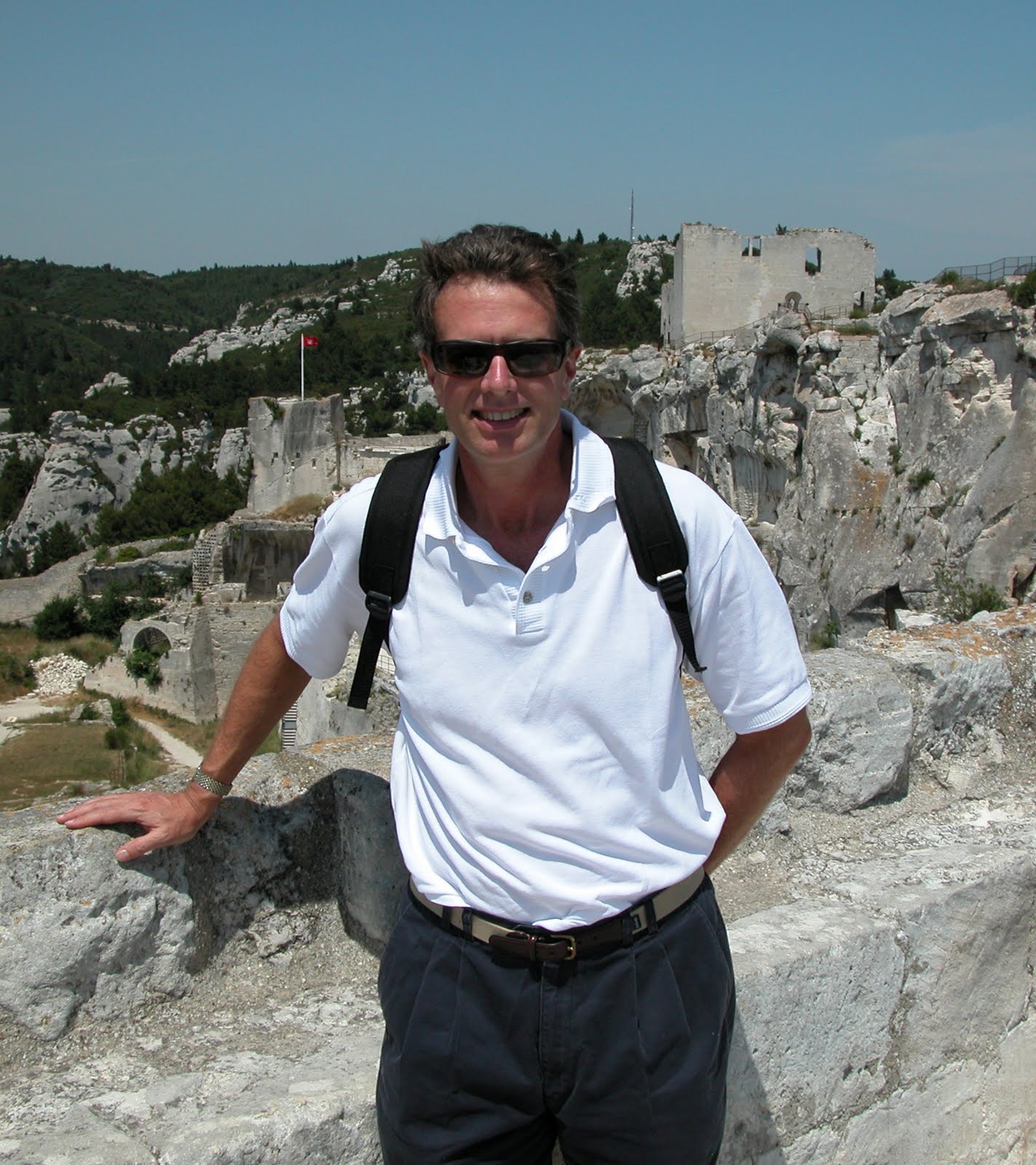
Davis Bunn is an award winning author who serves as writer in residence at Regent’s Par College, Oxford University. His novels have sold more than six million copies in sixteen languages.

Photograph by I.D. Bunn

Visit the author’s website.


Product Details:

List Price: $14.99
Paperback: 336 pages
Publisher: Touchstone; 1st edition (September 7, 2010)
Language: English
ISBN-10: 1416556338
ISBN-13: 978-1416556336

AND NOW…THE FIRST CHAPTER:

FROM THE CREST OF THE Herodium dig, Harry Bennett could look out and see three wars.

The isolated, cone-shaped hill rose two thousand feet over the Judean Desert. Herodium, the palace-fortress built by Herod the Great, had been erected on the site of his victory against the Parthians in 40 BCE. Herod had then served as king of Judea under his Roman masters, but he had been utterly despised by the Judeans. When Herod’s sons were finally vanquished, Herodium had been evacuated. Over the centuries, the city became a legend, its location a myth.

Modern excavations had begun in the sixties, only to be interrupted by wars and intifadas and disputes over jurisdiction. Harry Bennett was part of a group excavating the original palace fortress. The current project was supervised by a woman professor from the Sorbonne. She had fought for six years to gain the license, and nothing so minor as somebody else’s war was going to stop her work.

The volunteers came from a dozen nations, to dig and learn and bury themselves in history. Most were in their twenties and tried to keep up a brave face despite the rumbles of conflict and the brutal heat. The day Harry arrived at Herodium, three Scandinavian backpackers had perished hiking above the Ein Gedi National Forest. With water in their packs. Just felled by the ferocious heat.

And here Harry was, huddled under the relentless glare of that same deadly sun, using his trowel and his brush to scrape two thousand years of crud off a stone.

Officially Harry and the other volunteers were restricted to the dig and their hilltop camp. With Hamas missiles streaking the nighttime sky, none of the other unpaid staff were much interested in testing their boundaries. But twice each week the Sorbonne professor traveled to Jerusalem and delivered her finds to the ministry. When she departed that particular afternoon, Harry signaled to the Palestinian operating the forklift. Ten minutes later, they set off in Hassan’s decrepit pickup.

The angry wind blasting through his open window tasted of sand as dry as volcanic ash. Hassan followed the pitted track down an incline so steep Harry gripped the roof and propped one boot on the dashboard. He tried to ignore the swooping drop to his right by studying the horizon, which only heightened his sense of descending into danger. North and east rose the Golan hills and sixty years of struggle with Syria. Straight north was the Lebanese border, home to the Hezbollah hordes. To the southwest lay Gaza, provider of their nightly firework displays.

All West Bank digs were required to employ a certain number of locals. Hassan was one of the few who arrived on time, did an honest day’s work, and showed a keen interest in every new discovery. On Harry’s first day at the site, he had put the man down for a grave robber and a smuggler.

The West Bank was the richest area for artifacts in all Judea. There were thousands of sites, many dating from the Iron Age, others from the Roman era, and more still from Byzantium. Many sites remained undiscovered by archeologists but were well known to generations of Palestinians, who fiercely guarded their troves and passed the locations down from generation to generation.

Hassan’s former job wouldn’t have sat well with the Israeli authorities. But people like Hassan took the long view. Eventually things would settle down, and when they did, Hassan would return to his real trade. In the meantime, Hassan hid his profession from the Israeli authorities, lay low, and remained open to a little persuasion. In Harry’s case, that amounted to a thousand dollars.

They arrived in Hebron three hours later. The city crawled up the slopes of two hills and sprawled across a dull desert bowl. Entering Hebron around sunset, in the company of a Palestinian smuggler, was an act of total lunacy.

Harry Bennett wouldn’t have had it any other way.

Clustered on hilltops to the north of the old city rose the UN buildings, the university, and a huddle of government high-rises built with international relief funding. Other hills were dominated by Jewish settlements. These were rimmed by fences and wire and watchtowers that gleamed in the descending light. The rest of Hebron was just your basic war zone.

Sunset painted Hebron the color of old rust. The city held the tightly sullen feel of a pot that had boiled for centuries. Even the newer structures looked run-down. Most walls were pockmarked with bullet holes and decorated with generations of graffiti. Harry saw kids everywhere. They bore such tight expressions they resembled old people in miniature. Looking into their eyes made Harry’s chest hurt.

The streets were calm, the traffic light. Which was good, because it allowed them to make it to the city center early. It was also bad, because the Israel Defense Forces soldiers had nothing better to do than watch Hassan’s truck. Two IDF soldiers manning a reinforced guard station tracked the pickup with a fifty-caliber machine gun.

Hassan said, “This idea is not so good, maybe.”

Harry nodded slowly. He smelled it too, the biting funk of cordite not yet lit. But he would trust his driver. “You say go, we go.”

Hassan’s gaze flitted over to Harry. “You pay?”

“The deal’s the same. You get the other five hundred when we’re done.”

Hassan wiped his face with a corner of his checkered head-kerchief. “We stay.”

Harry halfway wished the man’s nerve would fail and he would turn his rattling truck around. “Better to come in twice than not go home at all.”

“You know danger?”

“Some.”

“I think maybe more than some. I think you see much action.”

“That was then and this is now,” Harry replied. “You’re my man on the ground here. I’m relying on your eyes and ears. I can’t tell what’s real and what’s just your normal garden-variety funk.”

Hassan skirted a pothole large enough to swallow the neighboring Israeli tank. “Say again, please.”

“Let’s assume for a second that you and I can do business together.”

Hassan pointed at Harry’s shirt pocket holding the five bills—the rest of his fee. “This is not business?”

“I’d call it a first step. Say your man shows up like you promised. Say he’s got the goods and the buy goes well. What happens next?”

“If the first buy goes well, you trust me for more.”

“Right. But I need someone who can sniff out traps and see through walls. There’s so much danger around here, my senses are on overload.”

The man actually smiled. “Welcome to Hebron.”

“I didn’t go to all this trouble for just one item, no matter how fine this guy’s treasure might be. I need you to tell me if we’re safe or if we should pull out and return another time.”

Hassan did not speak again until he parked the truck and led Harry into a cafÉ on Hebron’s main square. “What you like?”

“You mean, other than getting out of here with my skin intact? A mint tea would go down well.”

Hassan placed the order and settled into the rickety chair across from Harry. “There are many Americans like you?”

“I’m one of a kind.”

“Yes. I think you speak truth.” Hassan rose to his feet. “Drink your tea. I go ask what is happening.”

All Harry could do was sit there and watch the only man he knew in Hebron just walk away. From his spot by the bullet-ridden wall, isolated among the patrons at other tables who carefully did not look his way, Harry felt as though he had a bull’s-eye painted on his forehead. Even the kid who brought his tea and plate of unleavened bread looked scared. Harry stirred in a spoonful of gray, unrefined sugar and lifted the tulip-shaped glass by its rim. All he could taste was the flavor of death.

AFTER SUNSET, THE HEBRON AIR cooled at a grudging pace. Harry watched as the city square filled with people and traffic and shadows. The cafÉ became crowded with people who avoided looking Harry’s way. Across the plaza, the Tomb of the Patriarchs shone pearl white. Beside the cave complex stood the Mosque of Abraham, a mammoth structure dating back seven hundred years.

The caves had been bought by the patriarch Abraham for four hundred coins, such an astronomical sum that the previous owner had offered to throw in the entire valley. But Abraham had insisted upon overpaying so that his rightful ownership would never be questioned. He had wanted the caves as his family’s burial site because supposedly they were also where Adam and Eve had been laid to rest. Besides Abraham himself, the caves also held the remains of his wife, Sarah, along with Rebecca, Isaac, and Jacob.

The guy who made his way toward Harry’s table resembled an Arab version of the Pillsbury Doughboy. The man waddled as he walked. His legs splayed slightly from the knees down. His round face was topped by flattened greasy curls that glistened in the rancid lights of the cafÉ. He walked up, slumped into the chair across the table from Harry, and demanded, “You have money?”

Harry kept his gaze on the square and the crawling traffic. “Where’s Hassan?”

“Hassan is not my business. He is your business. You must answer my question. You have money?”

Harry was about to let the guy have it when he spotted Hassan returning across the plaza. When he reached the cafÉ’s perimeter, Hassan seated himself at an empty table, facing outward toward the plaza, placing himself between Harry and any incoming threat. Harry relaxed slightly. It was always a pleasure doing business with a pro.

Harry said, “Let’s take this from the top. I’m—”

“I know who you are. Harry Bennett seeks treasure all over the world. You see? We meet because I check you out.”

“What’s your name?”

“Wadi Haddad.”

“Wadi, like the word for oasis?”

“Yes, is same.” He wore a rumpled linen jacket, its armpits wet and darkened with sweat. He reached in a pocket and came up with a pack of filterless Gitanes. “You want?”

“Never learned to use them, thanks.”

Wadi Haddad lit the cigarette with a gold lighter. The stench of black tobacco encircled the table. “I have much interesting items. Very nice.”

“I didn’t come to Hebron for nice, Mr. Haddad. I came for exceptional. You understand that word?”

“Exceptional is also very expensive.”

“One of a kind,” Harry went on. “Unique. Extremely old. And I have always been partial to gold.”

Wadi Haddad revealed a lizard’s tongue, far too narrow for his globular face. It flitted in and out several times, tasting the air. “How much money you have?”

“Not a cent with me.”

“Then I also have nothing. Business is finished.” But Wadi Haddad did not move.

“Here’s how it’s going to work,” said Harry. “You show me the item. I photograph it.”

“No. Photographs absolutely not to happen.”

“I show the photographs to my clients. If they like, they transfer the money to an escrow account at the Bank of Jordan in Amman. You understand, escrow?”

“I know.”

“Good. Then you bring the item to Jerusalem and we make the exchange.”

“Not Jerusalem. Too much police everyplace.”

“Okay, Mr. Haddad. Where would you prefer?”

“Petra.”

“Too small. I like bright lights, big city.”

“Then Amman.”

Which had been Harry’s choice all along. Even so, he pretended to give that some thought. “Okay, Amman. Hotel Inter-Continental. You got an account at the Bank of Jordan?”

“I make one happen.”

“Then we’re ready to roll. All we need is the merchandise.”

“No photographs.”

“Then no business. Sorry, Charlie.”

“My name is Wadi.”

“Whatever. I don’t shoot, I don’t buy.”

“Photographs cost you a thousand dollars.”

Suddenly Harry was very tired of this two-step. “Fine. But I take the thousand from the final purchase price. And don’t even think of arguing.”

Wadi Haddad did not rise so much as bounce from the seat. “Okay, we go. Not your man.” He nodded toward Hassan. “Just you.”

“Be right with you.” Harry walked to Hassan’s table and squatted down beside the man’s chair. “You find anything?”

“Hebron is one tense city. People very worried.”

“Yeah, I caught that too.” Harry liked how the guy never stopped searching the shadows. “Where’d you see action, Hassan?”

“Nowhere. I see nothing, I do nothing. In the West Bank there is only IDF and terrorists.”

“Wadi’s taking me to check out the merchandise. He says I’ve got to do this alone. You think maybe you could watch my back?”

“Is good.” Hassan held to a catlike stillness. “I see something, I whistle. I can whistle very loud.”

Harry rose to his feet, patted the guy’s shoulder, and said, “You just earned yourself another five bills.”

WADI HADDAD MOVED SURPRISINGLY FAST on his splayed legs. He led Harry deep into the old city. The West Bank crisis was etched into every Hebron street, every bullet-ridden wall, every building topped by an IDF bunker. The streets were either dimly lit or not at all. But walking behind the wheezing Haddad, Harry had no trouble picking his way through the rubble. Behind him, the mosque and the cave complex shone like beacons. And up ahead loomed the wall.

The barrier separating the Jewish sector from Hebron’s old city was thirty feet high and topped with razor wire. Searchlights from the guard towers and nearby IDF bunkers serrated the night. The wall gleamed like a massive concrete lantern.

Somewhere in the distance a truck backfired. Wadi Haddad froze. A searchlight illuminated the man’s trembling jowls. Harry said, “You’re not from here.”

“My mother’s family only. I live sometimes Damascus, sometimes Aqaba.”

Aqaba was Jordan’s portal to the Red Sea, a haven for tourists and smugglers’ dhows. “Must be nice.”

Wadi Haddad started off once more, Harry following close. But when Haddad entered a dark, narrow alley, Harry dug in his heels. “Hold up there.”

“What’s the matter, treasure man?”

The buildings to either side reached across to form a crumbling arch. The windows fronting the street were both barred and dark. The alley was black. Harry had spent a lifetime avoiding alleys like this. Then he saw a cigarette tip gleam. “That your buddy down there?”

“Is guard, yes. In Hebron, many guards.”

“Ask him to step out where I can see him.”

Wadi didn’t like it, but he did as Harry said. The man emerged and flipped on a flashlight. In the dim rays reflected from the walls, Harry could see a face like a parrot, with too-narrow features sliding back from a truly enormous nose. The man’s eyes were set very close together and gleamed with the erratic light of an easy killer.

“Ask him to light up that alley for us.”

The man smirked at Harry’s nerves but did not wait for Wadi’s translation. The flashlight showed an empty lane that ended about eighty feet back with double metal doors. “What’s behind the doors, Wadi?”

“Where we go. My mother’s cousin’s house.”

Harry motioned to the man holding the light. “Lead on, friend.”

The guard spoke for the first time. “You have guns?”

Harry lifted his shirt and turned around. “Make business, not war. That’s my motto.”

“He can search you?”

“Sure thing.” Harry gestured at the doors. “Inside.”

• • •

THE DOORS RATTLED IN ALARM as the guard pushed them open. Wadi called out and, on hearing no response, stepped into a neglected courtyard with Harry close behind. The dusty compound appeared empty. A pair of plastic chairs sprawled by a rusty outdoor table, their upended legs jutting like broken teeth. From inside the house a dog barked. In the distance Harry both heard and felt the grinding tremor of an IDF tank on road patrol.

Wadi led Harry to a flat-roofed side building of unfinished concrete blocks and opened a door with flaking paint. The interior was an astonishment. The front room was a well-appointed display chamber about twelve feet square. Two walls were stuccoed a light peach. A third wall was covered by a frieze of mythical birds carved from what Harry suspected was olive wood. The fourth wall held a narrow steel door with a central combination lock.

“Looks like I found the guy I’ve been looking for,” Harry said.

Wadi held out his hand. “Thousand dollars.”

Harry was about to insist he see the item first, then decided there was no reason to get off on the wrong sandal.

Wadi counted in the Arab fashion, folding the bills over and peeling the oily edges with his thumb and forefinger. He slipped the money into his pocket and motioned with his chin to the guard.

The steel door swung open on greased hinges. The guard stepped inside and emerged with a black velvet stand shaped like a woman’s neck. What was draped on the stand took Harry’s breath away.

The concept of women’s ornamentation was as old as civilization itself. The earliest forms were fashioned as temple offerings and were considered to have magical properties. Many ancient cultures revered such jewelry for its talismanic power either to ward off evil or bring good health and prosperity.

In the very earliest days of Christianity, new believers drawn from Hellenistic temple cults often brought with them such ideas about the powers of jewelry. The necklace dated from the second century AD. The chain was a series of gold tubes, each stamped with a Christian design. It ended in an emerald the size of Harry’s thumb. The gemstone had been sanded flat and carved with the Chi-Rho symbol.

Without asking, Wadi handed Harry a pair of white gloves and a jeweler’s loupe. Closer inspection only confirmed Harry’s first impression. This was a museum-quality piece.

The problem was, Harry could not identify it as a fake. Which was troubling, because Harry knew for a fact the item was not genuine.

Harry Bennett had nothing against a little smuggling. He would certainly not have helped anyone track down another treasure dog.

Counterfeiters, though, were a different breed of lice.

After nearly three years of roiling conflict, the Israeli Antiquities Authority had basically lost control of smuggling in the West Bank. In the past, the IAA had nabbed about ninety thieves each year for pilfering tombs, ruined cities, palaces, and forts. Since the latest political troubles began, however, arrests had slumped to almost nothing. The IAA knew without question that the worst culprits were getting away. The international arts market was being flooded with ancient Hebrew treasure. What was more, a growing number of these items were bogus. Extremely well crafted, their workmanship often able to fool museum directors and other supposed experts, but phony just the same.

The Israeli government had needed somebody with Harry Bennett’s credentials, known throughout the world as a dedicated treasure dog. Somebody capable of infiltrating the system and identifying the source of the fake artifacts.

Only when Harry looked up did he realize he had been holding his breath. He handed the loupe and gloves back to Wadi and unsnapped the case of his pocket camera. “Okay if I shoot a few?”

Wadi smirked as he pulled the cigarettes from his pocket. The man knew a buyer’s lust when he saw it. “Sure, sure, many as you like. You want tea?”

DICKERING OVER PRICE TOOK UNTIL well after midnight. Even so, when Harry stepped through the compound’s steel door, the city remained noisily alive. Such was the manner of every Middle Eastern city Harry had ever visited, and it was one of the reasons why he relished the Arab world. These lands were full of pirates and their love of dark hours.

Wadi Haddad wore his sourest done-in-by-the-deal frown. “You give me no profit. My daughters starve.”

Harry clamped down on his first thought, which was that this guy definitely hadn’t missed a lot of meals. “Phone you in four days, right?”

“Four, maybe five. These days the border is very tight.”

“Then maybe you ought to bring out the other items you’re holding here for sale.”

“You buy more?”

“If they’re as fine as what you just showed me, sure, I think I can find buyers.”

“Not same price,” Wadi complained. “Too much hard bargain.”

Harry was about to say what he thought of Wadi’s poor-boy tactic when, from the distance, he heard a shrill whistle pierce the night.

The guard stood at the alley’s mouth, searching in all directions. Wadi remained intent upon business, sucking on his cigarette and grumbling through the smoke as he walked past where Harry stood tense and rooted to the dusty earth. “Next time your price plus thirty percent. You pay or I go find—”

Harry leaned forward and gripped Wadi’s shoulder and pulled him back. He slammed Wadi onto the alley wall, placing himself between the trader and the road. Wadi’s breath whooshed out in a fetid cloud. His eyes registered surprise and rising protest. But Harry kept him pinned where he was.

Then the world of Hebron roared in rage and flames.

© 2010 T. Davis Bunn

For more information please visit www.SimonandSchuster.com

MY REVIEW:

The Black Madonna is a fast paced, suspense filled tale that takes the reader on a whirlwind journey through the world of antiquities along with primary characters Storm Syrrell, Emma Webb, and Harry Bennett. From the mideastern desert, to a monastery in Poland, to the streets of London, to the mountains of Switzerland, and other locations along the way, the three friends seek to unravel the mystery surrounding an escalating bidding war for religious artifacts and the possibly related counterfeiting of similar relics. As the danger escalates and others become involved, they realize that everything revolves around a stolen icon known as the Black Madonna and that international repercussions could result if it is not recovered.

I thoroughly enjoyed The Black Madonna. I do hope that the unresolved relationship of a certain two characters will continue in another installment of this series.


Emily’s Chance by Sharon Gillenwater


MY REVIEW:

Chance Callahan fell in love with Emily Rose Denny the first time he laid eyes on her. Once he got to know her, his feelings for her grew stronger. However, Emily had other things in mind for her future. Callahan, Texas was just a stepping stone in her career plan of gaining an important position in a large city museum. As far as she could determine, that was the only way to prove to her parents that she could be a success. Poor Chance didn’t have a prayer – or did he? Will Emily ever learn to just be herself or will she forever strive to live up to her parents’ impossible expectations?

Emily’s Chance is a fun to read contemporary romance set in small town Texas. Characters are down-to-earth and their daily lives reflect their strong Christian values. A couple of sub-plots add another layer of interest to the story. I enjoyed catching up with characters from Jenna’s Cowboy as well as meeting new ones. Emily’s Chance is the second in The Callahans of Texas series but can be enjoyed as a stand-alone novel. For those like me who love books with a western setting, Emily’s Chance is a must read.

This book was provided for review by Revell, a division of Baker Publishing Group.


ABOUT THE BOOK:

Finding Unexpected Love in a Small Texas Town

Emily Rose may be in the tiny West Texas town of Callahan Crossing for the moment, but it’s just a rung on her ladder to success. Her work at the Callahan Crossing historical society will look good on her ever-growing resume as she attempts to break into the prestigious world of a big city museum curator.

Little does she know cowboy and contractor Chance Callahan has decided that he can convince her to stay—both with the town and with him. As he helps Emily restore the town’s history after a devastating fire, he also helps her uncover her own hidden worth and the value of love.

The second book in The Callahans of Texas series, Emily’s Chance is a heartwarming story of letting love take the lead.

ABOUT THE AUTHOR:

Sharon Gillenwater was born and raised in West Texas and loves to write about her native state. The author of several novels, including Jenna’s Cowboy, she is a member of American Christian Fiction Writers. When she’s not writing, she and her husband enjoy spending time with their son, daughter-in-law, and two adorable grandchildren. She lives in Washington.

Keep the Pigs Out by Don Dickerman

It is time for a FIRST Wild Card Tour book review! If you wish to join the FIRST blog alliance, just click the button. We are a group of reviewers who tour Christian books. A Wild Card post includes a brief bio of the author and a full chapter from each book toured. The reason it is called a FIRST Wild Card Tour is that you never know if the book will be fiction, non~fiction, for young, or for old…or for somewhere in between! Enjoy your free peek into the book!

You never know when I might play a wild card on you!

Today’s Wild Card author is:


and the book:


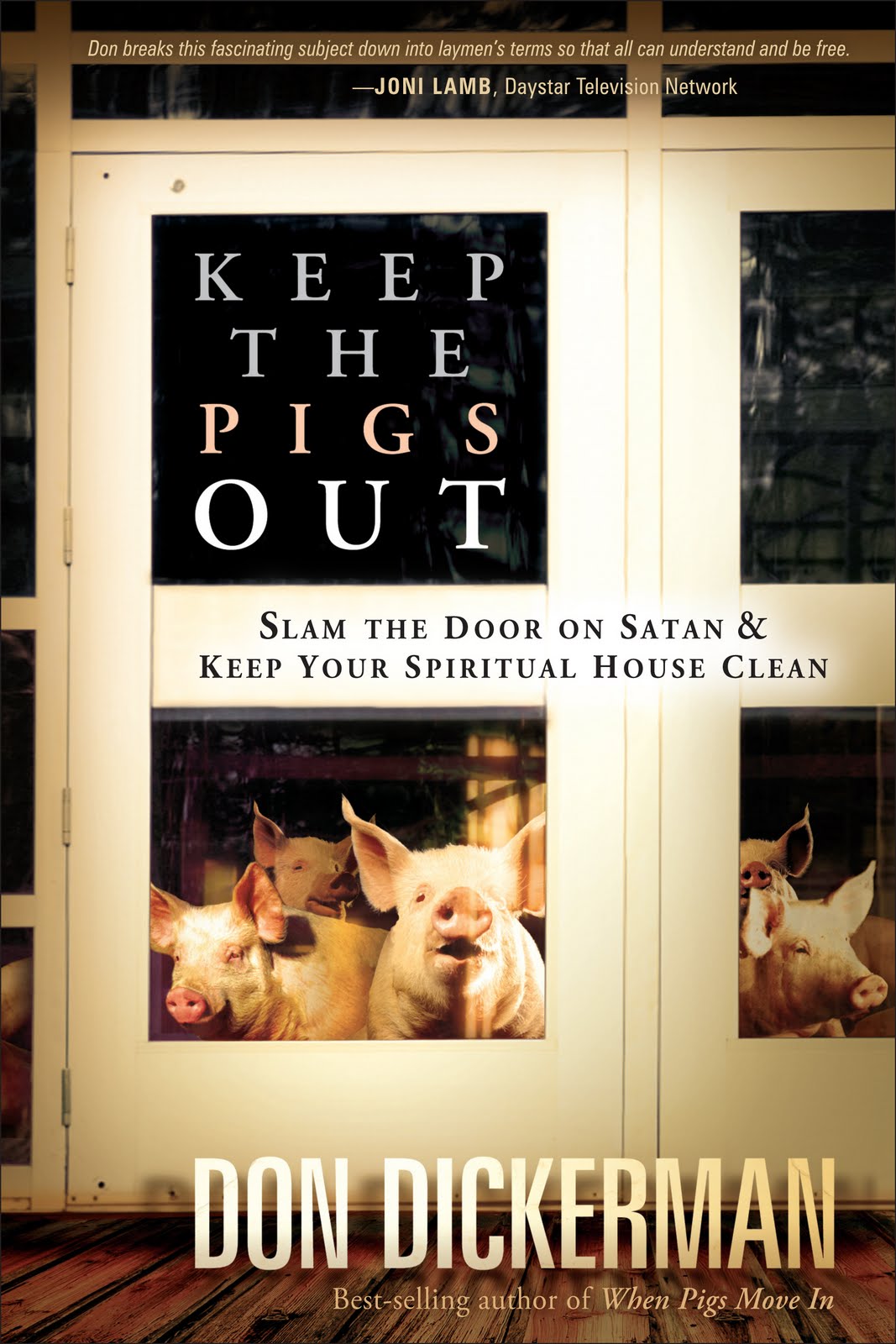
Keep the Pigs Out

Charisma House (October 5, 2010)

***Special thanks to Anna Coelho Silva | Publicity Coordinator, Book Group |
Strang Communications for sending me a review copy.***

ABOUT THE AUTHOR:

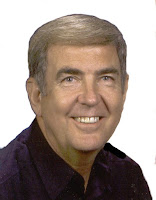
Don Dickerman, an ordained Southern Baptist minister, has directed an evangelistic ministry to prisons since 1974. Don received an anointing from the Lord Jesus to minister in the areas of deliverance and healing and has seen many lives transformed through his ministry. Prior to answering God’s call to Minster in prisons, he pastored churches and worked as an evangelist. Don is a graduate from a Baptist seminary and is Spirit-filled and anointed with an exciting ministry both to prisons and churches.

Visit the author’s website.

Here’s a book trailer for the the first book about keeping the pigs out, When Pigs Move in:

Product Details:

List Price: $14.99
Paperback: 240 pages
Publisher: Charisma House (October 5, 2010)
Language: English
ISBN-10: 1616381396
ISBN-13: 978-1616381394

AND NOW…THE FIRST CHAPTER:

A Vision
Within a Dream

During a nighttime dream, I saw a huge winged creature hovering in the sky. It was more like a vision within a dream than a dream. The sky itself was bright and clear, and there were no clouds. The scene was somewhat tranquil. The bird-looking creature was brilliant in its appearance. It had a neon glow to it. The best way I could describe this creature is that it looked very similar to the mythical griffin—a legendary creature with the body of a lion, the head of an eagle, and the wings of a dragon. It was huge, white with a green-and-gold glowing outline. This was a splendid creature with great beauty, somewhat majestic in its appearance. It was so magnificent that it almost seemed expressive of worship. It appeared that either someone was seated on the creature or was part of his being. He had a bow in his hand.

Now, before I proceed with this vision within a dream, I feel I must qualify what I am sharing with some personal knowledge about myself. I am a conservative Christian. I am a licensed and ordained minister through Southern Baptist churches. I would say that I’m a pretty normal guy. I dream every night, but generally not about spiritual things. I dream about life happenings, you know, just regular stuff—high school, sports, or not being able to find where I parked my car. Like most dreams, that’s all they are, just entertainment as we sleep. I don’t try to figure out if a dream has some significant meaning. I’m a very basic guy, and what qualifies someone to be a dream interpreter anyway?
I proceed with careful forethought and biblical analysis in these areas. I guess I’ve seen and heard too many false prophecies and false words. I would say I am spiritually cautious, and I “try the spirits” to see if they are of God (1 John 4:1, kjv). I desire Holy Spirit discernment, and I despise deception. Often I reverently say, “God, if You are going to speak to me, give me something clear. Don’t ask me to figure it out or to make some kind of spiritual application. Just make it plain for me.”
This particular enlightenment came like a vision within a dream. It was like a flash amidst other things I was dreaming about. I could not tell you what else I dreamed about that night, but I could draw you a picture of this vision—it was so vivid. It is difficult to tell how high in the air this creature was, perhaps fifty feet. It was somewhat low in relation to where clouds may be.
On the ground beneath this celestial creature was a herd of sheep. The sheep were huddled together on the side of a hill. The hillside was a beautiful green color, and the rolling hills somewhat reminded me of Ireland. The sheep were near a fence, and it was as if I were viewing this from across the fence. There seemed to be acres and acres of rolling pasture, almost like a golf course, but it was pasture. The sheep were all together near the fence. It was not a great number of sheep, maybe twenty-five to thirty.
The sheep had the faces of men; I hope I can describe this so that you get a glimpse of it. I realize as I’m sharing this that it may sound like I think I’m Ezekiel or a prophet of God. I am neither. I’m just a regular guy. However, in this vision each one of the sheep had the face of a man. Each face was different; it was like I was gazing into a small crowd of people. All of the sheep seemed very sad, some of the faces were bleeding, and some had tears in their eyes. They just stood there.
The creature from the sky pointed his bow at them and shot what seemed to be hooks or barbs into their flesh. The sheep appeared not to know where this attack was coming from, and they put up no defense. They only looked at each other. They all seemed to be bruised in different ways. They just stood there and took it. Each of them had the countenance of having been beaten and bruised. They seemed to have no leader among them. There was no shepherd in the vision. They were vulnerable and ignorant of the assault. The vision was brief but indelible.

The Dream Come to Life

The following night I was a guest preacher at a church in rural Fort Worth. I had actually forgotten the dream until I made a turn on a country road to get to the church. I saw a small herd of sheep huddled near the roadway fence. Immediately the dream came alive. Tears came to my eyes as I recalled the dream.

As I think about that dream today, I think how difficult it is for our modern society to relate to biblical accounts of sheep and shepherds. I don’t know if I’ve ever even touched a sheep, and I know I’ve never met a real shepherd. It is clear, however, that God’s Word compares believers and true followers as sheep, sheep of His pasture.

Then Jesus said to them again, “Most assuredly, I say to you, I am

the door of the sheep. All who ever came before Me are thieves

and robbers, but the sheep did not hear them. I am the door. If

anyone enters by Me, he will be saved, and will go in and out and

find pasture. . . . I am the good shepherd; and I know My sheep,

and am known by My own. As the Father knows Me, even so I

know the Father; and I lay down My life for the sheep.”

—John 10:7–9, 14–15

The words of Jesus in John 10 say that believers are the sheep of His pasture and that He is the Good Shepherd. Man can only come to God through a door, and that door is Jesus. Actually, the proper way to enter any place is through a door. God’s Word unmistakably compares believers to sheep. Psalm 95:7 says we are the “people of His pasture, and the sheep of His hand.” Again in Psalm 100:3 it says, “We are His people and the sheep of His pasture.”

In my dream all of the sheep were bruised, and the hurt was visible in their painful expressions. That is such a picture of the church today. Virtually all of the sheep in the church today are carrying wounds. Most don’t know how to defend themselves and are really not sure how the wounds got there. Having a shepherd that does not lead is like having no shepherd at all. Sheep know how to follow, but they don’t know how to fight. Jesus did not leave us defenseless. He left us with His Spirit and His Word. It is the call of the shepherd to equip us to stand.

I want to expose some of the “wiles” of the demons and how they access our lives. We cannot responsibly act upon things we do not know. Having no knowledge makes us extremely vulnerable. Ignorance gives great advantage to the demons. For the most part, Christians do not know because the demons have done a good job of keeping the information out of the pulpits and classrooms. It always amazes me at how Christians retreat when the D word is mentioned. Why is deliverance so difficult to discuss?

Why are people so quickly offended or intimidated by the subject of demons? Why can’t you talk about it? Why is the subject so unapproachable? I believe it is because of ignorance, or because of nonteaching and false teaching. Those Christian leaders who do talk about it have often made it to be something it is not, and that does great damage.

It is difficult for me to understand how a preacher can open his Bible and preach fifty-two Sundays in a year and never mention the deliverance and healing message of the Gospels. I don’t see how that can happen. I don’t see how a seminary can instruct their Bible students for three years and never prepare them for dealing with sickness or for engaging demon spirits. I honestly don’t get that. How can you sit in Sunday school and Bible classes most of your life and not be taught the reality of demonic activity in the life of believers? Would you agree that the demons have done a good job of keeping Christians in darkness? How can this be? Is it willing ignorance?

Second Peter 3:5 talks about deceived people who “willfully forget.” Willing ignorance—I believe that is what it is. It is a conscious choice not to preach or teach the scriptural truth concerning the work of demons. What else could it be? Why else would it be? Isn’t that like being dumb on purpose? I don’t mean that in an unkind sense; we have been and are being duped by a message with a lack of truth and power.

In the walk of spiritual freedom, there are things we need to do to remain free. As important, maybe even more important, are things we should not do.


A Season of Miracles by Rusty Whitener

This week, the

Christian Fiction Blog Alliance

is introducing

A Season of Miracles

Kregel Publications; Reprint edition (August 3, 2010)

by

Rusty Whitener

ABOUT THE AUTHOR:

Rusty Whitener is a novelist, screenwriter, and actor. His first screenplay, Touched, won second place at the 2009 Kairos Prize at the Los Angeles Movieguide Awards and first place at the Gideon film festival. That screenplay soon became A Season of Miracles. The movie version of this book is now in production with Elevating Entertainment. Find out more at www.rustywhitener.com and www.aseasonofmiraclesmovie.com. Videos and book club discussion questions are also available at www.aseasonofmiraclesbook.com.


Endorsements:

“A Season of Miracles is a must read for anyone who has ever played youth baseball. I read the book, and was reacquainted with my childhood. In the midst of an enjoyable read that took me down memory lane was a touching, challenging and beautiful story about how God can use the unlikeliest among us to draw us to Him.”—Matt Diaz, outfielder, Atlanta Braves

“Baseball, inspiration and childhood memories—a great combination. I couldn’t put it down!”—Richard Sterban, bass singer for The Oak Ridge Boys

“Rusty Whitener weaves a deft tale of young friendship and the curve balls of faith, the whole story seasoned with sunshine and the leathery scent of baseball gloves!”—Ray Blackston, author of Flabbergasted

A Season of Miracles is a heartwarming all American story of small town boys and Little League baseball. You’ll be cheering this captivating bunch of characters all the way home both in their game of baseball and the bigger game of life.”—Ann Gabhart, award-winning author of The Outsider

ABOUT THE BOOK:

Looking back on the 1971 Little League season, Zack Ross relives the summer that changed his life…

Gunning for the championship is all that matters until twelve-year-old Zack meets Rafer, a boy whose differences make him an outcast but whose abilities on the baseball field make him the key to victory.

Admired for his contribution to the team, Rafer turns everyone’s expectations upside down, bestowing a gift to Zack and his teammates that forces them to think—is there more to life than winning or losing? And what is this thing called grace?

If you would like to read the first chapter of A Season of Miracles, go HERE.

Lydia’s Charm by Wanda E. Brunstetter

This week,the

Christian Fiction Blog Alliance

is introducing

Lydia’s Charm

Barbour Books (September 1, 2010)

by

Wanda E. Brunstetter

ABOUT THE AUTHOR:

A Note From Wanda:

Ever since I was a child, I wanted to be a writer. When I was in the second grade, I wrote my first poem about a moth. Luckily, I received encouragement from my teacher. During my teen years, I wrote skits that my church teen group performed during special holidays.

It wasn’t until 1980, that I took a course on writing for children and teenagers. I became serious about a career as an author. Soon after that, I began to write stories, articles, poems, and devotionals, which appeared in a variety of Christian publications. Later, I had 5 books of puppet/ventriloquist scripts published. *These books are currently available by contacting me. (wanda@wandabrunstetter.com)

My first novel was released by Barbour Publishing’s book club, Heartsong Presents, in Dec. 1997. I have now written nearly fifty books, with over 4 million books in print. Many of the novels I’ve written are Amish-themed.

ABOUT THE BOOK:

Widowed and jobless, Lydia King moves her son and herself to Charm, Ohio, to be close to her mother and help with her grandfather. Menno Troyer, a furniture store owner, is also recently widowed and the father of four energetic boys.

Levi Stutzman, another newcomer to the area, is the only one in his family not handicapped by dwarfism and has dedicated his life to caring for them. As fall colors the countryside, will anonymous gifts left for Lydia bring her hope for a new life and romance, or will another tragedy flood her with infinite despair?

If you would like to read the first chapter of Lydia’s Charm, go HERE.

Watch the book trailer:

MY REVIEW:

Lydia’s Charm is yet another Amish novel in a market that seems to be saturated with them. While not my favorite genre, I don’t mind ‘bonnet fiction’ and usually gain something from each book I read. Lydia’s Charm is somewhat different than many I have read in that it is more character driven and not so focused on the Amish lifestyle and religious rules. With just a few basic changes, this book could have taken place anywhere with other characters.

The three primary characters, Lydia King, Levi Stutzman, and Menno Troyer all live with difficult situations. Lydia and Menno have both recently been widowed and Levi is the only normal sized member of his family. Lydia struggles to get along with her difficult mother, Menno desperately needs someone to help keep house and take care of his four sons, and Levi is afraid that if he ever marries he will pass along the hereditary dwarf gene to his own children. Both men are drawn to Lydia – but for entirely different reasons.

Which man will be there for Lydia as she endures even more difficult times in her life? Will Lydia and her mother discover the person who has been leaving them mysterious gifts just when they need them most? Will there be a happily ever after for any of them?  I won’t tell. You will have to read Lydia’s Charm for yourself.